Stage 03 · Host · Researched comparison
Best Go Job Queues for Background Work in 2026
Asynq is the first pick for most teams. It is an open-source Go library that runs background jobs on Redis, with scheduling, retries and a monitoring UI. River is the better fit if you already use PostgreSQL and want jobs stored in the same database as your data. Machinery suits teams that need brokers beyond Redis, such as RabbitMQ or AMQP. All three are free and open source.

By Shihab Mia
Published 27 Nov 2026 · 5 tools compared
We run no ads and no affiliate links at launch. The order of a list follows our published method. See how we score.
Prices are the starting prices vendors list publicly. Plans change, so confirm the current price on the vendor page before you buy.
Key takeaways
- Asynq, River, Machinery and Faktory are free and open source; each needs a backend service such as Redis, PostgreSQL or a Faktory server.
- River keeps job state in PostgreSQL, so you avoid running a separate broker.
- Machinery supports multiple brokers but has slower release activity than Asynq or River.
- NATS JetStream provides durable work queues for teams already running NATS.
Who each pick is for
- Teams already running Redis who need scheduled and retried jobsAsynq
- Go teams on PostgreSQL that want jobs in the same databaseRiver
- Teams that need RabbitMQ, AMQP or multiple broker backendsMachinery
- Polyglot teams that want one job server across languagesFaktory
- Teams already using NATS that need durable work queuesNATS JetStream
Comparison
| Tool | Best for | Standout feature | Listed starting price | Free plan or trial |
|---|---|---|---|---|
| 1Asynq | Teams already running Redis who need scheduled and retried jobs | Redis-backed with scheduling, retries and priorities | Free (open source) | Free plan |
| 2River | Go teams on PostgreSQL that want jobs in the same database | Uses PostgreSQL for storage, so no extra broker | Free (open source) | Free plan |
| 3Machinery | Teams that need RabbitMQ, AMQP or multiple broker backends | Supports several brokers and result backends | Free (open source) | Free plan |
| 4Faktory | Polyglot teams that want one job server across languages | Language-agnostic job server with a Go worker client | See vendor pricing page | Free plan |
| 5NATS JetStream | Teams already using NATS that need durable work queues | Durable streams with acknowledgements and redelivery | Free (open source) | Free plan |
How we picked
We picked libraries and servers that are designed for background job processing in Go and are currently maintained, and we noted maintenance status where it is weak. Criteria were fit for the job, supported backends, licence and price, and the operational cost of each backend. Sources are vendor pages, project documentation and public repositories. Prices and licence terms change, so confirm details on the vendor site before you commit.
The tools, one by one
Asynq
Best for teams already running Redis who need scheduled and retried jobs
What it is and where it fits
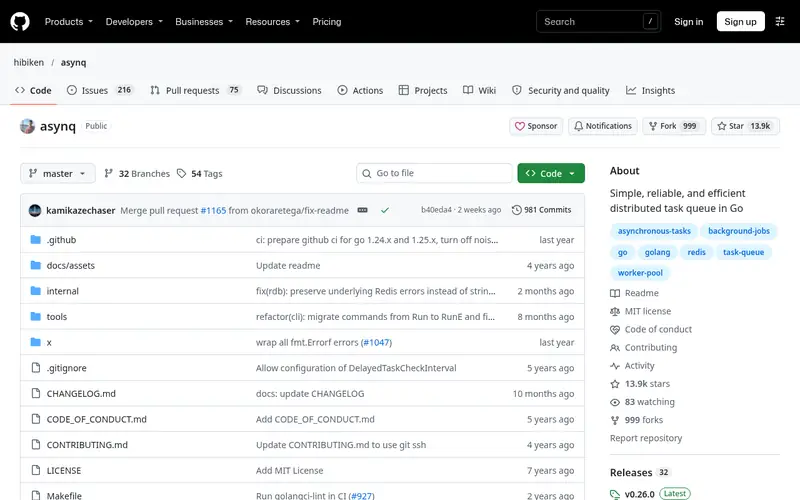
Asynq is a Go library for queueing background tasks on Redis. You register task handlers in your Go process, enqueue jobs from your app, and run worker processes that pull from named queues. It supports delayed and recurring tasks, retries with backoff, and per-queue priorities. A separate web UI and command-line tool let you inspect and requeue failed jobs.
It runs anywhere Go and Redis run, including containers and managed Redis services. The licence is open source, and there is no paid tier from the maintainers. The main limit is operational: you must run and secure Redis, and Redis persistence settings affect whether queued jobs survive a restart. Skip it if you cannot add Redis to your stack.
Standout: Redis-backed with scheduling, retries and priorities
Free (open source), as listed by the vendor (Asynq website). Confirm the current plan price before you buy.
Free plan. Plans change, so confirm on the vendor's pricing page before you buy.
Benefits
- Redis-backed with scheduling, retries and priorities
- includes a web UI and CLI for inspecting queues
Drawbacks
- Requires a Redis server
- no official support contract from the project
Skip it if this limit matters to you: requires a Redis server.
Verdict. A sensible pick for teams already running Redis who need scheduled and retried jobs.
River
Best for go teams on PostgreSQL that want jobs in the same database
What it is and where it fits
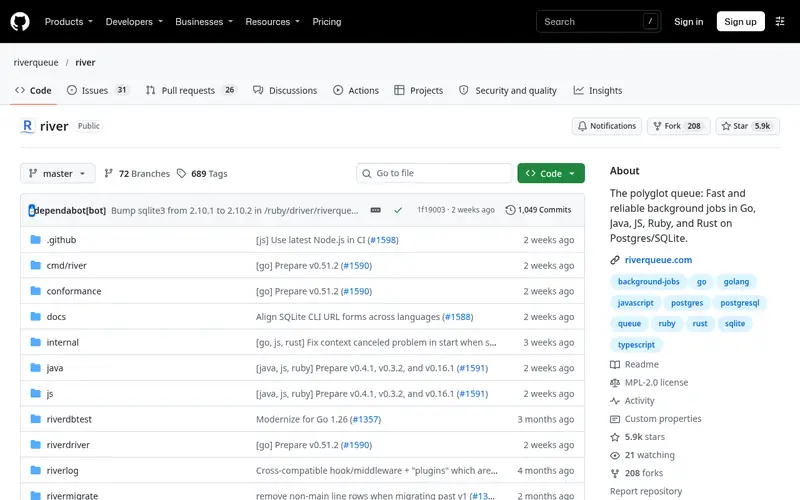
River is a job queue for Go that stores jobs in PostgreSQL. Because enqueueing happens in the same transaction as your application writes, a job is only created if the surrounding database transaction commits. That removes a common class of lost or duplicate job bugs. It supports retries, scheduled jobs and multiple queues.
It runs as a Go library inside your application or as a separate worker process. The licence is open source with no paid tier from the project. The tradeoff is that all job traffic hits your PostgreSQL instance, so heavy queue volume competes with application queries. Skip it if you use MySQL or need a broker decoupled from your primary database.
Standout: Uses PostgreSQL for storage, so no extra broker
Free (open source), as listed by the vendor (River website). Confirm the current plan price before you buy.
Free plan. Plans change, so confirm on the vendor's pricing page before you buy.
Benefits
- Uses PostgreSQL for storage, so no extra broker
- transactional enqueue alongside your data writes
Drawbacks
- Tied to PostgreSQL
- job throughput depends on your database capacity
Skip it if this limit matters to you: tied to PostgreSQL.
Verdict. A sensible pick for go teams on PostgreSQL that want jobs in the same database.
Machinery
Best for teams that need RabbitMQ, AMQP or multiple broker backends
What it is and where it fits
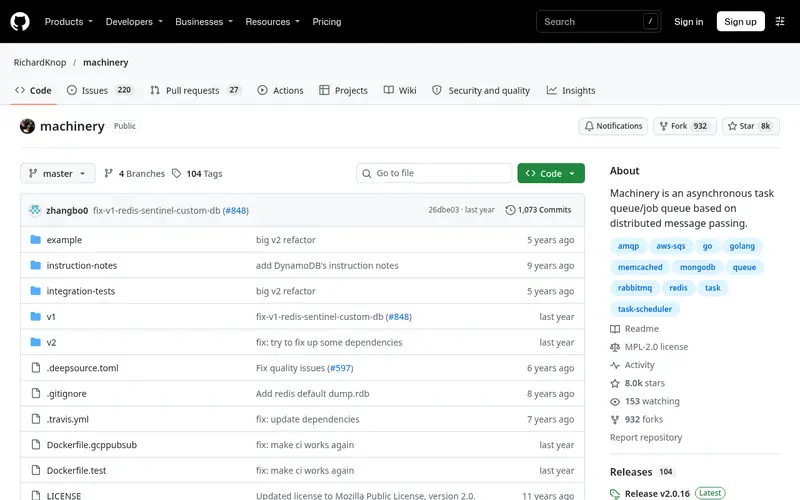
Machinery is a Go library for asynchronous task queues. It supports multiple brokers, including Redis, RabbitMQ and AMQP, and several result backends. Tasks are defined as named functions, and you can compose them into chains, groups and chords for multi-step workflows.
It runs wherever Go runs, with the broker and result backend deployed separately. The licence is open source. The main concern is maintenance pace: releases are less frequent than Asynq or River, so check the repository activity before committing. Skip it if you want a single simple backend and fast-moving releases.
Standout: Supports several brokers and result backends
Free (open source), as listed by the vendor (Machinery website). Confirm the current plan price before you buy.
Free plan. Plans change, so confirm on the vendor's pricing page before you buy.
Benefits
- Supports several brokers and result backends
- task signatures and chains for workflows
Drawbacks
- Slower release cadence than newer libraries
- more configuration to wire up
Skip it if this limit matters to you: slower release cadence than newer libraries.
Verdict. A sensible pick for teams that need RabbitMQ, AMQP or multiple broker backends.
Faktory
Best for polyglot teams that want one job server across languages
What it is and where it fits
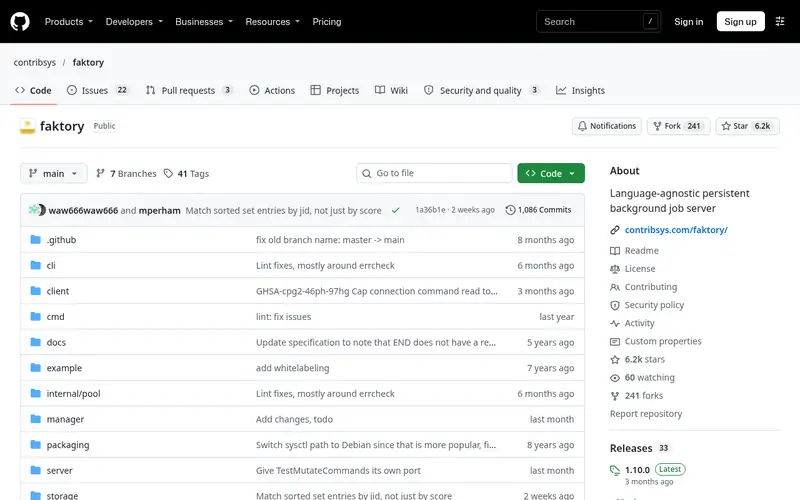
Faktory is a job server, not just a Go library. Workers in Go, Ruby, Python, JavaScript and other languages connect to a central Faktory server over a simple protocol, so one queue can serve services written in different languages. The Go client is the `faktory_worker_go` package.
You deploy the Faktory server yourself, typically alongside Redis, which it uses for storage. The core server is open source, and the project offers a commercial enterprise edition with additional features; check the vendor page for current terms. The main cost is operational: another service to run and monitor. Skip it if your stack is Go-only and Redis is already available.
Standout: Language-agnostic job server with a Go worker client
See vendor pricing page, as listed by the vendor (Faktory website). Confirm the current plan price before you buy.
Free plan. Plans change, so confirm on the vendor's pricing page before you buy.
Benefits
- Language-agnostic job server with a Go worker client
- web UI for queue inspection
Drawbacks
- Requires running a separate Faktory server
- some features sit behind a commercial licence
Skip it if this limit matters to you: requires running a separate Faktory server.
Verdict. A sensible pick for polyglot teams that want one job server across languages.
NATS JetStream
Best for teams already using NATS that need durable work queues
What it is and where it fits
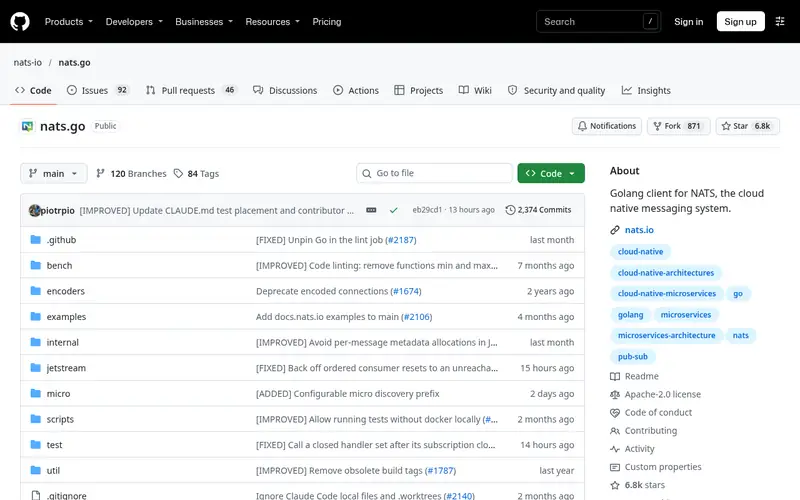
NATS JetStream is the persistence layer for the NATS messaging system. With the official Go client, you can create durable streams and pull consumers that behave like a work queue: messages are stored, delivered to one consumer in a group, and redelivered if not acknowledged.
It runs on a NATS server you deploy, and the client library is open source. JetStream is a messaging system, not a job library, so retry policies, scheduling and dead-letter handling are configured through stream and consumer settings rather than application-level APIs. Skip it if you want a purpose-built job queue with a monitoring UI.
Standout: Durable streams with acknowledgements and redelivery
Free (open source), as listed by the vendor (NATS JetStream website). Confirm the current plan price before you buy.
Free plan. Plans change, so confirm on the vendor's pricing page before you buy.
Benefits
- Durable streams with acknowledgements and redelivery
- official Go client
Drawbacks
- Requires a NATS server with JetStream enabled
- queue semantics need configuration
Skip it if this limit matters to you: requires a NATS server with JetStream enabled.
Verdict. A sensible pick for teams already using NATS that need durable work queues.
Who should use what
If you already run Redis, Asynq gives you scheduling, retries and a UI with little setup. If PostgreSQL is your primary database and you want jobs to commit with your data, use River. If you need RabbitMQ or AMQP, or multi-step workflows across brokers, Machinery is the fit. If your services are written in several languages, a Faktory server lets them share one queue. If you already run NATS, JetStream gives you durable work queues without adding another backend.
Questions to settle before you buy
What to check before you buy
- Confirm which backend the library needs and whether you already run it in production.
- Check the repository's recent commit and release activity before adopting it.
- Decide whether jobs must commit in the same transaction as your database writes.
- Verify retry, scheduling and dead-letter behavior against your failure cases.
- Plan how you will monitor queue depth and failed jobs, and whether a UI is included.
FAQ
Do I need Redis to run a Go job queue?
No. River uses PostgreSQL, Machinery supports RabbitMQ and AMQP, and NATS JetStream uses a NATS server. Asynq needs Redis.
Is Asynq free to use?
Yes. Asynq is open source with no paid tier from the maintainers. You pay for the Redis infrastructure it runs on, whether self-hosted or managed.
Can I use River without a separate broker?
Yes. River stores jobs in PostgreSQL, so there is no separate broker to deploy. The tradeoff is that job traffic shares capacity with your application queries.
Does Machinery support brokers other than Redis?
Yes. Machinery supports multiple brokers, including Redis, RabbitMQ and AMQP, along with several result backends. That flexibility comes with more configuration to wire up.
Which option works across multiple languages?
Faktory is a language-agnostic job server with worker clients for Go, Ruby, Python and other languages. NATS JetStream also works across languages through its client libraries.
Sources we checked
Method: how we score · editorial policy.
Change log. First published 27 Nov 2026.