Stage 03 · Host · Researched comparison
Best Go Caching Libraries in 2026
go-cache is the first pick for simple in-process key-value caching with expiry, and it suits single-binary services that need a small dependency. For a typed cache with generics support, look at ttlcache. For a shared cache across many instances, look at Redis clients such as go-redis or rueidis. All of these are open source and free to use.

By Shihab Mia
Published 27 Nov 2026 · 6 tools compared
We run no ads and no affiliate links at launch. The order of a list follows our published method. See how we score.
Prices are the starting prices vendors list publicly. Plans change, so confirm the current price on the vendor page before you buy.
Key takeaways
- go-cache, ttlcache, BigCache, Ristretto, go-redis and rueidis are all free and open source.
- In-memory libraries such as go-cache and ttlcache only cache data inside one process; they do not share state between instances.
- BigCache and Ristretto target high-throughput workloads and trade features such as per-item TTL control for speed.
- Redis clients need a running Redis server, which adds an external service and its own operational cost.
Who each pick is for
- Simple in-memory caching in single-process Go servicesgo-cache
- Typed in-memory caching with generics and capacity limitsttlcache
- High-throughput in-memory caching with many entriesBigCache
- High-hit-rate in-memory caching with admission controlRistretto
- Shared caching across services using a Redis servergo-redis
- Low-latency Redis access with client-side cachingrueidis
Comparison
| Tool | Best for | Standout feature | Listed starting price | Free plan or trial |
|---|---|---|---|---|
| 1go-cache | Simple in-memory caching in single-process Go services | Small API with per-item expiry and a default cleanup interval | Free (open source) | Free plan |
| 2ttlcache | Typed in-memory caching with generics and capacity limits | Generic key and value types | Free (open source) | Free plan |
| 3BigCache | High-throughput in-memory caching with many entries | Designed to hold many entries with low garbage collection pressure | Free (open source) | Free plan |
| 4Ristretto | High-hit-rate in-memory caching with admission control | Uses admission and eviction policies aimed at high hit rates | Free (open source) | Free plan |
| 5go-redis | Shared caching across services using a Redis server | Widely used client with support for Redis clusters, pipelines and pub/sub | Free (open source) | Free plan |
| 6rueidis | Low-latency Redis access with client-side caching | Supports Redis client-side caching | Free (open source) | Free plan |
How we picked
We picked libraries that are actively maintained and that genuinely serve a caching job in Go: in-process key-value caches, high-throughput caches and Redis clients. We checked each project's repository and documentation for platform support, licence, API shape and stated limits. We did not run benchmarks or hands-on tests. All listed projects are open source; Redis clients require a separate Redis server whose cost depends on how you host it, so confirm pricing on the vendor site.
The tools, one by one
go-cache
Best for simple in-memory caching in single-process Go services
What it is and where it fits
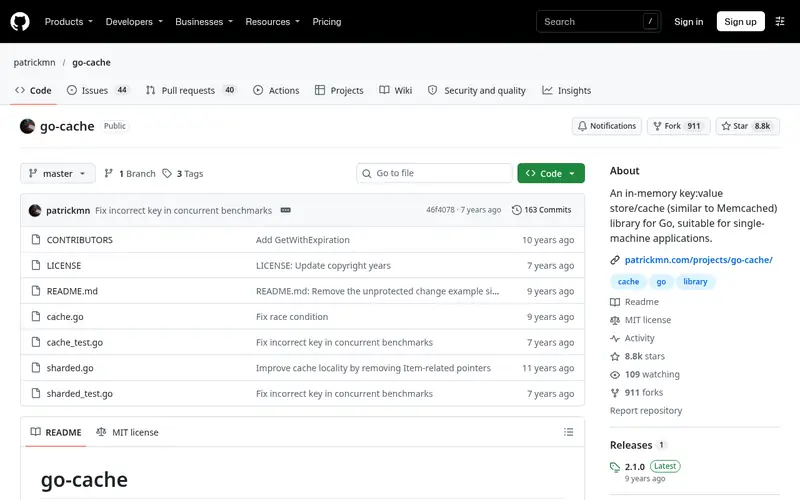
go-cache is an in-memory key-value store for Go with expiration times on items and a janitor goroutine that removes expired entries. It runs inside your process and needs no server, network or configuration file. The API is small: Set, Get, Delete and a few helpers.
It is a good fit for caching computed values, parsed configuration or small lookup tables in a single binary. Values are stored as interface{}, so callers use type assertions, and the library does not provide eviction by size or a maximum memory limit. Data is lost on restart and is not shared between instances.
Skip go-cache when you need a shared cache across replicas, strict type safety, or bounded memory. In those cases a Redis client or a typed cache is a better fit.
Standout: Small API with per-item expiry and a default cleanup interval
Free (open source), as listed by the vendor (go-cache website). Confirm the current plan price before you buy.
Free plan. Plans change, so confirm on the vendor's pricing page before you buy.
Benefits
- Small API with per-item expiry and a default cleanup interval
- no external dependencies
Drawbacks
- Stores values as interface{}, so type assertions are needed
- not safe to share across processes
Skip it if this limit matters to you: stores values as interface{}, so type assertions are needed.
Verdict. A sensible pick for simple in-memory caching in single-process Go services.
ttlcache
Best for typed in-memory caching with generics and capacity limits
What it is and where it fits
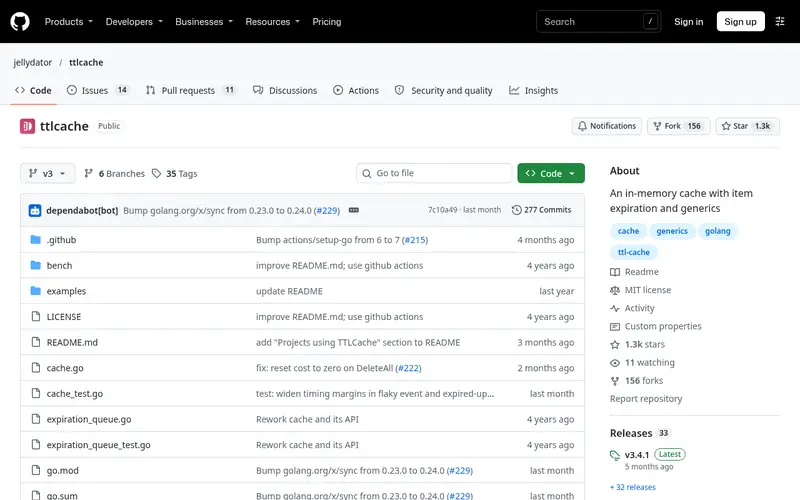
ttlcache is an in-memory cache for Go that uses generics, so keys and values keep their types. It supports per-item TTL, a maximum number of items, and callbacks when items are evicted or expired. It runs entirely in your process with no external service.
The library suits services that want type safety and a bounded cache size without pulling in a server. Capacity limits help avoid unbounded memory growth. Because it is in-process, each replica has its own cache and entries are not shared.
Skip it if you need a distributed cache or persistence across restarts. It is also a poor fit if your team is on a Go version that predates generics support.
Standout: Generic key and value types
Free (open source), as listed by the vendor (ttlcache website). Confirm the current plan price before you buy.
Free plan. Plans change, so confirm on the vendor's pricing page before you buy.
Benefits
- Generic key and value types
- supports capacity limits and per-item TTL
Drawbacks
- In-process only
- API surface is larger than go-cache
Skip it if this limit matters to you: in-process only.
Verdict. A sensible pick for typed in-memory caching with generics and capacity limits.
BigCache
Best for high-throughput in-memory caching with many entries
What it is and where it fits
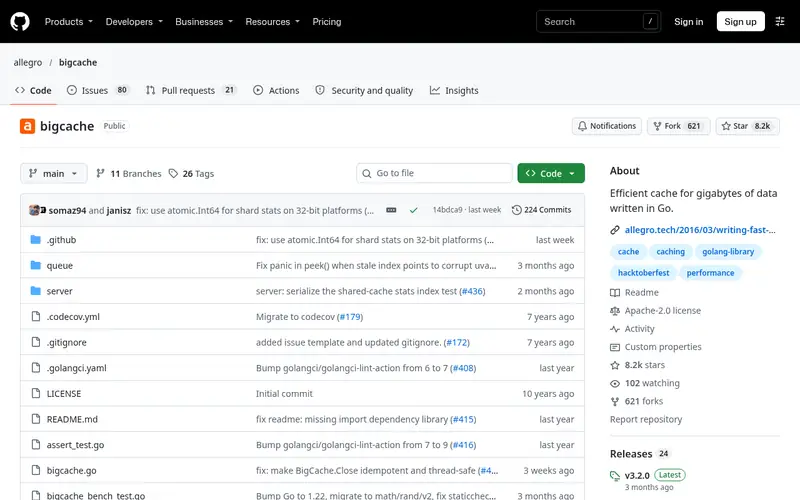
BigCache is an in-memory cache from Allegro built to store many entries while avoiding garbage collection overhead. It keeps entries in shards and stores values as byte slices, which means you serialize your data before storing it. The API is small and focused on Get, Set and Delete.
It fits services that cache large numbers of small items, such as session data or lookup results, and want predictable memory behavior. Configuration covers shard count, life window and cleanup interval. There is no per-item TTL; expiry works on a time window.
Skip BigCache if you need typed values, per-item expiration or a shared cache across processes. It is also not a good match for very large individual values.
Standout: Designed to hold many entries with low garbage collection pressure
Free (open source), as listed by the vendor (BigCache website). Confirm the current plan price before you buy.
Free plan. Plans change, so confirm on the vendor's pricing page before you buy.
Benefits
- Designed to hold many entries with low garbage collection pressure
- simple Get and Set API
Drawbacks
- Values are byte slices
- eviction is time-based rather than per-item TTL
Skip it if this limit matters to you: values are byte slices.
Verdict. A sensible pick for high-throughput in-memory caching with many entries.
Ristretto
Best for high-hit-rate in-memory caching with admission control
What it is and where it fits
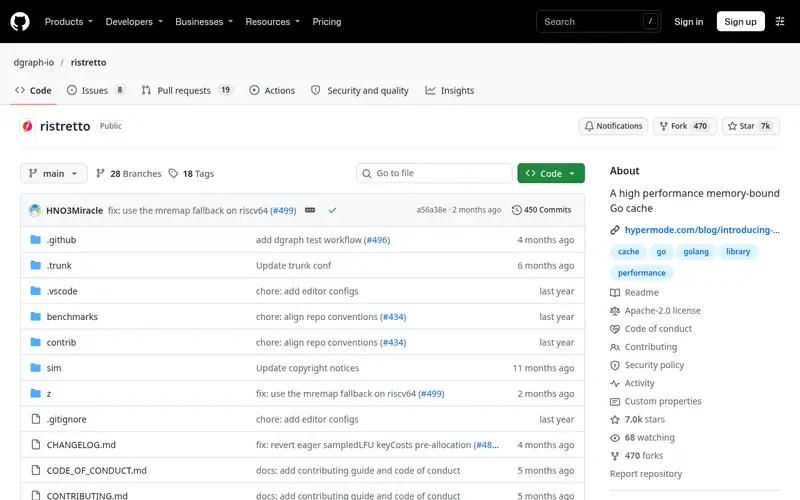
Ristretto is an in-memory cache from Dgraph built around a admission policy and cost-based eviction. It is designed for workloads where hit rate matters and where the cache must handle many concurrent goroutines. Entries have a cost, and the cache evicts based on that cost against a maximum.
Writes are buffered and processed asynchronously, so a value set may not be readable right away. That design helps throughput but requires care in code that expects immediate reads. Configuration includes number of counters and maximum cost.
Skip Ristretto if you need synchronous writes, simple per-item TTL semantics or a shared cache. It suits teams willing to tune and test cache behavior under load.
Standout: Uses admission and eviction policies aimed at high hit rates
Free (open source), as listed by the vendor (Ristretto website). Confirm the current plan price before you buy.
Free plan. Plans change, so confirm on the vendor's pricing page before you buy.
Benefits
- Uses admission and eviction policies aimed at high hit rates
- handles concurrent access
Drawbacks
- Asynchronous writes mean a Set may not be visible immediately
- tuning takes care
Skip it if this limit matters to you: asynchronous writes mean a Set may not be visible immediately.
Verdict. A sensible pick for high-hit-rate in-memory caching with admission control.
go-redis
Best for shared caching across services using a Redis server
What it is and where it fits
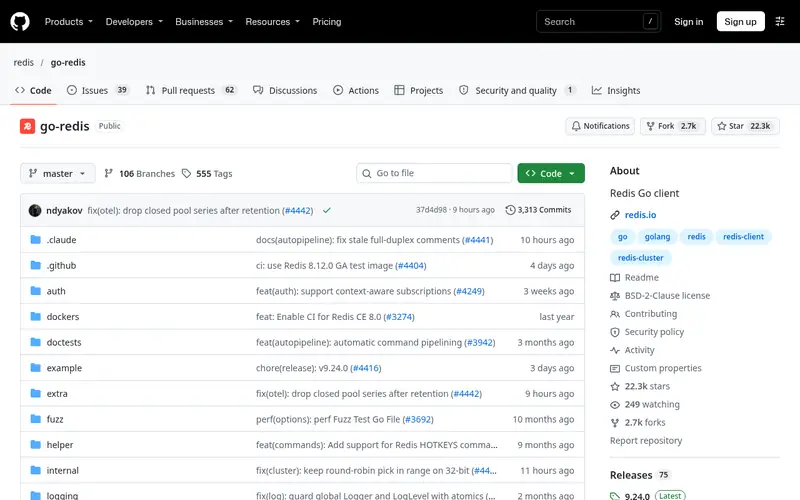
go-redis is a Redis client for Go. It gives your services a shared cache that survives restarts of individual app instances and works across replicas. It supports standalone Redis, Sentinel and Cluster, plus pipelines, transactions and pub/sub.
The library itself is free and open source. The Redis server is separate: you can run it yourself or use a managed service, and managed pricing varies by provider, so check the vendor pricing page. Caching patterns such as TTLs, eviction policies and max memory are configured on the server.
Skip go-redis if you only need a small in-process cache and do not want to operate a Redis server. It is also unnecessary when a single process is the only consumer of the data.
Standout: Widely used client with support for Redis clusters, pipelines and pub/sub
Free (open source), as listed by the vendor (go-redis website). Confirm the current plan price before you buy.
Free plan. Plans change, so confirm on the vendor's pricing page before you buy.
Benefits
- Widely used client with support for Redis clusters, pipelines and pub/sub
- context-aware API
Drawbacks
- Requires a Redis server
- you pay for and operate that server separately
Skip it if this limit matters to you: requires a Redis server.
Verdict. A sensible pick for shared caching across services using a Redis server.
rueidis
Best for low-latency Redis access with client-side caching
What it is and where it fits
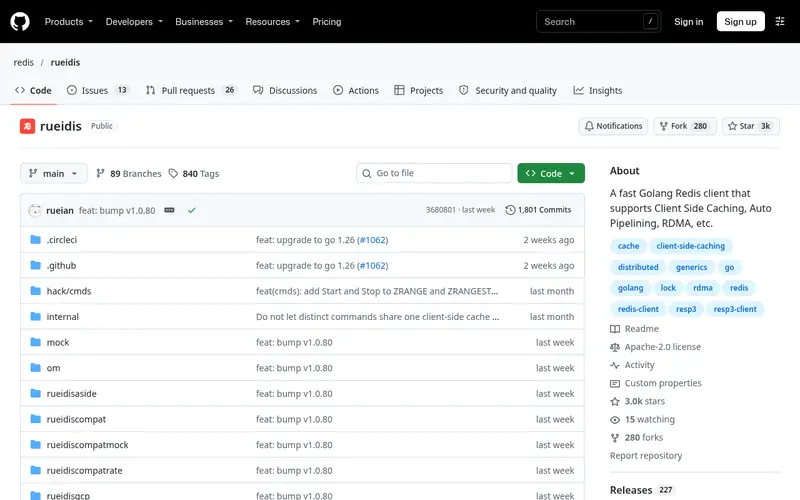
rueidis is a Go Redis client that supports client-side caching, where the client keeps a local copy of server data and Redis sends invalidation messages when it changes. It also auto-pipelines commands to reduce round trips. It works with standalone Redis, Sentinel and Cluster.
The client is free and open source, but it still needs a Redis server, which is a separate cost and operational concern. Client-side caching helps latency for read-heavy workloads but adds memory use in the client process and depends on server support for tracking.
Skip rueidis if you are already standardized on another client and do not need client-side caching. It is also a poor fit if you cannot run a Redis server.
Standout: Supports Redis client-side caching
Free (open source), as listed by the vendor (rueidis website). Confirm the current plan price before you buy.
Free plan. Plans change, so confirm on the vendor's pricing page before you buy.
Benefits
- Supports Redis client-side caching
- auto-pipelines commands for throughput
Drawbacks
- Requires a Redis server
- API differs from go-redis, so porting code takes work
Skip it if this limit matters to you: requires a Redis server.
Verdict. A sensible pick for low-latency Redis access with client-side caching.
Who should use what
A single-binary service that needs a small cache with expiry should start with go-cache. A team that wants typed values and a bounded size should use ttlcache. Services that cache many small items and care about garbage collection should look at BigCache or Ristretto. If several replicas must share cached data, use a Redis client such as go-redis or rueidis and plan for the server cost.
Questions to settle before you buy
What to check before you buy
- Confirm whether the cache must be shared across processes or can stay in one process.
- Check the licence and whether the project is actively maintained.
- Decide whether you need per-item TTL, a maximum size, or both.
- For Redis clients, price the server or managed service, not just the client.
- Test eviction and expiry behavior under your expected load before relying on it.
FAQ
Do I need Redis to cache in Go?
No. Libraries such as go-cache, ttlcache, BigCache and Ristretto cache data inside your process with no server. Redis is only needed when multiple processes or replicas must share the same cached data.
Which Go caching library is fastest?
We do not publish benchmarks. BigCache and Ristretto are designed for high-throughput workloads, while go-cache and ttlcache favor a simple API. Measure with your own data and access patterns before choosing.
Are these caching libraries free?
Yes. All six projects listed are open source and free to use. Redis clients still require a Redis server, which you host yourself or pay a provider for, so check that cost separately.
Can I use these caches for sensitive data?
In-process caches keep data in your own process memory. With Redis, data leaves your process, so secure the server and its network access. Do not paste secrets or production data into third-party web tools when testing cache behavior.
What happens to cached data on restart?
In-process caches such as go-cache and ttlcache lose all data when the process restarts. A Redis-backed cache can survive app restarts depending on how the server is configured for persistence.
Sources we checked
Method: how we score · editorial policy.
Change log. First published 27 Nov 2026.