Stage 03 · Host · Researched comparison
Best .NET ORMs in 2026
Entity Framework Core is the first pick for most teams. It is free, open source, works across .NET platforms, and ships with migrations and LINQ queries. Choose Dapper when you want hand-written SQL with minimal mapping overhead. Choose NHibernate when you need a mature, long-established ORM with a large feature set. All three are free or open source, so the choice comes down to query style, database support and how much abstraction you want.

By Shihab Mia
Published 27 Nov 2026 · 7 tools compared
We run no ads and no affiliate links at launch. The order of a list follows our published method. See how we score.
Prices are the starting prices vendors list publicly. Plans change, so confirm the current price on the vendor page before you buy.
Key takeaways
- Entity Framework Core is free and open source, and is the default choice for new .NET projects.
- Dapper is free and open source, and suits teams that prefer explicit SQL over a full ORM.
- NHibernate is free and open source, with a long history and broad mapping options.
- Most options on this list are open source; paid support and commercial editions exist for a few, so confirm prices on vendor pages.
Who each pick is for
- Teams that want a full ORM with migrations and LINQEntity Framework Core
- Developers who want fast mapping over explicit SQLDapper
- Teams needing a mature ORM with broad mapping featuresNHibernate
- LINQ queries with tight control over generated SQLLinq2Db
- Lightweight ORM inside the ServiceStack ecosystemServiceStack OrmLite
- Hybrid ORM and micro-ORM data accessRepoDB
- Teams wanting a commercial ORM with a designerLLBLGen Pro
Comparison
| Tool | Best for | Standout feature | Listed starting price | Free plan or trial |
|---|---|---|---|---|
| 1Entity Framework Core | Teams that want a full ORM with migrations and LINQ | First-party Microsoft support | Free (open source) | Free plan |
| 2Dapper | Developers who want fast mapping over explicit SQL | Small and fast | Free (open source) | Free plan |
| 3NHibernate | Teams needing a mature ORM with broad mapping features | Long-established with rich mapping options | Free (open source) | Free plan |
| 4Linq2Db | LINQ queries with tight control over generated SQL | Strong LINQ-to-SQL translation | Free (open source) | Free plan |
| 5ServiceStack OrmLite | Lightweight ORM inside the ServiceStack ecosystem | Simple API over ADO.NET | Free (open source) | Free plan |
| 6RepoDB | Hybrid ORM and micro-ORM data access | Mixes fluent operations with raw SQL | Free (open source) | Free plan |
| 7LLBLGen Pro | Teams wanting a commercial ORM with a designer | Visual designer and code generation | See vendor pricing page | Free trial (N days) |
How we picked
We compared options on fit for common .NET data-access jobs, supported platforms and databases, licence and price, and the main limits each one has. Sources are vendor documentation, project repositories and public pricing pages. We did not run benchmarks or collect user reviews. Prices and trial terms change, so confirm them on the vendor site before you commit.
The tools, one by one
Entity Framework Core
Best for teams that want a full ORM with migrations and LINQ
What it is and where it fits
Entity Framework Core is the ORM maintained by Microsoft as part of the .NET platform. It maps .NET classes to database tables, supports LINQ queries, change tracking and migrations, and works with SQL Server, PostgreSQL, SQLite, MySQL and others through providers. It runs on modern .NET and .NET Framework via older versions.
The project is open source under the MIT licence and is free to use. Documentation, tooling and community support are extensive. The main limits are performance tuning: complex queries can produce SQL that needs review, and the abstraction can hide database behaviour. Teams that need tight control over SQL often pair EF Core with raw SQL for hot paths.
Skip EF Core if you want a thin mapper over hand-written SQL, or if your database has no maintained provider.
Standout: First-party Microsoft support
Free (open source), as listed by the vendor (Entity Framework Core website). Confirm the current plan price before you buy.
Free plan. Plans change, so confirm on the vendor's pricing page before you buy.
Benefits
- First-party Microsoft support
- migrations and LINQ queries built in
Drawbacks
- Generated SQL can be hard to tune
- heavier abstraction than micro-ORMs
Skip it if this limit matters to you: generated SQL can be hard to tune.
Verdict. A sensible pick for teams that want a full ORM with migrations and LINQ.
Alternatives in this guide: Dapper, NHibernate, Linq2Db
Dapper
Best for developers who want fast mapping over explicit SQL
What it is and where it fits
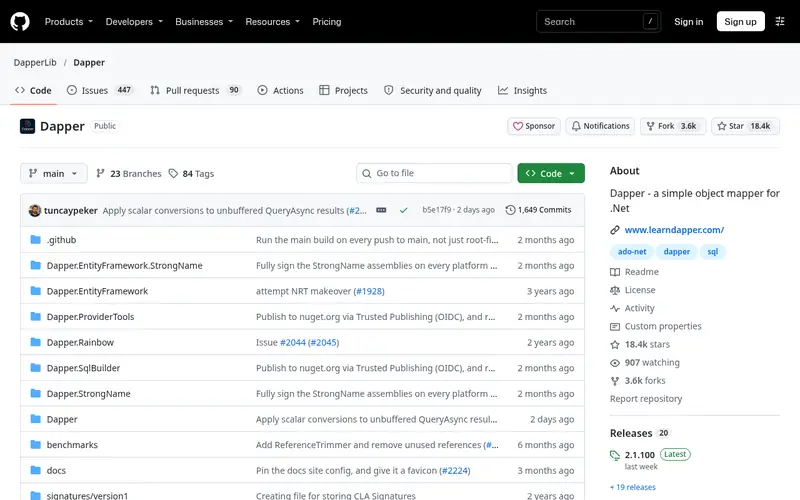
Dapper is a micro-ORM from the DapperLib project. It extends IDbConnection with methods that map query results to objects, and it works with any ADO.NET provider, including SQL Server, PostgreSQL, SQLite and MySQL. It runs on .NET and .NET Framework.
It is open source under the Apache 2.0 licence and free to use. Dapper does not generate SQL, manage schema or track changes. You write queries and handle migrations with another tool. That makes it predictable and light, but it puts more work on the developer.
Skip Dapper if you want an ORM to generate queries and handle schema changes for you.
Standout: Small and fast
Free (open source), as listed by the vendor (Dapper website). Confirm the current plan price before you buy.
Free plan. Plans change, so confirm on the vendor's pricing page before you buy.
Benefits
- Small and fast
- works with plain SQL you control
Drawbacks
- No migrations or change tracking
- you write the SQL
Skip it if this limit matters to you: no migrations or change tracking.
Verdict. A sensible pick for developers who want fast mapping over explicit SQL.
Alternatives in this guide: Entity Framework Core, NHibernate, Linq2Db
NHibernate
Best for teams needing a mature ORM with broad mapping features
What it is and where it fits
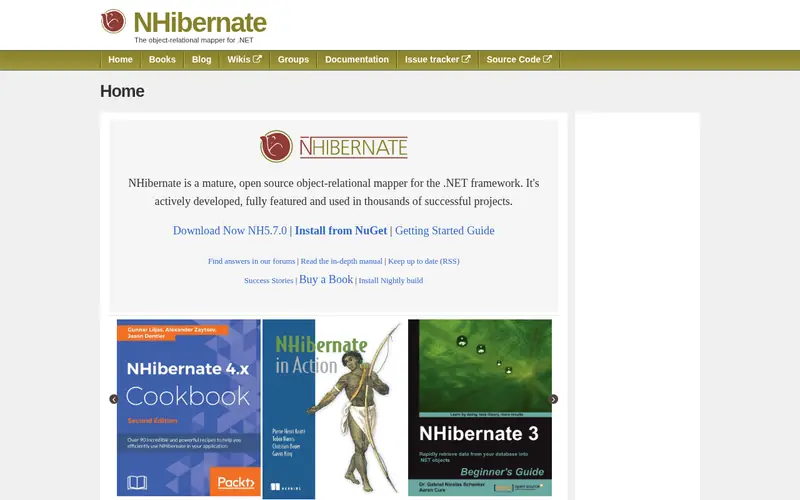
NHibernate is an object-relational mapper for .NET with roots in the Java Hibernate project. It supports mapping files and attributes, caching, lazy loading and a query API, and it works with many database systems through drivers. It runs on .NET and .NET Framework.
The project is open source under the LGPL licence and free to use. It has a long track record in enterprise systems. The trade-offs are configuration effort and a learning curve, and its ecosystem is smaller than EF Core's.
Skip NHibernate for greenfield projects where EF Core's tooling and documentation fit better.
Standout: Long-established with rich mapping options
Free (open source), as listed by the vendor (NHibernate website). Confirm the current plan price before you buy.
Free plan. Plans change, so confirm on the vendor's pricing page before you buy.
Benefits
- Long-established with rich mapping options
- supports many databases
Drawbacks
- Steeper learning curve
- configuration is heavier than EF Core
Skip it if this limit matters to you: steeper learning curve.
Verdict. A sensible pick for teams needing a mature ORM with broad mapping features.
Alternatives in this guide: Entity Framework Core, Dapper, Linq2Db
Linq2Db
Best for lINQ queries with tight control over generated SQL
What it is and where it fits
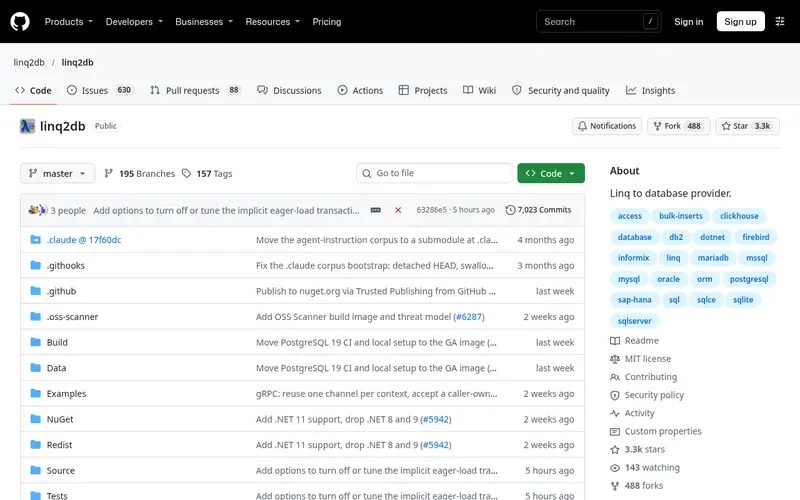
Linq2Db is an open-source ORM that translates LINQ queries to SQL and maps results to objects. It supports SQL Server, PostgreSQL, SQLite, MySQL, Oracle and others, and runs on .NET and .NET Framework. It offers a lighter alternative to EF Core for teams that want LINQ with more direct SQL control.
It is free under the MIT licence. It includes tooling for scaffolding classes from a database. The main limits are a smaller community and less integrated migration support than EF Core.
Skip Linq2Db if you depend on EF Core's migrations and first-party tooling.
Standout: Strong LINQ-to-SQL translation
Free (open source), as listed by the vendor (Linq2Db website). Confirm the current plan price before you buy.
Free plan. Plans change, so confirm on the vendor's pricing page before you buy.
Benefits
- Strong LINQ-to-SQL translation
- supports many databases
Drawbacks
- Smaller community than EF Core
- fewer built-in migration tools
Skip it if this limit matters to you: smaller community than EF Core.
Verdict. A sensible pick for LINQ queries with tight control over generated SQL.
Alternatives in this guide: Entity Framework Core, Dapper, NHibernate
ServiceStack OrmLite
Best for lightweight ORM inside the ServiceStack ecosystem
What it is and where it fits
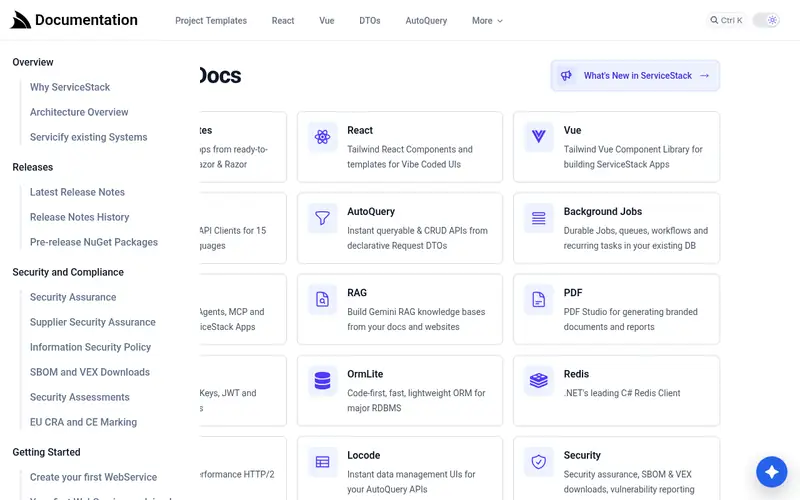
ServiceStack OrmLite is a lightweight, convention-based ORM that wraps ADO.NET. It maps POCOs to tables and offers typed queries, and it supports SQL Server, PostgreSQL, SQLite, MySQL and others. It runs on .NET.
The core library is open source and free to use. Some related ServiceStack components are commercial, so check the licence terms for the parts you use. It is a good fit for teams already using ServiceStack, and less common outside it.
Skip OrmLite if you are not in the ServiceStack ecosystem and want the largest community and tooling.
Standout: Simple API over ADO.NET
Free (open source), as listed by the vendor (ServiceStack OrmLite website). Confirm the current plan price before you buy.
Free plan. Plans change, so confirm on the vendor's pricing page before you buy.
Benefits
- Simple API over ADO.NET
- supports many databases
Drawbacks
- Best fit is ServiceStack projects
- smaller standalone community
Skip it if this limit matters to you: best fit is ServiceStack projects.
Verdict. A sensible pick for lightweight ORM inside the ServiceStack ecosystem.
Alternatives in this guide: Entity Framework Core, Dapper, NHibernate
RepoDB
Best for hybrid ORM and micro-ORM data access
What it is and where it fits
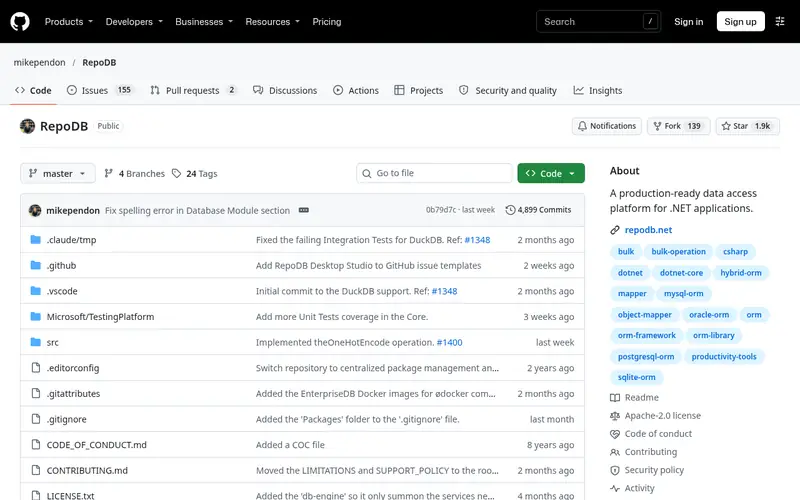
RepoDB is an open-source hybrid ORM and micro-ORM for .NET. It offers fluent CRUD operations, batch and bulk operations, and support for raw SQL, with providers for SQL Server, PostgreSQL, SQLite, MySQL and others. It runs on .NET and .NET Framework.
It is free under the Apache 2.0 licence. It aims to sit between full ORMs and micro-ORMs. The main limits are a smaller community and fewer tutorials compared with EF Core and Dapper.
Skip RepoDB if you need the widest hiring pool and documentation coverage.
Standout: Mixes fluent operations with raw SQL
Free (open source), as listed by the vendor (RepoDB website). Confirm the current plan price before you buy.
Free plan. Plans change, so confirm on the vendor's pricing page before you buy.
Benefits
- Mixes fluent operations with raw SQL
- supports many databases
Drawbacks
- Smaller community
- fewer learning resources than EF Core
Skip it if this limit matters to you: smaller community.
Verdict. A sensible pick for hybrid ORM and micro-ORM data access.
Alternatives in this guide: Entity Framework Core, Dapper, NHibernate
LLBLGen Pro
Best for teams wanting a commercial ORM with a designer
What it is and where it fits
LLBLGen Pro is a commercial ORM and code generator for .NET. It provides a designer for modelling, generates code and supports SQL Server, PostgreSQL, SQLite, MySQL, Oracle and others. It runs on .NET and .NET Framework.
It is a paid product with a trial. Pricing and trial length are listed on the vendor site, so confirm current terms there. It suits teams that want a designer-driven workflow and commercial support.
Skip LLBLGen Pro if you want an open-source stack with no licence cost.
Standout: Visual designer and code generation
See vendor pricing page, as listed by the vendor (LLBLGen Pro website). Confirm the current plan price before you buy.
Free trial (N days). Plans change, so confirm on the vendor's pricing page before you buy.
Benefits
- Visual designer and code generation
- supports many databases
Drawbacks
- Commercial licence
- smaller community than open-source options
Skip it if this limit matters to you: commercial licence.
Verdict. A sensible pick for teams wanting a commercial ORM with a designer.
Alternatives in this guide: Entity Framework Core, Dapper, NHibernate
Who should use what
New projects that want migrations and LINQ should start with Entity Framework Core. Teams with heavy SQL and performance-sensitive queries should use Dapper, often alongside a migration tool. Enterprise systems with complex mapping needs may fit NHibernate. Teams that want LINQ with tighter SQL control should look at Linq2Db, and ServiceStack users should consider OrmLite. Teams that want a commercial designer and support can evaluate LLBLGen Pro.
Questions to settle before you buy
What to check before you buy
- Confirm the ORM supports your database and provider version.
- Check the licence terms, including any commercial components.
- Decide whether you need migrations, change tracking or just query mapping.
- Review how the ORM generates SQL for your hot queries.
- Confirm the .NET version you target is supported.
FAQ
Is Entity Framework Core free?
Yes. EF Core is open source under the MIT licence and free to use. You pay only for hosting and any commercial support you choose.
Is Dapper an ORM?
Dapper is usually called a micro-ORM. It maps query results to objects but does not generate SQL, manage schema or track changes.
Which .NET ORM is fastest?
We do not publish benchmarks. Speed depends on your queries, database and configuration. Review generated SQL and test with your own workload.
Can I use these ORMs with PostgreSQL?
Yes. EF Core, Dapper, NHibernate, Linq2Db, OrmLite, RepoDB and LLBLGen Pro all list PostgreSQL support through providers or drivers.
Do I need a commercial ORM?
No. Most .NET teams use open-source options. A commercial ORM can make sense when you want a designer, vendor support or specific features.
Sources we checked
Method: how we score · editorial policy.
Change log. First published 27 Nov 2026.