Stage 02 · Test · Researched comparison
Best TypeScript Schema Validation Libraries in 2026
Zod is the first pick for most teams. It has a large ecosystem, static type inference from schemas, and works for form input, API payloads and environment variables. Pick Valibot if bundle size matters, since it ships as small, tree-shakeable functions. Pick TypeBox or AJV if you need JSON Schema output or high-throughput request validation. All of these run in Node.js and the browser, and all are open source.

By Shihab Mia
Published 27 Nov 2026 · 8 tools compared
We run no ads and no affiliate links at launch. The order of a list follows our published method. See how we score.
Prices are the starting prices vendors list publicly. Plans change, so confirm the current price on the vendor page before you buy.
Key takeaways
- Zod, Valibot, Yup, Joi, ArkType, TypeBox, Effect Schema, superstruct and AJV are all free and open source.
- Zod and Yup have the widest third-party integrations; Valibot and superstruct keep bundle size down.
- TypeBox and AJV center on JSON Schema, which helps when schemas are shared outside TypeScript.
- Schema libraries validate data at runtime; they do not replace a linter or a type checker.
Who each pick is for
- General-purpose validation with strong type inferenceZod
- Small client bundles with tree-shakeable schemasValibot
- Form validation in React and similar UI stacksYup
- Server-side validation in Node.js servicesJoi
- TypeScript-native syntax with fast parsingArkType
- JSON Schema-first validation with TypeScript typesTypeBox
- Projects already using the Effect ecosystemEffect Schema
- Validating against existing JSON Schema documentsAJV
Comparison
| Tool | Best for | Standout feature | Listed starting price | Free plan or trial |
|---|---|---|---|---|
| 1Zod | General-purpose validation with strong type inference | Types are inferred from schemas | Free (open source) | Free plan |
| 2Valibot | Small client bundles with tree-shakeable schemas | Modular functions tree-shake well | Free (open source) | Free plan |
| 3Yup | Form validation in React and similar UI stacks | Mature and widely used with form libraries | Free (open source) | Free plan |
| 4Joi | Server-side validation in Node.js services | Rich rule set and detailed error messages | Free (open source) | Free plan |
| 5ArkType | TypeScript-native syntax with fast parsing | Schemas look like TypeScript types | Free (open source) | Free plan |
| 6TypeBox | JSON Schema-first validation with TypeScript types | Produces standard JSON Schema | Free (open source) | Free plan |
| 7Effect Schema | Projects already using the Effect ecosystem | Bidirectional encode and decode | Free (open source) | Free plan |
| 8AJV | Validating against existing JSON Schema documents | Compiles schemas to fast validation functions | Free (open source) | Free plan |
How we picked
We compared libraries on fit for runtime validation in TypeScript projects, supported platforms, licence and price, JSON Schema support, type inference quality and main limits such as bundle size or ecosystem size. Sources are vendor documentation, project repositories and public pricing pages. All entries here are open source and free to use. Prices and licence terms can change, so confirm details on the vendor site before you commit.
The tools, one by one
Zod
Best for general-purpose validation with strong type inference
What it is and where it fits
Zod lets you declare a schema once and get both a runtime check and a TypeScript type from it. It covers primitives, objects, arrays, unions, discriminated unions, records and tuples, plus transforms, refinements and custom error messages. It runs in Node.js, Deno, Bun and browsers, and it is published under the MIT license.
The library is commonly used for API request bodies, form validation, configuration files and environment variables. It integrates with many form and API frameworks through community packages. The main tradeoff is bundle size: a full Zod import is heavier than function-based libraries, which matters for client-side bundles. Teams that need the smallest possible client payload often look at Valibot instead.
Standout: Types are inferred from schemas
Free (open source), as listed by the vendor (Zod website). Confirm the current plan price before you buy.
Free plan. Plans change, so confirm on the vendor's pricing page before you buy.
Benefits
- Types are inferred from schemas
- wide ecosystem of adapters and integrations
Drawbacks
- Larger bundle than minimal alternatives
- chained API can feel verbose
Skip it if this limit matters to you: larger bundle than minimal alternatives.
Verdict. A sensible pick for general-purpose validation with strong type inference.
Valibot
Best for small client bundles with tree-shakeable schemas
What it is and where it fits
Valibot builds schemas from individual functions rather than long method chains. Bundlers can drop the parts you do not import, so a small form schema adds little to a client bundle. It provides type inference, pipelines for transforms and refinements, and standard schema support. It runs in Node.js, Deno, Bun and browsers under the MIT license.
The API is close enough to Zod that porting is usually mechanical, but not identical, so existing error handling and custom messages need review. The ecosystem of framework adapters is smaller. Choose Valibot when client bundle size is a hard constraint and you can accept fewer ready-made integrations. Choose Zod when you want the largest set of community packages.
Standout: Modular functions tree-shake well
Free (open source), as listed by the vendor (Valibot website). Confirm the current plan price before you buy.
Free plan. Plans change, so confirm on the vendor's pricing page before you buy.
Benefits
- Modular functions tree-shake well
- small core footprint
Drawbacks
- Smaller ecosystem than Zod
- API differs enough to slow migration
Skip it if this limit matters to you: smaller ecosystem than Zod.
Verdict. A sensible pick for small client bundles with tree-shakeable schemas.
Yup
Best for form validation in React and similar UI stacks
What it is and where it fits
Yup is a long-standing schema builder with a chainable API for objects, strings, numbers, dates, arrays and mixed types. It supports transforms, custom tests, async validation and localization of messages. It is free and open source under the MIT license and runs in Node.js and browsers.
Yup is a common choice for form validation, especially with React form libraries that document Yup examples. Type inference exists but is less precise than Zod's, so some teams pair Yup with hand-written types. For new projects that want types derived from schemas, Zod or Valibot are usually a better fit. Yup remains a reasonable pick for existing codebases and teams already familiar with its API.
Standout: Mature and widely used with form libraries
Free (open source), as listed by the vendor (Yup website). Confirm the current plan price before you buy.
Free plan. Plans change, so confirm on the vendor's pricing page before you buy.
Benefits
- Mature and widely used with form libraries
- readable chain API
Drawbacks
- Type inference is weaker than Zod
- bundle size is larger
Skip it if this limit matters to you: type inference is weaker than Zod.
Verdict. A sensible pick for form validation in React and similar UI stacks.
Joi
Best for server-side validation in Node.js services
What it is and where it fits
Joi is a server-oriented validation library for Node.js with a broad set of rules for strings, numbers, dates, arrays, objects and alternatives. It supports custom rules, conditional schemas, references between fields and localized error messages. It is free and open source under the BSD-3-Clause license.
Joi predates the TypeScript-first libraries and does not infer types from schemas the way Zod does. You typically define a TypeScript type separately and keep it in sync by hand. It is a solid fit for Express or similar Node services where validation rules are complex and the schema is server-only. It is a poor fit for browser bundles, where its size is a drawback.
Standout: Rich rule set and detailed error messages
Free (open source), as listed by the vendor (Joi website). Confirm the current plan price before you buy.
Free plan. Plans change, so confirm on the vendor's pricing page before you buy.
Benefits
- Rich rule set and detailed error messages
- long track record in Node
Drawbacks
- TypeScript types are not inferred from schemas
- browser bundle is heavy
Skip it if this limit matters to you: typeScript types are not inferred from schemas.
Verdict. A sensible pick for server-side validation in Node.js services.
ArkType
Best for typeScript-native syntax with fast parsing
What it is and where it fits
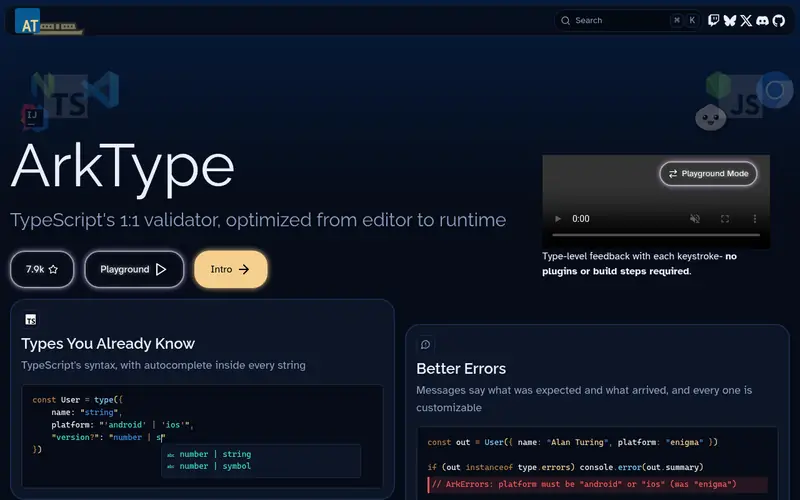
ArkType defines schemas using a syntax close to TypeScript type expressions, so a schema and its inferred type stay aligned. It handles unions, intersections, discriminated unions, tuples and constrained strings, and it reports parse errors with paths. It runs in Node.js and browsers and is free and open source under the MIT license.
The appeal is expressiveness: complex types can be written compactly, and inference covers cases that chain-based libraries handle awkwardly. The cost is a steeper learning curve and a smaller set of integrations than Zod. Teams with heavy type-level requirements may find it worth the switch; teams that want the most tutorials and community answers will likely stay with Zod.
Standout: Schemas look like TypeScript types
Free (open source), as listed by the vendor (ArkType website). Confirm the current plan price before you buy.
Free plan. Plans change, so confirm on the vendor's pricing page before you buy.
Benefits
- Schemas look like TypeScript types
- strong inference for complex types
Drawbacks
- Smaller community
- syntax can be harder to read for newcomers
Skip it if this limit matters to you: smaller community.
Verdict. A sensible pick for typeScript-native syntax with fast parsing.
TypeBox
Best for jSON Schema-first validation with TypeScript types
What it is and where it fits
TypeBox builds JSON Schema objects from TypeScript type definitions and provides a type compiler for fast validation. Because the output is standard JSON Schema, the same schema can feed OpenAPI documents, AJV or other JSON Schema consumers. It runs in Node.js and browsers and is free and open source under the MIT license.
This makes TypeBox a good bridge when schemas must be shared with non-TypeScript services or published as API contracts. The tradeoff is that the API is closer to JSON Schema than to a fluent builder, and error messages need formatting before they are useful in a UI. Teams that only need form validation in a TypeScript app may find Zod simpler.
Standout: Produces standard JSON Schema
Free (open source), as listed by the vendor (TypeBox website). Confirm the current plan price before you buy.
Free plan. Plans change, so confirm on the vendor's pricing page before you buy.
Benefits
- Produces standard JSON Schema
- types and schemas stay in sync
Drawbacks
- API is lower level
- error output needs extra work to format
Skip it if this limit matters to you: API is lower level.
Verdict. A sensible pick for JSON Schema-first validation with TypeScript types.
Effect Schema
Best for projects already using the Effect ecosystem
What it is and where it fits
Effect Schema is part of the Effect library and focuses on transforming data in both directions. A schema can decode unknown input into a typed value and encode a typed value back into a serialized form, which suits API boundaries and persistence. It supports refinements, filters and branded types. It is free and open source under the MIT license.
The library is a strong fit if your codebase already uses Effect for error handling, dependency injection or concurrency. Used on its own, it brings more concepts than a standalone validator, and the documentation assumes some Effect familiarity. Teams not using Effect should compare Zod or Valibot first, since those are smaller commitments.
Standout: Bidirectional encode and decode
Free (open source), as listed by the vendor (Effect Schema website). Confirm the current plan price before you buy.
Free plan. Plans change, so confirm on the vendor's pricing page before you buy.
Benefits
- Bidirectional encode and decode
- integrates with Effect services
Drawbacks
- Tied to the Effect ecosystem
- heavier learning curve
Skip it if this limit matters to you: tied to the Effect ecosystem.
Verdict. A sensible pick for projects already using the Effect ecosystem.
AJV
Best for validating against existing JSON Schema documents
What it is and where it fits
AJV validates data against JSON Schema documents and compiles each schema into a validation function. It supports several JSON Schema drafts and common formats, and it is widely used in API gateways, config validation and test tooling. It runs in Node.js and browsers and is free and open source under the MIT license.
AJV is the right choice when JSON Schema already exists, for example from an OpenAPI spec or a shared contract repository. It is not a schema builder in the TypeScript-first sense, so deriving types from schemas takes extra tooling such as json-schema-to-typescript. If you are starting from TypeScript types, TypeBox or Zod will feel more direct.
Standout: Compiles schemas to fast validation functions
Free (open source), as listed by the vendor (AJV website). Confirm the current plan price before you buy.
Free plan. Plans change, so confirm on the vendor's pricing page before you buy.
Benefits
- Compiles schemas to fast validation functions
- broad JSON Schema draft support
Drawbacks
- Not a TypeScript-first builder
- types need separate handling
Skip it if this limit matters to you: not a TypeScript-first builder.
Verdict. A sensible pick for validating against existing JSON Schema documents.
Who should use what
If you want one library for forms, APIs and config with the widest ecosystem, use Zod. If client bundle size is the priority, use Valibot. If your schemas must be published as JSON Schema or shared with non-TypeScript services, use TypeBox or AJV. If you are validating complex rules in a Node-only backend and already know the API, Joi or Yup can work. If your project already runs on Effect, use Effect Schema rather than adding a second validation model.
Questions to settle before you buy
What to check before you buy
- Confirm the library infers TypeScript types from schemas, or plan to maintain types by hand.
- Check bundle size impact if validation runs in the browser.
- Verify JSON Schema export if schemas are shared with other services or OpenAPI docs.
- Review error message formatting and localization support for your UI.
- Check the licence and release activity in the project repository.
FAQ
Do I need a schema validation library if I use TypeScript?
Yes, for untrusted input. TypeScript types are erased at runtime, so data from APIs, forms, files and environment variables is not checked by the compiler. A schema library validates that data at runtime and can infer the matching type, which keeps the check and the type in sync.
Which library is fastest?
Speed depends on schema shape and workload, and published comparisons vary. AJV compiles schemas to validation functions, which suits high-volume request validation. Zod, Valibot and ArkType are generally fast enough for forms and typical API payloads. Measure with your own schemas before choosing on performance alone.
Can I use these libraries in the browser?
Zod, Valibot, Yup, ArkType, TypeBox, superstruct and AJV run in browsers as well as Node.js. Joi is server-oriented and heavy for browser bundles. Effect Schema runs in both but assumes the Effect ecosystem. Check bundle size before shipping any validator to the client.
Do these libraries replace a linter?
No. Linters such as ESLint check code style and likely bugs at build time. Schema libraries validate data values at runtime. Most projects use both: a linter for code and a schema library for input from outside the program.
Are these libraries free?
Yes. All libraries in this guide are open source and free to use under their respective licences, which include MIT and BSD-3-Clause. There are no paid tiers for the libraries themselves. Hosted services built on top of them may charge, but that is separate from the library.
Sources we checked
Method: how we score · editorial policy.
Change log. First published 27 Nov 2026.