Stage 02 · Test · Researched comparison
Best Swift Networking Libraries in 2026
Alamofire is the first pick for most iOS and macOS apps that want a mature, widely used layer over URLSession. Moya suits teams that want requests modeled as typed endpoints. Get fits small projects that want a lightweight request builder. Apple's built-in URLSession remains the right choice when you want no third-party dependency at all.

By Shihab Mia
Published 27 Nov 2026 · 7 tools compared
We run no ads and no affiliate links at launch. The order of a list follows our published method. See how we score.
Prices are the starting prices vendors list publicly. Plans change, so confirm the current price on the vendor page before you buy.
Key takeaways
- Alamofire, Moya, Get, Apollo iOS, swift-openapi-generator and AsyncHTTPClient are open source and free to use.
- URLSession ships with Apple platforms and needs no dependency, but you write more request code yourself.
- Apollo iOS is specific to GraphQL APIs, and AsyncHTTPClient targets server-side Swift rather than app UI code.
- Check each project's repository for the latest Swift and platform version support before adopting it.
Who each pick is for
- App developers who want a mature HTTP layer over URLSessionAlamofire
- Teams that want typed, enumerated API endpointsMoya
- Developers who want a small, modern async request clientGet
- Apps that consume GraphQL APIs and want generated typesApollo iOS
- Teams with an OpenAPI spec that want generated client codeswift-openapi-generator
- Server-side Swift services that need an HTTP clientAsyncHTTPClient
- Apps that want no third-party networking dependencyURLSession
Comparison
| Tool | Best for | Standout feature | Listed starting price | Free plan or trial |
|---|---|---|---|---|
| 1Alamofire | App developers who want a mature HTTP layer over URLSession | Broad feature set for requests, response handling and validation | Free (open source) | Free plan |
| 2Moya | Teams that want typed, enumerated API endpoints | Compile-time endpoint definitions reduce string-based request code | Free (open source) | Free plan |
| 3Get | Developers who want a small, modern async request client | Small API surface with async/await support | Free (open source) | Free plan |
| 4Apollo iOS | Apps that consume GraphQL APIs and want generated types | Generates Swift types from GraphQL schema and operations | Free (open source) | Free plan |
| 5swift-openapi-generator | Teams with an OpenAPI spec that want generated client code | Generates Swift client code from a standard OpenAPI document | Free (open source) | Free plan |
| 6AsyncHTTPClient | Server-side Swift services that need an HTTP client | Built for Swift concurrency on the server | Free (open source) | Free plan |
| 7URLSession | Apps that want no third-party networking dependency | Ships with Apple platforms and needs no dependency | Free | Free plan |
How we picked
We picked libraries that are actively maintained, have public repositories or official documentation, and genuinely serve Swift networking work on Apple platforms or server-side Swift. We looked at platform support, licence, the main features each provides, and the limits that affect adoption, such as GraphQL-only scope or a required build step. Sources are vendor pages, official documentation and project repositories. Prices and free tiers can change, so confirm details on the vendor or project site before you commit.
The tools, one by one
Alamofire
Best for app developers who want a mature HTTP layer over URLSession
What it is and where it fits
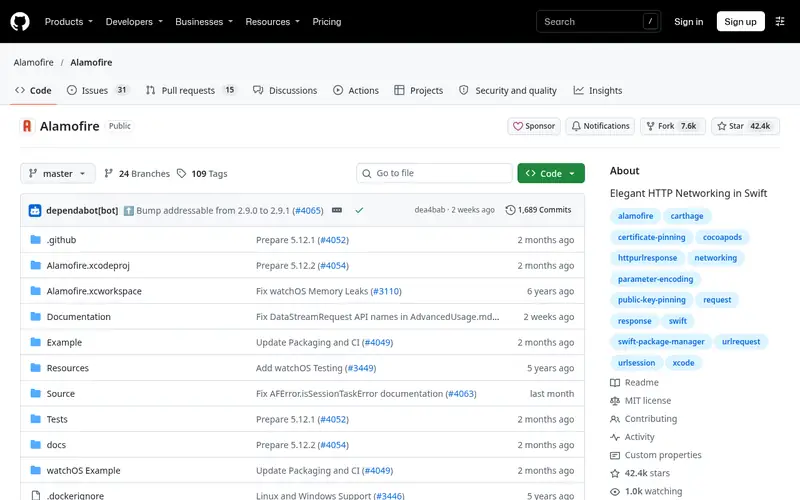
Alamofire is an HTTP networking library for Swift that wraps URLSession with chainable request building, response serialization, request retry, authentication helpers and network reachability monitoring. It runs on Apple platforms including iOS, macOS, tvOS and watchOS, and also supports server-side Swift.
The project is open source under the MIT license, so there is no paid tier. Version 5 is the current major line, and the repository documents the minimum Swift and OS versions it supports. Teams that already have a small, custom URLSession layer may not gain much by adding it, but apps with many endpoints and shared request logic often find the retry and validation features useful.
Standout: Broad feature set for requests, response handling and validation
Free (open source), as listed by the vendor (Alamofire website). Confirm the current plan price before you buy.
Free plan. Plans change, so confirm on the vendor's pricing page before you buy.
Benefits
- Broad feature set for requests, response handling and validation
- large user base and long release history
Drawbacks
- Adds a dependency over plain URLSession
- some features overlap with what URLSession now provides
Skip it if this limit matters to you: adds a dependency over plain URLSession.
Verdict. A sensible pick for app developers who want a mature HTTP layer over URLSession.
Alternatives in this guide: Moya, Get, Apollo iOS
Moya
Best for teams that want typed, enumerated API endpoints
What it is and where it fits
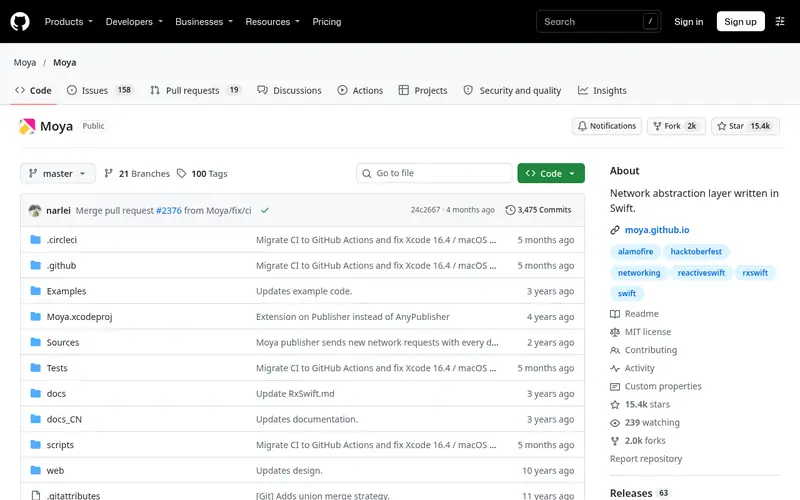
Moya is a networking abstraction built around the idea of defining each API endpoint as an enum case. You describe targets, methods, paths and parameters in one place, and Moya builds the requests. It can use Alamofire or a URLSession-based provider underneath.
It is open source under the MIT license and targets Apple platforms. The main trade-off is structure versus simplicity: large apps with many endpoints benefit from central definitions, while a small app may find the enum-per-endpoint pattern heavier than needed. Moya also offers test support by letting you stub providers, which helps when you want deterministic network tests.
Standout: Compile-time endpoint definitions reduce string-based request code
Free (open source), as listed by the vendor (Moya website). Confirm the current plan price before you buy.
Free plan. Plans change, so confirm on the vendor's pricing page before you buy.
Benefits
- Compile-time endpoint definitions reduce string-based request code
- works on top of Alamofire or URLSession
Drawbacks
- More setup and boilerplate for small apps
- abstraction can hide underlying request details
Skip it if this limit matters to you: more setup and boilerplate for small apps.
Verdict. A sensible pick for teams that want typed, enumerated API endpoints.
Alternatives in this guide: Alamofire, Get, Apollo iOS
Get
Best for developers who want a small, modern async request client
What it is and where it fits
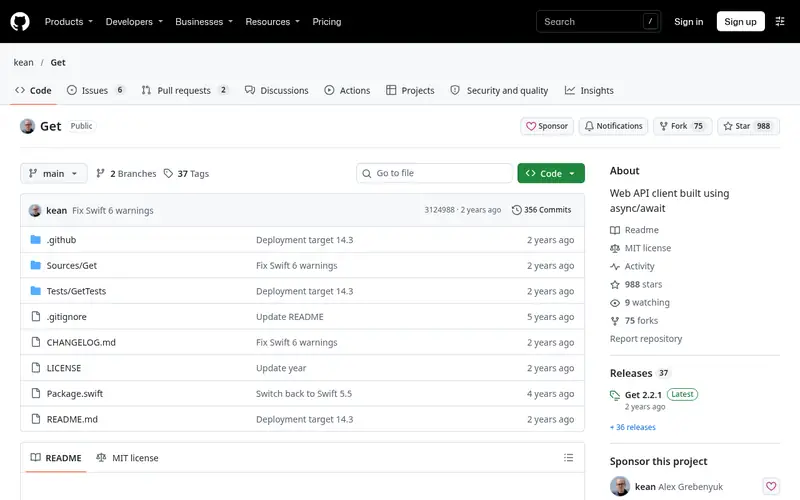
Get is a lightweight HTTP client from the developer behind the Nuke image library. It provides a concise API for building requests, sending them with async/await, and decoding responses, and it sits directly on URLSession.
The project is open source under the MIT license and targets Apple platforms. It suits developers who want a thin layer rather than a full framework, and who are comfortable reading the source when they need behavior details. If you depend on features like request retry policies, multipart uploads or reachability out of the box, Alamofire or Moya will cover more ground.
Standout: Small API surface with async/await support
Free (open source), as listed by the vendor (Get website). Confirm the current plan price before you buy.
Free plan. Plans change, so confirm on the vendor's pricing page before you buy.
Benefits
- Small API surface with async/await support
- built on URLSession with little extra abstraction
Drawbacks
- Fewer built-in features than Alamofire
- smaller community and fewer tutorials
Skip it if this limit matters to you: fewer built-in features than Alamofire.
Verdict. A sensible pick for developers who want a small, modern async request client.
Alternatives in this guide: Alamofire, Moya, Apollo iOS
Apollo iOS
Best for apps that consume GraphQL APIs and want generated types
What it is and where it fits
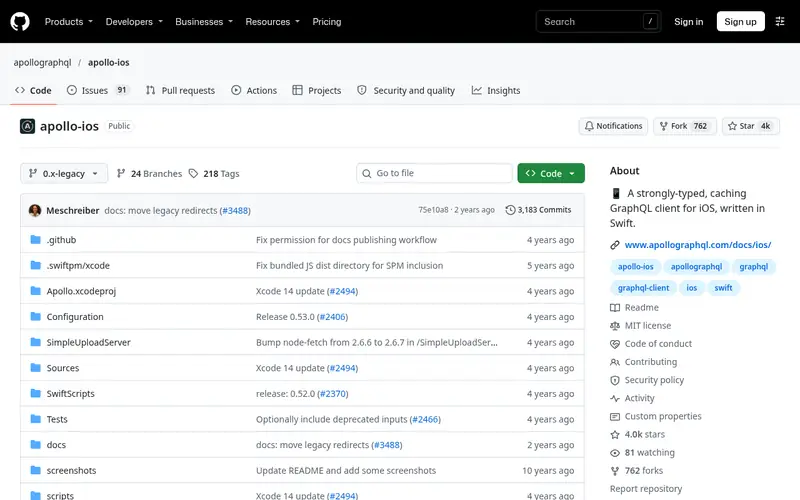
Apollo iOS is a GraphQL client for Swift. It reads your schema and operations, generates type-safe Swift code, and handles queries, mutations and subscriptions over HTTP and WebSocket transports. It also includes a normalized cache for storing and updating fetched data.
The client is open source under the MIT license and targets Apple platforms. It is the wrong tool for REST APIs, and projects that use a different GraphQL client or hand-written queries may not need it. The code generation step is worth planning for in your build setup, since it adds a tooling dependency to the project.
Standout: Generates Swift types from GraphQL schema and operations
Free (open source), as listed by the vendor (Apollo iOS website). Confirm the current plan price before you buy.
Free plan. Plans change, so confirm on the vendor's pricing page before you buy.
Benefits
- Generates Swift types from GraphQL schema and operations
- includes a normalized cache
Drawbacks
- Only useful for GraphQL backends
- code generation adds a build step
Skip it if this limit matters to you: only useful for GraphQL backends.
Verdict. A sensible pick for apps that consume GraphQL APIs and want generated types.
swift-openapi-generator
Best for teams with an OpenAPI spec that want generated client code
What it is and where it fits
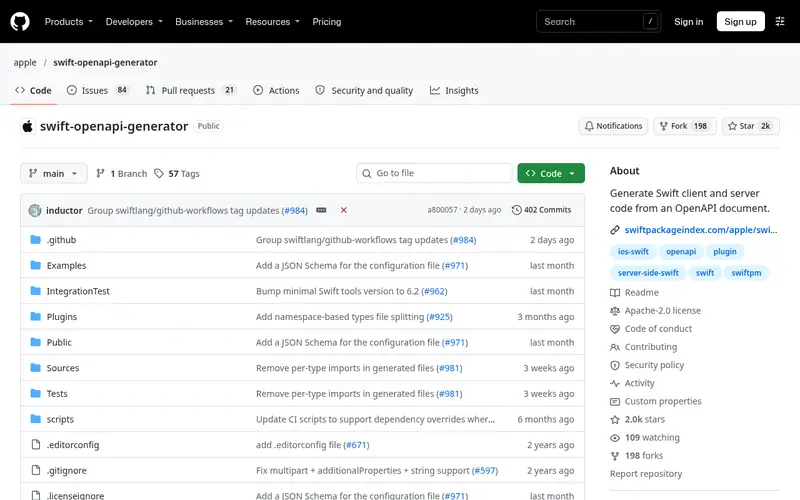
swift-openapi-generator is a command-line tool and Swift package plugin that turns an OpenAPI document into Swift types and client code. It is part of Apple's swift-openapi family, and the generated client works with a transport layer; URLSession support is available through a companion package.
The project is open source under the Apache 2.0 license and works across Apple platforms and server-side Swift. It fits teams that already maintain an OpenAPI spec and want generated, type-safe clients instead of hand-written request code. If your API has no spec, writing one first is a prerequisite, which is real work before you get any benefit.
Standout: Generates Swift client code from a standard OpenAPI document
Free (open source), as listed by the vendor (swift-openapi-generator website). Confirm the current plan price before you buy.
Free plan. Plans change, so confirm on the vendor's pricing page before you buy.
Benefits
- Generates Swift client code from a standard OpenAPI document
- maintained by Apple
Drawbacks
- Requires an OpenAPI spec and a build plugin
- generated code needs a transport such as URLSession
Skip it if this limit matters to you: requires an OpenAPI spec and a build plugin.
Verdict. A sensible pick for teams with an OpenAPI spec that want generated client code.
AsyncHTTPClient
Best for server-side Swift services that need an HTTP client
What it is and where it fits
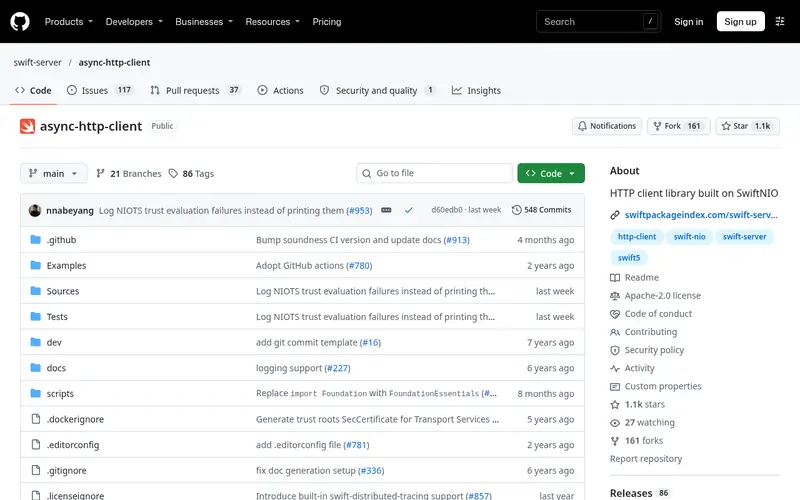
AsyncHTTPClient is an HTTP client for server-side Swift, built on SwiftNIO and async/await. It is maintained under the swift-server organization and is used by server frameworks and services that need to make outbound HTTP calls.
It is open source under the Apache 2.0 license and runs on Linux and macOS, which makes it a fit for backend services written in Swift. It is not the right choice for an iOS app's networking layer, where URLSession, Alamofire or Get are more appropriate. If you write Swift on the server and need connection pooling and streaming, this is the project to evaluate.
Standout: Built for Swift concurrency on the server
Free (open source), as listed by the vendor (AsyncHTTPClient website). Confirm the current plan price before you buy.
Free plan. Plans change, so confirm on the vendor's pricing page before you buy.
Benefits
- Built for Swift concurrency on the server
- maintained by the Swift Server Workgroup
Drawbacks
- Not aimed at app UI code
- API differs from URLSession-based libraries
Skip it if this limit matters to you: not aimed at app UI code.
Verdict. A sensible pick for server-side Swift services that need an HTTP client.
URLSession
Best for apps that want no third-party networking dependency
What it is and where it fits
URLSession is Apple's built-in networking API in the Foundation framework. It handles data tasks, uploads, downloads, background transfers and WebSocket tasks, and it works with async/await. Because it is part of the platform, there is no package to add and no license to review.
For small apps or teams that prefer minimal dependencies, URLSession plus Codable is often enough. The cost is boilerplate: you build requests, check status codes and decode responses yourself, and you design your own retry and auth handling. Many third-party libraries in this list are built on top of it, so understanding URLSession helps regardless of which one you pick.
Standout: Ships with Apple platforms and needs no dependency
Free, as listed by the vendor (URLSession website). Confirm the current plan price before you buy.
Free plan. Plans change, so confirm on the vendor's pricing page before you buy.
Benefits
- Ships with Apple platforms and needs no dependency
- supports async/await, uploads, downloads and background transfers
Drawbacks
- You write more request and decoding code yourself
- fewer convenience helpers than third-party libraries
Skip it if this limit matters to you: you write more request and decoding code yourself.
Verdict. A sensible pick for apps that want no third-party networking dependency.
Who should use what
If you are building a typical iOS app with many REST endpoints and want retry, validation and response helpers, start with Alamofire. If your team prefers typed endpoint definitions and centralized request configuration, Moya is a better fit. For a small app or a thin async layer, Get keeps the surface area low. If your backend is GraphQL, Apollo iOS gives you generated types and a cache. Teams with an OpenAPI spec should look at swift-openapi-generator, and server-side Swift services should evaluate AsyncHTTPClient. If you want no dependencies at all, use URLSession directly.
Questions to settle before you buy
What to check before you buy
- Confirm the library supports your minimum iOS, macOS or Linux version and current Swift release.
- Check the licence and whether it fits your distribution model, including App Store apps.
- Review how the library handles retries, authentication and error mapping for your API.
- For GraphQL or OpenAPI tools, confirm the code generation step fits your build and CI setup.
- Read the repository's open issues and release cadence to judge maintenance activity.
FAQ
Do I need a third-party library for networking in Swift?
No. URLSession is built into Apple platforms and covers most HTTP needs. Third-party libraries add convenience such as request chaining, retry policies, typed endpoints or generated code. Choose one when it removes repeated work in your codebase, not just because it is popular.
Is Alamofire still worth using in 2026?
Alamofire remains actively maintained and widely used. URLSession has gained async/await and other features, so some apps need less from a wrapper than before. Alamofire still offers request retry, response validation and reachability helpers in one package, which many teams find useful.
Which library should I use for a GraphQL API?
Apollo iOS is the main Swift client for GraphQL. It generates types from your schema and operations and includes a normalized cache. If you do not use GraphQL, it does not apply. For REST APIs, Alamofire, Moya, Get or URLSession are the relevant options.
Can I use these libraries on the server?
AsyncHTTPClient is designed for server-side Swift and runs on Linux and macOS. Alamofire and the other app-focused libraries target Apple platforms. Check each project's documentation for the exact platforms and Swift versions it supports before relying on it in a backend service.
Are these libraries free?
All the libraries listed here are open source and free to use under their respective licences, and URLSession is part of Apple's platforms. There are no paid tiers for the libraries themselves. Review each licence, such as MIT or Apache 2.0, to confirm it meets your project's requirements.
Sources we checked
Method: how we score · editorial policy.
Change log. First published 27 Nov 2026.