Stage 02 · Test · Researched comparison
Best Schema Registries for Event Streams in 2026
Confluent Schema Registry is the default pick for teams already running Apache Kafka and wanting a managed or self-hosted registry with strong compatibility rules. Apicurio Registry suits teams that need an open-source registry with multiple storage and serialization options. AWS Glue Schema Registry fits shops already on AWS that want schema validation tied to Glue and MSK. All three enforce schema compatibility so producers and consumers do not break each other.

By Shihab Mia
Published 27 Nov 2026 · 7 tools compared
We run no ads and no affiliate links at launch. The order of a list follows our published method. See how we score.
Prices are the starting prices vendors list publicly. Plans change, so confirm the current price on the vendor page before you buy.
Key takeaways
- Confluent Schema Registry supports Avro, Protobuf and JSON Schema with configurable compatibility levels, and is available as a managed cloud service or self-hosted.
- Apicurio Registry is open source under Apache 2.0 and stores schemas in Kafka, a database or in memory.
- AWS Glue Schema Registry and Azure Schema Registry are tied to their cloud platforms; Karapace and Redpanda offer Kafka-native alternatives.
- Buf Schema Registry focuses on Protobuf and gRPC rather than Kafka message serialization.
Who each pick is for
- Kafka teams wanting a mature managed or self-hosted registryConfluent Schema Registry
- Teams wanting an open-source registry with flexible storageApicurio Registry
- AWS shops using MSK, Kinesis or GlueAWS Glue Schema Registry
- Teams using Azure Event Hubs for streamingAzure Schema Registry
- Teams wanting a Kafka-native registry outside ConfluentKarapace
- Protobuf and gRPC teams managing API contractsBuf Schema Registry
- Redpanda users wanting a built-in compatible registryRedpanda Schema Registry
Comparison
| Tool | Best for | Standout feature | Listed starting price | Free plan or trial |
|---|---|---|---|---|
| 1Confluent Schema Registry | Kafka teams wanting a mature managed or self-hosted registry | Supports Avro, Protobuf and JSON Schema | See vendor pricing page | Free trial (30 days) |
| 2Apicurio Registry | Teams wanting an open-source registry with flexible storage | Apache 2.0 license | Free (open source) | Free plan |
| 3AWS Glue Schema Registry | AWS shops using MSK, Kinesis or Glue | Native integration with AWS streaming services | See vendor pricing page | No free plan |
| 4Azure Schema Registry | Teams using Azure Event Hubs for streaming | Built into Azure Event Hubs | See vendor pricing page | No free plan |
| 5Karapace | Teams wanting a Kafka-native registry outside Confluent | Open-source schema registry and REST proxy | Free (open source) | Free plan |
| 6Buf Schema Registry | Protobuf and gRPC teams managing API contracts | Strong Protobuf tooling and breaking-change detection | See vendor pricing page | Free plan |
| 7Redpanda Schema Registry | Redpanda users wanting a built-in compatible registry | Built into the Redpanda platform | See vendor pricing page | Free trial (30 days) |
How we picked
We selected registries that store versioned schemas and enforce compatibility for event-driven systems, then compared them on fit for Kafka and messaging use, supported schema formats, deployment model (managed, self-hosted or platform-bundled), license and pricing structure, and the main operational limits. Sources are vendor documentation, project repositories and public pricing pages. We did not run benchmarks. Prices and plan limits change, so confirm them on the vendor site before you commit.
The tools, one by one
Confluent Schema Registry
Best for kafka teams wanting a mature managed or self-hosted registry

What it is and where it fits
Confluent Schema Registry is the reference implementation for Kafka schema management. It stores versioned schemas by subject and enforces compatibility rules (backward, forward, full, and transitive variants) so a new schema version cannot break existing producers or consumers. Serializers for Avro, Protobuf and JSON Schema are included in the Confluent client libraries.
You can run it self-hosted as part of Confluent Platform under the Confluent Community License, or use the managed version in Confluent Cloud. The managed service removes the need to operate the registry and storage layer yourself. The self-hosted path gives more control but you own upgrades, storage and availability.
Skip it if you are not on Kafka, or if you want a fully permissive open-source license for a commercial product. Check the current license terms and cloud pricing on the vendor site, since both change.
Standout: Supports Avro, Protobuf and JSON Schema
See vendor pricing page, as listed by the vendor (Confluent Schema Registry website). Confirm the current plan price before you buy.
Free trial (30 days). Plans change, so confirm on the vendor's pricing page before you buy.
Benefits
- Supports Avro, Protobuf and JSON Schema
- configurable compatibility levels per subject
Drawbacks
- Managed service is tied to Confluent Cloud
- self-hosting adds operational work
Skip it if this limit matters to you: managed service is tied to Confluent Cloud.
Verdict. A sensible pick for kafka teams wanting a mature managed or self-hosted registry.
Alternatives in this guide: Apicurio Registry, AWS Glue Schema Registry, Azure Schema Registry
Apicurio Registry
Best for teams wanting an open-source registry with flexible storage
What it is and where it fits
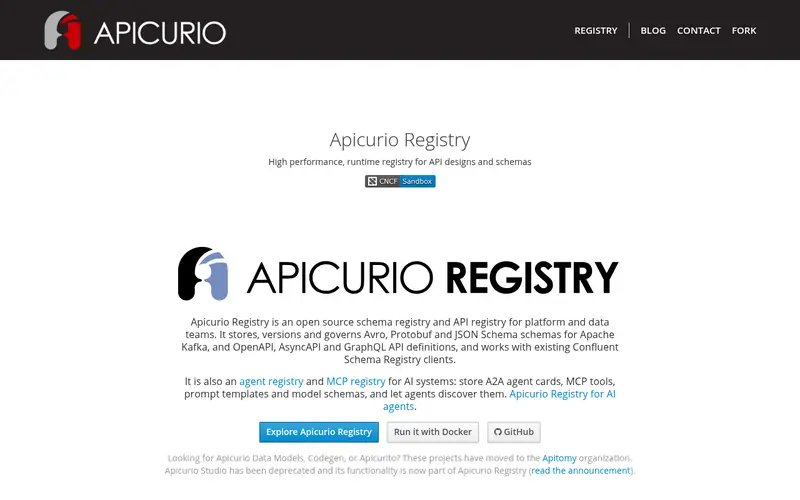
Apicurio Registry is an open-source schema and API registry. It stores Avro, Protobuf and JSON Schema artifacts for event streams, and also handles OpenAPI and AsyncAPI documents. Compatibility checking follows configurable rules per artifact, similar in spirit to Confluent's model.
Storage is pluggable: you can back it with Kafka, a SQL database or in-memory storage for testing. It ships as a Quarkus-based application with container images, so it runs on Kubernetes or a plain JVM. Serializer and deserializer libraries exist for Kafka clients.
Because it is open source, you run and scale it yourself. That means owning the database, backups and upgrades. It is a good fit when license terms matter or when you want one registry for both message schemas and API specs. Confirm current release status and supported storage options in the project docs.
Standout: Apache 2.0 license
Free (open source), as listed by the vendor (Apicurio Registry website). Confirm the current plan price before you buy.
Free plan. Plans change, so confirm on the vendor's pricing page before you buy.
Benefits
- Apache 2.0 license
- supports Avro, Protobuf, JSON Schema, OpenAPI and AsyncAPI
Drawbacks
- Fewer managed hosting options
- you operate the storage backend
Skip it if this limit matters to you: fewer managed hosting options.
Verdict. A sensible pick for teams wanting an open-source registry with flexible storage.
Alternatives in this guide: Confluent Schema Registry, AWS Glue Schema Registry, Azure Schema Registry
AWS Glue Schema Registry
Best for aWS shops using MSK, Kinesis or Glue
What it is and where it fits
AWS Glue Schema Registry stores and versions schemas for Avro and JSON Schema (and Protobuf in newer integrations) and validates them against compatibility rules. It integrates with Amazon MSK, Kinesis Data Streams, Apache Flink on AWS and AWS Glue jobs, so serializers can look up schemas without extra infrastructure.
Access is controlled through IAM, and the registry is a regional AWS resource. That fits teams already standardizing on AWS identity and networking. Billing follows the Glue pricing model, so check the vendor page for current rates rather than assuming a fixed number.
Skip it if you run Kafka outside AWS or need a registry that works across clouds. The integration value comes from being inside the AWS ecosystem; outside it, the tradeoffs favor a portable option like Apicurio or Confluent.
Standout: Native integration with AWS streaming services
See vendor pricing page, as listed by the vendor (AWS Glue Schema Registry website). Confirm the current plan price before you buy.
No free plan. Plans change, so confirm on the vendor's pricing page before you buy.
Benefits
- Native integration with AWS streaming services
- built-in compatibility checks
Drawbacks
- AWS-only
- tied to Glue and IAM
Skip it if this limit matters to you: AWS-only.
Verdict. A sensible pick for AWS shops using MSK, Kinesis or Glue.
Alternatives in this guide: Confluent Schema Registry, Apicurio Registry, Azure Schema Registry
Azure Schema Registry
Best for teams using Azure Event Hubs for streaming

What it is and where it fits
Azure Schema Registry is a feature of Azure Event Hubs. It stores schemas by group and name, supports Avro and JSON Schema, and validates compatibility so consumers can rely on stable contracts. Because it lives inside Event Hubs, you do not run separate registry infrastructure.
It works with the Event Hubs Kafka endpoint and with AMQP-based SDKs, so producers and consumers can fetch schemas at runtime. Access uses Azure role-based access control. Billing is part of Event Hubs; confirm current pricing on the vendor page.
The main limit is scope: it is designed for Event Hubs, not as a general registry for arbitrary Kafka clusters. If your streaming runs on Azure Event Hubs, it removes a moving part. If you are multi-cloud or self-hosted Kafka, a standalone registry is a better fit.
Standout: Built into Azure Event Hubs
See vendor pricing page, as listed by the vendor (Azure Schema Registry website). Confirm the current plan price before you buy.
No free plan. Plans change, so confirm on the vendor's pricing page before you buy.
Benefits
- Built into Azure Event Hubs
- works with Kafka and AMQP clients
Drawbacks
- Azure-only
- feature set narrower than standalone registries
Skip it if this limit matters to you: azure-only.
Verdict. A sensible pick for teams using Azure Event Hubs for streaming.
Alternatives in this guide: Confluent Schema Registry, Apicurio Registry, AWS Glue Schema Registry
Karapace
Best for teams wanting a Kafka-native registry outside Confluent
What it is and where it fits
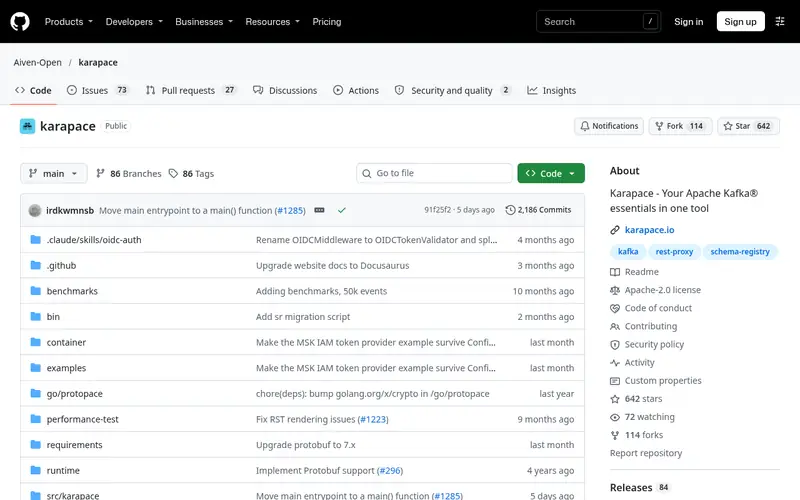
Karapace is an open-source schema registry and Kafka REST proxy maintained under the Aiven Open organization. It aims for compatibility with the Confluent Schema Registry API, so existing serializers and tooling can point at it with minimal changes. It supports Avro and JSON Schema.
Because it speaks the same API, teams migrating off a Confluent deployment can often swap the endpoint. It is written in Python and runs as a service alongside your Kafka cluster. You own deployment, storage and upgrades.
The tradeoff is ecosystem size: fewer integrations and less third-party documentation than the Confluent registry. For teams that want an open-source registry with a familiar API and are comfortable operating it, Karapace is a practical choice. Check the repository for current feature coverage before relying on a specific compatibility mode.
Standout: Open-source schema registry and REST proxy
Free (open source), as listed by the vendor (Karapace website). Confirm the current plan price before you buy.
Free plan. Plans change, so confirm on the vendor's pricing page before you buy.
Benefits
- Open-source schema registry and REST proxy
- Kafka-compatible API
Drawbacks
- Smaller community than Confluent
- you operate it yourself
Skip it if this limit matters to you: smaller community than Confluent.
Verdict. A sensible pick for teams wanting a Kafka-native registry outside Confluent.
Alternatives in this guide: Confluent Schema Registry, Apicurio Registry, AWS Glue Schema Registry
Buf Schema Registry
Best for protobuf and gRPC teams managing API contracts

What it is and where it fits
Buf Schema Registry (BSR) manages Protobuf schemas as versioned modules. It detects breaking changes against previous versions, hosts generated SDKs, and integrates with the Buf CLI and lint rules. For gRPC and Protobuf-centric systems it covers schema storage and compatibility checks well.
It is not a Kafka serializer registry in the Confluent sense. If your events are Protobuf messages defined in .proto files and consumed over gRPC or similar transports, BSR fits. If you need Avro subjects tied to Kafka topics, use a Kafka-oriented registry instead.
BSR has a hosted model with paid tiers for organizations; confirm current plan limits and pricing on the vendor page. It works well alongside a Kafka registry when a system uses both Protobuf APIs and Avro events.
Standout: Strong Protobuf tooling and breaking-change detection
See vendor pricing page, as listed by the vendor (Buf Schema Registry website). Confirm the current plan price before you buy.
Free plan. Plans change, so confirm on the vendor's pricing page before you buy.
Benefits
- Strong Protobuf tooling and breaking-change detection
- generated SDKs
Drawbacks
- Focused on Protobuf, not Kafka message serialization
- hosted model
Skip it if this limit matters to you: focused on Protobuf, not Kafka message serialization.
Verdict. A sensible pick for protobuf and gRPC teams managing API contracts.
Alternatives in this guide: Confluent Schema Registry, Apicurio Registry, AWS Glue Schema Registry
Redpanda Schema Registry
Best for redpanda users wanting a built-in compatible registry

What it is and where it fits
Redpanda includes a schema registry in its platform. It exposes an API compatible with the Confluent Schema Registry, so existing serializers and clients can connect. It supports Avro, Protobuf and JSON Schema with compatibility settings per subject.
Because it ships with Redpanda, you avoid running a separate registry service when your streaming platform is Redpanda. Configuration and access control follow the Redpanda platform model.
The limitation is portability: it is meant for Redpanda clusters, not as a general registry for Apache Kafka elsewhere. If you are evaluating Redpanda as your streaming platform, the bundled registry is a reason to consolidate. If you run mixed clusters, a standalone registry is simpler to reason about.
Standout: Built into the Redpanda platform
See vendor pricing page, as listed by the vendor (Redpanda Schema Registry website). Confirm the current plan price before you buy.
Free trial (30 days). Plans change, so confirm on the vendor's pricing page before you buy.
Benefits
- Built into the Redpanda platform
- Confluent-compatible API
Drawbacks
- Tied to Redpanda
- not a standalone product for other Kafka clusters
Skip it if this limit matters to you: tied to Redpanda.
Verdict. A sensible pick for redpanda users wanting a built-in compatible registry.
Alternatives in this guide: Confluent Schema Registry, Apicurio Registry, AWS Glue Schema Registry
Who should use what
If you run Apache Kafka and want a mature registry with managed or self-hosted options, start with Confluent Schema Registry. If license terms matter and you want one open-source registry for message schemas and API specs, look at Apicurio Registry. If your streaming is on AWS with MSK or Kinesis, AWS Glue Schema Registry removes extra infrastructure. If you are on Azure Event Hubs, the built-in Azure Schema Registry is the shortest path. Teams on Redpanda should use the bundled registry, and Protobuf/gRPC teams should evaluate Buf Schema Registry separately.
Questions to settle before you buy
What to check before you buy
- Confirm which schema formats you need (Avro, Protobuf, JSON Schema) and that the registry supports all of them.
- Check the compatibility modes available and whether they can be set per subject or globally.
- Verify the deployment model: managed service, self-hosted, or bundled with your streaming platform.
- Review the license terms if you plan to embed the registry in a commercial product.
- Confirm how serializers and clients authenticate, and whether that matches your identity setup.
FAQ
What does a schema registry actually do?
It stores versioned schemas and enforces compatibility rules so producers and consumers agree on message structure. When a producer registers a new schema version, the registry checks it against the configured compatibility level and rejects changes that would break existing consumers.
Do I need a schema registry if I use Avro?
Avro does not require a registry, but without one you must distribute schemas yourself and risk mismatches. A registry centralizes schema storage, versioning and compatibility checks, which is why most Kafka-based Avro deployments use one.
Can I use Apicurio Registry with Kafka clients?
Yes. Apicurio provides serializer and deserializer libraries for Kafka clients, and it can store schemas in Kafka or a database. Check the project documentation for the current client versions and compatibility modes it supports.
Is the Confluent Schema Registry free?
There is a self-hosted edition under the Confluent Community License and a managed service in Confluent Cloud. The managed service is paid, and the self-hosted edition has license terms that differ from Apache 2.0. Confirm current terms and pricing on the vendor site.
Can I run one registry across multiple clouds?
Standalone options like Apicurio Registry and Karapace can run wherever your Kafka cluster runs, which makes them portable across clouds. Cloud-native registries such as AWS Glue Schema Registry and Azure Schema Registry are tied to their platforms, so mixing them across clouds adds complexity.
Sources we checked
Method: how we score · editorial policy.
Change log. First published 27 Nov 2026.