Stage 02 · Test · Researched comparison
Best Rust HTTP Clients for Async and Blocking Code in 2026
reqwest is the first pick for most teams. It offers async and blocking APIs, HTTP/2, TLS choices and a large ecosystem, and it suits application code more than library code. For a smaller dependency tree in libraries, use ureq for blocking calls or hyper for low-level async control. All three are open source and free to use.

By Shihab Mia
Published 27 Nov 2026 · 6 tools compared
We run no ads and no affiliate links at launch. The order of a list follows our published method. See how we score.
Prices are the starting prices vendors list publicly. Plans change, so confirm the current price on the vendor page before you buy.
Key takeaways
- reqwest is the most common choice for application code, with async and blocking APIs in one crate.
- ureq is a blocking client with a small dependency footprint and no async runtime requirement.
- hyper gives you protocol-level control but leaves connection pooling and redirects to you.
- Every tool here is free and open source, so cost is not the deciding factor.
Who each pick is for
Comparison
| Tool | Best for | Standout feature | Listed starting price | Free plan or trial |
|---|---|---|---|---|
| 1reqwest | Application code that needs async and blocking HTTP | Async and blocking APIs in one crate | Free (open source) | Free plan |
| 2hyper | Low-level async HTTP where you control the connection | Protocol-level control over connections and requests | Free (open source) | Free plan |
| 3ureq | Blocking HTTP with a small dependency tree | Simple blocking API with no async runtime | Free (open source) | Free plan |
| 4isahc | Async and blocking HTTP backed by libcurl | Backed by libcurl for broad protocol and TLS support | Free (open source) | Free plan |
| 5awc | HTTP client inside Actix Web projects | Fits the Actix runtime and ecosystem | Free (open source) | Free plan |
| 6attohttpc | Small blocking client for simple requests | Minimal blocking API with a small footprint | Free (open source) | Free plan |
How we picked
We picked crates that are actively maintained, published on crates.io and documented, and that genuinely send HTTP requests. Criteria were fit for common jobs (async application code, blocking tools, library-friendly dependencies, low-level control), platform and runtime requirements, licence terms, TLS backend options and the main limits users hit. Sources are vendor and project pages, crate documentation and public repositories. Prices and licences can change, so confirm on the project page before you commit.
The tools, one by one
reqwest
Best for application code that needs async and blocking HTTP
What it is and where it fits
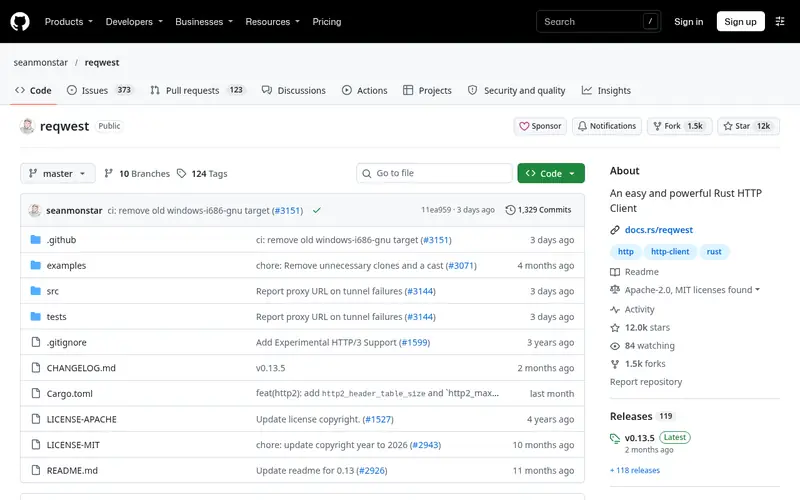
reqwest is an HTTP client built on hyper. It provides a high-level async API and an optional blocking API behind a feature flag. It supports HTTP/1.1 and HTTP/2, gzip and brotli decompression, cookie handling, redirects, proxies and multipart form data. TLS can be provided by rustls or by the platform's native TLS stack, selected through feature flags.
It runs anywhere Rust runs, including Linux, macOS, Windows and WebAssembly targets with limits. The crate is dual-licensed under MIT and Apache-2.0. Because it depends on tokio for async use, it is a heavier choice for small libraries that want to avoid forcing a runtime on downstream users. Skip it if you need a minimal dependency graph or full control over the connection state machine.
Standout: Async and blocking APIs in one crate
Free (open source), as listed by the vendor (reqwest website). Confirm the current plan price before you buy.
Free plan. Plans change, so confirm on the vendor's pricing page before you buy.
Benefits
- Async and blocking APIs in one crate
- HTTP/2, cookies, redirects and proxy support built in
Drawbacks
- Large dependency tree
- pulls in an async runtime for async use
Skip it if this limit matters to you: large dependency tree.
Verdict. A sensible pick for application code that needs async and blocking HTTP.
hyper
Best for low-level async HTTP where you control the connection
What it is and where it fits
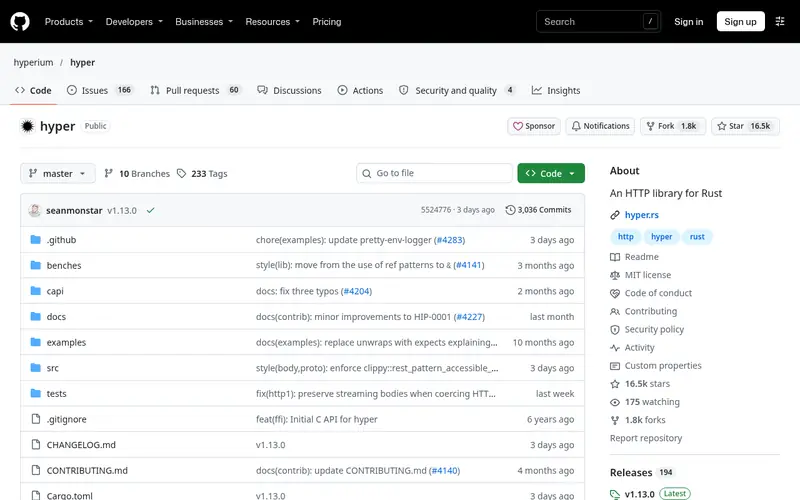
hyper is a low-level HTTP library that implements HTTP/1.1 and HTTP/2 on top of tokio. It gives you direct control over connections, request and response bodies, and protocol settings. Higher-level clients such as reqwest are built on it, which makes it a stable base for custom networking code.
It is a good fit when you need streaming bodies, custom connection pooling, or protocol details that a high-level client hides. It does not handle redirects, cookies, proxy configuration or serialization for you, so expect to write that logic yourself. It is dual-licensed under MIT and Apache-2.0. Skip it if you want a client you can call in a few lines; use reqwest or ureq instead.
Standout: Protocol-level control over connections and requests
Free (open source), as listed by the vendor (hyper website). Confirm the current plan price before you buy.
Free plan. Plans change, so confirm on the vendor's pricing page before you buy.
Benefits
- Protocol-level control over connections and requests
- Foundation for many higher-level clients
Drawbacks
- No built-in redirects, cookies or JSON helpers
- More code to write for common tasks
Skip it if this limit matters to you: no built-in redirects, cookies or JSON helpers.
Verdict. A sensible pick for low-level async HTTP where you control the connection.
ureq
Best for blocking HTTP with a small dependency tree
What it is and where it fits
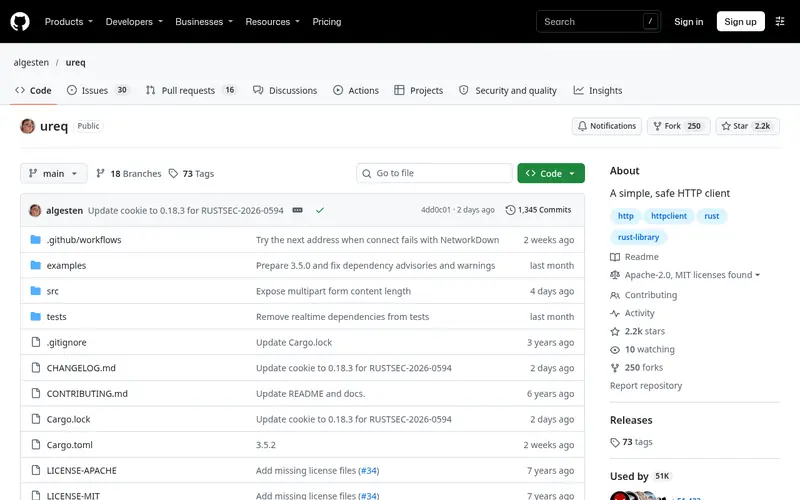
ureq is a synchronous HTTP client. It sends requests on the calling thread and returns a response without an async runtime. That makes it easy to use in command-line tools, build scripts and small services where async adds complexity without benefit. It supports TLS through rustls or native TLS, depending on features.
The API is small: build an agent, send a request, read the response. It handles redirects and basic authentication and offers timeouts. It is dual-licensed under MIT and Apache-2.0. The main limit is concurrency: blocking calls tie up a thread each, so it is a poor fit for servers handling many simultaneous requests. Use it when simplicity and a small build matter more than throughput.
Standout: Simple blocking API with no async runtime
Free (open source), as listed by the vendor (ureq website). Confirm the current plan price before you buy.
Free plan. Plans change, so confirm on the vendor's pricing page before you buy.
Benefits
- Simple blocking API with no async runtime
- Small dependency footprint
Drawbacks
- Blocking only, so not suited to high-concurrency async services
- Fewer features than reqwest
Skip it if this limit matters to you: blocking only, so not suited to high-concurrency async services.
Verdict. A sensible pick for blocking HTTP with a small dependency tree.
isahc
Best for async and blocking HTTP backed by libcurl
What it is and where it fits
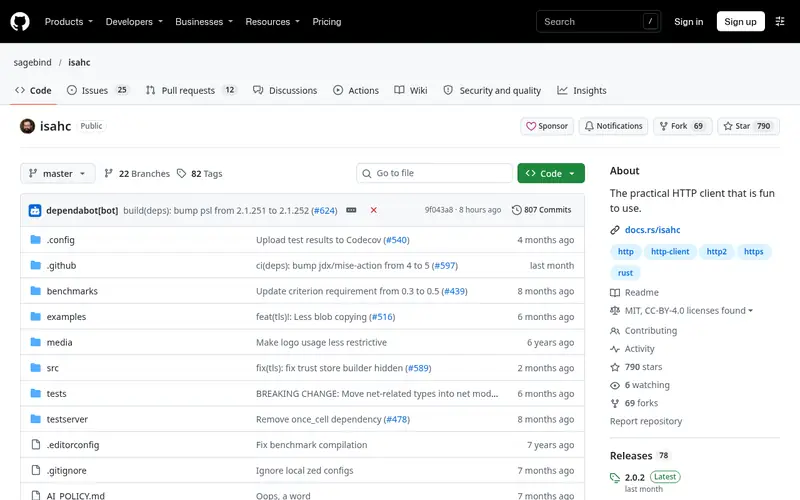
isahc wraps libcurl and exposes both async and blocking APIs. Because libcurl does the network work, you get its mature handling of TLS backends, proxies, HTTP/2 and protocol edge cases. The crate presents a Rust-idiomatic request and response API on top.
It suits projects that already depend on libcurl or need behavior that matches curl closely. The tradeoff is a native dependency: you need libcurl available at build time, which complicates cross-compilation and static builds compared with pure-Rust TLS stacks. It is licensed under MIT. Skip it if you want a pure-Rust dependency tree or if your build environment cannot provide libcurl.
Standout: Backed by libcurl for broad protocol and TLS support
Free (open source), as listed by the vendor (isahc website). Confirm the current plan price before you buy.
Free plan. Plans change, so confirm on the vendor's pricing page before you buy.
Benefits
- Backed by libcurl for broad protocol and TLS support
- Offers both async and blocking APIs
Drawbacks
- Requires the libcurl system library
- Less common than reqwest in new projects
Skip it if this limit matters to you: requires the libcurl system library.
Verdict. A sensible pick for async and blocking HTTP backed by libcurl.
awc
Best for hTTP client inside Actix Web projects
What it is and where it fits
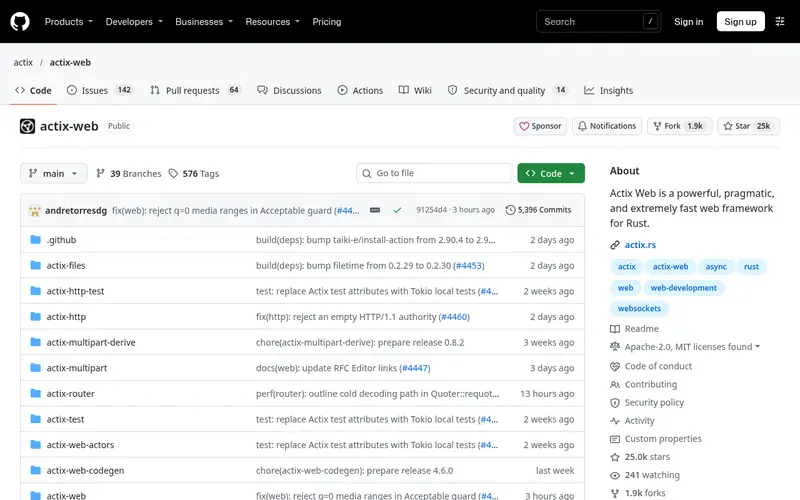
awc is the HTTP client that ships with the Actix Web ecosystem. It runs on the Actix runtime and integrates with Actix types, which makes it a natural choice when your service is already built on Actix Web. It supports HTTP/1.1 and HTTP/2, connection pooling and TLS through rustls or native TLS.
Using it outside Actix means adopting that runtime, so it rarely makes sense as a standalone pick. The crate is dual-licensed under MIT and Apache-2.0. Choose it when consistency with an existing Actix codebase matters more than picking the most widely used client. Otherwise reqwest is the safer default.
Standout: Fits the Actix runtime and ecosystem
Free (open source), as listed by the vendor (awc website). Confirm the current plan price before you buy.
Free plan. Plans change, so confirm on the vendor's pricing page before you buy.
Benefits
- Fits the Actix runtime and ecosystem
- Supports HTTP/2 and connection pooling
Drawbacks
- Tied to the Actix runtime
- Less useful outside Actix projects
Skip it if this limit matters to you: tied to the Actix runtime.
Verdict. A sensible pick for HTTP client inside Actix Web projects.
attohttpc
Best for small blocking client for simple requests
What it is and where it fits
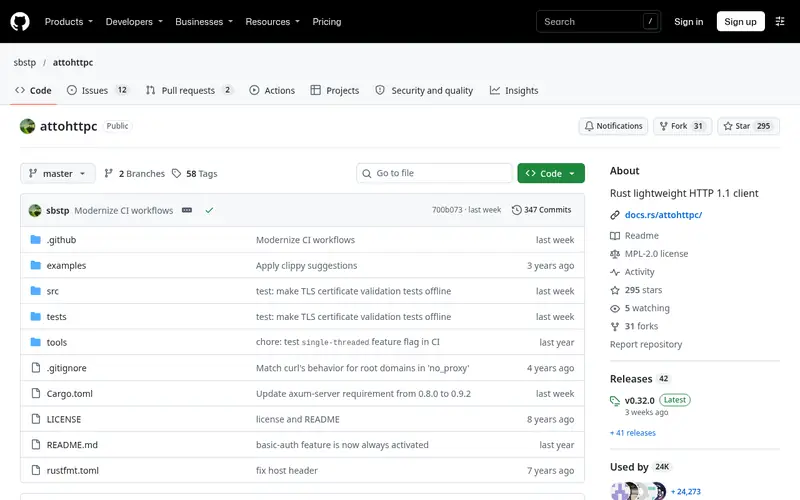
attohttpc is a lightweight blocking HTTP client. It targets simple request-and-response work in tools and scripts where a full async stack is unnecessary. It supports TLS, timeouts, redirects and common headers, and it keeps the API compact.
It is dual-licensed under MIT and Apache-2.0. Compared with ureq, it is a smaller project with fewer users, so weigh maintenance activity before adopting it for long-lived code. It is a reasonable fit for small command-line utilities. It is not suited to high-concurrency servers, where an async client is the better tool.
Standout: Minimal blocking API with a small footprint
Free (open source), as listed by the vendor (attohttpc website). Confirm the current plan price before you buy.
Free plan. Plans change, so confirm on the vendor's pricing page before you buy.
Benefits
- Minimal blocking API with a small footprint
- Supports TLS and common request features
Drawbacks
- Blocking only
- Smaller feature set and community than reqwest
Skip it if this limit matters to you: blocking only.
Verdict. A sensible pick for small blocking client for simple requests.
Who should use what
If you are building an async web service and want redirects, cookies and JSON handled for you, start with reqwest. If you are writing a library and want to avoid forcing tokio on your users, ureq is the simpler blocking option. If you need custom connection handling or streaming at the protocol level, use hyper. If your service already runs on Actix Web, awc keeps your stack consistent. Teams that depend on libcurl behavior should look at isahc.
Questions to settle before you buy
What to check before you buy
- Confirm whether you need async, blocking or both, and whether an async runtime is acceptable.
- Check the TLS backend options and whether they fit your build and cross-compilation targets.
- Review the dependency tree, especially for libraries that downstream users will compile.
- Verify the licence matches your project's requirements.
- Check recent release activity and open issues before adopting a smaller crate.
FAQ
Is reqwest the best Rust HTTP client?
It is the most widely used high-level client and a good default for application code. It is not always the best fit: libraries may prefer ureq to avoid a runtime dependency, and low-level work may call for hyper. The right choice depends on your API style and dependency constraints.
Do these clients require an async runtime?
reqwest, hyper and awc are async and depend on a runtime, typically tokio or the Actix runtime. ureq and attohttpc are blocking and need no async runtime. isahc offers both async and blocking APIs and uses libcurl underneath.
Are Rust HTTP clients free?
Yes. Every client listed here is open source and free to use. Most are dual-licensed under MIT and Apache-2.0; check each project's repository for the exact terms. There is no paid tier for these crates.
Can I use these clients in WebAssembly?
reqwest supports WebAssembly targets with limits, using the browser's fetch API. Pure network clients that rely on sockets, such as hyper and ureq, do not run in the browser. Check each crate's documentation for target support before you rely on it.
How do I pick between ureq and reqwest?
Choose ureq for blocking code, small tools and libraries that should not pull in an async runtime. Choose reqwest when you need async concurrency, HTTP/2, cookies, redirects and a broad feature set. Both are maintained and free.
Sources we checked
Method: how we score · editorial policy.
Change log. First published 27 Nov 2026.