Stage 02 · Test · Researched comparison
Best Ruby HTTP Clients in 2026
Faraday is the first pick for most teams because it wraps any adapter and gives you middleware, retries and logging in one place. Pick HTTParty if you want a small DSL for simple JSON APIs with very little setup. Pick HTTP.rb or httpx if you want a modern, fast client with a clean API and fewer layers. All three are free and open source.

By Shihab Mia
Published 27 Nov 2026 · 7 tools compared
We run no ads and no affiliate links at launch. The order of a list follows our published method. See how we score.
Prices are the starting prices vendors list publicly. Plans change, so confirm the current price on the vendor page before you buy.
Key takeaways
- Faraday, HTTParty, HTTP.rb, httpx, Excon and Typhoeus are free and open source; Net::HTTP ships with Ruby.
- Faraday and HTTParty are the most common choices for general API work, while httpx and HTTP.rb suit projects that want a lean modern client.
- Typhoeus and Excon add parallel requests and connection reuse for high-volume jobs.
- Every client here runs in your own process, so request data stays on your machine and is not sent to a third-party web page.
Who each pick is for
- Teams that want one client with swappable adapters and middlewareFaraday
- Small scripts and Rails apps calling JSON APIs with minimal setupHTTParty
- Developers who want a modern, chainable client with fewer layersHTTP.rb
- Projects that need HTTP/2, connection pooling and a lean modern APIhttpx
- High-volume API clients that need connection reuse and simple mockingExcon
- Parallel HTTP requests and batch jobs that need concurrencyTyphoeus
- Zero-dependency scripts and code that must avoid extra gemsNet::HTTP
Comparison
| Tool | Best for | Standout feature | Listed starting price | Free plan or trial |
|---|---|---|---|---|
| 1Faraday | Teams that want one client with swappable adapters and middleware | Adapter-based design lets you switch between Net::HTTP, Typhoeus and others | Free (open source) | Free plan |
| 2HTTParty | Small scripts and Rails apps calling JSON APIs with minimal setup | Very short syntax for GET and POST with automatic JSON parsing | Free (open source) | Free plan |
| 3HTTP.rb | Developers who want a modern, chainable client with fewer layers | Clean chainable API for headers, timeouts and body | Free (open source) | Free plan |
| 4httpx | Projects that need HTTP/2, connection pooling and a lean modern API | Supports HTTP/2 and connection pooling out of the box | Free (open source) | Free plan |
| 5Excon | High-volume API clients that need connection reuse and simple mocking | Persistent connections and a straightforward request API | Free (open source) | Free plan |
| 6Typhoeus | Parallel HTTP requests and batch jobs that need concurrency | Built on libcurl for parallel requests and strong protocol coverage | Free (open source) | Free plan |
| 7Net::HTTP | Zero-dependency scripts and code that must avoid extra gems | Ships with Ruby, so no gem to add | Free | Free plan |
How we picked
We compared clients on fit for common Ruby HTTP jobs, supported platforms and Ruby versions, licence and price, maintenance activity, and main limits such as missing retries or extra system dependencies. Sources are vendor pages, official documentation and project repositories. Prices and licences can change, so confirm details on the project site before you commit.
The tools, one by one
Faraday
Best for teams that want one client with swappable adapters and middleware
What it is and where it fits
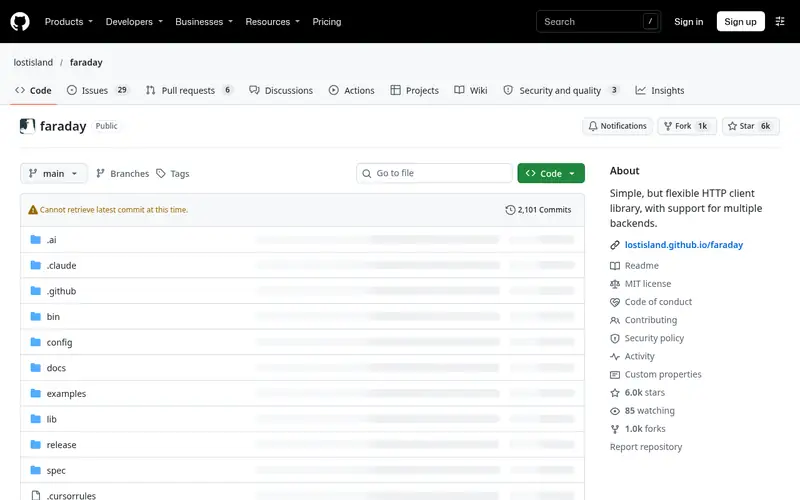
Faraday is a Ruby HTTP client library built around a middleware stack and pluggable adapters. You write requests once and choose the adapter underneath, so you can move from Net::HTTP to Typhoeus or another backend without rewriting call sites. Middleware handles JSON parsing, retries, logging, and authentication headers.
It runs wherever Ruby runs, including Rails apps, background workers and scripts. The project is open source under the MIT licence and is maintained on GitHub. There is no paid tier and no hosted service, so there are no request limits beyond what your own infrastructure allows.
Skip Faraday if you want a one-file script with no setup, or if your team prefers a client with no adapter abstraction. For small projects, HTTParty or HTTP.rb will feel lighter.
Standout: Adapter-based design lets you switch between Net::HTTP, Typhoeus and others
Free (open source), as listed by the vendor (Faraday website). Confirm the current plan price before you buy.
Free plan. Plans change, so confirm on the vendor's pricing page before you buy.
Benefits
- Adapter-based design lets you switch between Net::HTTP, Typhoeus and others
- middleware stack covers retries, logging and auth
Drawbacks
- More configuration than a single-purpose client
- the middleware model takes time to learn
Skip it if this limit matters to you: more configuration than a single-purpose client.
Verdict. A sensible pick for teams that want one client with swappable adapters and middleware.
HTTParty
Best for small scripts and Rails apps calling JSON APIs with minimal setup
What it is and where it fits
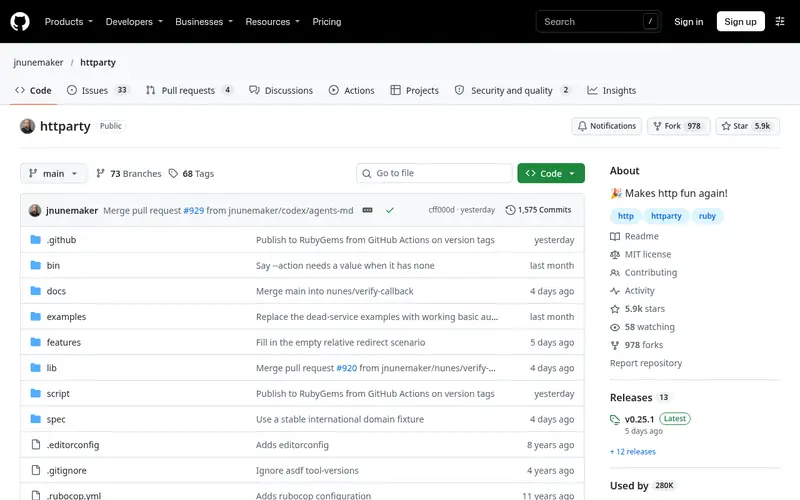
HTTParty is a Ruby HTTP client that adds a small DSL on top of Net::HTTP. You include it in a class, set a base URI and headers, and call class-level methods like get and post. Responses parse JSON automatically when the content type says so.
It works on any Ruby platform and is common in Rails apps, rake tasks and one-off scripts. The library is open source under the MIT licence and distributed as a gem. It has no paid plan and no hosted component.
Choose something else if you need a middleware pipeline, automatic retries with backoff, or parallel requests. HTTParty keeps things simple, and that simplicity is the point.
Standout: Very short syntax for GET and POST with automatic JSON parsing
Free (open source), as listed by the vendor (HTTParty website). Confirm the current plan price before you buy.
Free plan. Plans change, so confirm on the vendor's pricing page before you buy.
Benefits
- Very short syntax for GET and POST with automatic JSON parsing
- easy to include in a class and add default headers
Drawbacks
- Fewer built-in retry and middleware features than Faraday
- less active development than some alternatives
Skip it if this limit matters to you: fewer built-in retry and middleware features than Faraday.
Verdict. A sensible pick for small scripts and Rails apps calling JSON APIs with minimal setup.
HTTP.rb
Best for developers who want a modern, chainable client with fewer layers
What it is and where it fits
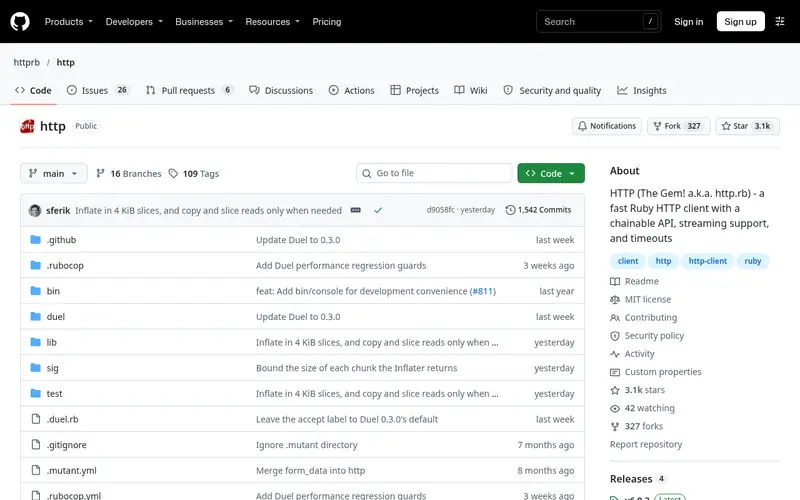
HTTP.rb is a Ruby HTTP client with a chainable interface. You build a request by calling methods for headers, timeouts and the body, then send it. It uses a native parser and supports persistent connections, streaming responses and timeouts per request.
It runs on standard Ruby and works in Rails, Sinatra and plain scripts. The project is open source under the MIT licence and maintained on GitHub. There is no paid tier.
Skip it if you depend on Faraday middleware or need a large plugin ecosystem. Also check that your target Ruby version is supported before adopting it in an older codebase.
Standout: Clean chainable API for headers, timeouts and body
Free (open source), as listed by the vendor (HTTP.rb website). Confirm the current plan price before you buy.
Free plan. Plans change, so confirm on the vendor's pricing page before you buy.
Benefits
- Clean chainable API for headers, timeouts and body
- built on a fast native HTTP parser
Drawbacks
- Smaller ecosystem of plugins than Faraday
- fewer built-in retry helpers
Skip it if this limit matters to you: smaller ecosystem of plugins than Faraday.
Verdict. A sensible pick for developers who want a modern, chainable client with fewer layers.
httpx
Best for projects that need HTTP/2, connection pooling and a lean modern API
What it is and where it fits
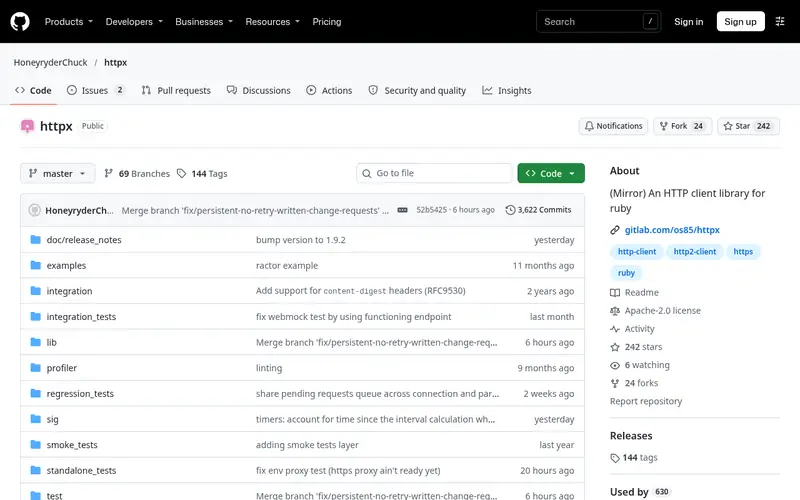
httpx is a Ruby HTTP client focused on modern protocol support. It handles HTTP/2, connection reuse and concurrent requests through a pool. Plugins add retries, redirect following, cookies and circuit breakers.
It runs on standard Ruby and suits services that call other services often and want to keep connections open. The library is open source under the MIT licence and maintained on GitHub. No paid plan exists.
Consider another client if your team needs the widest possible set of examples and Stack Overflow answers, or if you must support very old Ruby versions. Check the project's supported Ruby range first.
Standout: Supports HTTP/2 and connection pooling out of the box
Free (open source), as listed by the vendor (httpx website). Confirm the current plan price before you buy.
Free plan. Plans change, so confirm on the vendor's pricing page before you buy.
Benefits
- Supports HTTP/2 and connection pooling out of the box
- clean API with plugins for retries and follow-redirects
Drawbacks
- Smaller user base than Faraday or HTTParty
- some plugins are less documented
Skip it if this limit matters to you: smaller user base than Faraday or HTTParty.
Verdict. A sensible pick for projects that need HTTP/2, connection pooling and a lean modern API.
Excon
Best for high-volume API clients that need connection reuse and simple mocking
What it is and where it fits
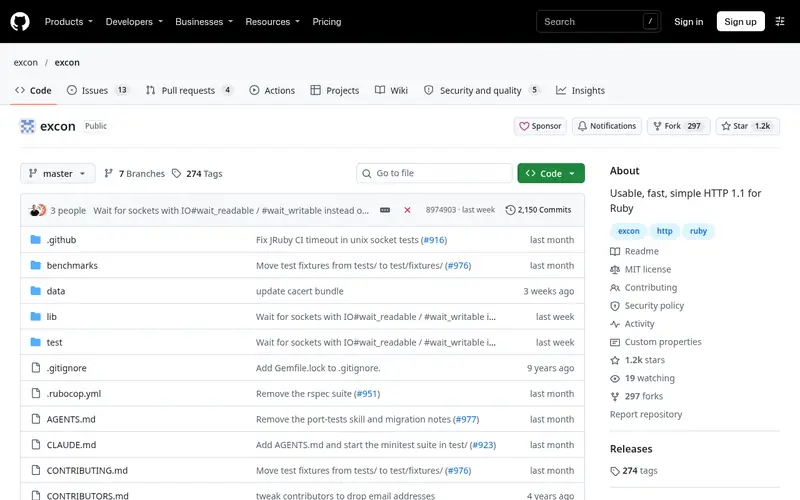
Excon is a Ruby HTTP client built for speed and connection reuse. It keeps persistent connections, supports streaming and chunked responses, and includes a stub mechanism for tests so you can avoid real network calls.
It runs on standard Ruby and is used in projects that make many requests to the same host. The library is open source under the MIT licence and maintained on GitHub. There is no paid tier.
Skip Excon if you want a middleware stack or automatic JSON handling. You will write a bit more glue code than with Faraday or HTTParty.
Standout: Persistent connections and a straightforward request API
Free (open source), as listed by the vendor (Excon website). Confirm the current plan price before you buy.
Free plan. Plans change, so confirm on the vendor's pricing page before you buy.
Benefits
- Persistent connections and a straightforward request API
- built-in stubbing support for tests
Drawbacks
- Fewer high-level conveniences than Faraday
- documentation is thinner than larger projects
Skip it if this limit matters to you: fewer high-level conveniences than Faraday.
Verdict. A sensible pick for high-volume API clients that need connection reuse and simple mocking.
Typhoeus
Best for parallel HTTP requests and batch jobs that need concurrency
What it is and where it fits
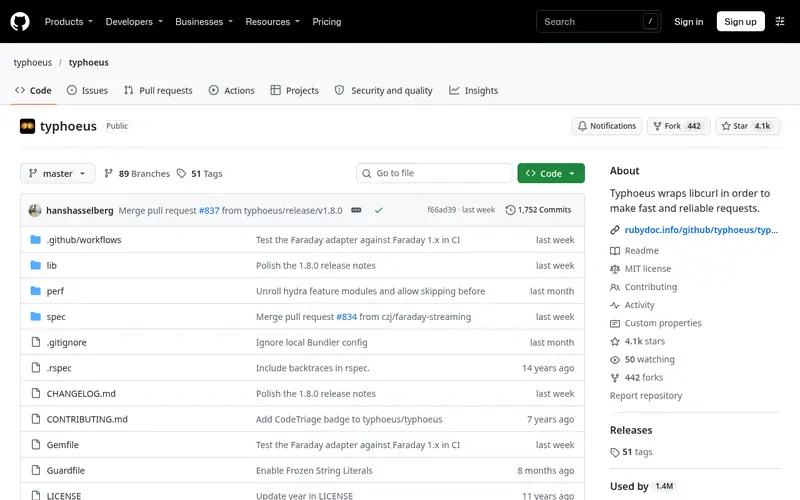
Typhoeus wraps libcurl and lets you run many requests in parallel. It supports HTTP/2 through libcurl, timeouts, and response caching. You can use it directly or as a Faraday adapter.
It runs on standard Ruby but needs libcurl installed on the system. The project is open source under the MIT licence and maintained on GitHub. No paid plan exists.
Choose another client if you cannot install system libraries, or if you only make one request at a time. For simple sequential calls, HTTP.rb or HTTParty is easier.
Standout: Built on libcurl for parallel requests and strong protocol coverage
Free (open source), as listed by the vendor (Typhoeus website). Confirm the current plan price before you buy.
Free plan. Plans change, so confirm on the vendor's pricing page before you buy.
Benefits
- Built on libcurl for parallel requests and strong protocol coverage
- supports memoized and cached responses
Drawbacks
- Depends on libcurl being available
- the API is lower level than Faraday or HTTParty
Skip it if this limit matters to you: depends on libcurl being available.
Verdict. A sensible pick for parallel HTTP requests and batch jobs that need concurrency.
Net::HTTP
Best for zero-dependency scripts and code that must avoid extra gems
What it is and where it fits
Net::HTTP is part of Ruby's standard library. It covers GET, POST and other methods, supports TLS, proxies and timeouts, and requires no installation beyond Ruby itself.
It runs anywhere Ruby runs. Because it is part of the standard library, it follows Ruby's release cycle and licence. There is no paid tier and no hosted service.
Use Net::HTTP when you cannot add dependencies or need fine control. For everyday API work, a wrapper like Faraday or HTTParty will save code and reduce mistakes.
Standout: Ships with Ruby, so no gem to add
Free, as listed by the vendor (Net::HTTP website). Confirm the current plan price before you buy.
Free plan. Plans change, so confirm on the vendor's pricing page before you buy.
Benefits
- Ships with Ruby, so no gem to add
- full control over requests and responses
Drawbacks
- Verbose API with manual connection and header handling
- fewer conveniences like automatic retries
Skip it if this limit matters to you: verbose API with manual connection and header handling.
Verdict. A sensible pick for zero-dependency scripts and code that must avoid extra gems.
Who should use what
If you are building a Rails app that calls several APIs and needs retries and logging, start with Faraday. If you are writing a small script or rake task that hits one JSON endpoint, HTTParty keeps the code short. If you need HTTP/2 and connection pooling for service-to-service traffic, look at httpx. If you cannot add gems at all, Net::HTTP is already there. Teams doing batch or parallel requests should evaluate Typhoeus and Excon.
Questions to settle before you buy
What to check before you buy
- Confirm the client supports your Ruby version and is actively maintained.
- Check whether you need HTTP/2, connection pooling or parallel requests.
- Decide if you want middleware and retries built in or added by hand.
- Note any system dependencies, such as libcurl for Typhoeus.
- Review the licence and confirm it fits your project's distribution model.
FAQ
Do I need a gem for HTTP requests in Ruby?
No. Net::HTTP is part of the standard library and can make requests without any gem. Most teams add a gem like Faraday or HTTParty for shorter code, automatic JSON parsing and retries.
Which Ruby HTTP client is fastest?
Speed depends on the adapter, connection reuse and workload. Typhoeus and httpx support parallel or pooled requests, which often matters more than raw per-request speed. Test with your own traffic rather than relying on general claims.
Are these clients free?
Yes. All seven are free or open source. Faraday, HTTParty, HTTP.rb, httpx, Excon and Typhoeus are open source, and Net::HTTP ships with Ruby. None require a paid subscription.
Can I use Faraday with Typhoeus?
Yes. Faraday supports multiple adapters, including Typhoeus, so you can keep Faraday middleware while using Typhoeus for parallel requests. Check the Faraday adapter documentation for the current setup.
Is it safe to send API tokens with these clients?
The clients run in your own process, so tokens are not sent to a third-party web page. Still, keep secrets out of logs and source control, use environment variables, and enable TLS verification, which these clients support.
Sources we checked
Method: how we score · editorial policy.
Change log. First published 27 Nov 2026.