Stage 02 · Test · Researched comparison
Best Scala Testing Frameworks in 2026
ScalaTest is the first pick for most teams because it offers several styles, broad build-tool support and deep integration with the Scala ecosystem. MUnit suits developers who want a small, fast framework with a simple assertion API. ScalaCheck is the choice when you need property-based testing and plan to pair it with one of the other frameworks. All three are free and open source.

By Shihab Mia
Published 27 Nov 2026 · 7 tools compared
We run no ads and no affiliate links at launch. The order of a list follows our published method. See how we score.
Prices are the starting prices vendors list publicly. Plans change, so confirm the current price on the vendor page before you buy.
Key takeaways
- ScalaTest, MUnit, specs2, ZIO Test, weaver-test, ScalaCheck and utest are all free and open source.
- ScalaTest and specs2 offer multiple test styles; MUnit and utest favor a smaller, simpler API.
- ZIO Test and weaver-test are built for effect systems (ZIO and Cats Effect respectively), not plain synchronous code.
- ScalaCheck is a property-based testing library, so it is usually combined with a unit-testing framework rather than used alone.
Who each pick is for
- Teams that want one framework with many test stylesScalaTest
- Developers who want a small, fast framework with simple assertionsMUnit
- Teams that prefer a specification-style, composable test APIspecs2
- ZIO applications that need effect-aware testing and test environmentsZIO Test
- Cats Effect projects that want a lightweight, effect-aware runnerweaver-test
- Property-based testing that generates inputs and checks invariantsScalaCheck
- Developers who want a minimal, macro-based testing libraryutest
Comparison
| Tool | Best for | Standout feature | Listed starting price | Free plan or trial |
|---|---|---|---|---|
| 1ScalaTest | Teams that want one framework with many test styles | Several styles (FunSuite, FlatSpec, WordSpec and more) | Free (open source) | Free plan |
| 2MUnit | Developers who want a small, fast framework with simple assertions | Compact API with clear assertion messages | Free (open source) | Free plan |
| 3specs2 | Teams that prefer a specification-style, composable test API | Rich matchers and composable specifications | Free (open source) | Free plan |
| 4ZIO Test | ZIO applications that need effect-aware testing and test environments | Built-in support for effects, test environments and resource management | Free (open source) | Free plan |
| 5weaver-test | Cats Effect projects that want a lightweight, effect-aware runner | Designed for Cats Effect with a small API | Free (open source) | Free plan |
| 6ScalaCheck | Property-based testing that generates inputs and checks invariants | Automatic input generation and shrinking of failing cases | Free (open source) | Free plan |
| 7utest | Developers who want a minimal, macro-based testing library | Small API with clear failure output | Free (open source) | Free plan |
How we picked
We compared frameworks on fit for common Scala testing jobs, supported platforms (JVM, Scala.js, Scala Native), licence and cost, integration with build tools and other libraries, and the main limits each project documents. Sources are official project sites, documentation and repositories. All entries here are free and open source. Prices and features change, so confirm details on the vendor or project site before you commit.
The tools, one by one
ScalaTest
Best for teams that want one framework with many test styles
What it is and where it fits
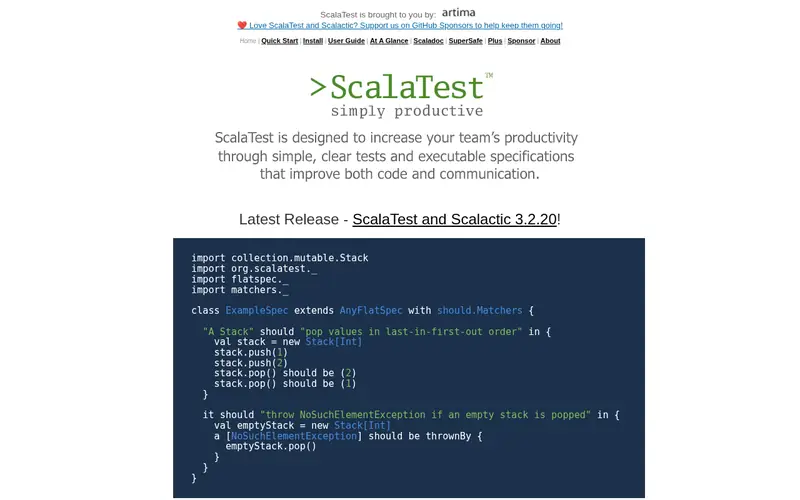
ScalaTest is the most widely used testing framework in the Scala ecosystem. It provides multiple testing styles so teams can write tests in a syntax that fits their codebase, from simple function-based suites to behavior-driven specifications. It runs on the JVM and also supports Scala.js and Scala Native through its cross-builds.
It integrates with sbt, Maven, Gradle and common IDE runners, and it works alongside mocking libraries and property-based tools. The project is open source under the Apache 2.0 license. The main trade-off is size: the API is broad, and mixing styles across a team can make tests harder to read. Teams that want a minimal API may prefer MUnit or utest.
Standout: Several styles (FunSuite, FlatSpec, WordSpec and more)
Free (open source), as listed by the vendor (ScalaTest website). Confirm the current plan price before you buy.
Free plan. Plans change, so confirm on the vendor's pricing page before you buy.
Benefits
- Several styles (FunSuite, FlatSpec, WordSpec and more)
- wide build-tool and runner support
Drawbacks
- Large API surface to learn
- style choices can fragment a codebase
Skip it if this limit matters to you: large API surface to learn.
Verdict. A sensible pick for teams that want one framework with many test styles.
MUnit
Best for developers who want a small, fast framework with simple assertions
What it is and where it fits
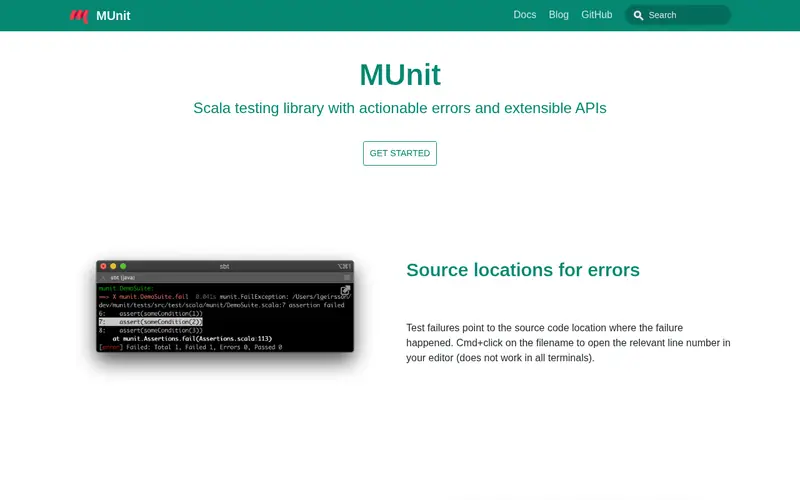
MUnit is a lightweight testing library from the Scalameta project. Tests are written as methods that return a value, and assertions produce readable diffs when they fail. It supports asynchronous tests and integrates with sbt and common CI setups.
MUnit cross-builds to the JVM, Scala.js and Scala Native, which makes it a practical choice for cross-platform libraries. It is open source under the Apache 2.0 license. It does not try to match ScalaTest's range of styles, so teams that rely on behavior-driven syntax may need to adjust. It pairs well with ScalaCheck for property-based tests.
Standout: Compact API with clear assertion messages
Free (open source), as listed by the vendor (MUnit website). Confirm the current plan price before you buy.
Free plan. Plans change, so confirm on the vendor's pricing page before you buy.
Benefits
- Compact API with clear assertion messages
- works with sbt, Scala.js and Scala Native
Drawbacks
- Fewer built-in styles than ScalaTest
- smaller ecosystem of extensions
Skip it if this limit matters to you: fewer built-in styles than ScalaTest.
Verdict. A sensible pick for developers who want a small, fast framework with simple assertions.
specs2
Best for teams that prefer a specification-style, composable test API
What it is and where it fits
specs2 is a testing library built around specifications and matchers. It offers both mutable and immutable styles and a large set of matchers for assertions. It integrates with sbt and can be combined with ScalaCheck for property-based testing.
The project is open source under the MIT license and runs on the JVM. Its strength is expressiveness: specifications can be composed and reused. The cost is complexity, and new team members often need time to learn the matcher API. Teams that want the smallest possible surface area should look at MUnit instead.
Standout: Rich matchers and composable specifications
Free (open source), as listed by the vendor (specs2 website). Confirm the current plan price before you buy.
Free plan. Plans change, so confirm on the vendor's pricing page before you buy.
Benefits
- Rich matchers and composable specifications
- supports mutable and immutable styles
Drawbacks
- Steeper learning curve
- documentation can be dense for newcomers
Skip it if this limit matters to you: steeper learning curve.
Verdict. A sensible pick for teams that prefer a specification-style, composable test API.
ZIO Test
Best for zIO applications that need effect-aware testing and test environments
What it is and where it fits
ZIO Test is the testing library for the ZIO ecosystem. It runs tests as effects, provides test environments for dependency injection, and includes facilities for time control and resource handling. Assertions are expressed with its own assertion API.
It is open source under the Apache 2.0 license and runs on the JVM and Scala.js. The main limit is scope: it is designed for code built on ZIO, and teams using other effect systems or plain Scala will get more from ScalaTest or MUnit. It also requires familiarity with ZIO concepts before tests feel natural.
Standout: Built-in support for effects, test environments and resource management
Free (open source), as listed by the vendor (ZIO Test website). Confirm the current plan price before you buy.
Free plan. Plans change, so confirm on the vendor's pricing page before you buy.
Benefits
- Built-in support for effects, test environments and resource management
- integrates with the ZIO runtime
Drawbacks
- Tied to the ZIO ecosystem
- not aimed at plain synchronous code
Skip it if this limit matters to you: tied to the ZIO ecosystem.
Verdict. A sensible pick for ZIO applications that need effect-aware testing and test environments.
weaver-test
Best for cats Effect projects that want a lightweight, effect-aware runner
What it is and where it fits
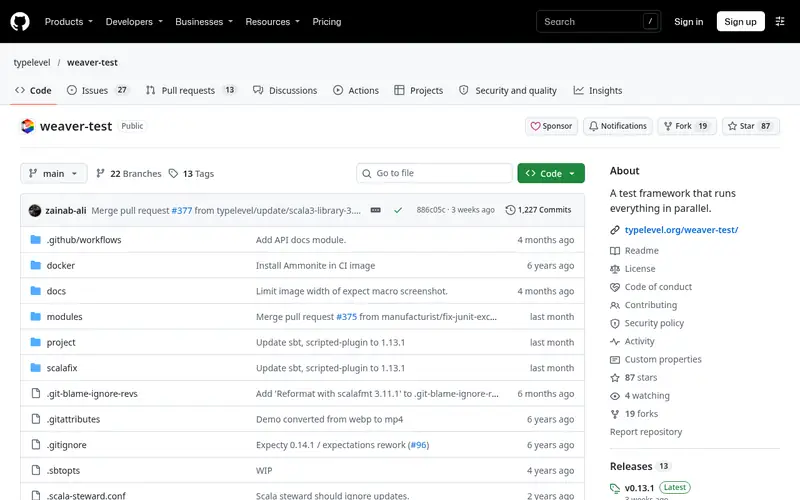
weaver-test is a test framework for Scala built on Cats Effect. Tests are written as effects, and the framework handles concurrent execution and resource safety. It integrates with sbt and supports the Typelevel ecosystem, including integration with ScalaCheck.
The project is open source under the Apache 2.0 license and runs on the JVM and Scala.js. It is a good fit for teams already using Cats Effect and the Typelevel libraries. Teams outside that stack, or those wanting many built-in test styles, will find ScalaTest or MUnit a better match.
Standout: Designed for Cats Effect with a small API
Free (open source), as listed by the vendor (weaver-test website). Confirm the current plan price before you buy.
Free plan. Plans change, so confirm on the vendor's pricing page before you buy.
Benefits
- Designed for Cats Effect with a small API
- integrates with sbt and common CI
Drawbacks
- Focused on the Typelevel stack
- fewer features for non-effect code
Skip it if this limit matters to you: focused on the Typelevel stack.
Verdict. A sensible pick for cats Effect projects that want a lightweight, effect-aware runner.
ScalaCheck
Best for property-based testing that generates inputs and checks invariants
What it is and where it fits
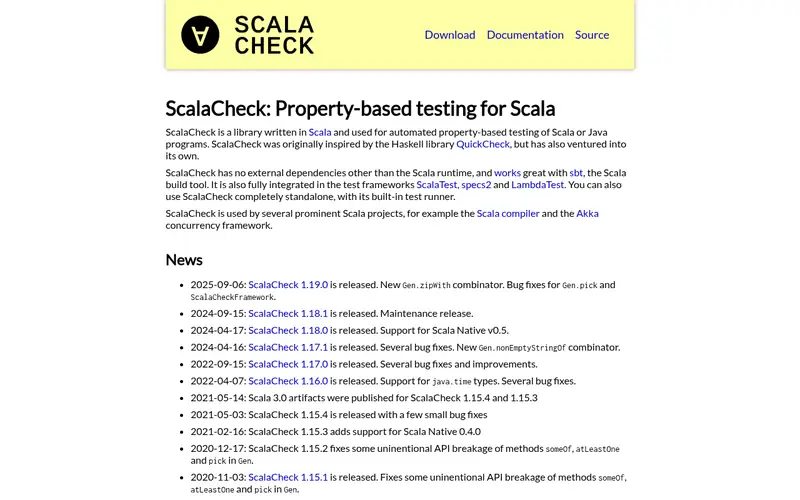
ScalaCheck is a property-based testing library. Instead of writing example-based tests, you describe properties that should hold for all inputs, and ScalaCheck generates data to check them. When a property fails, it shrinks the input to a small counterexample.
It is open source under the BSD 3-Clause license and runs on the JVM, Scala.js and Scala Native. It is usually paired with a unit-testing framework rather than used alone. The main cost is design effort: good properties require clear thinking about invariants, and generated data needs generators that match your domain.
Standout: Automatic input generation and shrinking of failing cases
Free (open source), as listed by the vendor (ScalaCheck website). Confirm the current plan price before you buy.
Free plan. Plans change, so confirm on the vendor's pricing page before you buy.
Benefits
- Automatic input generation and shrinking of failing cases
- integrates with ScalaTest, MUnit, specs2 and others
Drawbacks
- Not a full unit-testing framework on its own
- properties take thought to design
Skip it if this limit matters to you: not a full unit-testing framework on its own.
Verdict. A sensible pick for property-based testing that generates inputs and checks invariants.
utest
Best for developers who want a minimal, macro-based testing library
What it is and where it fits
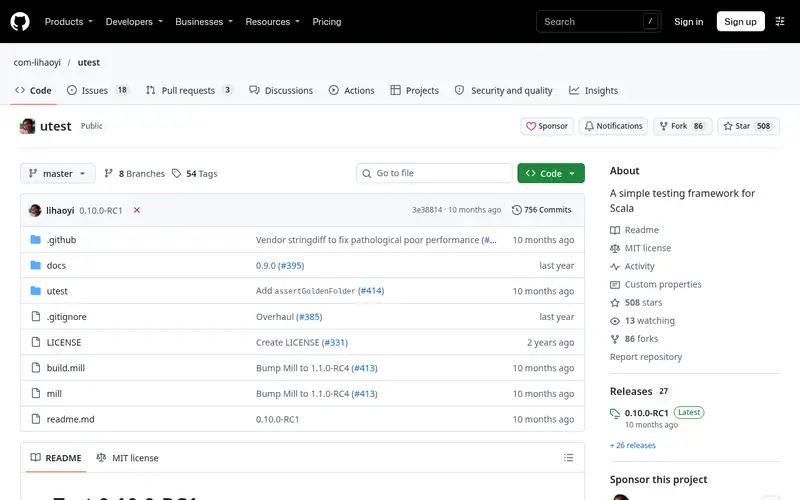
utest is a small testing library from the Li Haoyi project family. It uses macros to capture assertion expressions and report failures with the values involved. Tests are organized into suites, and the library integrates with sbt.
It is open source under the MIT license and cross-builds to the JVM, Scala.js and Scala Native. Its appeal is simplicity and readable failure messages. The trade-off is a smaller ecosystem and fewer built-in styles than ScalaTest, so teams that need broad tooling support may look elsewhere.
Standout: Small API with clear failure output
Free (open source), as listed by the vendor (utest website). Confirm the current plan price before you buy.
Free plan. Plans change, so confirm on the vendor's pricing page before you buy.
Benefits
- Small API with clear failure output
- works across JVM, Scala.js and Scala Native
Drawbacks
- Smaller community than ScalaTest
- fewer integrations
Skip it if this limit matters to you: smaller community than ScalaTest.
Verdict. A sensible pick for developers who want a minimal, macro-based testing library.
Who should use what
Teams starting a new Scala project with no strong effect-system preference should start with ScalaTest for its range of styles, or MUnit for a smaller API. Projects built on ZIO should use ZIO Test, and Cats Effect projects should look at weaver-test. Teams that want to check invariants across many inputs should add ScalaCheck to whichever unit-testing framework they use. Developers who prefer a minimal, macro-based library and cross-platform builds can consider utest.
Questions to settle before you buy
What to check before you buy
- Confirm the framework supports every platform you target (JVM, Scala.js, Scala Native).
- Check that your build tool (sbt, Maven, Gradle) and CI runner are supported.
- Verify the test style fits your team's conventions and existing code.
- Confirm integration with any mocking or property-based libraries you rely on.
- Read the licence and confirm it matches your project's requirements.
FAQ
Is ScalaTest free?
Yes. ScalaTest is open source under the Apache 2.0 license, with no paid tier.
Can I use ScalaCheck without another framework?
ScalaCheck is a property-based testing library, so it is normally combined with a unit-testing framework such as ScalaTest, MUnit or specs2 to run and report tests.
Which framework works with ZIO?
ZIO Test is built for the ZIO ecosystem. For Cats Effect, weaver-test is the equivalent choice.
Do these frameworks work with Scala.js and Scala Native?
ScalaTest, MUnit, ScalaCheck and utest cross-build to Scala.js and Scala Native. ZIO Test supports Scala.js. Check each project's documentation for current platform support.
Do I need to paste code or data into a website to use these?
No. All of these frameworks run locally in your build, so test code and data stay on your machine.
Sources we checked
Method: how we score · editorial policy.
Change log. First published 27 Nov 2026.