Stage 02 · Test · Researched comparison
Best Scala HTTP Clients in 2026
sttp client is the first pick for most teams because it offers one API across several backends and both Scala 2 and Scala 3. Choose http4s Ember if you already build on http4s and cats-effect. Choose requests-scala if you want a small, synchronous client for scripts and simple services. Pekko HTTP suits teams already on that actor stack.

By Shihab Mia
Published 27 Nov 2026 · 5 tools compared
We run no ads and no affiliate links at launch. The order of a list follows our published method. See how we score.
Prices are the starting prices vendors list publicly. Plans change, so confirm the current price on the vendor page before you buy.
Key takeaways
- sttp client is free and open source, supports multiple backends, and works on the JVM, Scala.js and Scala Native.
- http4s Ember is free and open source and fits projects already using http4s and cats-effect.
- Pekko HTTP is the Apache 2.0 fork of Akka HTTP and is a direct drop-in for teams that want to stay on a permissive licence.
Who each pick is for
- Teams that want one API across several backendssttp client
- Projects already built on http4s and cats-effecthttp4s Ember client
- Teams that want Akka HTTP under Apache 2.0Pekko HTTP client
- Scripts and small services that need a simple clientrequests-scala
- ZIO applications that want client and server in one libraryZIO HTTP client
Comparison
| Tool | Best for | Standout feature | Listed starting price | Free plan or trial |
|---|---|---|---|---|
| 1sttp client | Teams that want one API across several backends | One API over multiple backends | Free (open source) | Free plan |
| 2http4s Ember client | Projects already built on http4s and cats-effect | Shared model with the http4s server | Free (open source) | Free plan |
| 3Pekko HTTP client | Teams that want Akka HTTP under Apache 2.0 | Apache 2.0 licence | Free (open source) | Free plan |
| 4requests-scala | Scripts and small services that need a simple client | Small, synchronous API | Free (open source) | Free plan |
| 5ZIO HTTP client | ZIO applications that want client and server in one library | Native ZIO integration | Free (open source) | Free plan |
How we picked
We compared these libraries on fit for common Scala HTTP jobs, supported Scala versions and platforms, licence terms, and main limits such as blocking behavior or ecosystem lock-in. Sources are vendor pages, official documentation and project repositories. We did not run benchmarks. Licences and prices can change, so confirm the current terms on the vendor or repository page before you commit.
The tools, one by one
sttp client
Best for teams that want one API across several backends
What it is and where it fits
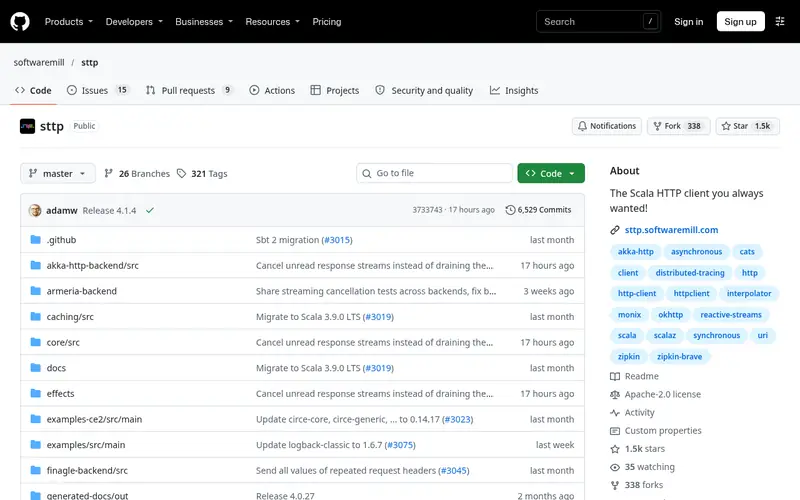
sttp client is a Scala HTTP client library from SoftwareMill. It gives you a single request-building API and lets you pick a backend, such as HttpClient, OkHttp, Armeria, http4s or ZIO. It supports Scala 2.12, 2.13 and Scala 3, and runs on the JVM, Scala.js and Scala Native. The core is Apache 2.0 licensed.
The library covers synchronous, asynchronous and streaming requests, plus testing stubs and integrations for effect systems. Because the backend is separate, you can change transport without rewriting request code. The trade-off is more modules and configuration than a single-purpose client.
Skip it if you want the smallest possible dependency or you are already deeply tied to one effect stack and prefer its native client.
Standout: One API over multiple backends
Free (open source), as listed by the vendor (sttp client website). Confirm the current plan price before you buy.
Free plan. Plans change, so confirm on the vendor's pricing page before you buy.
Benefits
- One API over multiple backends
- works on JVM, Scala.js and Scala Native
Drawbacks
- Backend choice adds setup decisions
- many modules to track
Skip it if this limit matters to you: backend choice adds setup decisions.
Verdict. A sensible pick for teams that want one API across several backends.
Alternatives in this guide: http4s Ember client, Pekko HTTP client, requests-scala
http4s Ember client
Best for projects already built on http4s and cats-effect
What it is and where it fits
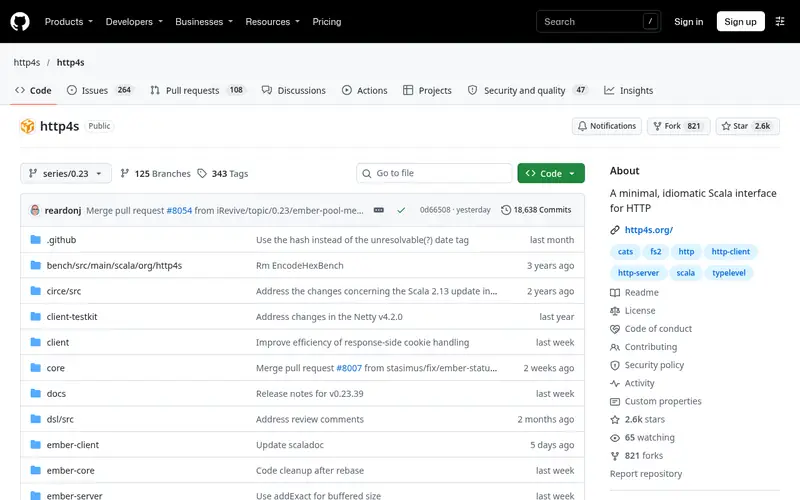
http4s is a purely functional HTTP library for Scala. Ember is its built-in client and server backend, written on cats-effect. If your service already uses http4s for routing, the Ember client reuses the same request and response types, so client and server code share one model.
The client is Apache 2.0 licensed and runs on the JVM. It supports streaming bodies and integrates with the cats-effect ecosystem. Because it is effect-typed, you need comfort with IO and resource handling. The client follows the http4s version, so upgrades move with the library.
Skip it if your project does not use cats-effect, or if you want a client that works without an effect system.
Standout: Shared model with the http4s server
Free (open source), as listed by the vendor (http4s Ember client website). Confirm the current plan price before you buy.
Free plan. Plans change, so confirm on the vendor's pricing page before you buy.
Benefits
- Shared model with the http4s server
- pure functional API on cats-effect
Drawbacks
- Requires cats-effect knowledge
- tied to the http4s release cycle
Skip it if this limit matters to you: requires cats-effect knowledge.
Verdict. A sensible pick for projects already built on http4s and cats-effect.
Alternatives in this guide: sttp client, Pekko HTTP client, requests-scala
Pekko HTTP client
Best for teams that want Akka HTTP under Apache 2.0
What it is and where it fits
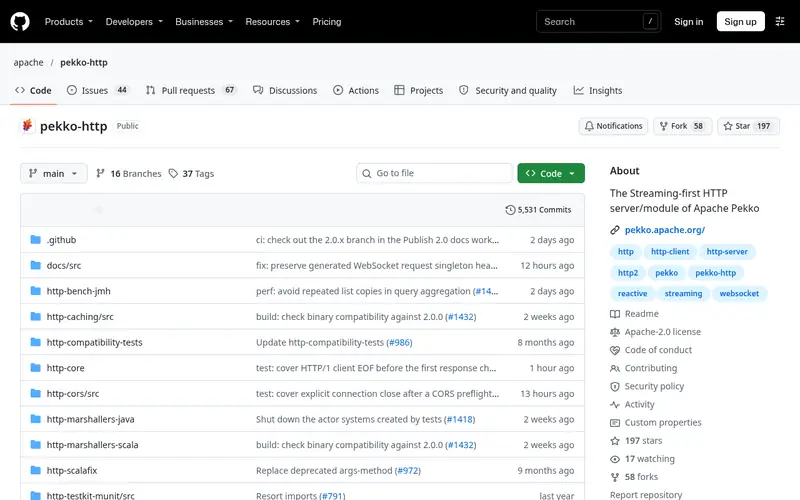
Apache Pekko HTTP is the community fork of Akka HTTP, hosted by the Apache Software Foundation. It keeps the same streaming client model on Pekko Streams and actors, and it is licensed under Apache 2.0. The package names differ, so code needs an import change.
For teams that used Akka HTTP and want to stay on a permissive licence, Pekko HTTP is the direct path. The API is close enough that most client code ports with limited edits, but you should still test connection pooling and streaming behavior.
Skip it if you depend on Akka-specific commercial modules or if your team has already standardized on another client.
Standout: Apache 2.0 licence
Free (open source), as listed by the vendor (Pekko HTTP client website). Confirm the current plan price before you buy.
Free plan. Plans change, so confirm on the vendor's pricing page before you buy.
Benefits
- Apache 2.0 licence
- API close to Akka HTTP
Drawbacks
- Smaller ecosystem than Akka
- migration still needs testing
Skip it if this limit matters to you: smaller ecosystem than Akka.
Verdict. A sensible pick for teams that want Akka HTTP under Apache 2.0.
Alternatives in this guide: sttp client, http4s Ember client, requests-scala
requests-scala
Best for scripts and small services that need a simple client
What it is and where it fits
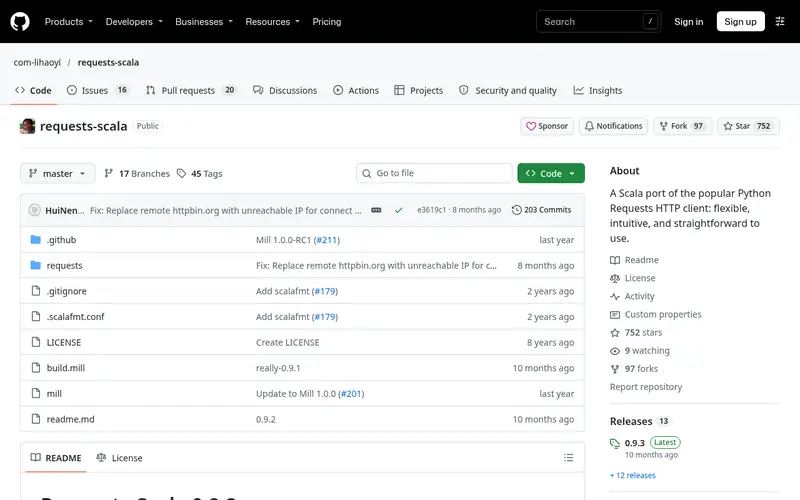
requests-scala is a small HTTP client from Li Haoyi, modeled on the Python requests library. It offers a simple synchronous API for GET, POST and other methods, with helpers for JSON, form data and file uploads. It is Apache 2.0 licensed and runs on the JVM.
It suits build scripts, command-line tools and small services where a blocking call is fine. It does not aim to replace an async, streaming client for high-throughput services. For those, pair it with an async library or choose sttp or http4s.
Skip it if you need non-blocking I/O, fine-grained connection pooling or streaming bodies at scale.
Standout: Small, synchronous API
Free (open source), as listed by the vendor (requests-scala website). Confirm the current plan price before you buy.
Free plan. Plans change, so confirm on the vendor's pricing page before you buy.
Benefits
- Small, synchronous API
- easy to read in scripts
Drawbacks
- Blocking by default
- fewer streaming features
Skip it if this limit matters to you: blocking by default.
Verdict. A sensible pick for scripts and small services that need a simple client.
Alternatives in this guide: sttp client, http4s Ember client, Pekko HTTP client
ZIO HTTP client
Best for zIO applications that want client and server in one library
What it is and where it fits
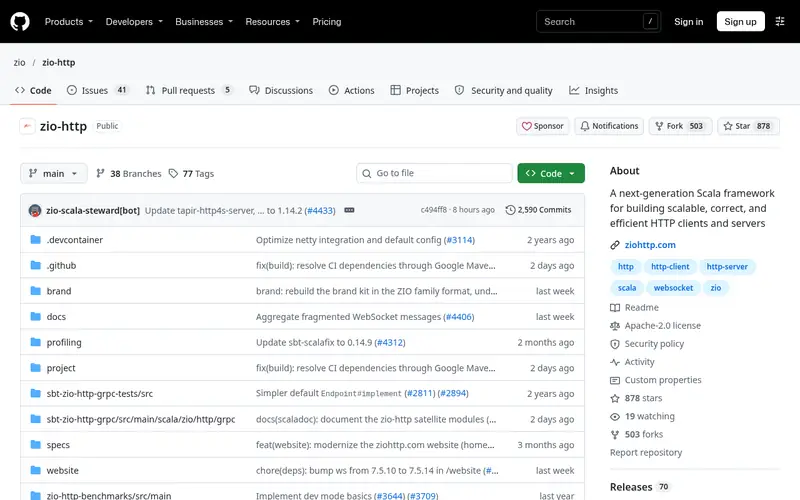
ZIO HTTP is an HTTP library for Scala built on ZIO. It provides a client alongside its server, so a ZIO service can share types and effect handling across both sides. It is Apache 2.0 licensed and runs on the JVM.
The client supports streaming and integrates with ZIO's environment and error model. If your application already uses ZIO, this keeps dependencies consistent. If you use cats-effect or plain Futures, the fit is weaker.
Skip it if you are not on ZIO, or if you need a client that works across multiple effect systems.
Standout: Native ZIO integration
Free (open source), as listed by the vendor (ZIO HTTP client website). Confirm the current plan price before you buy.
Free plan. Plans change, so confirm on the vendor's pricing page before you buy.
Benefits
- Native ZIO integration
- client and server in one project
Drawbacks
- Requires ZIO knowledge
- smaller ecosystem than http4s
Skip it if this limit matters to you: requires ZIO knowledge.
Verdict. A sensible pick for ZIO applications that want client and server in one library.
Alternatives in this guide: sttp client, http4s Ember client, Pekko HTTP client
Who should use what
If you want one client API and the freedom to swap backends, start with sttp client. If your service is already built on http4s and cats-effect, use the Ember client so client and server share one model. If you need Apache 2.0, use Pekko HTTP. For scripts and small tools, requests-scala keeps code short. ZIO teams should use ZIO HTTP for consistency across client and server.
Questions to settle before you buy
What to check before you buy
- Confirm the library supports your Scala version and target platform (JVM, Scala.js, Scala Native).
- Read the licence terms before you ship or redistribute.
- Check whether the client is blocking or effect-typed and match it to your concurrency model.
- Verify streaming and connection pooling support if you handle large bodies or high request volume.
- Check the release cadence and whether the project tracks the Scala version you plan to use.
FAQ
Is sttp client free?
Yes. sttp client is open source under Apache 2.0. You can use it in commercial projects without a paid licence. Costs only appear if you choose a paid backend or add commercial support.
What is the difference between Pekko HTTP and other clients?
Pekko HTTP is the Apache 2.0 fork of Akka HTTP, built on Pekko Streams and actors. Its API is close to Akka HTTP, but package names differ. Teams that need a permissive licence usually pick Pekko HTTP.
Can I use these clients with Scala 3?
sttp client, http4s, Pekko HTTP, requests-scala and ZIO HTTP publish builds for Scala 3. Check the specific version on each project page, since support can lag behind the newest Scala release.
Which client should I use for a simple script?
requests-scala is the simplest choice for scripts and small tools. Its synchronous API keeps code short. For anything that needs non-blocking I/O or streaming, use sttp client or an effect-typed client instead.
Do these clients work on Scala.js or Scala Native?
sttp client supports the JVM, Scala.js and Scala Native. Most of the others target the JVM. Check each project's documentation before you rely on a non-JVM platform.
Sources we checked
Method: how we score · editorial policy.
Change log. First published 27 Nov 2026.