Stage 02 · Test · Researched comparison
Best Rust WebSocket Libraries in 2026
tokio-tungstenite is the first pick for most async Rust services that need a WebSocket client or server, because it builds on the widely used tungstenite protocol core and works with Tokio. Choose fastwebsockets when raw throughput matters, and axum or actix-ws when you want WebSocket support built into an existing web framework. These libraries run in your own process, so message data stays on your infrastructure.

By Shihab Mia
Published 27 Nov 2026 · 6 tools compared
We run no ads and no affiliate links at launch. The order of a list follows our published method. See how we score.
Prices are the starting prices vendors list publicly. Plans change, so confirm the current price on the vendor page before you buy.
Key takeaways
- tokio-tungstenite and tungstenite are open source and free, with tungstenite providing the blocking and protocol layer.
- fastwebsockets targets low-overhead, high-throughput use and is free under an open-source licence.
- axum and actix-ws add WebSocket handling to their frameworks and cost nothing beyond the framework itself.
- async-tungstenite offers runtime independence for libraries that cannot assume Tokio.
Who each pick is for
- Async WebSocket clients and servers on the Tokio runtimetokio-tungstenite
- Blocking WebSocket use and the shared protocol coretungstenite
- High-throughput WebSocket servers that need low overheadfastwebsockets
- Teams already building HTTP services with the axum frameworkaxum WebSocket support
- WebSocket handling inside Actix Web applicationsactix-ws
- Async WebSocket code that must work across multiple runtimesasync-tungstenite
Comparison
| Tool | Best for | Standout feature | Listed starting price | Free plan or trial |
|---|---|---|---|---|
| 1tokio-tungstenite | Async WebSocket clients and servers on the Tokio runtime | Works with Tokio and the mature tungstenite protocol core | Free (open source) | Free plan |
| 2tungstenite | Blocking WebSocket use and the shared protocol core | Provides the protocol layer used by the async crates | Free (open source) | Free plan |
| 3fastwebsockets | High-throughput WebSocket servers that need low overhead | Designed for minimal per-message overhead | Free (open source) | Free plan |
| 4axum WebSocket support | Teams already building HTTP services with the axum framework | WebSocket upgrade fits the same router and extractor model as other axum handlers | Free (open source) | Free plan |
| 5actix-ws | WebSocket handling inside Actix Web applications | Integrates with Actix Web request handling | Free (open source) | Free plan |
| 6async-tungstenite | Async WebSocket code that must work across multiple runtimes | Supports Tokio, async-std and other runtimes through features | Free (open source) | Free plan |
How we picked
We compared libraries on fit for common WebSocket jobs (client, server, framework integration), supported runtimes and platforms, licence and price, and documented limits such as blocking versus async models and maintenance status. Sources are vendor documentation, docs.rs pages and project repositories. Prices and maintenance status can change, so confirm details on the project site before you commit.
The tools, one by one
tokio-tungstenite
Best for async WebSocket clients and servers on the Tokio runtime
What it is and where it fits
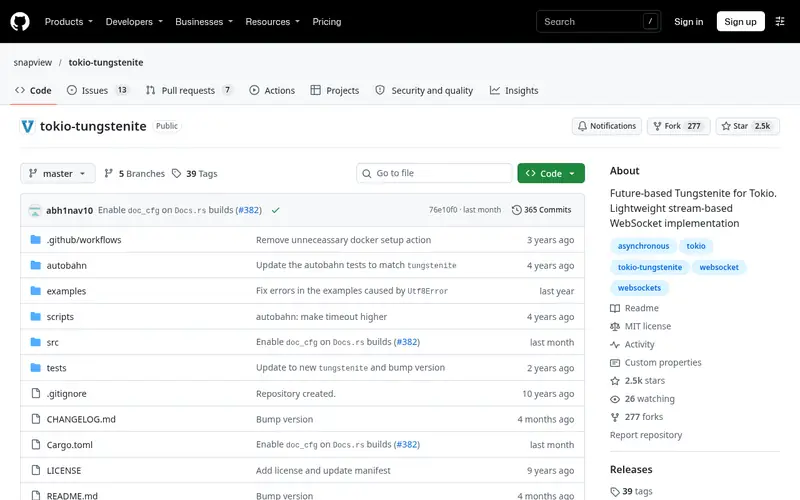
tokio-tungstenite wraps the tungstenite protocol implementation in async streams and sinks for the Tokio runtime. It handles the WebSocket handshake, message framing and ping/pong control frames, and exposes them as Stream and Sink types. You can use it as a client connecting to a remote endpoint or as a server after accepting an HTTP upgrade. It is the usual choice when a service already runs on Tokio and needs WebSocket support without adopting a full web framework.
The crate is MIT licensed and free. It does not include routing, TLS setup or connection management, so you pair it with a TLS crate and your own task handling. Documentation lives on docs.rs. Skip it if you need a blocking API or want batteries-included routing from a framework.
Standout: Works with Tokio and the mature tungstenite protocol core
Free (open source), as listed by the vendor (tokio-tungstenite website). Confirm the current plan price before you buy.
Free plan. Plans change, so confirm on the vendor's pricing page before you buy.
Benefits
- Works with Tokio and the mature tungstenite protocol core
- supports both client and server roles
Drawbacks
- You wire up framing and connection handling yourself
- async-only, so blocking code needs a different path
Skip it if this limit matters to you: you wire up framing and connection handling yourself.
Verdict. A sensible pick for async WebSocket clients and servers on the Tokio runtime.
Alternatives in this guide: tungstenite, fastwebsockets, axum WebSocket support
tungstenite
Best for blocking WebSocket use and the shared protocol core
What it is and where it fits
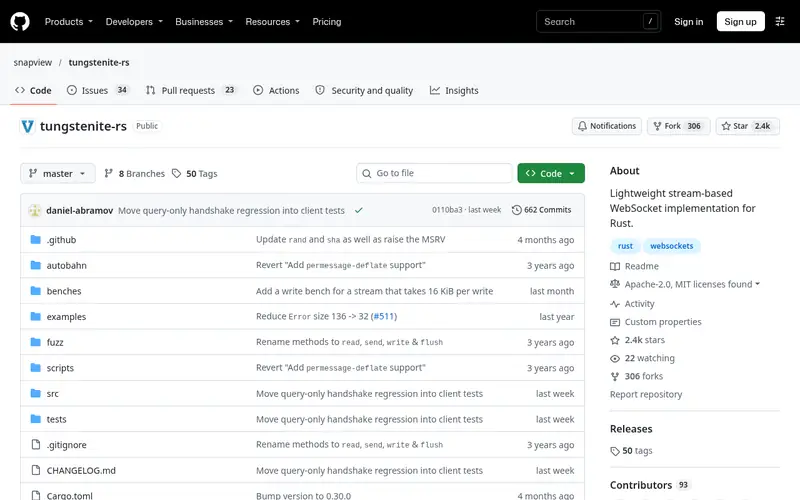
tungstenite is the base WebSocket implementation that tokio-tungstenite and async-tungstenite build on. It handles the handshake, frame parsing, masking and control frames, and works over blocking sockets. It supports several TLS backends through feature flags. If you have a synchronous program, such as a CLI tool or a small service, tungstenite can be simpler than pulling in an async runtime.
It is MIT licensed and free. Because it is blocking, each connection typically needs its own thread, which limits scale compared with async options. Most server projects use it indirectly through tokio-tungstenite rather than directly. Choose it directly for blocking clients or when you want the protocol layer without a runtime.
Standout: Provides the protocol layer used by the async crates
Free (open source), as listed by the vendor (tungstenite website). Confirm the current plan price before you buy.
Free plan. Plans change, so confirm on the vendor's pricing page before you buy.
Benefits
- Provides the protocol layer used by the async crates
- supports blocking sockets and TLS backends
Drawbacks
- Blocking model does not scale like async
- lower-level, so more code to write
Skip it if this limit matters to you: blocking model does not scale like async.
Verdict. A sensible pick for blocking WebSocket use and the shared protocol core.
Alternatives in this guide: tokio-tungstenite, fastwebsockets, axum WebSocket support
fastwebsockets
Best for high-throughput WebSocket servers that need low overhead
What it is and where it fits
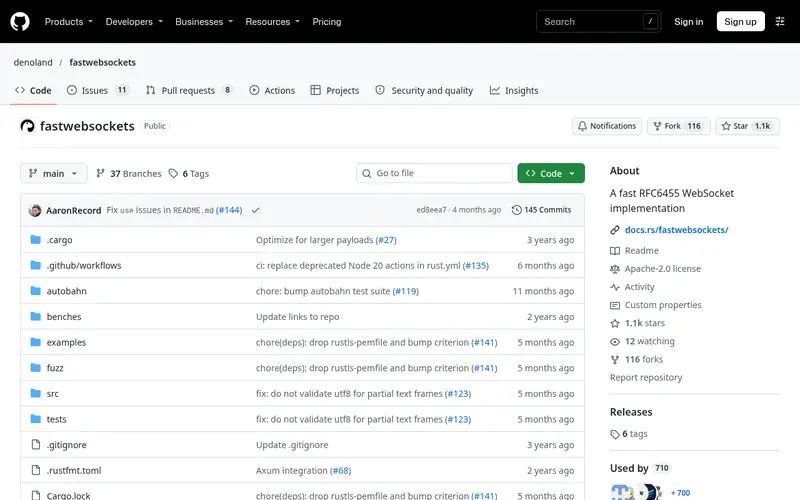
fastwebsockets is a WebSocket library focused on performance, originally developed in the Deno ecosystem. It provides frame reading and writing with an emphasis on low allocation and fast parsing, and it supports the HTTP upgrade flow so you can attach it to a server. It works with Tokio and gives you control over buffers and frame handling.
It is open source and free. The trade-off is a smaller user base and fewer examples than tungstenite, so expect to read the source and docs closely. It suits services that push many small messages and have measured a bottleneck. Skip it if you want the most widely used API or need blocking support.
Standout: Designed for minimal per-message overhead
Free (open source), as listed by the vendor (fastwebsockets website). Confirm the current plan price before you buy.
Free plan. Plans change, so confirm on the vendor's pricing page before you buy.
Benefits
- Designed for minimal per-message overhead
- supports upgrade handling and fragmented messages
Drawbacks
- Smaller ecosystem than tungstenite
- API is lower-level and less documented for beginners
Skip it if this limit matters to you: smaller ecosystem than tungstenite.
Verdict. A sensible pick for high-throughput WebSocket servers that need low overhead.
Alternatives in this guide: tokio-tungstenite, tungstenite, axum WebSocket support
axum WebSocket support
Best for teams already building HTTP services with the axum framework
What it is and where it fits
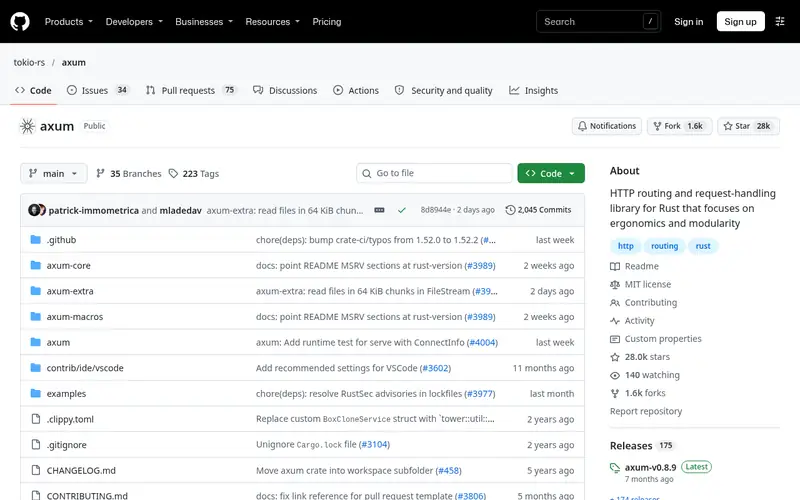
axum includes a WebSocket extractor and upgrade type in its core crate. A handler takes a WebSocketUpgrade, returns a response, and receives a WebSocket stream to read and write messages. Because it shares the router, middleware and state model with the rest of axum, adding a WebSocket endpoint to an existing service takes little extra structure. It runs on Tokio and Hyper.
axum is MIT licensed and free. The WebSocket layer is intentionally thin: you write the receive loop, handle close frames and manage per-connection state. It is a good fit if you already use axum. If you use a different framework, adding axum just for WebSockets is usually not worth it.
Standout: WebSocket upgrade fits the same router and extractor model as other axum handlers
Free (open source), as listed by the vendor (axum WebSocket support website). Confirm the current plan price before you buy.
Free plan. Plans change, so confirm on the vendor's pricing page before you buy.
Benefits
- WebSocket upgrade fits the same router and extractor model as other axum handlers
- built on Tokio and Hyper
Drawbacks
- Tied to the axum framework
- you still handle message loops and state yourself
Skip it if this limit matters to you: tied to the axum framework.
Verdict. A sensible pick for teams already building HTTP services with the axum framework.
Alternatives in this guide: tokio-tungstenite, tungstenite, fastwebsockets
actix-ws
Best for webSocket handling inside Actix Web applications
What it is and where it fits
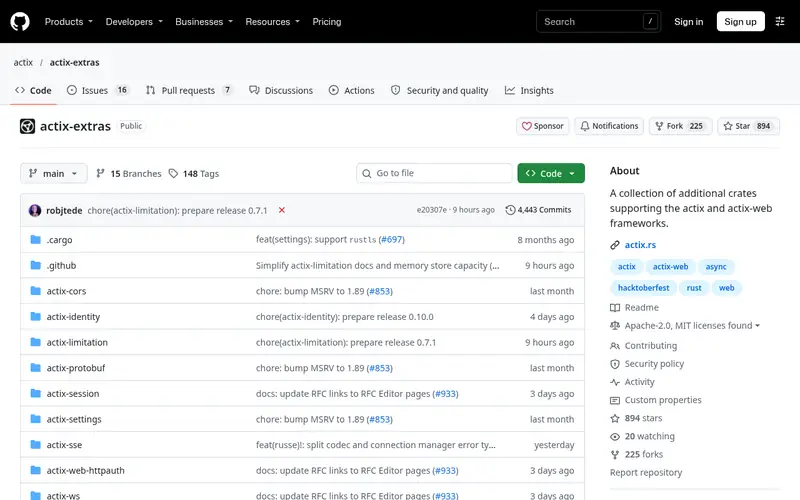
actix-ws provides WebSocket support for Actix Web. It handles the upgrade handshake and gives you a session with separate sender and receiver halves, so one task can read while another writes. It works with the Actix actor and service model and fits into existing route handlers.
It is open source and free. Like axum's support, it covers the transport and leaves message routing, authentication and state to your code. Choose it when your service already runs on Actix Web. If you are starting fresh and have no framework preference, compare it with axum before committing.
Standout: Integrates with Actix Web request handling
Free (open source), as listed by the vendor (actix-ws website). Confirm the current plan price before you buy.
Free plan. Plans change, so confirm on the vendor's pricing page before you buy.
Benefits
- Integrates with Actix Web request handling
- provides sender and receiver halves for concurrent use
Drawbacks
- Only useful within the Actix ecosystem
- fewer standalone examples than tungstenite
Skip it if this limit matters to you: only useful within the Actix ecosystem.
Verdict. A sensible pick for webSocket handling inside Actix Web applications.
Alternatives in this guide: tokio-tungstenite, tungstenite, fastwebsockets
async-tungstenite
Best for async WebSocket code that must work across multiple runtimes
What it is and where it fits
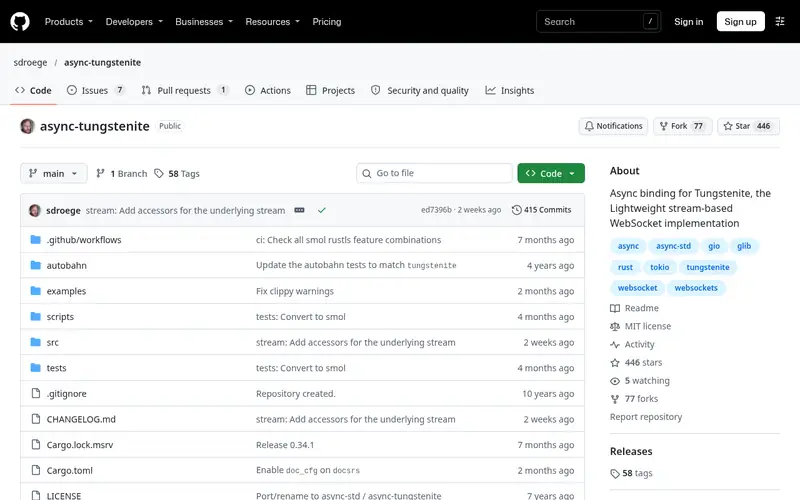
async-tungstenite is an async wrapper around tungstenite that is not tied to a single runtime. Through feature flags it supports Tokio, async-std and other executors, and it offers TLS backends in the same way as tungstenite. That makes it useful for libraries that want to avoid forcing a runtime on their users.
It is MIT licensed and free. The flexibility comes with more feature flags to manage, and its user base is smaller than tokio-tungstenite's. If your project is Tokio-only, tokio-tungstenite is the more direct choice. Pick async-tungstenite when runtime independence is a real requirement.
Standout: Supports Tokio, async-std and other runtimes through features
Free (open source), as listed by the vendor (async-tungstenite website). Confirm the current plan price before you buy.
Free plan. Plans change, so confirm on the vendor's pricing page before you buy.
Benefits
- Supports Tokio, async-std and other runtimes through features
- shares the tungstenite core
Drawbacks
- Feature configuration adds complexity
- less commonly used than tokio-tungstenite
Skip it if this limit matters to you: feature configuration adds complexity.
Verdict. A sensible pick for async WebSocket code that must work across multiple runtimes.
Alternatives in this guide: tokio-tungstenite, tungstenite, fastwebsockets
Who should use what
If you run a Tokio service and need a client or server, start with tokio-tungstenite. If you already build HTTP services with axum or Actix Web, use the framework's built-in WebSocket support to avoid a second stack. If you have measured a throughput bottleneck and control the server loop, evaluate fastwebsockets. If you need blocking code or runtime independence, look at tungstenite or async-tungstenite.
Questions to settle before you buy
What to check before you buy
- Confirm the crate supports your async runtime or blocking model.
- Check the last release date and open issues to judge maintenance.
- Decide whether you need TLS and which backend you will use.
- Review how the library handles ping/pong, close frames and fragmentation.
- Plan connection limits, backpressure and message size caps before going live.
FAQ
Is tokio-tungstenite the same as tungstenite?
No. tungstenite is the blocking protocol implementation. tokio-tungstenite wraps it in async streams and sinks for the Tokio runtime. Most async services use tokio-tungstenite, which pulls in tungstenite as a dependency.
Should I use a framework's WebSocket support or a standalone crate?
Use the framework's support if you already run axum or Actix Web, because it shares routing and middleware. Use a standalone crate like tokio-tungstenite if you have no framework or want tighter control over the connection loop.
Is fastwebsockets faster than tungstenite?
fastwebsockets is designed for low per-message overhead, but the right choice depends on your workload. Measure your own traffic before switching. Both are free and open source, so you can test them in a branch.
When should I choose async-tungstenite over tokio-tungstenite?
Choose async-tungstenite when your code must work across multiple runtimes, such as a library that cannot assume Tokio. If your project is Tokio-only, tokio-tungstenite is the more direct choice.
Do these libraries send data to third parties?
No. They run inside your own process and connect only to the endpoints you configure. Unlike online WebSocket test pages, they do not route your messages through a third-party server, which matters for tokens and production data.
Sources we checked
Method: how we score · editorial policy.
Change log. First published 27 Nov 2026.