Stage 02 · Test · Researched comparison
Best Rust Testing Tools in 2026
Start with cargo test, the built-in test runner in the Rust toolchain. It suits most projects and costs nothing. Add proptest when you want property-based testing with generated inputs, and mockall when you need generated test doubles for traits. Both are open-source crates that build on the standard test harness, so they fit into an existing cargo workflow without a separate platform.

By Shihab Mia
Published 22 Nov 2026 · 7 tools compared
We run no ads and no affiliate links at launch. The order of a list follows our published method. See how we score.
Prices are the starting prices vendors list publicly. Plans change, so confirm the current price on the vendor page before you buy.
Key takeaways
- cargo test ships with the Rust toolchain and runs unit, integration and doc tests with no extra install.
- proptest and quickcheck add property-based testing; mockall generates mock implementations of traits.
- insta handles snapshot testing, and cargo-llvm-cov reports line and branch coverage.
- All picks here are free and open source; confirm current licence terms on each project repository.
Who each pick is for
- Running unit, integration and doc tests in any Rust projectcargo test
- Property-based testing with generated inputs and automatic shrinkingproptest
- Lightweight property-based testing with a small APIquickcheck
- Generating mock implementations of traits for unit testsmockall
- Snapshot testing for output, serialized data and CLI resultsinsta
- Line and branch coverage reports for Rust test suitescargo-llvm-cov
- Fixture-based and parameterized tests in Rustrstest
Comparison
| Tool | Best for | Standout feature | Listed starting price | Free plan or trial |
|---|---|---|---|---|
| 1cargo test | Running unit, integration and doc tests in any Rust project | Ships with the Rust toolchain | Free (open source) | Free plan |
| 2proptest | Property-based testing with generated inputs and automatic shrinking | Generates inputs from strategies | Free (open source) | Free plan |
| 3quickcheck | Lightweight property-based testing with a small API | Small API that is quick to adopt | Free (open source) | Free plan |
| 4mockall | Generating mock implementations of traits for unit tests | Automates mock generation with a macro | Free (open source) | Free plan |
| 5insta | Snapshot testing for output, serialized data and CLI results | Stores snapshots in readable files | Free (open source) | Free plan |
| 6cargo-llvm-cov | Line and branch coverage reports for Rust test suites | Uses LLVM source-based coverage | Free (open source) | Free plan |
| 7rstest | Fixture-based and parameterized tests in Rust | Fixtures with dependency injection | Free (open source) | Free plan |
How we picked
We picked tools that do a distinct job in a Rust test suite and are actively maintained with public repositories. Criteria were fit for the job, platform support through the Rust toolchain, licence and price, and clear limits. We did not run benchmarks or collect user reviews. Details come from vendor documentation, project repositories and public pricing pages. Prices and licences change, so confirm on the project site before you commit.
The tools, one by one
cargo test
Best for running unit, integration and doc tests in any Rust project
What it is and where it fits
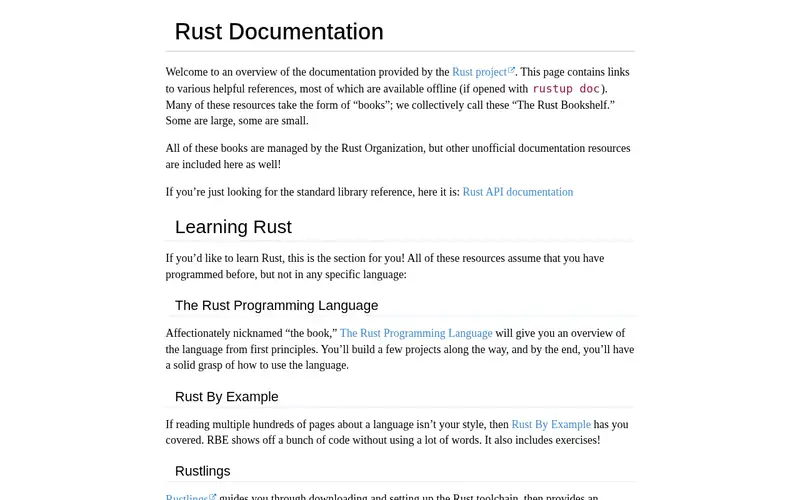
cargo test is the standard test runner included with Cargo. It compiles test targets and runs functions marked with the #[test] attribute, plus examples in documentation comments. Integration tests live in the tests directory and are compiled as separate crates. It runs on every platform the Rust toolchain supports: Linux, macOS and Windows.
There is nothing to license or configure. Test filtering works through name matching, and the --nocapture flag shows printed output. The runner executes tests in parallel by default, which you can limit with --test-threads. It does not generate mocks, shrink property-test failures or report coverage; those jobs need the crates below. Teams that only need a test runner should stay here and skip the rest.
Standout: Ships with the Rust toolchain
Free (open source), as listed by the vendor (cargo test website). Confirm the current plan price before you buy.
Free plan. Plans change, so confirm on the vendor's pricing page before you buy.
Benefits
- Ships with the Rust toolchain
- runs unit, integration and doc tests
Drawbacks
- No built-in mocking, property testing or coverage
- parallel output can be hard to read
Skip it if this limit matters to you: no built-in mocking, property testing or coverage.
Verdict. A sensible pick for running unit, integration and doc tests in any Rust project.
Alternatives in this guide: proptest, quickcheck, mockall
proptest
Best for property-based testing with generated inputs and automatic shrinking
What it is and where it fits
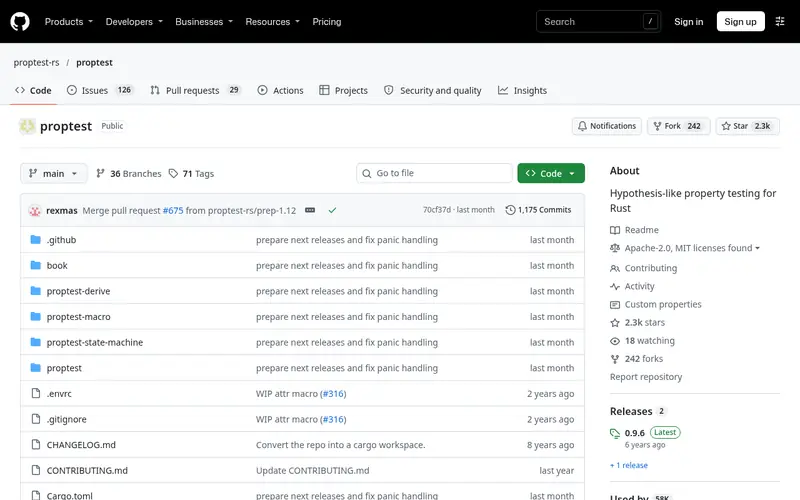
proptest is a property-based testing library. You describe inputs with strategies, and the crate generates many cases, then shrinks a failure down to a small reproducible input. It integrates with cargo test through macros such as proptest! and works on any platform the Rust toolchain supports.
It is published as a crate under an open-source licence. The main cost is runtime: generated cases are slower than hand-written examples, so keep property tests focused. Persistence of failing seeds helps reproduce regressions. Skip it if your tests are simple input-output checks that example-based tests already cover well.
Standout: Generates inputs from strategies
Free (open source), as listed by the vendor (proptest website). Confirm the current plan price before you buy.
Free plan. Plans change, so confirm on the vendor's pricing page before you buy.
Benefits
- Generates inputs from strategies
- shrinks failing cases to a minimal example
Drawbacks
- Slower than example-based tests
- strategies take time to learn
Skip it if this limit matters to you: slower than example-based tests.
Verdict. A sensible pick for property-based testing with generated inputs and automatic shrinking.
Alternatives in this guide: cargo test, quickcheck, mockall
quickcheck
Best for lightweight property-based testing with a small API
What it is and where it fits
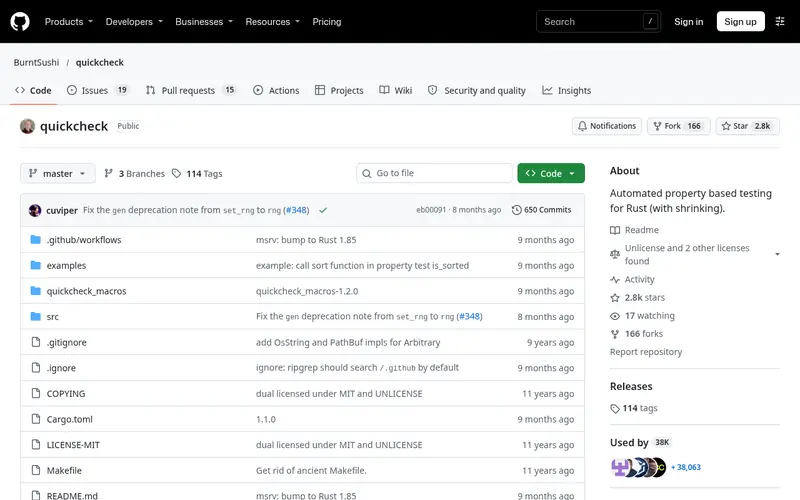
quickcheck is a property-testing crate modeled on the Haskell library of the same name. You write a function that takes generated values and returns a boolean, and the crate runs it across many random inputs. It shrinks failures and reports the smallest counterexample. It runs wherever cargo test runs.
The crate is open source and small, which makes it easy to add to an existing suite. Its generator set is narrower than proptest's, and the project sees less frequent updates. It suits teams that want a minimal property-testing layer without learning a strategy system. For complex generators, proptest is the better fit.
Standout: Small API that is quick to adopt
Free (open source), as listed by the vendor (quickcheck website). Confirm the current plan price before you buy.
Free plan. Plans change, so confirm on the vendor's pricing page before you buy.
Benefits
- Small API that is quick to adopt
- automatic shrinking of failing inputs
Drawbacks
- Fewer generator features than proptest
- less active development
Skip it if this limit matters to you: fewer generator features than proptest.
Verdict. A sensible pick for lightweight property-based testing with a small API.
Alternatives in this guide: cargo test, proptest, mockall
mockall
Best for generating mock implementations of traits for unit tests
What it is and where it fits
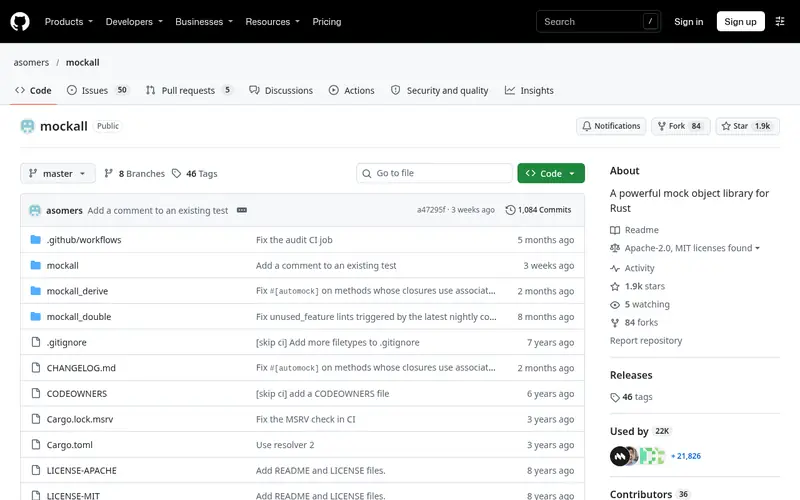
mockall generates mock structs from trait definitions using the automock attribute. Tests set expectations on method calls, return values and call counts. It works with cargo test and runs on the platforms the toolchain supports.
The crate is open source. It fits unit tests where a real dependency is slow or hard to construct, such as network clients or databases. Overuse leads to tests that assert on interactions rather than behavior, so keep mocks at boundaries. If your code relies on concrete types rather than traits, refactoring is needed before mockall helps.
Standout: Automates mock generation with a macro
Free (open source), as listed by the vendor (mockall website). Confirm the current plan price before you buy.
Free plan. Plans change, so confirm on the vendor's pricing page before you buy.
Benefits
- Automates mock generation with a macro
- supports expectations and call counts
Drawbacks
- Macro errors can be hard to read
- mocking traits with generics needs care
Skip it if this limit matters to you: macro errors can be hard to read.
Verdict. A sensible pick for generating mock implementations of traits for unit tests.
Alternatives in this guide: cargo test, proptest, quickcheck
insta
Best for snapshot testing for output, serialized data and CLI results
What it is and where it fits
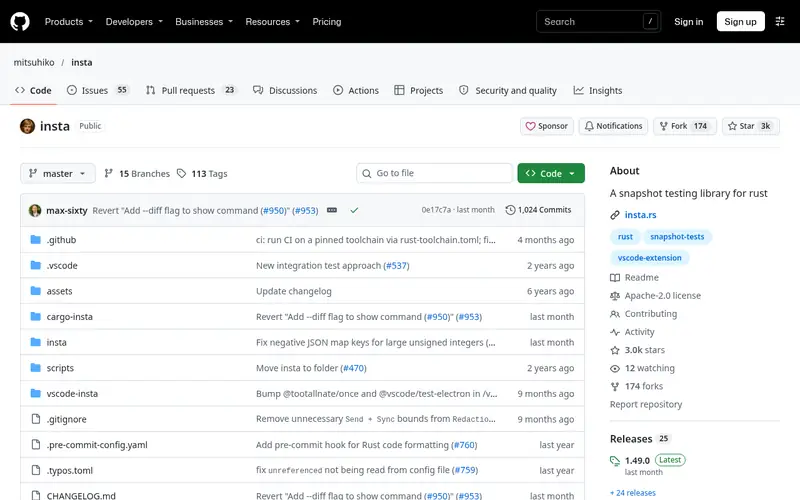
insta is a snapshot testing library. Tests compare output against a stored snapshot file, and a cargo insta review command lets you accept or reject changes. It suits serialized structs, rendered output and command-line results. It runs on the platforms the Rust toolchain supports.
The crate is open source. Snapshots are committed with the code, so changes show up in review. The risk is accepting snapshots without reading them, which hides regressions. Keep snapshots small and focused. It pairs well with cargo test but does not replace example-based assertions for logic.
Standout: Stores snapshots in readable files
Free (open source), as listed by the vendor (insta website). Confirm the current plan price before you buy.
Free plan. Plans change, so confirm on the vendor's pricing page before you buy.
Benefits
- Stores snapshots in readable files
- review workflow for accepting changes
Drawbacks
- Snapshots need review discipline
- large outputs make diffs noisy
Skip it if this limit matters to you: snapshots need review discipline.
Verdict. A sensible pick for snapshot testing for output, serialized data and CLI results.
Alternatives in this guide: cargo test, proptest, quickcheck
cargo-llvm-cov
Best for line and branch coverage reports for Rust test suites
What it is and where it fits
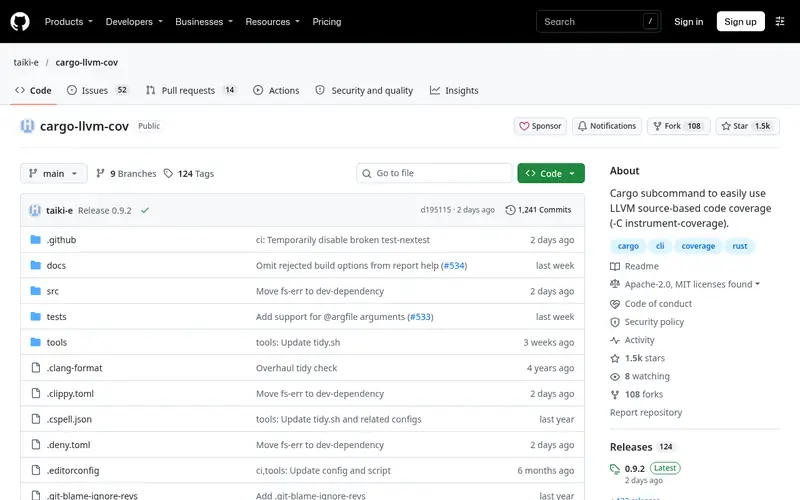
cargo-llvm-cov is a cargo subcommand that collects coverage using LLVM instrumentation. It reports line and branch coverage and exports formats such as lcov and HTML for CI or local review. It runs on Linux, macOS and Windows where the Rust toolchain and llvm-tools are available.
The project is open source. You install it with cargo install and add the llvm-tools component through rustup. Coverage builds are slower, so run them in CI or on demand rather than on every save. Coverage numbers show what ran, not whether assertions are correct; treat them as one signal among several.
Standout: Uses LLVM source-based coverage
Free (open source), as listed by the vendor (cargo-llvm-cov website). Confirm the current plan price before you buy.
Free plan. Plans change, so confirm on the vendor's pricing page before you buy.
Benefits
- Uses LLVM source-based coverage
- outputs lcov, text and HTML reports
Drawbacks
- Requires the llvm-tools component
- coverage runs are slower than plain tests
Skip it if this limit matters to you: requires the llvm-tools component.
Verdict. A sensible pick for line and branch coverage reports for Rust test suites.
Alternatives in this guide: cargo test, proptest, quickcheck
rstest
Best for fixture-based and parameterized tests in Rust
What it is and where it fits
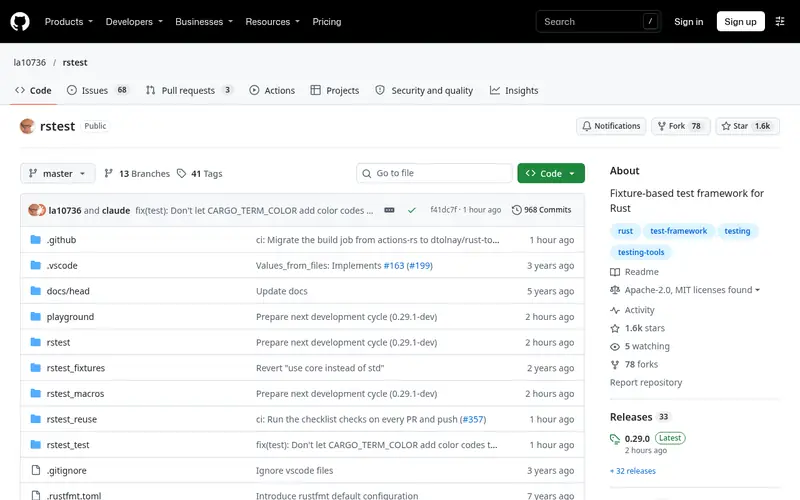
rstest adds fixtures and parameterized tests to cargo test. You define fixtures as functions, and tests request them by name; the macro resolves dependencies. Parameterized cases let one test run across a table of inputs. It runs on the platforms the Rust toolchain supports.
The crate is open source. It reduces duplication in suites with shared setup, such as database handles or config objects. The trade-off is extra macro syntax that new contributors must learn. For small suites, plain helper functions may be enough. It works alongside the other crates here and does not replace the standard runner.
Standout: Fixtures with dependency injection
Free (open source), as listed by the vendor (rstest website). Confirm the current plan price before you buy.
Free plan. Plans change, so confirm on the vendor's pricing page before you buy.
Benefits
- Fixtures with dependency injection
- table-driven parameterized cases
Drawbacks
- Adds macros beyond standard test syntax
- fixture lifetimes need care
Skip it if this limit matters to you: adds macros beyond standard test syntax.
Verdict. A sensible pick for fixture-based and parameterized tests in Rust.
Alternatives in this guide: cargo test, proptest, quickcheck
Who should use what
If you are starting a project, use cargo test alone and add crates only when a need appears. Teams testing parsers, encoders or data transforms should add proptest for generated inputs, or quickcheck for a lighter option. Code with network or database boundaries benefits from mockall, while CLI tools and serialized output fit insta snapshots. Projects tracking coverage in CI should add cargo-llvm-cov, and suites with heavy shared setup can use rstest fixtures.
Questions to settle before you buy
What to check before you buy
- Confirm the crate supports your current Rust toolchain version and target platforms.
- Check the licence terms on the repository if you ship commercially.
- Decide whether you need property testing, mocking or snapshots before adding dependencies.
- For coverage, install the llvm-tools component and test the report format in CI.
- Keep test data and credentials out of committed snapshots and fixtures.
FAQ
Is cargo test enough on its own?
For many projects, yes. It runs unit, integration and doc tests with no extra dependency. Add crates only when you need generated inputs, mocks, snapshots or coverage reports.
Do these tools work on Windows, macOS and Linux?
Yes. They build on the Rust toolchain and cargo, which support all three platforms. cargo-llvm-cov also needs the llvm-tools component installed through rustup.
Are these Rust testing tools free?
All tools listed here are free and open source. Check each repository for the exact licence, since terms can differ between projects.
Can I use proptest and quickcheck together?
You can, but it usually adds little. Both do property-based testing with different APIs. Pick one per project to keep the suite consistent and easier to maintain.
Does coverage prove my tests are good?
No. Coverage shows which code ran during tests. It does not show whether assertions are correct or edge cases are covered. Use it as one signal alongside review and targeted tests.
Sources we checked
Method: how we score · editorial policy.
Change log. First published 22 Nov 2026.