Stage 02 · Test · Researched comparison
Best Rust JWT Libraries in 2026
jsonwebtoken is the first pick for most teams. It is widely used, covers HS, RS, ES and PS algorithms, and fits typical web service token signing and verification. Choose josekit if you need JOSE features such as JWK sets, JWE encryption or broader algorithm coverage. Choose jwt-compact if you want strongly typed tokens with built-in validation and a smaller API surface. All three are open source and free to use.

By Shihab Mia
Published 27 Nov 2026 · 6 tools compared
We run no ads and no affiliate links at launch. The order of a list follows our published method. See how we score.
Prices are the starting prices vendors list publicly. Plans change, so confirm the current price on the vendor page before you buy.
Key takeaways
- jsonwebtoken is the common default for HMAC and RSA signing in Rust web services and is free under the MIT license.
- josekit covers more of the JOSE family, including JWK, JWS and JWE, and is free under the MIT license.
- jwt-compact focuses on typed claims and validation rules rather than raw token handling.
- Every library here is open source, so there is no paid tier and no per-token cost.
Who each pick is for
- General JWT signing and verification in web servicesjsonwebtoken
- Full JOSE support including JWK, JWS and JWEjosekit
- Typed claims with built-in validation rulesjwt-compact
- Minimal HS256 and RS256 token handlingjwt-simple
- Capability tokens as an alternative to JWTbiscuit-auth
- JWT validation in async services with JWKS rotationaliri
Comparison
| Tool | Best for | Standout feature | Listed starting price | Free plan or trial |
|---|---|---|---|---|
| 1jsonwebtoken | General JWT signing and verification in web services | Wide algorithm support | Free (open source) | Free plan |
| 2josekit | Full JOSE support including JWK, JWS and JWE | Covers JWS, JWE and JWK | Free (open source) | Free plan |
| 3jwt-compact | Typed claims with built-in validation rules | Strong typing for claims | Free (open source) | Free plan |
| 4jwt-simple | Minimal HS256 and RS256 token handling | Small dependency footprint | Free (open source) | Free plan |
| 5biscuit-auth | Capability tokens as an alternative to JWT | Offline attenuation of permissions | Free (open source) | Free plan |
| 6aliri | JWT validation in async services with JWKS rotation | JWKS fetching and key rotation built in | Free (open source) | Free plan |
How we picked
We compared crates on fit for common JWT jobs (signing, verification, validation, key handling), supported algorithms, platform and runtime requirements, license, and main limits. Sources are the official project repositories and their documentation. Prices and licenses can change, so confirm the current terms on each project page before you commit.
The tools, one by one
jsonwebtoken
Best for general JWT signing and verification in web services
What it is and where it fits
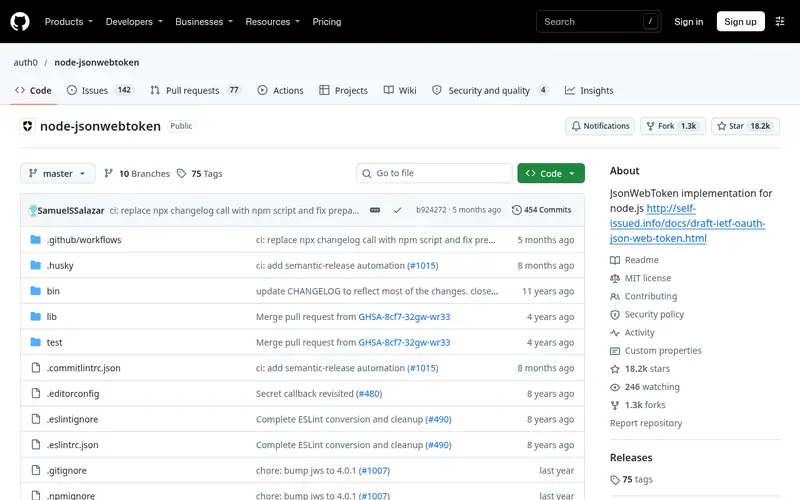
jsonwebtoken is the most common choice for JWT work in Rust. It encodes and decodes tokens and supports HMAC, RSA, ECDSA and RSA-PSS families through the ring or aws-lc-rs backends. You define a claims struct with serde, pick an algorithm, and call encode or decode. Validation covers expiration, audience and issuer through a Validation struct you configure.
It runs anywhere Rust runs and has no runtime dependencies beyond its crypto backend. The crate is MIT licensed. It does not implement JWE, so encrypted tokens are out of scope. JWK set fetching and rotation are left to your own code. Teams that need those features should look at josekit instead.
Standout: Wide algorithm support
Free (open source), as listed by the vendor (jsonwebtoken website). Confirm the current plan price before you buy.
Free plan. Plans change, so confirm on the vendor's pricing page before you buy.
Benefits
- Wide algorithm support
- simple encode and decode API
Drawbacks
- No JWE encryption
- limited JWK set handling
Skip it if this limit matters to you: no JWE encryption.
Verdict. A sensible pick for general JWT signing and verification in web services.
Alternatives in this guide: josekit, jwt-compact, jwt-simple
josekit
Best for full JOSE support including JWK, JWS and JWE
What it is and where it fits
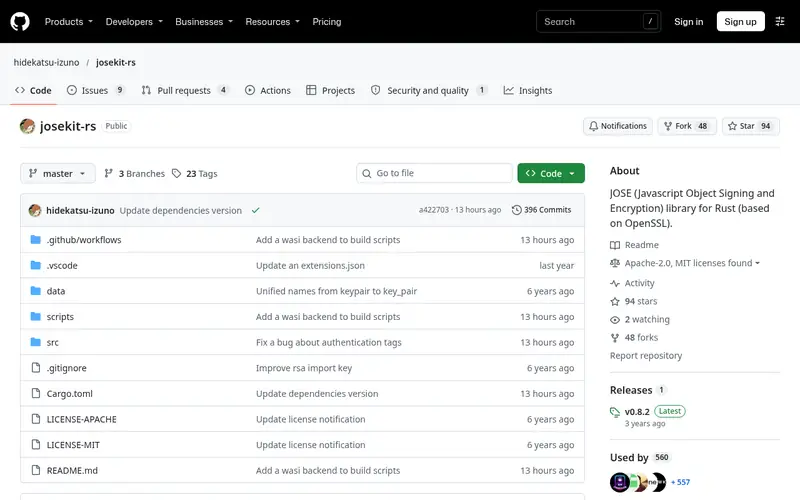
josekit implements more of the JOSE specifications than most Rust crates. It handles JWS signing and verification, JWE encryption and decryption, and JWK and JWK Set parsing. That makes it a fit for systems that exchange keys through JWK endpoints or need encrypted tokens rather than signed-only ones.
The crate is MIT licensed and works on standard Rust targets. The API is more explicit than jsonwebtoken: you build signers, verifiers, encryphers and decryphers as separate objects. That structure helps when you support several algorithms at once, but it adds boilerplate for a single HS256 service. If you only sign and verify simple tokens, jsonwebtoken is less work.
Standout: Covers JWS, JWE and JWK
Free (open source), as listed by the vendor (josekit website). Confirm the current plan price before you buy.
Free plan. Plans change, so confirm on the vendor's pricing page before you buy.
Benefits
- Covers JWS, JWE and JWK
- broad algorithm list
Drawbacks
- Larger API to learn
- more setup for simple cases
Skip it if this limit matters to you: larger API to learn.
Verdict. A sensible pick for full JOSE support including JWK, JWS and JWE.
Alternatives in this guide: jsonwebtoken, jwt-compact, jwt-simple
jwt-compact
Best for typed claims with built-in validation rules
What it is and where it fits
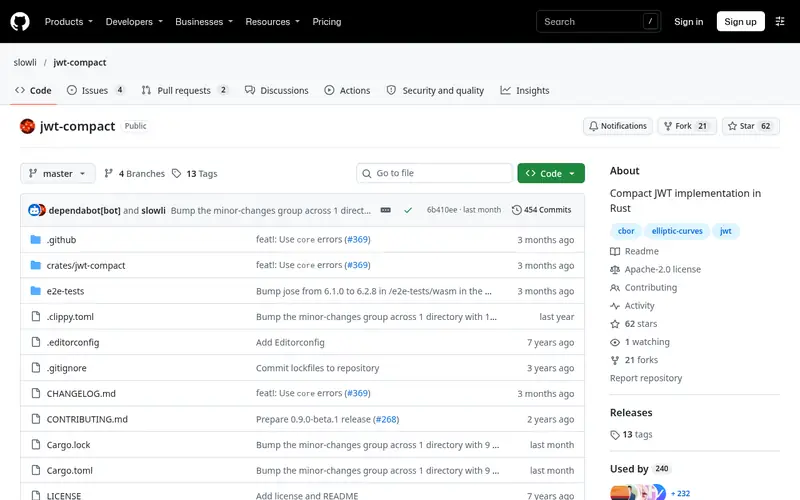
jwt-compact centers on typed tokens. You derive traits on a claims struct, and the library handles serialization, signing and validation together. Expiration and other time-based checks are part of the token type, so invalid tokens fail at decode time rather than in later application code.
It is MIT licensed and runs on standard Rust targets. The design suits services that want compile-time guarantees about claim shape and a small, focused API. It covers fewer algorithms and JOSE features than josekit, and it does not aim to be a general JOSE toolkit. Teams that need JWE or JWK set handling should use josekit.
Standout: Strong typing for claims
Free (open source), as listed by the vendor (jwt-compact website). Confirm the current plan price before you buy.
Free plan. Plans change, so confirm on the vendor's pricing page before you buy.
Benefits
- Strong typing for claims
- validation built into the type
Drawbacks
- Smaller ecosystem
- fewer algorithm options than josekit
Skip it if this limit matters to you: smaller ecosystem.
Verdict. A sensible pick for typed claims with built-in validation rules.
Alternatives in this guide: jsonwebtoken, josekit, jwt-simple
jwt-simple
Best for minimal HS256 and RS256 token handling
What it is and where it fits
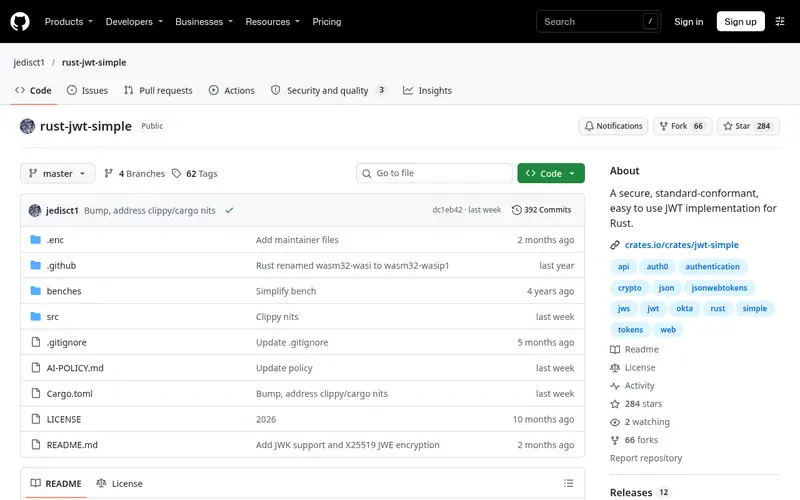
jwt-simple is a small crate for encoding and decoding JWTs with a limited set of algorithms, mainly HMAC and RSA. The API is short: build a header and claims, then encode or decode with a key. It suits scripts and small services that only need basic signing and verification.
It is MIT licensed and has a modest dependency tree, which helps build times. Validation is thinner than in jsonwebtoken, so you check expiration and audience yourself in many cases. It does not cover ECDSA or JWE. If you need broad algorithm support or structured validation, jsonwebtoken or josekit are better fits.
Standout: Small dependency footprint
Free (open source), as listed by the vendor (jwt-simple website). Confirm the current plan price before you buy.
Free plan. Plans change, so confirm on the vendor's pricing page before you buy.
Benefits
- Small dependency footprint
- straightforward API
Drawbacks
- Narrow algorithm support
- fewer validation helpers
Skip it if this limit matters to you: narrow algorithm support.
Verdict. A sensible pick for minimal HS256 and RS256 token handling.
Alternatives in this guide: jsonwebtoken, josekit, jwt-compact
biscuit-auth
Best for capability tokens as an alternative to JWT
What it is and where it fits
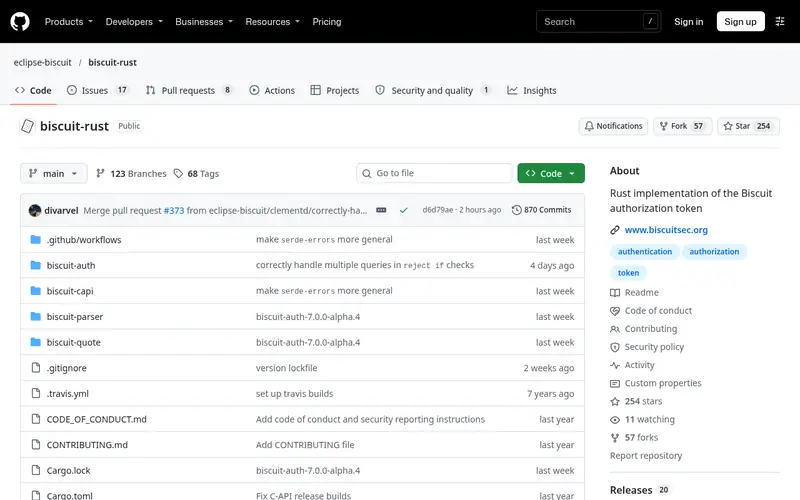
biscuit-auth implements Biscuit tokens, which are not JWTs. A Biscuit token carries authorization logic that a holder can attenuate offline without contacting the issuer. That model fits delegated access and fine-grained permissions better than a flat claims list in some systems.
The crate is Apache-2.0 licensed and runs on standard Rust targets. It is the wrong pick if you must interoperate with existing JWT consumers, gateways or identity providers. It is the right pick when you control both ends and want attenuation and embedded authorization checks. Treat it as a separate design choice, not a drop-in JWT replacement.
Standout: Offline attenuation of permissions
Free (open source), as listed by the vendor (biscuit-auth website). Confirm the current plan price before you buy.
Free plan. Plans change, so confirm on the vendor's pricing page before you buy.
Benefits
- Offline attenuation of permissions
- expressive authorization rules
Drawbacks
- Not a JWT implementation
- different token format and tooling
Skip it if this limit matters to you: not a JWT implementation.
Verdict. A sensible pick for capability tokens as an alternative to JWT.
Alternatives in this guide: jsonwebtoken, josekit, jwt-compact
aliri
Best for jWT validation in async services with JWKS rotation
What it is and where it fits
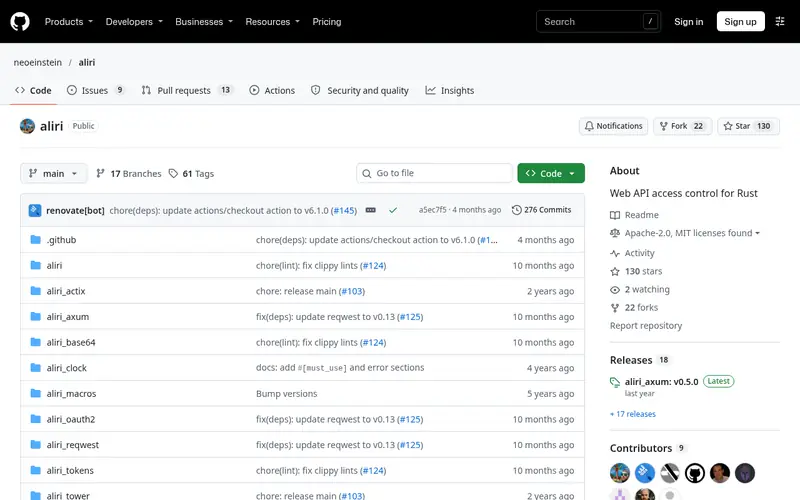
aliri is a set of crates for validating JWTs in services, with a focus on fetching and rotating keys from a JWKS endpoint. It integrates with async runtimes and is aimed at resource servers that check tokens issued elsewhere rather than services that mint them.
The project is MIT licensed. It splits functionality across crates, so you add the pieces you need. That structure helps when you want key rotation handled for you, but it means more configuration than a single encode and decode call. Teams that both issue and verify tokens in one service may prefer jsonwebtoken for issuing and aliri for checking tokens from an identity provider.
Standout: JWKS fetching and key rotation built in
Free (open source), as listed by the vendor (aliri website). Confirm the current plan price before you buy.
Free plan. Plans change, so confirm on the vendor's pricing page before you buy.
Benefits
- JWKS fetching and key rotation built in
- async-friendly design
Drawbacks
- Validation-focused, less about issuing tokens
- more moving parts
Skip it if this limit matters to you: validation-focused, less about issuing tokens.
Verdict. A sensible pick for JWT validation in async services with JWKS rotation.
Alternatives in this guide: jsonwebtoken, josekit, jwt-compact
Who should use what
If you run a typical web service that signs and verifies HS256 or RS256 tokens, start with jsonwebtoken. If you need JWE encryption, JWK set parsing or several algorithms in one system, use josekit. If you want typed claims with validation built into the type, use jwt-compact. If your service only validates tokens from an external identity provider and needs JWKS rotation, look at aliri. If you control both ends and want offline attenuation, consider biscuit-auth as a separate design.
Questions to settle before you buy
What to check before you buy
- Confirm the crate supports the exact algorithms your issuer and consumers use.
- Check whether you need JWE encryption or only JWS signing and verification.
- Decide if JWK set fetching and key rotation must be handled by the library.
- Review how expiration, audience and issuer validation are configured.
- Check the license and the crate's recent release activity before adopting it.
FAQ
Is jsonwebtoken still maintained?
The jsonwebtoken repository shows ongoing releases and issue activity. Check the repository for the latest version and changelog before adopting it, since maintenance status can change over time.
Can these libraries encrypt tokens?
josekit supports JWE encryption and decryption. jsonwebtoken, jwt-simple and jwt-compact focus on signed tokens (JWS). If you need encrypted tokens, josekit is the fit among these options.
Which library handles JWK sets?
josekit parses JWK and JWK Set data. aliri focuses on fetching and rotating keys from a JWKS endpoint for validation. jsonwebtoken leaves JWK set handling to your own code.
Are these libraries free?
Yes. All the crates listed are open source with no paid tier. Licenses vary by project, so check each repository for the exact terms.
Is biscuit-auth a JWT library?
No. biscuit-auth implements Biscuit tokens, a different format with offline attenuation. It is listed as an alternative for teams that control both ends and want capability-style authorization.
Sources we checked
Method: how we score · editorial policy.
Change log. First published 27 Nov 2026.