Stage 02 · Test · Researched comparison
Best Ruby Testing Frameworks in 2026
RSpec is the first pick for most teams that want a readable, behavior-driven syntax and a large ecosystem of extensions. Minitest suits developers who prefer a small, fast framework that ships with Ruby. Cucumber fits teams that write acceptance tests in plain language with non-developers. All three are open source and free to use.

By Shihab Mia
Published 22 Nov 2026 · 8 tools compared
We run no ads and no affiliate links at launch. The order of a list follows our published method. See how we score.
Prices are the starting prices vendors list publicly. Plans change, so confirm the current price on the vendor page before you buy.
Key takeaways
- RSpec, Minitest, and Cucumber are free and open source, so cost is not a factor when choosing between them.
- Minitest ships with Ruby, so it needs no extra install for basic unit tests.
- RSpec has the largest set of matchers and community extensions for behavior-driven tests.
- Cucumber runs plain-language feature files and works best when business stakeholders read the tests.
Who each pick is for
- Teams that want readable behavior-driven tests and rich matchersRSpec
- Developers who want a small, fast framework bundled with RubyMinitest
- Teams writing acceptance tests in plain language with stakeholdersCucumber
- Simulating user interaction in browser-based acceptance testsCapybara
- Building test data with reusable factories instead of fixturesFactory Bot
- One-line matchers for common Rails model and controller testsShoulda Matchers
- Measuring test coverage and finding untested codeSimpleCov
- Maintaining older Ruby projects that already use xUnit-style testsTest::Unit
Comparison
| Tool | Best for | Standout feature | Listed starting price | Free plan or trial |
|---|---|---|---|---|
| 1RSpec | Teams that want readable behavior-driven tests and rich matchers | Expressive DSL with nested describe and context blocks | Free (open source) | Free plan |
| 2Minitest | Developers who want a small, fast framework bundled with Ruby | Ships with Ruby, so no extra install for basic use | Free (open source) | Free plan |
| 3Cucumber | Teams writing acceptance tests in plain language with stakeholders | Feature files in plain language that non-developers can read | Free (open source) | Free plan |
| 4Capybara | Simulating user interaction in browser-based acceptance tests | Works with RSpec, Minitest, and Cucumber | Free (open source) | Free plan |
| 5Factory Bot | Building test data with reusable factories instead of fixtures | Clear factory definitions that replace brittle fixtures | Free (open source) | Free plan |
| 6Shoulda Matchers | One-line matchers for common Rails model and controller tests | Short matchers for validations, associations, and routes | Free (open source) | Free plan |
| 7SimpleCov | Measuring test coverage and finding untested code | Works with RSpec and Minitest | Free (open source) | Free plan |
| 8Test::Unit | Maintaining older Ruby projects that already use xUnit-style tests | Familiar xUnit style for developers coming from other languages | Free (open source) | Free plan |
How we picked
We picked frameworks and libraries that do the job named for this keyword: writing and running tests for Ruby and Rails code. Criteria were fit for unit, integration, or acceptance testing; platform support; price and license; and the main limits users hit in practice. Sources are vendor pages, official documentation, and project repositories. Prices and plan details change, so confirm current terms on the vendor site before you commit.
The tools, one by one
RSpec
Best for teams that want readable behavior-driven tests and rich matchers
What it is and where it fits
RSpec is a behavior-driven testing framework for Ruby. You write specs with describe, context, and it blocks, and assert with matchers like expect(value).to eq(4). It runs on any platform that runs Ruby, including macOS, Linux, and Windows, and it works with Rails through the rspec-rails gem. The project is open source under the MIT license.
RSpec is not bundled with Ruby, so you add it to your Gemfile and run it with the rspec command. Its structure encourages grouping tests by behavior, which helps when a codebase grows. Extensions cover things like mocking, Rails helpers, and CI output formats. The main cost is learning the DSL and keeping large suites fast. Skip RSpec if you want the smallest possible dependency set or prefer assertions over a custom syntax.
Standout: Expressive DSL with nested describe and context blocks
Free (open source), as listed by the vendor (RSpec website). Confirm the current plan price before you buy.
Free plan. Plans change, so confirm on the vendor's pricing page before you buy.
Benefits
- Expressive DSL with nested describe and context blocks
- large ecosystem of extensions and formatters
Drawbacks
- More setup and syntax to learn than Minitest
- slower startup on very large suites
Skip it if this limit matters to you: more setup and syntax to learn than Minitest.
Verdict. A sensible pick for teams that want readable behavior-driven tests and rich matchers.
Minitest
Best for developers who want a small, fast framework bundled with Ruby
What it is and where it fits
Minitest is a testing framework that ships with Ruby. It provides a complete suite of test, spec, mock, and benchmark tools in a small package. You can write tests in the classic assert style or in a spec style with describe and it blocks. It runs wherever Ruby runs and needs no separate install for the bundled version.
Because it is part of the standard library, Minitest is a low-friction choice for new projects and small gems. It supports parallel test execution, which helps on larger suites. The trade-off is a smaller set of matchers and fewer community extensions than RSpec. Teams that want a minimal dependency footprint or are maintaining older code often stay with Minitest. Skip it if you need the richer DSL and plugin ecosystem that RSpec offers.
Standout: Ships with Ruby, so no extra install for basic use
Free (open source), as listed by the vendor (Minitest website). Confirm the current plan price before you buy.
Free plan. Plans change, so confirm on the vendor's pricing page before you buy.
Benefits
- Ships with Ruby, so no extra install for basic use
- small and fast with a simple assertion API
Drawbacks
- Fewer built-in matchers than RSpec
- smaller ecosystem of third-party extensions
Skip it if this limit matters to you: fewer built-in matchers than RSpec.
Verdict. A sensible pick for developers who want a small, fast framework bundled with Ruby.
Cucumber
Best for teams writing acceptance tests in plain language with stakeholders
What it is and where it fits
Cucumber is a tool for behavior-driven development that runs tests written in Gherkin, a plain-language syntax with Given, When, and Then steps. The Ruby implementation, cucumber-ruby, connects each step to Ruby code. It runs on any platform with Ruby and integrates with Rails projects.
Cucumber works best for acceptance tests that describe user-facing behavior, especially when product managers or QA staff read the feature files. It is not a replacement for unit tests; most teams pair it with RSpec or Minitest. The extra step-definition layer adds maintenance work, and suites can get slow if feature files grow large. Skip Cucumber if your team does not need plain-language specs or if only developers read the tests.
Standout: Feature files in plain language that non-developers can read
Free (open source), as listed by the vendor (Cucumber website). Confirm the current plan price before you buy.
Free plan. Plans change, so confirm on the vendor's pricing page before you buy.
Benefits
- Feature files in plain language that non-developers can read
- strong fit for behavior-driven collaboration
Drawbacks
- Extra layer between feature files and code
- slower to write than direct unit tests
Skip it if this limit matters to you: extra layer between feature files and code.
Verdict. A sensible pick for teams writing acceptance tests in plain language with stakeholders.
Capybara
Best for simulating user interaction in browser-based acceptance tests
What it is and where it fits
Capybara is a library for writing browser-based acceptance tests in Ruby. It simulates how a user interacts with a page: clicking links, filling forms, and checking content. It is not a standalone test framework. You use it inside RSpec, Minitest, or Cucumber. It runs on any platform with Ruby and supports drivers for real browsers and headless setups.
Capybara is the common choice for Rails system tests and for teams that need to verify JavaScript-driven pages. It handles waiting for asynchronous elements, which reduces flaky tests. The main limit is speed: browser tests are much slower than unit tests, so most teams keep them to critical paths. Skip Capybara if you only need unit or integration tests that do not touch a browser.
Standout: Works with RSpec, Minitest, and Cucumber
Free (open source), as listed by the vendor (Capybara website). Confirm the current plan price before you buy.
Free plan. Plans change, so confirm on the vendor's pricing page before you buy.
Benefits
- Works with RSpec, Minitest, and Cucumber
- driver support for real browsers and headless setups
Drawbacks
- Not a test framework on its own
- browser tests are slower than unit tests
Skip it if this limit matters to you: not a test framework on its own.
Verdict. A sensible pick for simulating user interaction in browser-based acceptance tests.
Factory Bot
Best for building test data with reusable factories instead of fixtures
What it is and where it fits
Factory Bot is a library for setting up Ruby objects as test data. You define factories once and build or create records in tests, which replaces hand-written fixtures. It works with RSpec, Minitest, and Cucumber, and runs on any platform with Ruby. The project is open source under the MIT license.
Factory Bot helps when tests need varied or related records, such as a user with several posts. It supports associations, traits, and sequences. The trade-off is that creating database records in every test can slow a suite, so many teams use build instead of create where possible. Skip Factory Bot if your project uses simple fixtures and does not need generated data.
Standout: Clear factory definitions that replace brittle fixtures
Free (open source), as listed by the vendor (Factory Bot website). Confirm the current plan price before you buy.
Free plan. Plans change, so confirm on the vendor's pricing page before you buy.
Benefits
- Clear factory definitions that replace brittle fixtures
- works with RSpec, Minitest, and Cucumber
Drawbacks
- Not a test framework by itself
- factories can get slow if overused
Skip it if this limit matters to you: not a test framework by itself.
Verdict. A sensible pick for building test data with reusable factories instead of fixtures.
Shoulda Matchers
Best for one-line matchers for common Rails model and controller tests
What it is and where it fits
Shoulda Matchers is a library of one-line matchers for testing common Rails functionality. It covers validations, associations, and routes, so a test like it { should validate_presence_of(:name) } replaces several lines of setup. It works with RSpec and Minitest and runs on any platform with Ruby and Rails. The project is open source under the MIT license.
The library is useful for trimming repetitive model tests in Rails apps. It is Rails-specific, so it does not apply to plain Ruby gems or non-Rails projects. Some teams avoid it because a short matcher can hide the behavior a test verifies. Skip Shoulda Matchers if you want explicit assertions or if your project does not use Rails.
Standout: Short matchers for validations, associations, and routes
Free (open source), as listed by the vendor (Shoulda Matchers website). Confirm the current plan price before you buy.
Free plan. Plans change, so confirm on the vendor's pricing page before you buy.
Benefits
- Short matchers for validations, associations, and routes
- works with RSpec and Minitest
Drawbacks
- Rails-specific, so it does not help plain Ruby projects
- can hide what a test actually checks
Skip it if this limit matters to you: rails-specific, so it does not help plain Ruby projects.
Verdict. A sensible pick for one-line matchers for common Rails model and controller tests.
SimpleCov
Best for measuring test coverage and finding untested code
What it is and where it fits
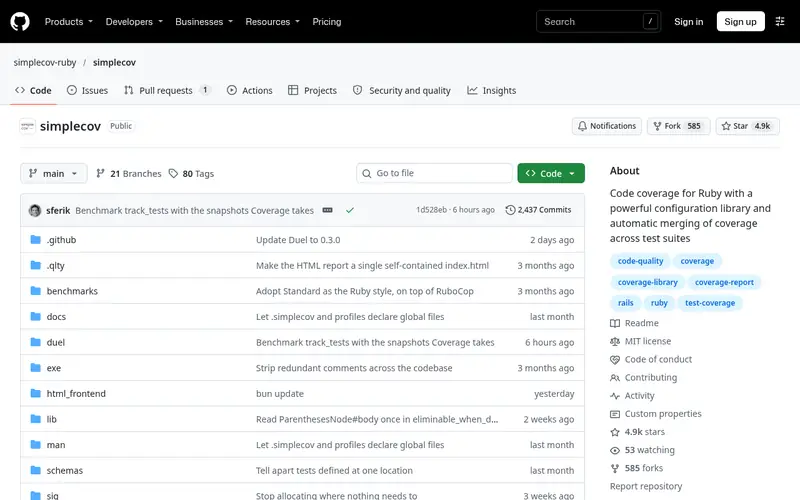
SimpleCov is a code coverage tool for Ruby. It tracks which lines your tests execute and produces HTML reports that show covered and uncovered code. It works with RSpec and Minitest and runs on any platform with Ruby. The project is open source under the MIT license.
SimpleCov is often added to CI to catch code that tests never touch. It supports merging results from parallel test runs and can enforce a minimum coverage threshold. The main limit is that coverage measures execution, not correctness: a high number does not mean the tests are good. Skip SimpleCov if you only want a quick local check and do not need reports or thresholds.
Standout: Works with RSpec and Minitest
Free (open source), as listed by the vendor (SimpleCov website). Confirm the current plan price before you buy.
Free plan. Plans change, so confirm on the vendor's pricing page before you buy.
Benefits
- Works with RSpec and Minitest
- HTML reports show which lines are covered
Drawbacks
- Coverage numbers do not prove test quality
- adds some runtime overhead
Skip it if this limit matters to you: coverage numbers do not prove test quality.
Verdict. A sensible pick for measuring test coverage and finding untested code.
Test::Unit
Best for maintaining older Ruby projects that already use xUnit-style tests
What it is and where it fits
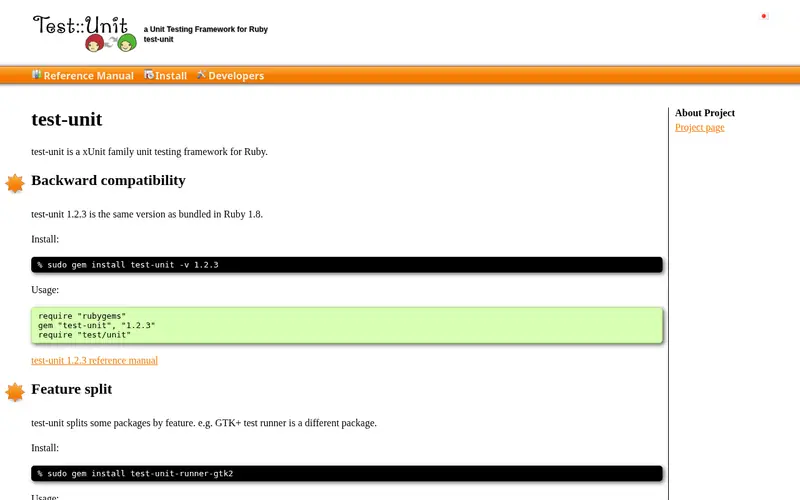
Test::Unit is an xUnit-style testing framework for Ruby. It uses test classes with methods named test_*, plus assertion methods like assert_equal. It runs on any platform with Ruby. The project is open source under the Ruby license and is maintained as a separate gem.
Test::Unit is a reasonable fit for teams that prefer the xUnit pattern or are maintaining older codebases that already use it. New Ruby projects more often choose Minitest or RSpec, which have larger communities and more extensions. The framework is stable but sees less active development than the alternatives. Skip Test::Unit for new projects unless your team already standardizes on it.
Standout: Familiar xUnit style for developers coming from other languages
Free (open source), as listed by the vendor (Test::Unit website). Confirm the current plan price before you buy.
Free plan. Plans change, so confirm on the vendor's pricing page before you buy.
Benefits
- Familiar xUnit style for developers coming from other languages
- simple assertion methods
Drawbacks
- Less active than RSpec or Minitest
- smaller ecosystem of extensions
Skip it if this limit matters to you: less active than RSpec or Minitest.
Verdict. A sensible pick for maintaining older Ruby projects that already use xUnit-style tests.
Who should use what
New Rails teams that want readable tests and a large ecosystem should start with RSpec. Developers who prefer a small framework bundled with Ruby, or who maintain older code, should use Minitest. Teams that write acceptance tests with product managers or QA staff should add Cucumber on top of a unit framework. Projects that need browser interaction should pair Capybara with RSpec or Minitest. Add Factory Bot for test data and SimpleCov for coverage once the base framework is in place.
Questions to settle before you buy
What to check before you buy
- Confirm the framework runs on your Ruby version and your CI environment.
- Check whether you need plain-language acceptance tests or only unit tests.
- Decide if you want a framework bundled with Ruby or a separate gem.
- Review how the framework handles parallel test runs and test data setup.
- Check the license and whether the project is actively maintained.
FAQ
Is RSpec better than Minitest?
Neither is strictly better. RSpec offers a richer DSL and more extensions, which suits teams that want behavior-driven specs. Minitest is smaller, ships with Ruby, and needs no extra install for basic tests. Pick based on team preference and project size.
Do I need Cucumber for Rails testing?
No. Cucumber is for acceptance tests written in plain language. Most Rails teams use RSpec or Minitest for unit and integration tests and add Cucumber only when non-developers need to read the tests.
Are these Ruby testing frameworks free?
Yes. RSpec, Minitest, Cucumber, Capybara, Factory Bot, Shoulda Matchers, SimpleCov, and Test::Unit are all open source and free to use. Costs come from CI minutes and developer time, not licenses.
Can I use Capybara without RSpec?
Yes. Capybara works with RSpec, Minitest, and Cucumber. It is a library for browser interaction, not a test framework, so you pair it with one of those frameworks.
How do I measure test coverage in Ruby?
Add SimpleCov to your test setup. It works with RSpec and Minitest, produces HTML reports, and can enforce a minimum coverage threshold in CI. Coverage shows executed lines, not whether the tests are correct.
Sources we checked
Method: how we score · editorial policy.
Change log. First published 22 Nov 2026.