Stage 02 · Test · Researched comparison
Best Ruby Authorization Libraries in 2026
Pundit is the first pick for most Rails teams that want plain Ruby policy classes with little magic. CanCanCan suits teams that prefer one ability file with a readable rule DSL. Action Policy fits projects that want policy objects plus a separate authorization context and caching. All three are open source and free to use.

By Shihab Mia
Published 27 Nov 2026 · 6 tools compared
We run no ads and no affiliate links at launch. The order of a list follows our published method. See how we score.
Prices are the starting prices vendors list publicly. Plans change, so confirm the current price on the vendor page before you buy.
Key takeaways
- Pundit, CanCanCan, Action Policy, Rolify and access-granted are all free and open source, so cost is not the deciding factor.
- Pundit and Action Policy use per-resource policy classes; CanCanCan centralizes rules in a single ability file.
- Rolify adds role management on top of authorization, and it is often paired with Pundit or CanCanCan rather than used alone.
- Rails built-in `before_action` checks are free and built in, but they scale poorly once rules grow past a few controllers.
Who each pick is for
- Rails teams that want plain Ruby policy classesPundit
- Teams that prefer one central ability fileCanCanCan
- Apps that need policy objects plus an explicit contextAction Policy
- Apps that need role assignment stored in the databaseRolify
- Small apps that want a compact role-based DSLaccess-granted
- Very small apps with a handful of rulesRails built-in before_action checks
Comparison
| Tool | Best for | Standout feature | Listed starting price | Free plan or trial |
|---|---|---|---|---|
| 1Pundit | Rails teams that want plain Ruby policy classes | Simple policy objects with no DSL to learn | Free (open source) | Free plan |
| 2CanCanCan | Teams that prefer one central ability file | One ability file defines all rules in a readable DSL | Free (open source) | Free plan |
| 3Action Policy | Apps that need policy objects plus an explicit context | Explicit authorization context passed to every rule | Free (open source) | Free plan |
| 4Rolify | Apps that need role assignment stored in the database | Database-backed roles scoped to resources | Free (open source) | Free plan |
| 5access-granted | Small apps that want a compact role-based DSL | Short DSL for role and permission rules | Free (open source) | Free plan |
| 6Rails built-in before_action checks | Very small apps with a handful of rules | No dependency to add or maintain | Free | Free plan |
How we picked
We picked libraries that are actively maintained, published as gems or built into Rails, and designed specifically for authorization. We compared the structure each one imposes (policy classes, a central ability file, or controller filters), the platforms they support, licence and price, and the main limits such as missing role management or weak scoping. Sources are the official GitHub repositories, vendor documentation and the Rails guides. Prices and features change, so confirm details on the project page before you commit.
The tools, one by one
Pundit
Best for rails teams that want plain Ruby policy classes
What it is and where it fits
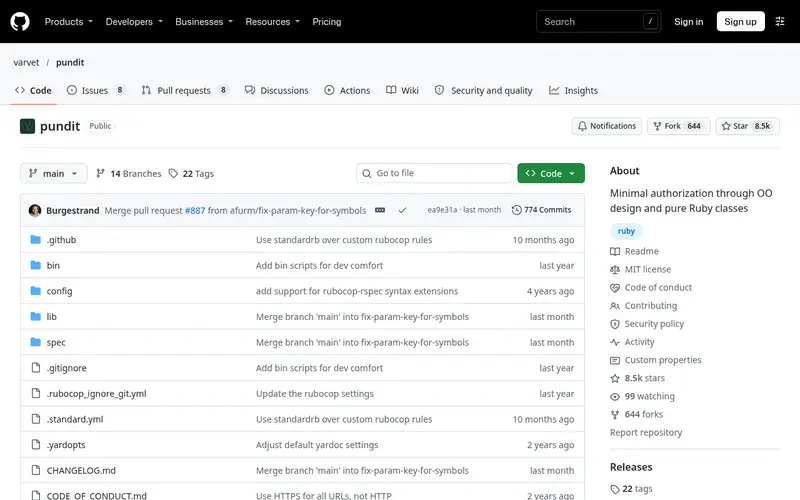
Pundit gives you policy classes named after your models, with query methods like `index?` and `update?`. Controllers call `authorize` and `policy_scope`, and the gem raises an error when a check is missing. It runs as a Rails gem and depends on ActiveSupport. The code is small and readable, which makes it easy to review in a pull request.
The project is open source under the MIT license and maintained on GitHub. There is no paid tier and no hosted service. Pundit does not manage roles, so you store roles or attributes on your user model and read them inside policies. Teams that want a single rules file or built-in role tables should look at CanCanCan or Rolify instead.
Standout: Simple policy objects with no DSL to learn
Free (open source), as listed by the vendor (Pundit website). Confirm the current plan price before you buy.
Free plan. Plans change, so confirm on the vendor's pricing page before you buy.
Benefits
- Simple policy objects with no DSL to learn
- easy to test in isolation
Drawbacks
- No built-in role management
- you wire up user roles yourself
Skip it if this limit matters to you: no built-in role management.
Verdict. A sensible pick for rails teams that want plain Ruby policy classes.
Alternatives in this guide: CanCanCan, Action Policy, Rolify
CanCanCan
Best for teams that prefer one central ability file
What it is and where it fits
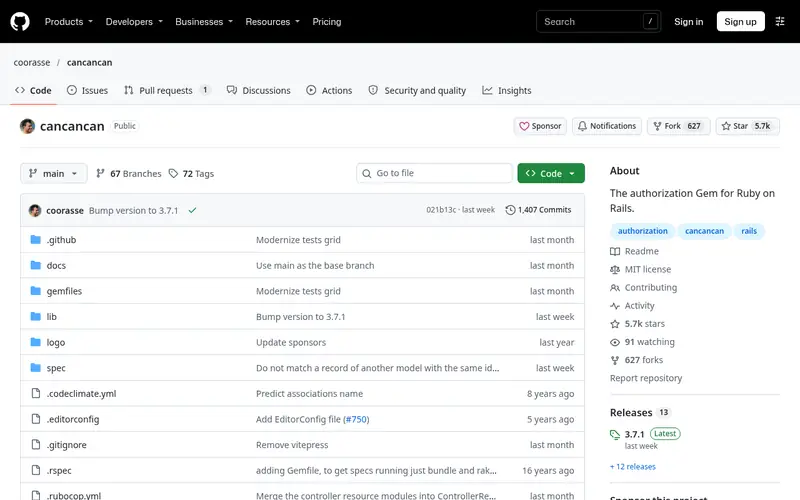
CanCanCan is the maintained continuation of the original CanCan gem. You define an `Ability` class with `can` and `cannot` rules, then check them with `can?` in views and `authorize!` in controllers. Rules can be conditioned on attributes, which covers most record-level checks without extra code.
It is open source and free, distributed as a gem from the CanCanCommunity repository. It does not require Rails, though most users run it inside Rails. The main limit is scale: a single ability file with many rules and conditions becomes difficult to reason about, and the order of rules matters. Teams that prefer small, separate policy classes often choose Pundit instead.
Standout: One ability file defines all rules in a readable DSL
Free (open source), as listed by the vendor (CanCanCan website). Confirm the current plan price before you buy.
Free plan. Plans change, so confirm on the vendor's pricing page before you buy.
Benefits
- One ability file defines all rules in a readable DSL
- works with Rails and other Ruby apps
Drawbacks
- Large ability files get hard to follow
- rule order affects results
Skip it if this limit matters to you: large ability files get hard to follow.
Verdict. A sensible pick for teams that prefer one central ability file.
Alternatives in this guide: Pundit, Action Policy, Rolify
Action Policy
Best for apps that need policy objects plus an explicit context
What it is and where it fits
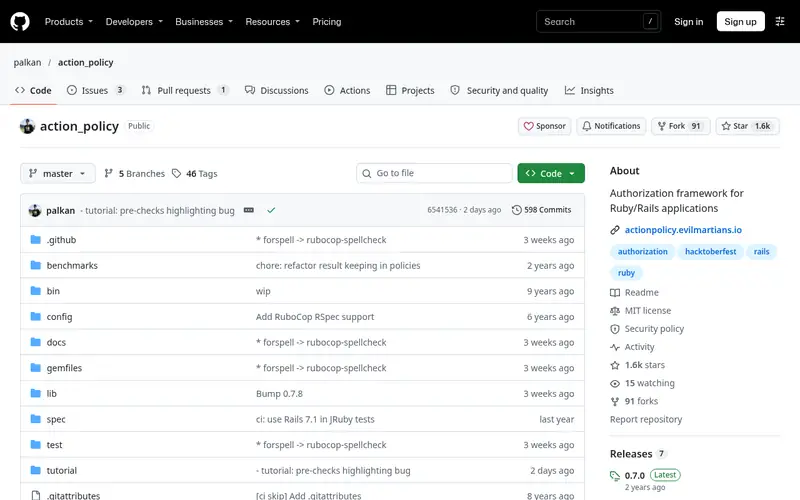
Action Policy is an authorization framework built around policy classes, similar in shape to Pundit but with an explicit context object. Every check receives the user, the record and any extra context you pass, which helps when rules depend on the current account, request or feature flag. It also ships result caching and a test helper set.
The gem is open source and free, maintained by Vladimir Dementyev on GitHub. It works with Rails and plain Ruby. Because it adds context, caching and its own naming conventions, new team members need a short ramp-up. Teams that want the smallest possible surface area should compare it with Pundit before committing.
Standout: Explicit authorization context passed to every rule
Free (open source), as listed by the vendor (Action Policy website). Confirm the current plan price before you buy.
Free plan. Plans change, so confirm on the vendor's pricing page before you buy.
Benefits
- Explicit authorization context passed to every rule
- built-in caching for policy results
Drawbacks
- More concepts to learn than Pundit
- smaller community than Pundit or CanCanCan
Skip it if this limit matters to you: more concepts to learn than Pundit.
Verdict. A sensible pick for apps that need policy objects plus an explicit context.
Rolify
Best for apps that need role assignment stored in the database
What it is and where it fits
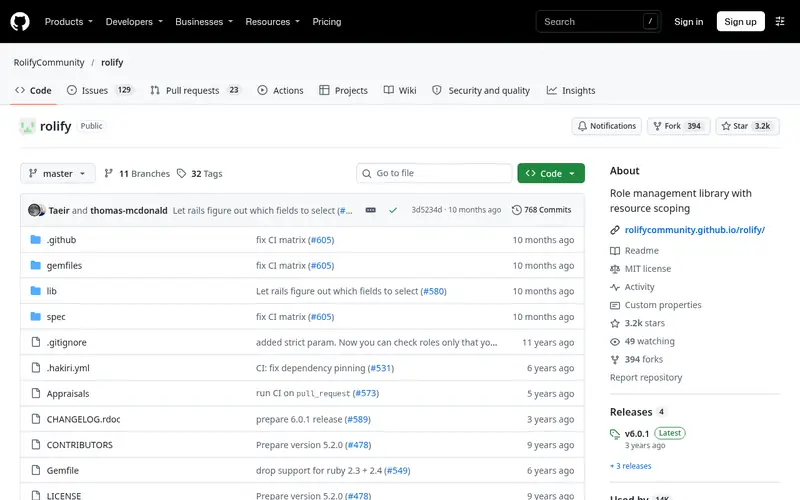
Rolify manages roles rather than full authorization rules. You add a role model and a join table, then assign roles to users globally or scoped to a specific record, such as an admin role on one project. It provides query methods like `has_role?` and `has_role?(:admin, project)`.
It is open source and free, maintained by the RolifyCommunity on GitHub, and works with ActiveRecord and Rails. Rolify is usually combined with Pundit or CanCanCan, which read the roles and decide what a user may do. On its own it does not answer "can this user edit this record," so do not pick it as your only authorization layer. It also adds migrations you need to plan for.
Standout: Database-backed roles scoped to resources
Free (open source), as listed by the vendor (Rolify website). Confirm the current plan price before you buy.
Free plan. Plans change, so confirm on the vendor's pricing page before you buy.
Benefits
- Database-backed roles scoped to resources
- pairs with Pundit or CanCanCan
Drawbacks
- Handles roles only, not permission rules
- adds tables and migrations
Skip it if this limit matters to you: handles roles only, not permission rules.
Verdict. A sensible pick for apps that need role assignment stored in the database.
Alternatives in this guide: Pundit, CanCanCan, Action Policy
access-granted
Best for small apps that want a compact role-based DSL
What it is and where it fits
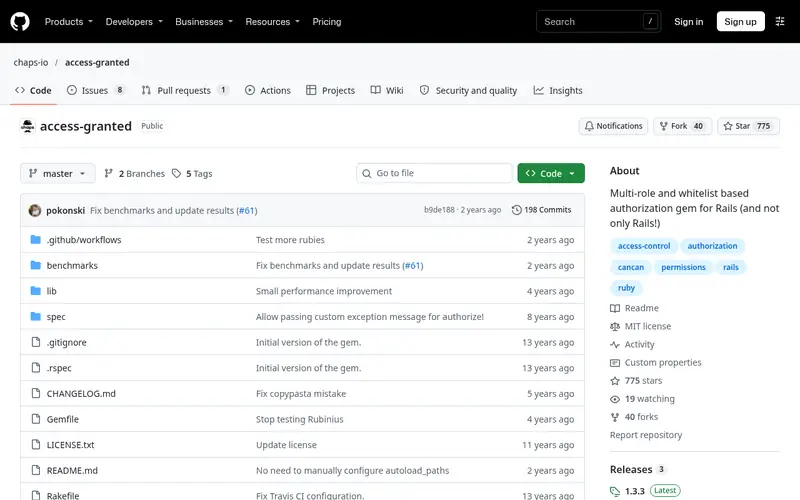
access-granted is a lightweight authorization gem with a small DSL. You declare roles and the actions each role may perform, then check access in controllers with a `permit!` call and handle denials with a rescue. Rules live in code, so there are no extra tables or migrations.
The gem is open source and free, maintained under the chaps-io organization on GitHub. It suits small Rails apps where the rule set is short and stable. It has a smaller maintainer base and fewer features than Pundit or CanCanCan, and it does not provide policy scoping for index queries. Teams with complex record-level rules should choose one of the larger libraries.
Standout: Short DSL for role and permission rules
Free (open source), as listed by the vendor (access-granted website). Confirm the current plan price before you buy.
Free plan. Plans change, so confirm on the vendor's pricing page before you buy.
Benefits
- Short DSL for role and permission rules
- no database tables required
Drawbacks
- Small maintainer base
- fewer features than Pundit or CanCanCan
Skip it if this limit matters to you: small maintainer base.
Verdict. A sensible pick for small apps that want a compact role-based DSL.
Alternatives in this guide: Pundit, CanCanCan, Action Policy
Rails built-in before_action checks
Best for very small apps with a handful of rules
What it is and where it fits
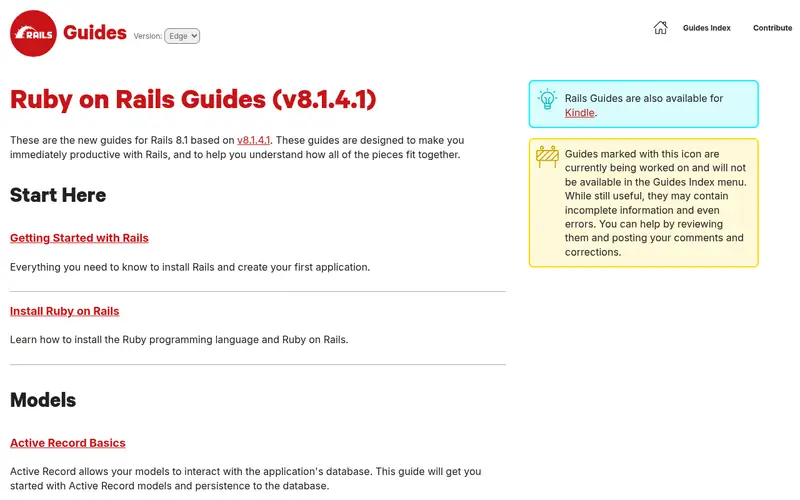
Rails ships with controller filters, and `before_action` is the simplest way to block access. You write a private method that checks the current user and redirects or raises when the check fails, then register it for the actions that need it. No gem is involved.
This approach is free because it is part of Rails, documented in the official Action Controller guide. It works well for small apps with a few rules. It does not scale to many models and actions: checks get duplicated across controllers, there is no policy object to test in isolation, and index scoping is manual. Once rules grow, move to Pundit, CanCanCan or Action Policy.
Standout: No dependency to add or maintain
Free, as listed by the vendor (Rails built-in before_action checks website). Confirm the current plan price before you buy.
Free plan. Plans change, so confirm on the vendor's pricing page before you buy.
Benefits
- No dependency to add or maintain
- behavior is visible in each controller
Drawbacks
- Rules spread across controllers
- no shared policy layer or scoping helpers
Skip it if this limit matters to you: rules spread across controllers.
Verdict. A sensible pick for very small apps with a handful of rules.
Alternatives in this guide: Pundit, CanCanCan, Action Policy
Who should use what
A small Rails app with a few admin checks can start with Rails `before_action` filters and add nothing. A team that wants small, testable policy classes per model should use Pundit. A team that prefers one readable rules file and attribute conditions should use CanCanCan. An app that needs database-backed roles scoped to records should add Rolify alongside Pundit or CanCanCan. A project that needs an explicit authorization context and result caching should evaluate Action Policy.
Questions to settle before you buy
What to check before you buy
- Confirm the gem supports your Rails and Ruby versions from its repository or changelog.
- Decide whether you need role storage in the database (Rolify) or roles read from your user model.
- Check that the library covers record-level checks and index scoping, not just controller actions.
- Plan how you will test policies or abilities in isolation before writing rules.
- Review the licence and the maintainer activity on the project repository.
FAQ
Is Pundit or CanCanCan better?
Neither is strictly better. Pundit uses one policy class per model, which keeps rules small and easy to test. CanCanCan puts all rules in one ability file with a readable DSL. Pick Pundit for many models with distinct rules, and CanCanCan when a single central rule set is easier for your team to follow.
Do I need Rolify if I use Pundit?
No. Pundit reads roles or attributes from your user model, so you can store roles in a column or a join table yourself. Rolify is useful when you want ready-made role assignment scoped to specific records and the query methods that come with it.
Are these libraries free?
Yes. Pundit, CanCanCan, Action Policy, Rolify and access-granted are open source and free to use. Rails `before_action` is part of the framework. There are no paid tiers for these libraries, though you should check each repository for its current licence.
Can I use these outside Rails?
Pundit, CanCanCan and Action Policy are Ruby gems and can work outside Rails with some setup, though most documentation assumes Rails. Rolify depends on ActiveRecord. access-granted is built around Rails controllers. Check each repository for non-Rails support before you rely on it.
How do I migrate from controller filters to a library?
Start by listing every `before_action` check and the rule it enforces. Group those rules by model, then write one policy class per model in Pundit, or one ability file in CanCanCan. Replace each filter with an `authorize` call, add tests for each rule, and remove the old filters once the tests pass.
Sources we checked
Method: how we score · editorial policy.
Change log. First published 27 Nov 2026.