Stage 02 · Test · Researched comparison
Best Python WebSocket Libraries in 2026
websockets is the first pick for most asyncio projects that need a standards-based WebSocket server or client with no extra dependencies. Choose Starlette when you want WebSocket routes inside an ASGI app alongside HTTP endpoints. Choose websocket-client when you need a simple synchronous client that works without asyncio. All three are open source and free to use.

By Shihab Mia
Published 27 Nov 2026 · 8 tools compared
We run no ads and no affiliate links at launch. The order of a list follows our published method. See how we score.
Prices are the starting prices vendors list publicly. Plans change, so confirm the current price on the vendor page before you buy.
Key takeaways
- websockets is a pure-Python asyncio library for building WebSocket servers and clients, released under the BSD license.
- Starlette adds WebSocket routing to an ASGI framework and is the base for FastAPI's WebSocket support.
- websocket-client provides a synchronous client for scripts and apps that do not run an event loop.
- Every tool listed here is free and open source, so cost is not a deciding factor.
Who each pick is for
- asyncio WebSocket servers and clientswebsockets
- WebSocket routes inside an ASGI appStarlette
- synchronous WebSocket clients in scriptswebsocket-client
- WebSocket support inside an async HTTP frameworkaiohttp
- typed APIs that also need WebSocket endpointsFastAPI
- async web apps with built-in WebSocket routesSanic
- WAMP and advanced WebSocket protocol workAutobahn
- WebSocket clients built on HTTPXhttpx-ws
Comparison
| Tool | Best for | Standout feature | Listed starting price | Free plan or trial |
|---|---|---|---|---|
| 1websockets | asyncio WebSocket servers and clients | Pure-Python asyncio design | Free (open source) | Free plan |
| 2Starlette | WebSocket routes inside an ASGI app | WebSocket routes next to HTTP routes | Free (open source) | Free plan |
| 3websocket-client | synchronous WebSocket clients in scripts | Simple blocking API | Free (open source) | Free plan |
| 4aiohttp | WebSocket support inside an async HTTP framework | Client and server WebSocket support | Free (open source) | Free plan |
| 5FastAPI | typed APIs that also need WebSocket endpoints | WebSocket routes with type hints | Free (open source) | Free plan |
| 6Sanic | async web apps with built-in WebSocket routes | WebSocket decorator built into the framework | Free (open source) | Free plan |
| 7Autobahn | WAMP and advanced WebSocket protocol work | Supports WAMP in addition to raw WebSocket | Free (open source) | Free plan |
| 8httpx-ws | WebSocket clients built on HTTPX | Reuses HTTPX client configuration | Free (open source) | Free plan |
How we picked
We compared libraries on fit for common WebSocket jobs (server, client, framework integration), supported platforms and Python versions, licence and price, and the main limits each one documents. We also noted whether a library handles only WebSockets or bundles them into a larger framework. Sources are official project documentation, repositories and licence pages. Prices and licences can change, so confirm details on the vendor or project site before you commit.
The tools, one by one
websockets
Best for asyncio WebSocket servers and clients
What it is and where it fits
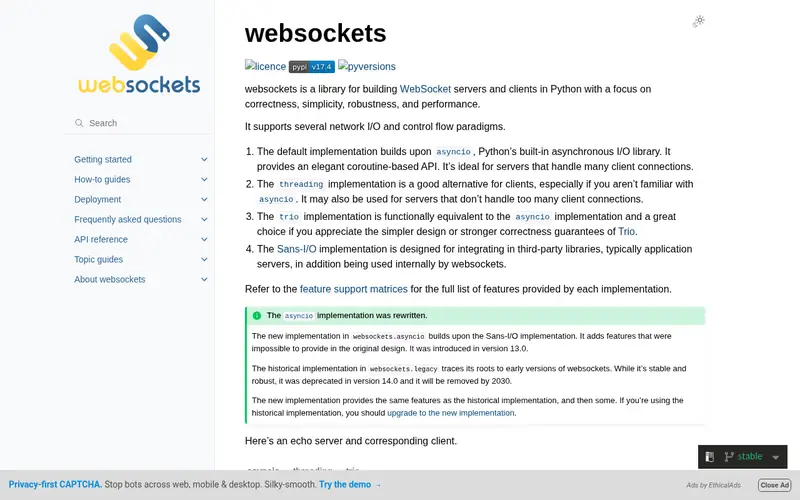
websockets is a library built on Python's asyncio module. It provides a server implementation and a client implementation that follow RFC 6455, the WebSocket protocol standard. You can run a server with a few lines of code and connect to it from another process or from JavaScript in a browser.
The library ships with connection helpers, automatic ping and pong keepalive, and support for subprotocols and compression. It runs on any platform that supports Python 3 and asyncio, including Linux, macOS and Windows. It is released under the BSD 3-Clause license.
It does not handle HTTP routing, authentication or static files, so you pair it with a framework or a reverse proxy when you need those. Teams that want WebSocket routes inside a larger ASGI application usually pick Starlette instead.
Standout: Pure-Python asyncio design
Free (open source), as listed by the vendor (websockets website). Confirm the current plan price before you buy.
Free plan. Plans change, so confirm on the vendor's pricing page before you buy.
Benefits
- Pure-Python asyncio design
- supports both server and client roles
Drawbacks
- Requires asyncio knowledge
- not a full web framework
Skip it if this limit matters to you: requires asyncio knowledge.
Verdict. A sensible pick for asyncio WebSocket servers and clients.
Alternatives in this guide: Starlette, websocket-client, aiohttp
Starlette
Best for webSocket routes inside an ASGI app
What it is and where it fits
Starlette is a lightweight ASGI framework. It includes a WebSocket route class that lets you accept connections, receive messages and send replies inside the same application that serves HTTP endpoints. FastAPI builds on Starlette, so its WebSocket support comes from this project.
It runs on any ASGI server, such as Uvicorn or Hypercorn, on Linux, macOS and Windows. The project is released under the BSD 3-Clause license. You get middleware, dependency injection and test client support for WebSocket connections.
Starlette does not include authentication, database access or templating beyond what you add. It is a good fit when you already have an ASGI app and want to add a real-time endpoint without a second server process.
Standout: WebSocket routes next to HTTP routes
Free (open source), as listed by the vendor (Starlette website). Confirm the current plan price before you buy.
Free plan. Plans change, so confirm on the vendor's pricing page before you buy.
Benefits
- WebSocket routes next to HTTP routes
- works with ASGI servers
Drawbacks
- No built-in auth or session handling
- needs an ASGI server
Skip it if this limit matters to you: no built-in auth or session handling.
Verdict. A sensible pick for webSocket routes inside an ASGI app.
Alternatives in this guide: websockets, websocket-client, aiohttp
websocket-client
Best for synchronous WebSocket clients in scripts
What it is and where it fits
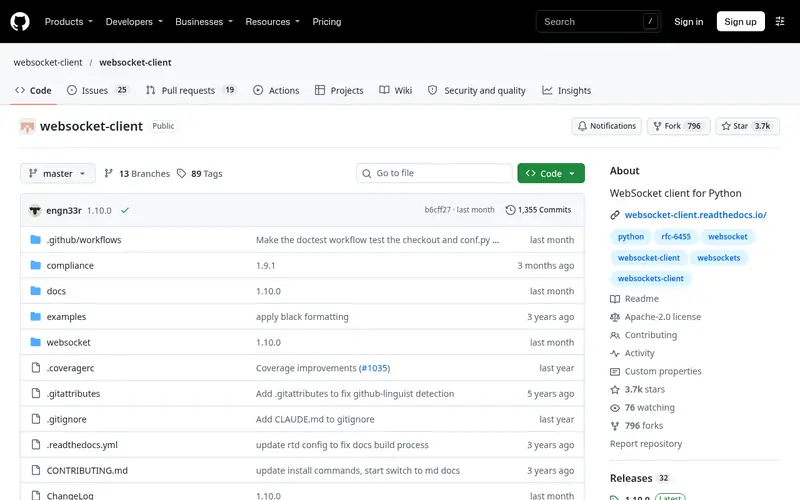
websocket-client is a client library that lets you open a WebSocket connection and send or receive messages with blocking calls. It works in plain Python scripts, desktop applications and test code where an event loop is not available or not wanted.
The library supports TLS, proxies, custom headers and subprotocols. It runs on Linux, macOS and Windows and is released under the Apache 2.0 license. A callback-based mode is available for handling incoming messages.
It does not provide a server. For concurrent connections you manage threads yourself, which adds complexity compared with asyncio libraries. Use it when a script needs to talk to a WebSocket endpoint and you want the simplest possible code.
Standout: Simple blocking API
Free (open source), as listed by the vendor (websocket-client website). Confirm the current plan price before you buy.
Free plan. Plans change, so confirm on the vendor's pricing page before you buy.
Benefits
- Simple blocking API
- works without asyncio
Drawbacks
- Client only
- blocking calls need threads for concurrency
Skip it if this limit matters to you: client only.
Verdict. A sensible pick for synchronous WebSocket clients in scripts.
Alternatives in this guide: websockets, Starlette, aiohttp
aiohttp
Best for webSocket support inside an async HTTP framework
What it is and where it fits
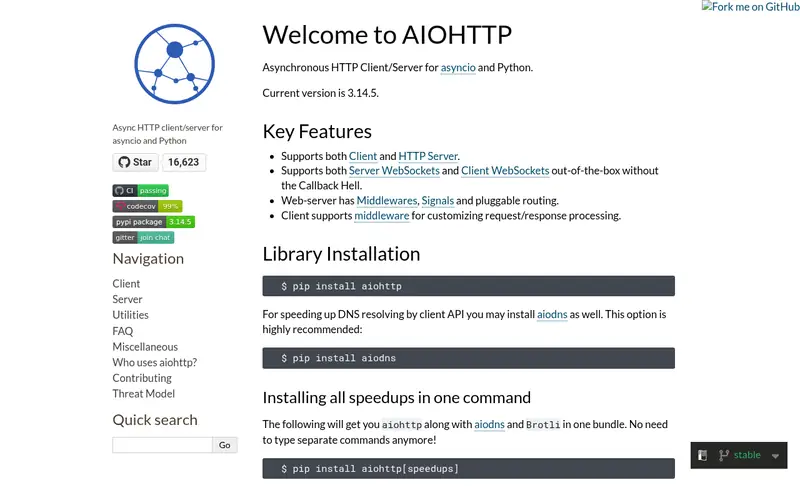
aiohttp is an asynchronous HTTP client and server library for asyncio. It includes WebSocket support on both sides: a server can upgrade a request to a WebSocket, and the client can connect to remote WebSocket endpoints.
It runs on any platform that supports asyncio and is released under the Apache 2.0 license. The library also handles routing, sessions, cookies and static files, so a single process can serve HTTP and WebSocket traffic.
The tradeoff is size and coupling. If you only need WebSockets, a focused library is easier to learn. If you already use aiohttp for HTTP, its WebSocket support keeps your stack in one place.
Standout: Client and server WebSocket support
Free (open source), as listed by the vendor (aiohttp website). Confirm the current plan price before you buy.
Free plan. Plans change, so confirm on the vendor's pricing page before you buy.
Benefits
- Client and server WebSocket support
- full HTTP client and server
Drawbacks
- Larger API surface
- tied to its own framework
Skip it if this limit matters to you: larger API surface.
Verdict. A sensible pick for webSocket support inside an async HTTP framework.
Alternatives in this guide: websockets, Starlette, websocket-client
FastAPI
Best for typed APIs that also need WebSocket endpoints
What it is and where it fits
FastAPI is a web framework built on Starlette and Pydantic. It exposes a WebSocket route decorator, so you can define a real-time endpoint in the same application as your typed HTTP API. Dependencies and validation work the same way as for HTTP routes.
It runs on ASGI servers such as Uvicorn on Linux, macOS and Windows and is released under the MIT license. The framework generates OpenAPI documentation for HTTP routes, but WebSocket handlers do not appear in that schema.
Choose FastAPI when your project already uses it for HTTP and you want WebSocket endpoints without adding a second framework. For a WebSocket-only service, a smaller library is simpler.
Standout: WebSocket routes with type hints
Free (open source), as listed by the vendor (FastAPI website). Confirm the current plan price before you buy.
Free plan. Plans change, so confirm on the vendor's pricing page before you buy.
Benefits
- WebSocket routes with type hints
- generated API docs for HTTP routes
Drawbacks
- WebSocket handlers are not covered by OpenAPI docs
- depends on Starlette
Skip it if this limit matters to you: webSocket handlers are not covered by OpenAPI docs.
Verdict. A sensible pick for typed APIs that also need WebSocket endpoints.
Alternatives in this guide: websockets, Starlette, websocket-client
Sanic
Best for async web apps with built-in WebSocket routes
What it is and where it fits
Sanic is an asynchronous web framework that includes WebSocket route support. You declare a handler with a decorator, and the framework manages the connection lifecycle, including receiving and sending messages.
It runs on Linux, macOS and Windows and is released under the MIT license. The framework includes routing, middleware and a test client, so WebSocket endpoints sit alongside regular HTTP handlers.
Sanic has its own conventions, so code written for it does not transfer directly to Starlette or aiohttp. It suits teams that want one async framework for both HTTP and real-time traffic and are comfortable with its patterns.
Standout: WebSocket decorator built into the framework
Free (open source), as listed by the vendor (Sanic website). Confirm the current plan price before you buy.
Free plan. Plans change, so confirm on the vendor's pricing page before you buy.
Benefits
- WebSocket decorator built into the framework
- async by default
Drawbacks
- Smaller ecosystem than Starlette-based stacks
- framework-specific patterns
Skip it if this limit matters to you: smaller ecosystem than Starlette-based stacks.
Verdict. A sensible pick for async web apps with built-in WebSocket routes.
Alternatives in this guide: websockets, Starlette, websocket-client
Autobahn
Best for wAMP and advanced WebSocket protocol work
What it is and where it fits
Autobahn is a WebSocket and WAMP library for Python. WAMP is a messaging protocol that runs over WebSocket and adds remote procedure calls and publish-subscribe patterns. Autobahn provides both client and server components.
It runs on asyncio and Twisted and is released under the MIT license. If you only need plain WebSocket messages, the extra WAMP layer is unnecessary. If you need RPC or pub-sub semantics, Autobahn provides them without building a custom message format.
The library is larger and has more concepts to learn than websockets or websocket-client. It fits projects that have settled on WAMP as their messaging layer.
Standout: Supports WAMP in addition to raw WebSocket
Free (open source), as listed by the vendor (Autobahn website). Confirm the current plan price before you buy.
Free plan. Plans change, so confirm on the vendor's pricing page before you buy.
Benefits
- Supports WAMP in addition to raw WebSocket
- client and server roles
Drawbacks
- Heavier than a plain WebSocket library
- WAMP adds a learning curve
Skip it if this limit matters to you: heavier than a plain WebSocket library.
Verdict. A sensible pick for WAMP and advanced WebSocket protocol work.
Alternatives in this guide: websockets, Starlette, websocket-client
httpx-ws
Best for webSocket clients built on HTTPX
What it is and where it fits
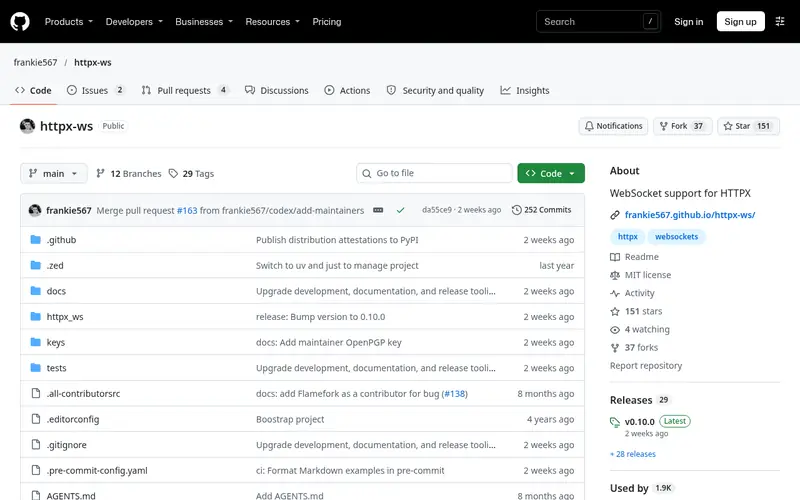
httpx-ws adds WebSocket support to the HTTPX client. If your code already uses HTTPX for HTTP requests, you can open WebSocket connections with the same client settings, including proxies, TLS configuration and timeouts.
It supports both synchronous and asynchronous usage and is released under the MIT license. It runs wherever HTTPX runs, including Linux, macOS and Windows.
The library provides a client only. For a server, pair it with websockets, Starlette or another server library. It is a reasonable choice when you want one HTTP client dependency for both request types.
Standout: Reuses HTTPX client configuration
Free (open source), as listed by the vendor (httpx-ws website). Confirm the current plan price before you buy.
Free plan. Plans change, so confirm on the vendor's pricing page before you buy.
Benefits
- Reuses HTTPX client configuration
- supports sync and async use
Drawbacks
- Client only
- smaller project than the older client libraries
Skip it if this limit matters to you: client only.
Verdict. A sensible pick for webSocket clients built on HTTPX.
Alternatives in this guide: websockets, Starlette, websocket-client
Who should use what
If you are building a standalone WebSocket service on asyncio, start with websockets. If you already run an ASGI app and want a real-time route next to your HTTP endpoints, use Starlette or FastAPI. If you need a blocking client inside a script or desktop tool, websocket-client is the simplest path. If your project needs RPC or publish-subscribe over WebSocket, look at Autobahn and WAMP.
Questions to settle before you buy
What to check before you buy
- Confirm the library supports your Python version and target platform.
- Check whether you need a server, a client, or both, and pick a library that covers the role.
- Review the licence terms if you ship closed-source software.
- Test how the library handles reconnects, ping and pong, and closed connections.
- Read the documentation for limits on message size, concurrency and backpressure.
FAQ
Which Python WebSocket library is best for beginners?
websockets is a common starting point because its documentation walks through a small server and client. Starlette and FastAPI are easier if you already know those frameworks. websocket-client is simplest for a short blocking script that only connects to an existing endpoint.
Do these libraries work with asyncio?
websockets, aiohttp, Starlette, FastAPI, Sanic, Autobahn and httpx-ws are built for asyncio or ASGI. websocket-client uses blocking calls and does not require an event loop, though it can run inside one with care.
Are these WebSocket libraries free?
Yes. All eight projects listed here are open source and free to use under their respective licences, which include BSD, MIT and Apache 2.0. There are no paid tiers for the libraries themselves.
Can I use these libraries behind a reverse proxy?
Yes, but the proxy must be configured to forward WebSocket upgrade requests. Common proxies such as Nginx and Caddy support this with specific settings. Check the proxy documentation alongside the library docs.
Do I need a separate server for WebSockets?
Not always. Frameworks such as Starlette, FastAPI, Sanic and aiohttp serve HTTP and WebSocket traffic from one ASGI or async process. A standalone library like websockets runs its own server, which you can place behind a proxy.
Sources we checked
Method: how we score · editorial policy.
Change log. First published 27 Nov 2026.