Stage 02 · Test · Researched comparison
Best Python HTTP Clients for Developers in 2026
Requests is the first pick for most developers who need a simple synchronous HTTP client, and it suits scripts, automation and small services. HTTPX is the better choice when you need async support and HTTP/2 in one library. aiohttp fits projects already built on asyncio that need a client and server in one package. All three are free and open source.

By Shihab Mia
Published 22 Nov 2026 · 7 tools compared
We run no ads and no affiliate links at launch. The order of a list follows our published method. See how we score.
Prices are the starting prices vendors list publicly. Plans change, so confirm the current price on the vendor page before you buy.
Key takeaways
- Requests, HTTPX, aiohttp, urllib3, httplib2, Treq and PycURL are all free and open source.
- Requests is synchronous only; HTTPX and aiohttp support async code.
- HTTPX and urllib3 support HTTP/2 or connection pooling for higher-volume work.
- These are libraries you install locally, so request data stays on your own machine.
Who each pick is for
- Simple synchronous HTTP calls in scripts and appsRequests
- Projects that need sync and async in one clientHTTPX
- asyncio applications needing a client and serveraiohttp
- Low-level control over connections and retriesurllib3
- Caching-aware HTTP calls in small toolshttplib2
- Twisted-based applications needing HTTP callsTreq
- High-performance transfers using libcurlPycURL
Comparison
| Tool | Best for | Standout feature | Listed starting price | Free plan or trial |
|---|---|---|---|---|
| 1Requests | Simple synchronous HTTP calls in scripts and apps | Simple API that most Python developers already know | Free (open source) | Free plan |
| 2HTTPX | Projects that need sync and async in one client | Supports both sync and async with a similar API | Free (open source) | Free plan |
| 3aiohttp | asyncio applications needing a client and server | Native async client and server in one package | Free (open source) | Free plan |
| 4urllib3 | Low-level control over connections and retries | Connection pooling and retry controls | Free (open source) | Free plan |
| 5httplib2 | Caching-aware HTTP calls in small tools | Built-in caching and persistent connections | Free (open source) | Free plan |
| 6Treq | Twisted-based applications needing HTTP calls | Integrates with the Twisted event loop | Free (open source) | Free plan |
| 7PycURL | High-performance transfers using libcurl | Wraps libcurl for broad protocol support | Free (open source) | Free plan |
How we picked
We picked libraries that are actively maintained and genuinely serve as Python HTTP clients. Criteria were fit for common HTTP tasks, platform support, license and price, whether the tool runs locally so request data stays on your machine, and main limits such as sync-only or async-only design. Sources are vendor documentation, project repositories and public license pages. Prices and features change, so confirm details on the vendor site before you commit.
The tools, one by one
Requests
Best for simple synchronous HTTP calls in scripts and apps
What it is and where it fits
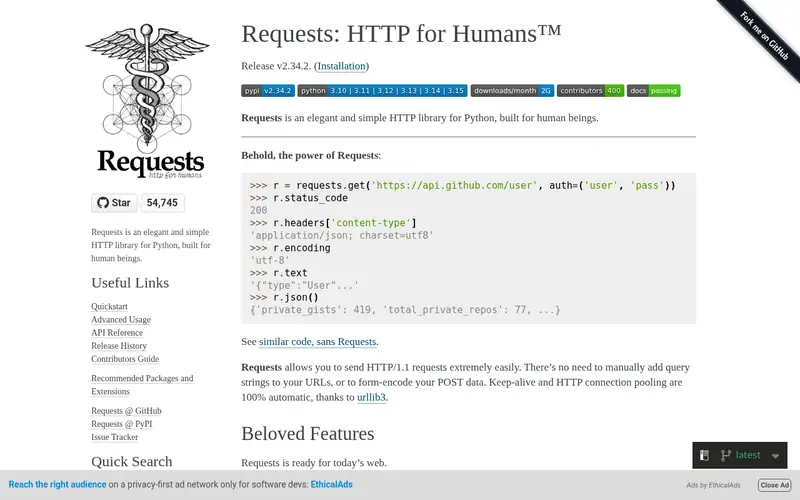
Requests is the most widely used Python HTTP client for synchronous work. It handles sessions, cookies, redirects, timeouts, SSL verification and file uploads with a small, readable API. It runs on any platform that supports Python and installs from PyPI with pip. The project is open source under the Apache 2.0 license.
Requests does not support async or HTTP/2. For high-concurrency services you would pair it with threads or move to an async client. It is a good default for scripts, test helpers and internal tools where blocking calls are fine. Skip it if your application is built entirely on asyncio and needs non-blocking I/O.
Standout: Simple API that most Python developers already know
Free (open source), as listed by the vendor (Requests website). Confirm the current plan price before you buy.
Free plan. Plans change, so confirm on the vendor's pricing page before you buy.
Benefits
- Simple API that most Python developers already know
- large ecosystem of adapters and docs
Drawbacks
- No native async support
- no built-in HTTP/2
Skip it if this limit matters to you: no native async support.
Verdict. A sensible pick for simple synchronous HTTP calls in scripts and apps.
HTTPX
Best for projects that need sync and async in one client
What it is and where it fits
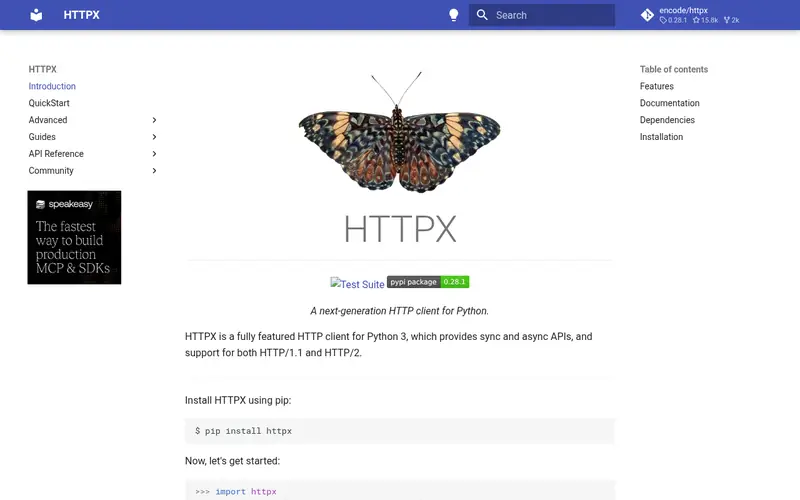
HTTPX offers a Requests-like API and adds async support, so you can use one library for both blocking and non-blocking code. It supports HTTP/2 when you install the optional h2 dependency, plus connection pooling, timeouts and streaming responses. It runs on standard Python platforms and installs from PyPI. The project is open source under a BSD license.
Because it covers more ground, HTTPX has more configuration options than Requests, which can mean a longer learning curve. It is a strong fit for new services that may need async later, and for teams that want one client across sync and async code. Skip it if you only need the simplest synchronous calls and prefer the smallest dependency.
Standout: Supports both sync and async with a similar API
Free (open source), as listed by the vendor (HTTPX website). Confirm the current plan price before you buy.
Free plan. Plans change, so confirm on the vendor's pricing page before you buy.
Benefits
- Supports both sync and async with a similar API
- HTTP/2 support
Drawbacks
- HTTP/2 needs the optional h2 package
- larger surface area than Requests
Skip it if this limit matters to you: HTTP/2 needs the optional h2 package.
Verdict. A sensible pick for projects that need sync and async in one client.
aiohttp
Best for asyncio applications needing a client and server
What it is and where it fits
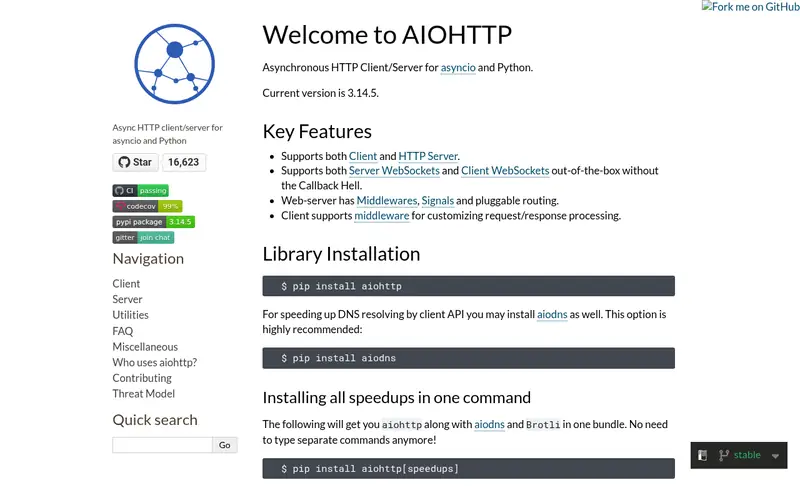
aiohttp is an asyncio-based library that provides both an HTTP client and an HTTP server. The client supports connection pooling, streaming uploads and downloads, timeouts and WebSocket connections. It runs wherever asyncio runs and installs from PyPI. The project is open source under the Apache 2.0 license.
The client is async-only, so it does not fit synchronous scripts without an event loop. Its API is different from Requests, which means some relearning. aiohttp suits services that already use asyncio and want one dependency for outbound calls and, if needed, an inbound server. Skip it for simple scripts or codebases that are not async.
Standout: Native async client and server in one package
Free (open source), as listed by the vendor (aiohttp website). Confirm the current plan price before you buy.
Free plan. Plans change, so confirm on the vendor's pricing page before you buy.
Benefits
- Native async client and server in one package
- strong streaming support
Drawbacks
- Async-only client
- API differs from Requests
Skip it if this limit matters to you: async-only client.
Verdict. A sensible pick for asyncio applications needing a client and server.
urllib3
Best for low-level control over connections and retries
What it is and where it fits
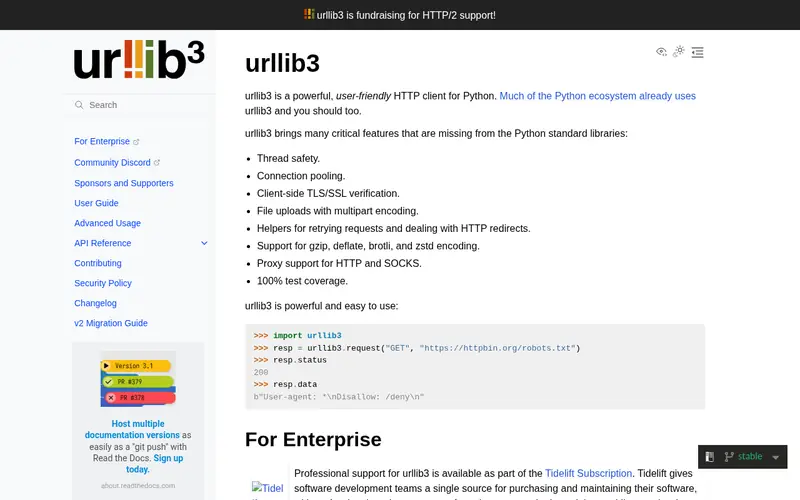
urllib3 is a low-level HTTP client that handles connection pooling, retries, thread safety and SSL verification. Requests builds on top of it, so many Python projects already have it installed. It runs on standard Python platforms and installs from PyPI. The project is open source under the MIT license.
The API is closer to the metal than Requests, so you write more code for common tasks like JSON handling and sessions. It is synchronous only. urllib3 fits libraries and tools that need fine control over pools and retries, or that want to avoid a higher-level dependency. Skip it if you want the shortest path to a simple GET or POST.
Standout: Connection pooling and retry controls
Free (open source), as listed by the vendor (urllib3 website). Confirm the current plan price before you buy.
Free plan. Plans change, so confirm on the vendor's pricing page before you buy.
Benefits
- Connection pooling and retry controls
- widely used as a dependency
Drawbacks
- Lower-level API than Requests
- synchronous only
Skip it if this limit matters to you: lower-level API than Requests.
Verdict. A sensible pick for low-level control over connections and retries.
httplib2
Best for caching-aware HTTP calls in small tools
What it is and where it fits
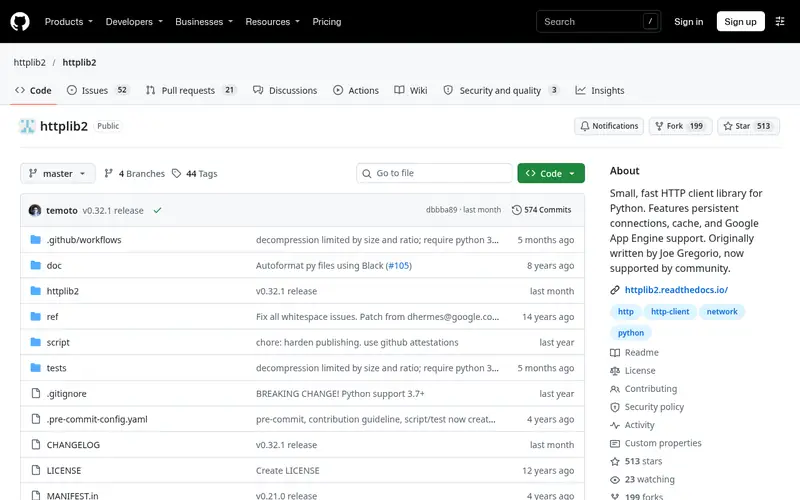
httplib2 is a small HTTP client library that adds caching and persistent connections on top of Python's standard HTTP handling. It supports features like authentication and caching that can reduce repeated requests. It runs on standard Python platforms and installs from PyPI. The project is open source under the MIT license.
The library has a smaller user base and fewer examples than Requests, and it is synchronous only. It can be a reasonable fit for small tools that benefit from caching and do not need async. Skip it for large services or teams that want the widest ecosystem and documentation.
Standout: Built-in caching and persistent connections
Free (open source), as listed by the vendor (httplib2 website). Confirm the current plan price before you buy.
Free plan. Plans change, so confirm on the vendor's pricing page before you buy.
Benefits
- Built-in caching and persistent connections
- small dependency
Drawbacks
- Smaller community than Requests
- synchronous only
Skip it if this limit matters to you: smaller community than Requests.
Verdict. A sensible pick for caching-aware HTTP calls in small tools.
Treq
Best for twisted-based applications needing HTTP calls
What it is and where it fits
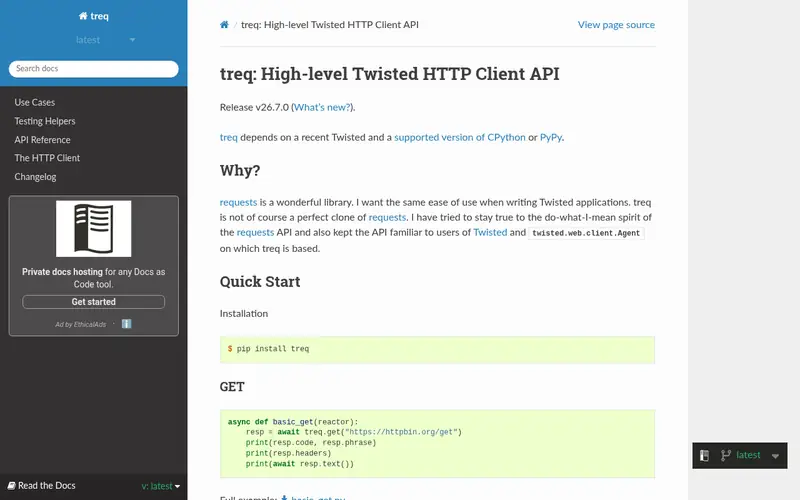
Treq is an HTTP client built on Twisted, offering a Requests-like API for Twisted applications. It supports deferred-based async calls, streaming and common request features. It runs on standard Python platforms and installs from PyPI. The project is open source under the MIT license.
Treq only makes sense if your application already uses Twisted. Outside that ecosystem it adds a heavy dependency for little benefit. It suits existing Twisted services that need HTTP calls without switching frameworks. Skip it for asyncio projects, where aiohttp or HTTPX are the natural choices.
Standout: Integrates with the Twisted event loop
Free (open source), as listed by the vendor (Treq website). Confirm the current plan price before you buy.
Free plan. Plans change, so confirm on the vendor's pricing page before you buy.
Benefits
- Integrates with the Twisted event loop
- Requests-like API
Drawbacks
- Tied to Twisted
- smaller community
Skip it if this limit matters to you: tied to Twisted.
Verdict. A sensible pick for twisted-based applications needing HTTP calls.
PycURL
Best for high-performance transfers using libcurl
What it is and where it fits
PycURL is a Python interface to libcurl, giving access to its protocol support and transfer controls. It can handle many protocols and offers detailed options for timeouts, proxies and transfers. It requires the libcurl library to be installed on the system, and it installs from PyPI. The project is open source under the LGPL or MIT license depending on the component.
The API is more complex than Requests and closer to libcurl's C interface, so expect a steeper learning curve. It suits performance-sensitive or protocol-heavy work where libcurl's features matter. Skip it for everyday API calls where a simpler client will do.
Standout: Wraps libcurl for broad protocol support
Free (open source), as listed by the vendor (PycURL website). Confirm the current plan price before you buy.
Free plan. Plans change, so confirm on the vendor's pricing page before you buy.
Benefits
- Wraps libcurl for broad protocol support
- fine control over transfers
Drawbacks
- Requires the libcurl system library
- API is more complex
Skip it if this limit matters to you: requires the libcurl system library.
Verdict. A sensible pick for high-performance transfers using libcurl.
Who should use what
For scripts and small services that make blocking calls, Requests is the simplest choice. For new services that may need async and HTTP/2, HTTPX covers both sync and async in one library. For asyncio applications that also want a server, aiohttp fits. For libraries that need low-level control over pools and retries, urllib3 is the right layer. Twisted projects should use Treq, and libcurl-based work fits PycURL.
Questions to settle before you buy
What to check before you buy
- Confirm whether your codebase is synchronous or asyncio-based before choosing.
- Check whether you need HTTP/2 and whether it requires an optional dependency.
- Review the license terms if you ship the library inside a product.
- Check that the library is actively maintained and supports your Python version.
- Test timeout, retry and SSL settings in a staging environment before production.
FAQ
Is Requests still the best default Python HTTP client?
Requests remains a solid default for synchronous code because its API is simple and widely documented. It does not support async or HTTP/2, so projects with those needs should look at HTTPX or aiohttp instead.
What is the difference between HTTPX and aiohttp?
HTTPX offers both sync and async APIs with a Requests-like style and optional HTTP/2. aiohttp is async-only and includes both a client and a server. Choose HTTPX for mixed code and aiohttp for asyncio services that also need a server.
Do these libraries send my data to a third party?
No. These are libraries you install and run locally, so requests go directly from your machine to the target server. That differs from online HTTP testing pages, where you should avoid pasting secrets, tokens or production data.
Are these Python HTTP clients free?
Yes. Requests, HTTPX, aiohttp, urllib3, httplib2, Treq and PycURL are all free and open source. Check each project's license if you redistribute the library.
Which client supports HTTP/2?
HTTPX supports HTTP/2 when you install the optional h2 package. Requests and urllib3 do not provide built-in HTTP/2 support in the same way, so check current documentation for your version.
Sources we checked
Method: how we score · editorial policy.
Change log. First published 22 Nov 2026.