Stage 02 · Test · Researched comparison
Best Protobuf Tools for Developers in 2026
protoc, the official Protocol Buffers compiler from Google, is the first pick for most teams because it generates code for many languages and defines the format itself. Teams that want a graphical schema workflow should look at buf, which adds linting, breaking-change detection and a registry. For quick inspection of encoded payloads, protobuf-inspector and similar decoders help, but avoid pasting production data into third-party web pages.

By Shihab Mia
Published 22 Nov 2026 · 7 tools compared
We run no ads and no affiliate links at launch. The order of a list follows our published method. See how we score.
Prices are the starting prices vendors list publicly. Plans change, so confirm the current price on the vendor page before you buy.
Key takeaways
- protoc is free and open source and is the reference compiler for .proto files across C++, Java, Python, Go and other languages.
- buf is free to use locally and adds linting, formatting and breaking-change checks; its paid registry tiers are listed on the vendor pricing page.
- Browser-based Protobuf decoders are convenient but should not receive secrets, tokens or production payloads.
- Most tools here are open source; confirm current licences and prices on the official project or vendor pages before you commit.
Who each pick is for
- Generating code from .proto files in many languagesprotoc (Protocol Buffers Compiler)
- Schema linting, formatting and breaking-change detectionbuf
- Decoding raw Protobuf payloads without a schemaprotobuf-inspector
- Enforcing style rules on .proto filesprotolint
- Using Protobuf inside .NET applicationsGoogle.Protobuf for .NET
- Protobuf in JavaScript and TypeScript projectsprotobufjs
- Calling gRPC services from the command linegrpcurl
Comparison
| Tool | Best for | Standout feature | Listed starting price | Free plan or trial |
|---|---|---|---|---|
| 1protoc (Protocol Buffers Compiler) | Generating code from .proto files in many languages | Reference implementation of the format | Free (open source) | Free plan |
| 2buf | Schema linting, formatting and breaking-change detection | Combines lint, format and breaking checks in one CLI | See vendor pricing page | Free plan |
| 3protobuf-inspector | Decoding raw Protobuf payloads without a schema | Decodes messages without .proto files | Free (open source) | Free plan |
| 4protolint | Enforcing style rules on .proto files | Focused linter with configurable rules | Free (open source) | Free plan |
| 5Google.Protobuf for .NET | Using Protobuf inside .NET applications | Official runtime library for C# | Free (open source) | Free plan |
| 6protobufjs | Protobuf in JavaScript and TypeScript projects | Works in Node.js and browsers | Free (open source) | Free plan |
| 7grpcurl | Calling gRPC services from the command line | Uses server reflection to discover schemas | Free (open source) | Free plan |
How we picked
We selected tools that directly support Protobuf work: schema authoring, code generation, linting, runtime serialization and payload inspection. Criteria included fit for the job, supported platforms, licence and price, whether data stays local, and known limits. Sources are official vendor pages, project documentation and public repositories. Prices and plan limits change, so confirm current details on the vendor site before relying on them.
The tools, one by one
protoc (Protocol Buffers Compiler)
Best for generating code from .proto files in many languages
What it is and where it fits
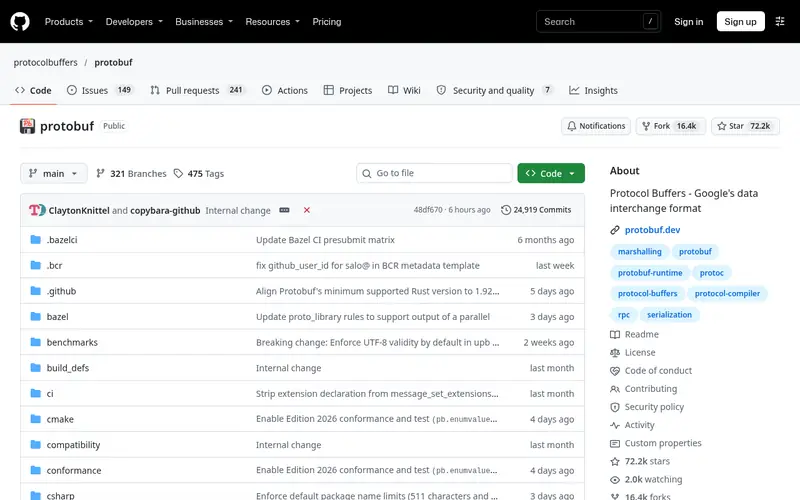
protoc is the official compiler shipped with the Protocol Buffers project. You write .proto schema files and run protoc to generate source code for C++, Java, Python, Go, C#, Ruby, PHP and other languages through plugins. It defines the wire format, so generated code stays compatible with other conforming implementations.
It runs on Windows, macOS and Linux, and is also distributed through package managers and language toolchains. The project is open source under a BSD-style licence, so there is no paid tier. The main limits are practical: protoc does not lint your schema, does not detect breaking changes between versions, and plugin and include-path configuration can be fiddly on large projects. Teams that want those checks usually pair protoc with buf. Skip it only if you never touch .proto files directly.
Standout: Reference implementation of the format
Free (open source), as listed by the vendor (protoc (Protocol Buffers Compiler) website). Confirm the current plan price before you buy.
Free plan. Plans change, so confirm on the vendor's pricing page before you buy.
Benefits
- Reference implementation of the format
- broad language support
Drawbacks
- No built-in linting or breaking-change checks
- plugin setup takes work
Skip it if this limit matters to you: no built-in linting or breaking-change checks.
Verdict. A sensible pick for generating code from .proto files in many languages.
Alternatives in this guide: buf, protobuf-inspector, protolint
buf
Best for schema linting, formatting and breaking-change detection

What it is and where it fits
buf is a CLI and platform for working with Protobuf schemas. The command-line tool runs linting, formatting and breaking-change detection against your .proto files, and it can drive protoc plugins for code generation. It also manages dependencies and module versions, which helps when schemas are shared across repositories.
The CLI is free to use and runs on Windows, macOS and Linux. The company offers a hosted schema registry with paid tiers; check the vendor pricing page for current plans and limits. buf works alongside protoc rather than replacing the wire format. The trade-off is added configuration and a workflow that differs from plain protoc. Teams with a single small schema may find it heavier than needed, while organizations sharing schemas across many services get the most value.
Standout: Combines lint, format and breaking checks in one CLI
See vendor pricing page, as listed by the vendor (buf website). Confirm the current plan price before you buy.
Free plan. Plans change, so confirm on the vendor's pricing page before you buy.
Benefits
- Combines lint, format and breaking checks in one CLI
- Works with protoc plugins
Drawbacks
- Registry features push toward a hosted service
- Extra config to learn
Skip it if this limit matters to you: registry features push toward a hosted service.
Verdict. A sensible pick for schema linting, formatting and breaking-change detection.
Alternatives in this guide: protoc (Protocol Buffers Compiler), protobuf-inspector, protolint
protobuf-inspector
Best for decoding raw Protobuf payloads without a schema
What it is and where it fits
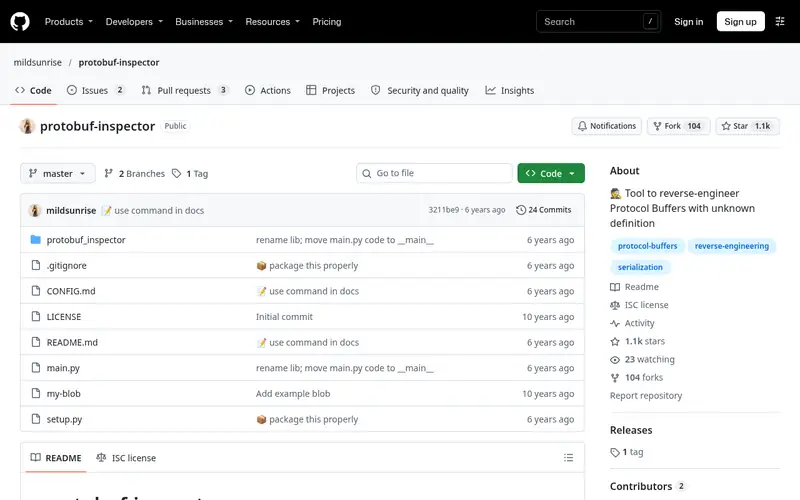
protobuf-inspector is a Python tool that parses raw Protobuf binary data and prints its structure without requiring a .proto schema. It guesses field types and nesting, which helps when you have a captured payload and no definition handy. Because it runs locally, you avoid sending data to a third-party service.
It installs through pip and runs on any platform with Python. The project is open source and free. The main limitation is accuracy: without a schema, field types and meanings are inferred, so output can be ambiguous for nested or packed fields. It is a debugging aid, not a validator. Use it on test data where possible, and treat any decoded output as a best guess rather than a contract.
Standout: Decodes messages without .proto files
Free (open source), as listed by the vendor (protobuf-inspector website). Confirm the current plan price before you buy.
Free plan. Plans change, so confirm on the vendor's pricing page before you buy.
Benefits
- Decodes messages without .proto files
- Runs locally as a Python tool
Drawbacks
- Heuristic output can be ambiguous
- Command-line only
Skip it if this limit matters to you: heuristic output can be ambiguous.
Verdict. A sensible pick for decoding raw Protobuf payloads without a schema.
Alternatives in this guide: protoc (Protocol Buffers Compiler), buf, protolint
protolint
Best for enforcing style rules on .proto files
What it is and where it fits
protolint is a linter and formatter for Protocol Buffers files. It checks naming, ordering and formatting conventions and can fix some issues automatically. You can run it from the command line, wire it into CI, or use editor integrations so problems show up as you type.
It is written in Go, ships as a single binary for Windows, macOS and Linux, and is free and open source. Configuration lives in a YAML file where you enable or disable rules. The limit is scope: protolint enforces style, not backward compatibility or schema design. It complements buf's breaking-change checks rather than replacing them. Small teams may not need a separate linter, but projects with many contributors often adopt one to keep diffs clean.
Standout: Focused linter with configurable rules
Free (open source), as listed by the vendor (protolint website). Confirm the current plan price before you buy.
Free plan. Plans change, so confirm on the vendor's pricing page before you buy.
Benefits
- Focused linter with configurable rules
- Integrates with editors and CI
Drawbacks
- Style checks only, not wire compatibility
- Rule set needs tuning per team
Skip it if this limit matters to you: style checks only, not wire compatibility.
Verdict. A sensible pick for enforcing style rules on .proto files.
Alternatives in this guide: protoc (Protocol Buffers Compiler), buf, protobuf-inspector
Google.Protobuf for .NET
Best for using Protobuf inside .NET applications
What it is and where it fits
Google.Protobuf is the official C# runtime library for Protocol Buffers. You generate classes from .proto files with protoc, then use this package to serialize and parse messages in .NET applications. It supports the standard message types, well-known types and common serialization patterns.
The library is distributed as a NuGet package and is free and open source. It targets modern .NET versions and works on Windows, macOS and Linux. The limit is that it is a runtime library, not a full toolchain: you still need protoc or a build integration to generate code, and schema management is up to you. Developers outside .NET should use the equivalent library for their language. Within .NET, it is the default choice for Protobuf work.
Standout: Official runtime library for C#
Free (open source), as listed by the vendor (Google.Protobuf for .NET website). Confirm the current plan price before you buy.
Free plan. Plans change, so confirm on the vendor's pricing page before you buy.
Benefits
- Official runtime library for C#
- Works with protoc-generated classes
Drawbacks
- Tied to the .NET ecosystem
- Requires generated code step
Skip it if this limit matters to you: tied to the .NET ecosystem.
Verdict. A sensible pick for using Protobuf inside .NET applications.
Alternatives in this guide: protoc (Protocol Buffers Compiler), buf, protobuf-inspector
protobufjs
Best for protobuf in JavaScript and TypeScript projects
What it is and where it fits
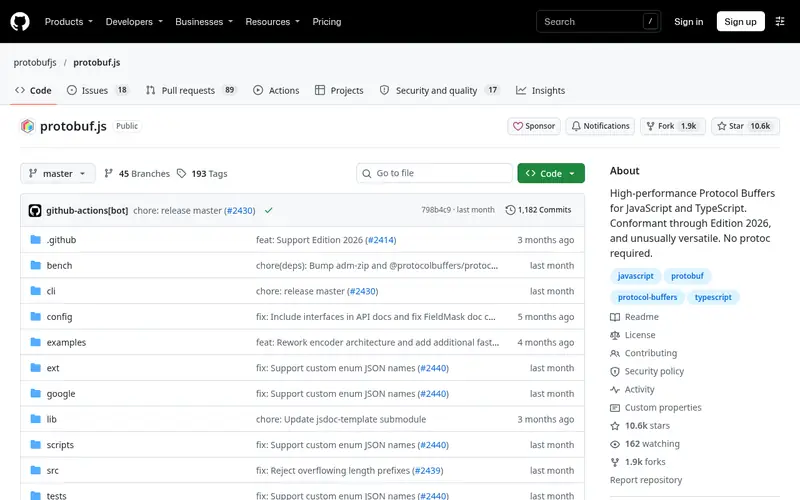
protobufjs is a JavaScript and TypeScript implementation of Protocol Buffers. It can parse .proto files at runtime or use pre-generated static code, and it works in Node.js and in browsers. It supports the common message and service definitions and is widely used in web clients that talk to gRPC or Protobuf backends.
The project is free and open source and installs through npm. It runs wherever JavaScript runs. The trade-off is performance and bundle size: runtime reflection is convenient but slower and heavier than static generated code, so production clients often precompile. The API also differs from protoc-generated code in other languages, which can confuse teams working across stacks. It is a good fit for JavaScript-first projects and quick prototypes.
Standout: Works in Node.js and browsers
Free (open source), as listed by the vendor (protobufjs website). Confirm the current plan price before you buy.
Free plan. Plans change, so confirm on the vendor's pricing page before you buy.
Benefits
- Works in Node.js and browsers
- Can load .proto files at runtime
Drawbacks
- Runtime reflection adds overhead
- API differs from generated-code workflows
Skip it if this limit matters to you: runtime reflection adds overhead.
Verdict. A sensible pick for protobuf in JavaScript and TypeScript projects.
Alternatives in this guide: protoc (Protocol Buffers Compiler), buf, protobuf-inspector
grpcurl
Best for calling gRPC services from the command line
What it is and where it fits
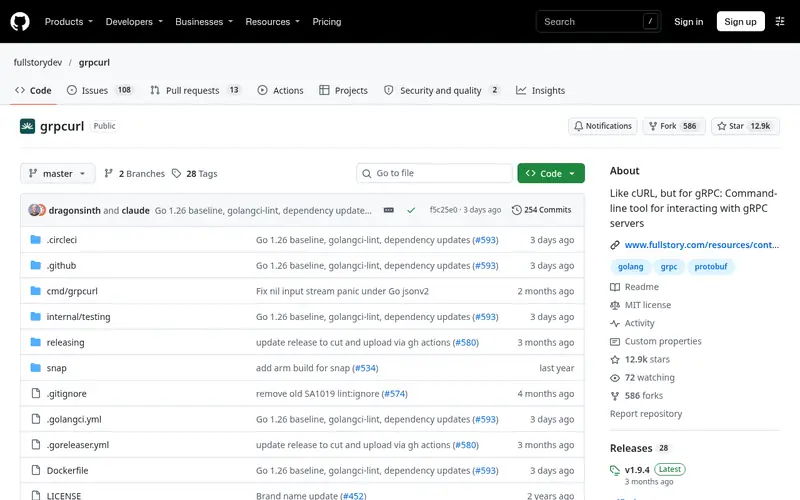
grpcurl is a command-line tool for interacting with gRPC servers. Since gRPC uses Protobuf messages, grpcurl is a practical way to list services, describe methods and send test requests without writing a client. It can use server reflection to discover schemas or load local .proto files.
It is written in Go, ships as a single binary for Windows, macOS and Linux, and is free and open source. The main limit is that it depends on either reflection being enabled on the server or access to the proto definitions; without one of those, it cannot build requests. It is a testing and debugging tool, not a schema editor or code generator. Developers working with gRPC services will get the most from it.
Standout: Uses server reflection to discover schemas
Free (open source), as listed by the vendor (grpcurl website). Confirm the current plan price before you buy.
Free plan. Plans change, so confirm on the vendor's pricing page before you buy.
Benefits
- Uses server reflection to discover schemas
- Handy for testing gRPC endpoints
Drawbacks
- Requires reflection or local proto files
- Not a general Protobuf editor
Skip it if this limit matters to you: requires reflection or local proto files.
Verdict. A sensible pick for calling gRPC services from the command line.
Alternatives in this guide: protoc (Protocol Buffers Compiler), buf, protobuf-inspector
Who should use what
Teams starting with Protobuf should begin with protoc for code generation and add buf once schemas are shared across services. JavaScript and TypeScript developers should use protobufjs, while .NET teams should use Google.Protobuf. If you need to inspect captured payloads, protobuf-inspector runs locally and avoids sending data to a web service. For style consistency across many contributors, add protolint. For testing gRPC endpoints, grpcurl covers service discovery and request sending from the command line.
Questions to settle before you buy
What to check before you buy
- Confirm the tool supports every language and platform your team uses.
- Check the licence and any paid tier limits on the official pricing page.
- Decide whether schema linting and breaking-change checks are required.
- Verify that any payload inspection runs locally, and never paste secrets or production data into third-party pages.
- Test code generation and plugin setup on a small schema before migrating a large one.
FAQ
Is protoc free to use?
Yes. protoc is part of the open-source Protocol Buffers project and is free under a BSD-style licence. You can use it commercially without a paid tier. Costs come from surrounding tooling and hosting, not from the compiler itself.
Do I need buf if I already use protoc?
Not always. buf adds linting, formatting and breaking-change detection that protoc does not provide. Small projects can stay on protoc. Teams sharing schemas across repositories usually benefit from buf's checks and dependency management.
Can I decode a Protobuf message without a .proto file?
Sometimes. Tools like protobuf-inspector infer structure from raw bytes, but field types and meanings are guesses. For reliable decoding, use the original schema. Avoid pasting production payloads into third-party web decoders.
Which library should I use for JavaScript?
protobufjs is the common choice for JavaScript and TypeScript. It works in Node.js and browsers and can load .proto files at runtime or use precompiled code. Precompiling is better for production bundle size and speed.
Are browser-based Protobuf tools safe for production data?
Treat them with caution. Any data you paste into a third-party web page leaves your machine. Prefer tools that run locally in the browser or offline, and never paste secrets, tokens or production payloads into pages you do not control.
Sources we checked
Method: how we score · editorial policy.
Change log. First published 22 Nov 2026.