Stage 02 · Test · Researched comparison
Best Property-Based Testing Libraries in 2026
Fast-check is the first pick for most JavaScript and TypeScript teams. It runs in Node, browsers and common test runners, and it is free and open source. For Python, Hypothesis is the mature choice with a large strategy library and a database of failing examples. For Rust, proptest integrates with the standard test harness. Teams on other stacks can pick from the options below.

By Shihab Mia
Published 22 Nov 2026 · 7 tools compared
We run no ads and no affiliate links at launch. The order of a list follows our published method. See how we score.
Prices are the starting prices vendors list publicly. Plans change, so confirm the current price on the vendor page before you buy.
Key takeaways
- Fast-check, Hypothesis, proptest, jqwik, QuickCheck, gopter and FsCheck are free and open source.
- Hypothesis and fast-check ship shrinking and example databases that replay failures.
- Most libraries plug into an existing test runner, so you keep your current CI setup.
- These are code libraries, not web pages, so test data stays on your machine and in your repo.
Who each pick is for
- JavaScript and TypeScript projectsfast-check
- Python projects and data-heavy codeHypothesis
- Rust crates and librariesproptest
- Java and JVM projects on JUnitjqwik
- Haskell codebasesQuickCheck
- Go packages and servicesgopter
- F# and C# projects on .NETFsCheck
Comparison
| Tool | Best for | Standout feature | Listed starting price | Free plan or trial |
|---|---|---|---|---|
| 1fast-check | JavaScript and TypeScript projects | Works with Jest, Vitest, Mocha and node:test | Free (open source) | Free plan |
| 2Hypothesis | Python projects and data-heavy code | Large strategy library and example database | Free (open source) | Free plan |
| 3proptest | Rust crates and libraries | Integrates with cargo test | Free (open source) | Free plan |
| 4jqwik | Java and JVM projects on JUnit | Runs on the JUnit Platform | Free (open source) | Free plan |
| 5QuickCheck | Haskell codebases | Long-standing design that shaped later libraries | Free (open source) | Free plan |
| 6gopter | Go packages and services | Works with the standard go test tool | Free (open source) | Free plan |
| 7FsCheck | F# and C# projects on .NET | Usable from F# and C# | Free (open source) | Free plan |
How we picked
We picked libraries that genuinely do property-based testing for a named language or runtime, are currently maintained, and have a public repository or documentation site. We weighed fit for the job, supported platforms and test runners, licence and price, and the main limits such as language lock-in and generator coverage. Sources are vendor pages, documentation and project repositories. Prices and licences can change, so confirm on the vendor site.
The tools, one by one
fast-check
Best for javaScript and TypeScript projects
What it is and where it fits
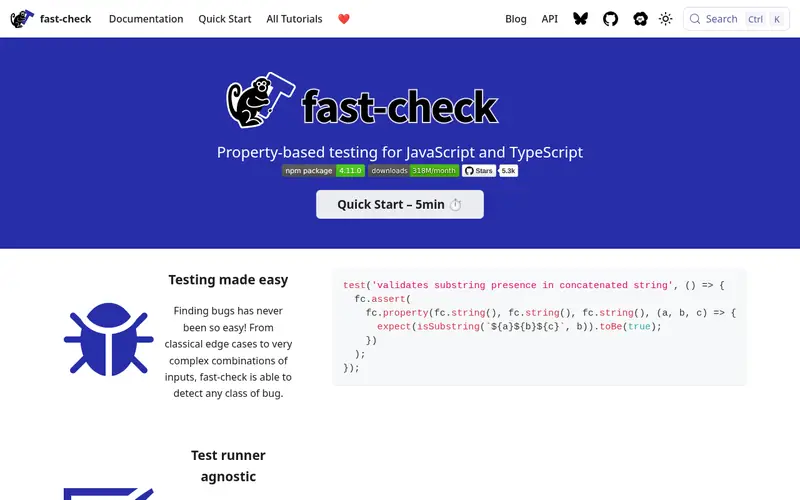
fast-check is a property-based testing library for JavaScript and TypeScript. You describe properties that should always hold, and the library generates random inputs to try to break them. When a case fails, it shrinks the input to a small counterexample. It runs in Node and in browsers and integrates with common runners such as Jest, Vitest, Mocha and node:test.
The library ships many built-in arbitraries for numbers, strings, arrays, objects, dates and functions, plus combinators to build custom generators. It also supports model-based testing and race-condition checks. The project is open source under the MIT licence, with no paid tier.
Teams that only write example-based tests may not need it. Skip fast-check if your runtime is not JavaScript or TypeScript.
Standout: Works with Jest, Vitest, Mocha and node:test
Free (open source), as listed by the vendor (fast-check website). Confirm the current plan price before you buy.
Free plan. Plans change, so confirm on the vendor's pricing page before you buy.
Benefits
- Works with Jest, Vitest, Mocha and node:test
- built-in arbitraries for many data types
Drawbacks
- Advanced arbitraries take time to learn
- async property support needs care
Skip it if this limit matters to you: advanced arbitraries take time to learn.
Verdict. A sensible pick for javaScript and TypeScript projects.
Alternatives in this guide: Hypothesis, proptest, jqwik
Hypothesis
Best for python projects and data-heavy code
What it is and where it fits
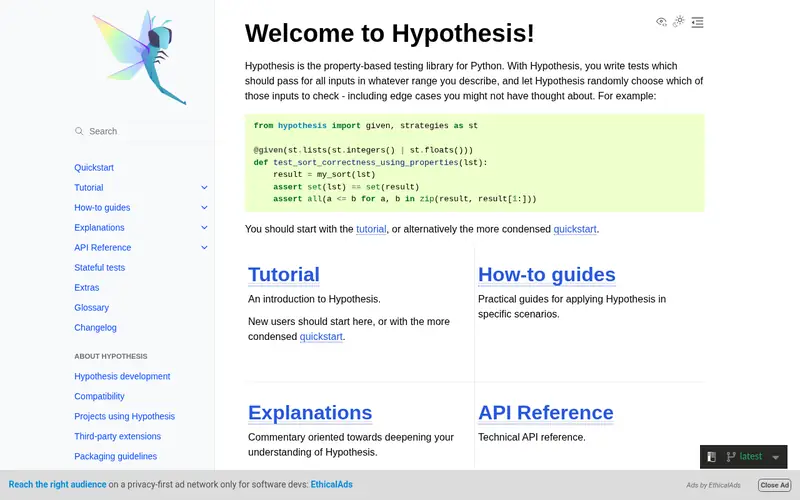
Hypothesis is a property-based testing library for Python. It generates inputs from strategies, shrinks failing cases, and stores failures in a local example database so they replay on later runs. It works with pytest and unittest and is widely used for data validation, parsers and numeric code.
The strategy library covers primitives, collections, dates, text and NumPy arrays, and you can compose custom strategies. Stateful testing lets you model a system as a sequence of operations and check invariants after each step. The project is open source under the Mozilla Public License 2.0.
Very slow test suites can suffer because Hypothesis tries many examples by default. You can cap examples per test. Skip it if your code is not Python.
Standout: Large strategy library and example database
Free (open source), as listed by the vendor (Hypothesis website). Confirm the current plan price before you buy.
Free plan. Plans change, so confirm on the vendor's pricing page before you buy.
Benefits
- Large strategy library and example database
- integrates with pytest
Drawbacks
- Some strategies need tuning for slow tests
- stateful testing has a learning curve
Skip it if this limit matters to you: some strategies need tuning for slow tests.
Verdict. A sensible pick for python projects and data-heavy code.
Alternatives in this guide: fast-check, proptest, jqwik
proptest
Best for rust crates and libraries
What it is and where it fits
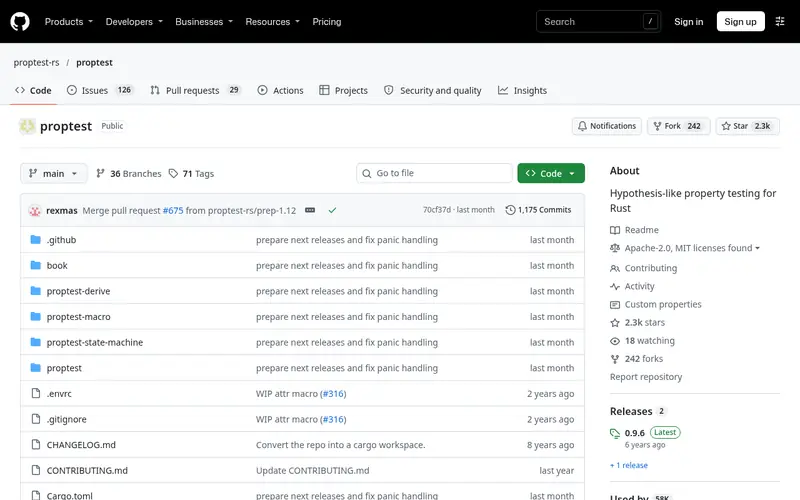
proptest is a property-based testing library for Rust. It plugs into the standard test harness, so properties run with cargo test. It generates values from strategies, shrinks failures to minimal cases, and can persist failing inputs to a regression file so they run again later.
The crate covers primitives, collections, tuples and custom strategies, and it supports state-machine testing for sequences of operations. It is open source under the MIT and Apache-2.0 licences, with no paid tier.
Heavy use of generated tests can slow compile and test cycles. Skip proptest if your project is not written in Rust.
Standout: Integrates with cargo test
Free (open source), as listed by the vendor (proptest website). Confirm the current plan price before you buy.
Free plan. Plans change, so confirm on the vendor's pricing page before you buy.
Benefits
- Integrates with cargo test
- strong shrinking and failure persistence
Drawbacks
- Macro-based API takes adjustment
- compile times rise with heavy use
Skip it if this limit matters to you: macro-based API takes adjustment.
Verdict. A sensible pick for rust crates and libraries.
Alternatives in this guide: fast-check, Hypothesis, jqwik
jqwik
Best for java and JVM projects on JUnit
What it is and where it fits
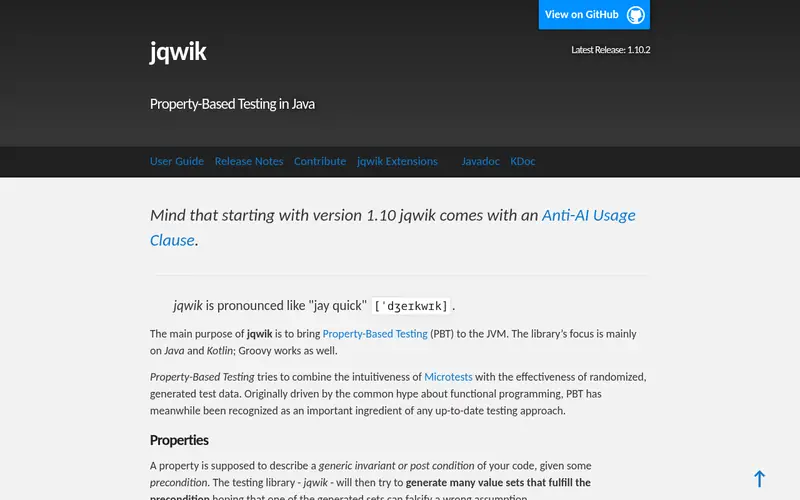
jqwik is a property-based testing library for Java and other JVM languages. It runs on the JUnit Platform, so it works with JUnit 5 and common build tools. You declare properties with annotations, and jqwik generates inputs, shrinks failures and reports the smallest counterexample.
It provides generators for primitives, collections, strings and custom types, plus support for stateful testing and statistics on generated values. The project is open source under the Eclipse Public License 2.0.
Teams outside the JVM cannot use it. Skip jqwik if your tests already rely on a different property library for Java.
Standout: Runs on the JUnit Platform
Free (open source), as listed by the vendor (jqwik website). Confirm the current plan price before you buy.
Free plan. Plans change, so confirm on the vendor's pricing page before you buy.
Benefits
- Runs on the JUnit Platform
- good reporting of shrunk failures
Drawbacks
- JVM-only
- annotation-driven style differs from example tests
Skip it if this limit matters to you: JVM-only.
Verdict. A sensible pick for java and JVM projects on JUnit.
Alternatives in this guide: fast-check, Hypothesis, proptest
QuickCheck
Best for haskell codebases
What it is and where it fits
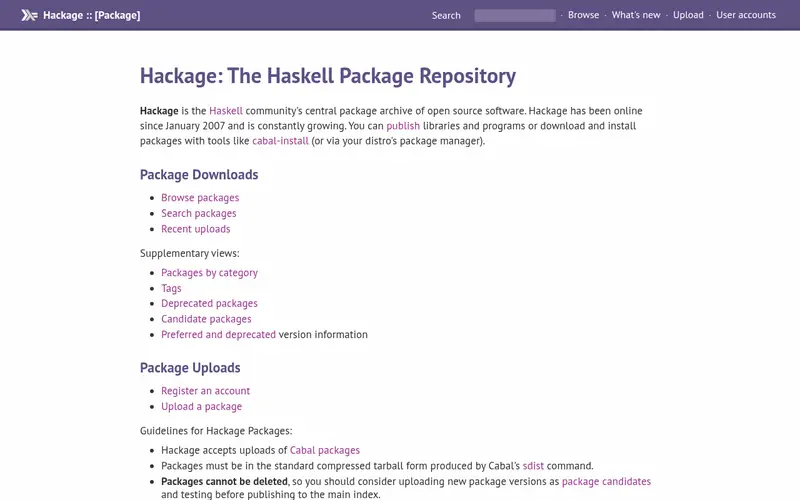
QuickCheck is the original property-based testing library, written for Haskell. You state properties as functions, and QuickCheck generates random inputs, checks the property and shrinks failures to small counterexamples. It integrates with common Haskell build tools and test runners.
The package provides generators for standard types and combinators for custom ones, plus support for classifying and collecting test data. It is open source under a BSD-style licence.
The API is smaller than some newer ports, and it only serves Haskell projects. Skip it if your stack is not Haskell.
Standout: Long-standing design that shaped later libraries
Free (open source), as listed by the vendor (QuickCheck website). Confirm the current plan price before you buy.
Free plan. Plans change, so confirm on the vendor's pricing page before you buy.
Benefits
- Long-standing design that shaped later libraries
- simple property syntax
Drawbacks
- Haskell-only
- fewer built-in generators than newer ports
Skip it if this limit matters to you: haskell-only.
Verdict. A sensible pick for haskell codebases.
Alternatives in this guide: fast-check, Hypothesis, proptest
gopter
Best for go packages and services
What it is and where it fits
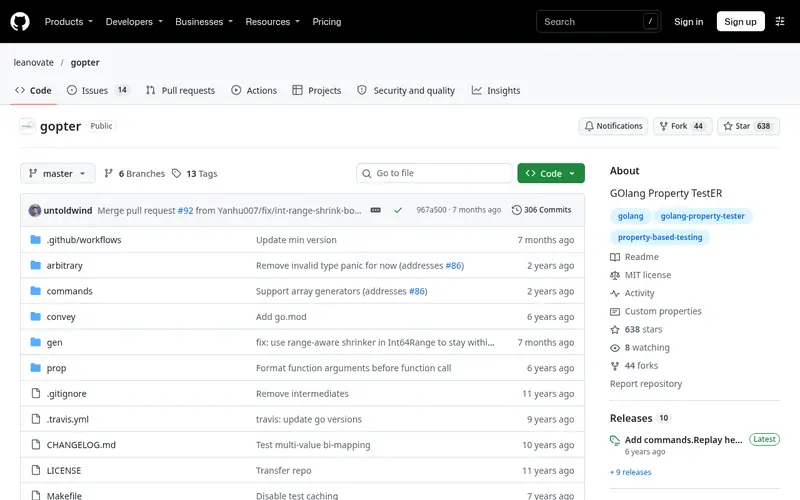
gopter is a property-based testing library for Go. It integrates with the standard testing package, so properties run with go test. It provides generators for primitives, collections and custom types, and it shrinks failing inputs to smaller counterexamples.
The library covers property checks, generators and some stateful testing patterns. It is open source under the MIT licence.
The project has a smaller ecosystem than the Python and JavaScript options, so fewer examples and integrations exist. Skip gopter if you need a large set of prebuilt generators.
Standout: Works with the standard go test tool
Free (open source), as listed by the vendor (gopter website). Confirm the current plan price before you buy.
Free plan. Plans change, so confirm on the vendor's pricing page before you buy.
Benefits
- Works with the standard go test tool
- generators for common Go types
Drawbacks
- Smaller community than some ports
- fewer built-in stateful helpers
Skip it if this limit matters to you: smaller community than some ports.
Verdict. A sensible pick for go packages and services.
Alternatives in this guide: fast-check, Hypothesis, proptest
FsCheck
Best for f# and C# projects on .NET
What it is and where it fits
FsCheck is a property-based testing library for .NET, written in F# and usable from C#. It generates inputs, checks properties and shrinks failures. It integrates with test frameworks such as xUnit and NUnit.
The library provides generators for primitives, collections and custom types, plus support for model-based testing. It is open source under a BSD-style licence.
C# users may find the F#-first documentation harder to follow. Skip FsCheck if your project is not on .NET.
Standout: Usable from F# and C#
Free (open source), as listed by the vendor (FsCheck website). Confirm the current plan price before you buy.
Free plan. Plans change, so confirm on the vendor's pricing page before you buy.
Benefits
- Usable from F# and C#
- integrates with common .NET test frameworks
Drawbacks
- Documentation leans toward F#
- C# usage needs more setup
Skip it if this limit matters to you: documentation leans toward F#.
Verdict. A sensible pick for F# and C# projects on .NET.
Alternatives in this guide: fast-check, Hypothesis, proptest
Who should use what
JavaScript and TypeScript teams should start with fast-check because it works with common runners. Python teams doing data or parser work should use Hypothesis for its strategy library and example database. Rust crates fit proptest, and Java teams on JUnit should look at jqwik. Haskell, Go and .NET teams have QuickCheck, gopter and FsCheck respectively. If your stack is not listed, check whether a port exists for your language before adding a new dependency.
Questions to settle before you buy
What to check before you buy
- Confirm the library supports your language version and test runner.
- Check that shrinking produces readable counterexamples for your data types.
- Verify failing inputs can be saved and replayed in CI.
- Review the licence against your project's distribution rules.
- Check the repository for recent commits and open issues before adopting it.
FAQ
Do property-based tests replace example-based tests?
No. They complement them. Keep example tests for known cases and edge conditions, and use properties to explore a wider input space. Many teams run both in the same suite.
Are these libraries free?
Yes. All seven listed here are open source with no paid tier. You pay only in setup time and CI compute for the extra test runs.
Do I need to paste data into a website?
No. These are code libraries that run locally and in your CI pipeline. Test data stays on your machine and in your repository, which avoids the risk of sending secrets to a third-party page.
Which library should a Python team pick?
Hypothesis is the common choice for Python. It integrates with pytest, ships a large strategy library and stores failing examples for replay.
Can I use more than one library in a project?
Yes, if your project spans languages. For example, a TypeScript front end and a Python service can each use the library that fits its runtime. Keep the property style consistent across teams.
Sources we checked
Method: how we score · editorial policy.
Change log. First published 22 Nov 2026.