Stage 02 · Test · Researched comparison
Best PHP WebSocket Libraries in 2026
Ratchet is the first pick for teams that want a pure PHP WebSocket server with no extensions, and it suits classic PHP applications that need a simple event-driven server. Workerman is a strong alternative if you want a long-running PHP process with a larger feature set and active maintenance. OpenSwoole suits high-concurrency workloads where a PHP extension is acceptable. All three are open source and free.

By Shihab Mia
Published 28 Nov 2026 · 8 tools compared
We run no ads and no affiliate links at launch. The order of a list follows our published method. See how we score.
Prices are the starting prices vendors list publicly. Plans change, so confirm the current price on the vendor page before you buy.
Key takeaways
- Ratchet is pure PHP and needs no extension, but its project maintenance is slower than the alternatives.
- Swoole and OpenSwoole are PHP extensions, so they need server-level install access and cannot run on typical shared hosting.
- Workerman, Laravel Reverb, Soketi and Centrifugo are all open source and free to self-host.
- Soketi and Centrifugo are separate servers, not PHP libraries, and PHP apps connect to them as clients.
Who each pick is for
- Pure PHP WebSocket servers with no extensionRatchet
- High-concurrency WebSocket servers as a PHP extensionSwoole
- Teams wanting a maintained Swoole-compatible extensionOpenSwoole
- Long-running PHP socket servers without extensionsWorkerman
- Laravel apps that need first-party WebSocketsLaravel Reverb
- Self-hosted Pusher-compatible server for PHP clientsSoketi
- PHP WebSocket client connectionswebsocket-php (textalk)
- Standalone real-time server with PHP client librariesCentrifugo
Comparison
| Tool | Best for | Standout feature | Listed starting price | Free plan or trial |
|---|---|---|---|---|
| 1Ratchet | Pure PHP WebSocket servers with no extension | No PHP extension required | Free (open source) | Free plan |
| 2Swoole | High-concurrency WebSocket servers as a PHP extension | Coroutine-based concurrency | Free (open source) | Free plan |
| 3OpenSwoole | Teams wanting a maintained Swoole-compatible extension | Active fork of Swoole with its own release cycle | Free (open source) | Free plan |
| 4Workerman | Long-running PHP socket servers without extensions | Pure PHP with no extension needed | Free (open source) | Free plan |
| 5Laravel Reverb | Laravel apps that need first-party WebSockets | First-party Laravel package | Free (open source) | Free plan |
| 6Soketi | Self-hosted Pusher-compatible server for PHP clients | Pusher protocol compatible | Free (open source) | Free plan |
| 7websocket-php (textalk) | PHP WebSocket client connections | Client and server roles in one library | Free (open source) | Free plan |
| 8Centrifugo | Standalone real-time server with PHP client libraries | Language-agnostic server with PHP client | Free (open source) | Free plan |
How we picked
We compared these options on fit for PHP WebSocket work, whether they need a PHP extension or a separate runtime, licence and price, and the main operational limits such as process supervision and scaling. Sources are vendor documentation, project repositories and public pricing pages. Prices and maintenance activity change, so confirm details on the vendor site before you commit.
The tools, one by one
Ratchet
Best for pure PHP WebSocket servers with no extension
What it is and where it fits
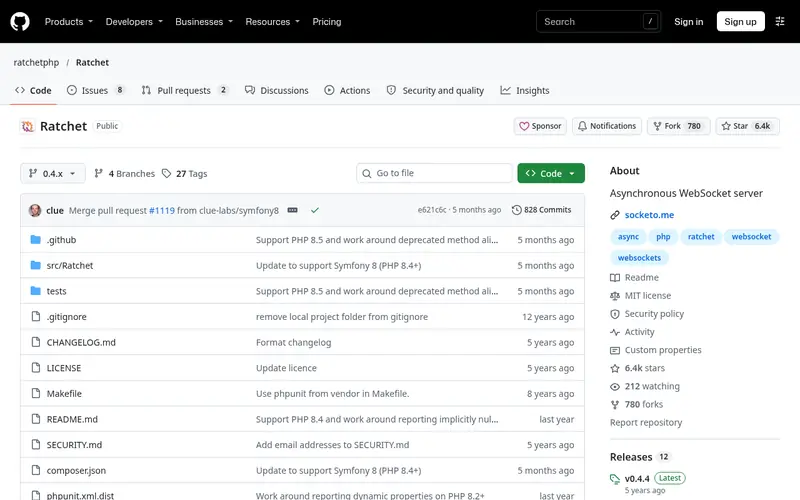
Ratchet is a PHP library for building WebSocket servers on top of ReactPHP. You write a class that implements its message interfaces, run it as a long-running process, and clients connect over the standard WebSocket protocol. It also includes WAMP support for pub/sub and RPC patterns. Because it is pure PHP, it runs anywhere PHP runs, including environments where you cannot install extensions.
The tradeoff is pace. The project sees less frequent releases than the alternatives, so check the repository for recent activity before you commit to it for a long-lived product. It also needs a process supervisor such as systemd or Supervisor to keep the server running. Skip Ratchet if you need very high connection counts or want a large maintained feature set.
Standout: No PHP extension required
Free (open source), as listed by the vendor (Ratchet website). Confirm the current plan price before you buy.
Free plan. Plans change, so confirm on the vendor's pricing page before you buy.
Benefits
- No PHP extension required
- Integrates with ReactPHP event loop
Drawbacks
- Slower maintenance activity
- Fewer built-in features than extension-based options
Skip it if this limit matters to you: slower maintenance activity.
Verdict. A sensible pick for pure PHP WebSocket servers with no extension.
Alternatives in this guide: Swoole, OpenSwoole, Workerman
Swoole
Best for high-concurrency WebSocket servers as a PHP extension
What it is and where it fits
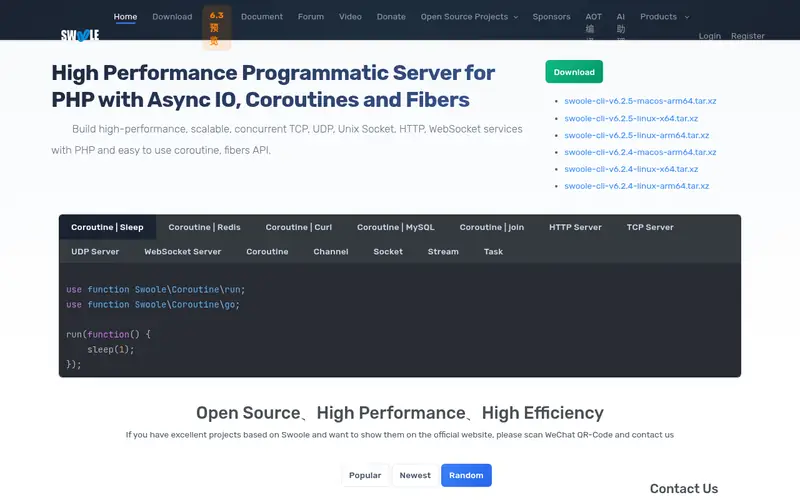
Swoole is a PHP extension that adds coroutines, async I/O and a WebSocket server to PHP. You create a server object, set callbacks for open, message and close events, and start it. Because it runs inside the PHP process as an extension, it handles many concurrent connections with less memory than process-per-connection designs.
Installing it means compiling or installing the extension on the server, which rules out most shared hosting. Code written for Swoole is not portable to plain PHP-FPM setups. It is a good fit when you control the server and expect heavy concurrent traffic. Read the official docs carefully, since the API differs from standard PHP.
Standout: Coroutine-based concurrency
Free (open source), as listed by the vendor (Swoole website). Confirm the current plan price before you buy.
Free plan. Plans change, so confirm on the vendor's pricing page before you buy.
Benefits
- Coroutine-based concurrency
- Built-in WebSocket server support
Drawbacks
- Requires installing a PHP extension
- Not available on shared hosting
Skip it if this limit matters to you: requires installing a PHP extension.
Verdict. A sensible pick for high-concurrency WebSocket servers as a PHP extension.
Alternatives in this guide: Ratchet, OpenSwoole, Workerman
OpenSwoole
Best for teams wanting a maintained Swoole-compatible extension
What it is and where it fits
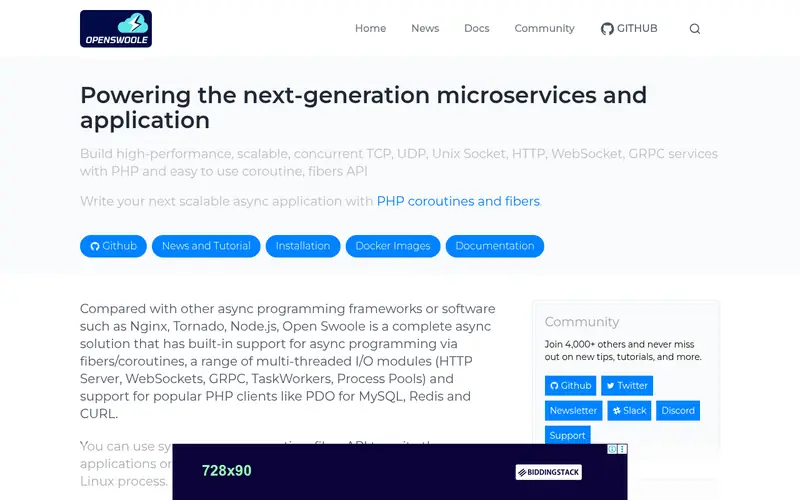
OpenSwoole is a fork of Swoole maintained as a separate project. It provides coroutines, async I/O and WebSocket server classes similar to Swoole's. Teams that want a Swoole-style extension with its own maintenance track and documentation site often pick it.
Like Swoole, it requires server-level access to install the extension and will not run on shared hosting. Code is largely compatible with Swoole but not identical, so test migrations. It suits backend teams running their own servers and expecting high connection counts. If you only need a few hundred connections and no extension, a pure PHP option is simpler.
Standout: Active fork of Swoole with its own release cycle
Free (open source), as listed by the vendor (OpenSwoole website). Confirm the current plan price before you buy.
Free plan. Plans change, so confirm on the vendor's pricing page before you buy.
Benefits
- Active fork of Swoole with its own release cycle
- WebSocket server and coroutine APIs
Drawbacks
- Extension install required
- API differences from Swoole can trip up existing code
Skip it if this limit matters to you: extension install required.
Verdict. A sensible pick for teams wanting a maintained Swoole-compatible extension.
Workerman
Best for long-running PHP socket servers without extensions
What it is and where it fits
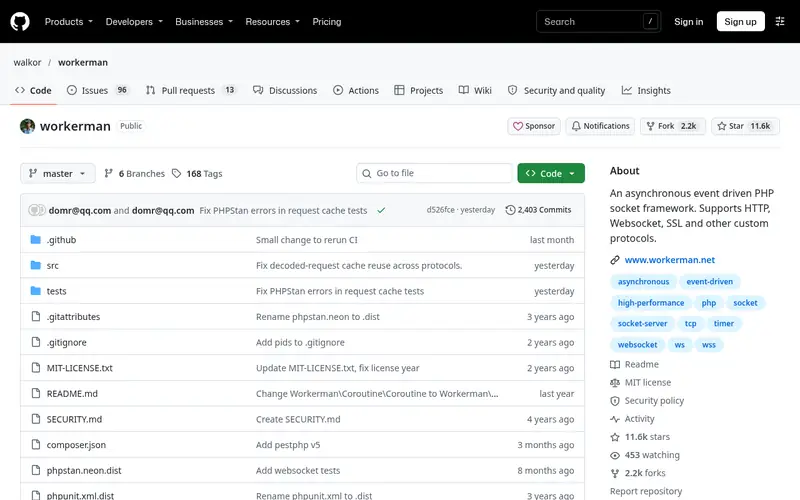
Workerman is a pure PHP socket server library. It supports WebSocket, TCP, UDP and HTTP protocols, and you run it as a long-running process managed by systemd, Supervisor or its own daemon mode. Because it is plain PHP, it installs with Composer and runs wherever PHP runs.
It is more actively developed than Ratchet and covers more protocols, which makes it a common choice for chat servers, push services and custom socket work. The catch is the programming model: state lives in memory between requests, so you must handle restarts, memory growth and graceful shutdown. It also needs a process supervisor in production. Skip it if your host blocks long-running CLI processes.
Standout: Pure PHP with no extension needed
Free (open source), as listed by the vendor (Workerman website). Confirm the current plan price before you buy.
Free plan. Plans change, so confirm on the vendor's pricing page before you buy.
Benefits
- Pure PHP with no extension needed
- Active project with WebSocket, TCP and HTTP support
Drawbacks
- Needs a process manager in production
- Different programming model from request-response PHP
Skip it if this limit matters to you: needs a process manager in production.
Verdict. A sensible pick for long-running PHP socket servers without extensions.
Alternatives in this guide: Ratchet, Swoole, OpenSwoole
Laravel Reverb
Best for laravel apps that need first-party WebSockets
What it is and where it fits
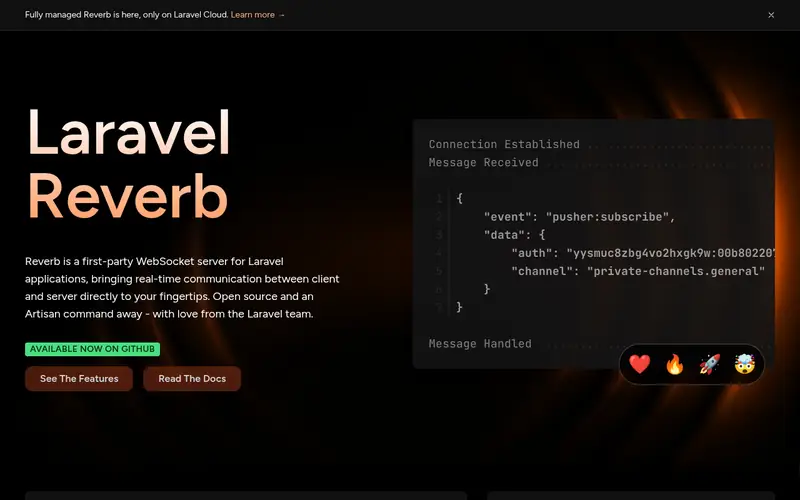
Laravel Reverb is a first-party WebSocket server for Laravel. It speaks the Pusher protocol, so Laravel Echo and existing broadcasting code work with it. You install it as a Composer package, run the Reverb process, and point your broadcasting configuration at it.
It is the shortest path to WebSockets in a Laravel application, and it removes the need for a third-party hosted Pusher service. The limits are scope and operations: it is only relevant if you use Laravel, and you still need to run and supervise the server process, plus configure scaling with Redis when you run more than one node. Skip it for non-Laravel projects or when you want a language-agnostic server.
Standout: First-party Laravel package
Free (open source), as listed by the vendor (Laravel Reverb website). Confirm the current plan price before you buy.
Free plan. Plans change, so confirm on the vendor's pricing page before you buy.
Benefits
- First-party Laravel package
- Works with Laravel's broadcasting and Echo
Drawbacks
- Only useful inside Laravel
- Needs a running Reverb process plus queue and cache setup
Skip it if this limit matters to you: only useful inside Laravel.
Verdict. A sensible pick for laravel apps that need first-party WebSockets.
Alternatives in this guide: Ratchet, Swoole, OpenSwoole
Soketi
Best for self-hosted Pusher-compatible server for PHP clients
What it is and where it fits
Soketi is an open-source, Pusher-compatible WebSocket server written in Node.js. PHP applications connect to it with the official Pusher PHP SDK or Laravel Echo, so you keep your existing client code and swap the host. It supports channels, presence and private channels.
The important caveat is that Soketi is not a PHP library. You deploy and operate a Node.js service alongside your PHP app, which adds a runtime to your stack. It suits teams already using the Pusher protocol that want to self-host. Skip it if you want a single-language stack or cannot run Node.js in production.
Standout: Pusher protocol compatible
Free (open source), as listed by the vendor (Soketi website). Confirm the current plan price before you buy.
Free plan. Plans change, so confirm on the vendor's pricing page before you buy.
Benefits
- Pusher protocol compatible
- PHP apps connect with existing Pusher SDKs
Drawbacks
- Node.js server, not PHP
- Needs separate deployment and operations
Skip it if this limit matters to you: node.js server, not PHP.
Verdict. A sensible pick for self-hosted Pusher-compatible server for PHP clients.
Alternatives in this guide: Ratchet, Swoole, OpenSwoole
websocket-php (textalk)
Best for pHP WebSocket client connections
What it is and where it fits
websocket-php, maintained under the sirn-se namespace, provides WebSocket client and server classes in pure PHP. Most users employ it as a client to connect from PHP to an external WebSocket server, such as Centrifugo or a Node service. It supports text and binary frames and the standard handshake.
It is not a replacement for a full server framework like Workerman when you need to host many connections. It fits scripts, queue workers and backend jobs that need to open a WebSocket connection and send or receive messages. It installs with Composer and needs no extension. Check the repository for current release activity before relying on it.
Standout: Client and server roles in one library
Free (open source), as listed by the vendor (websocket-php (textalk) website). Confirm the current plan price before you buy.
Free plan. Plans change, so confirm on the vendor's pricing page before you buy.
Benefits
- Client and server roles in one library
- Composer install with no extension
Drawbacks
- Client-focused, not a full server framework
- Smaller community than server libraries
Skip it if this limit matters to you: client-focused, not a full server framework.
Verdict. A sensible pick for PHP WebSocket client connections.
Alternatives in this guide: Ratchet, Swoole, OpenSwoole
Centrifugo
Best for standalone real-time server with PHP client libraries
What it is and where it fits
Centrifugo is a standalone real-time messaging server written in Go. PHP applications publish messages to it over HTTP or its API, and clients connect to Centrifugo directly over WebSocket. Official PHP client libraries exist for the server-side API.
It offloads connection management, presence and scaling to a dedicated service, which suits apps with many browser clients and a PHP backend. The cost is another service to deploy and monitor, and a Go binary in your stack. It is not a PHP WebSocket library in the strict sense. Skip it if you want everything in PHP or have a very small connection count.
Standout: Language-agnostic server with PHP client
Free (open source), as listed by the vendor (Centrifugo website). Confirm the current plan price before you buy.
Free plan. Plans change, so confirm on the vendor's pricing page before you buy.
Benefits
- Language-agnostic server with PHP client
- Handles scaling and presence
Drawbacks
- Separate Go server to operate
- PHP side is a client, not a server library
Skip it if this limit matters to you: separate Go server to operate.
Verdict. A sensible pick for standalone real-time server with PHP client libraries.
Alternatives in this guide: Ratchet, Swoole, OpenSwoole
Who should use what
A classic PHP app on shared or managed hosting with no extension access should start with Ratchet or Workerman. A team running its own servers and expecting high concurrency should look at OpenSwoole or Swoole. A Laravel project should use Laravel Reverb first. A team already on the Pusher protocol that wants to self-host should consider Soketi or Centrifugo, with websocket-php for client-side connections from PHP scripts.
Questions to settle before you buy
What to check before you buy
- Confirm your host allows long-running CLI processes and a process supervisor.
- Check whether the option needs a PHP extension or a separate runtime such as Node.js or Go.
- Review the repository's recent release activity before choosing a low-activity project.
- Plan how you will scale beyond one node, usually with Redis or a message broker.
- Test reconnection, heartbeat and graceful shutdown behavior under load.
FAQ
Do I need a PHP extension to run a WebSocket server?
No. Ratchet, Workerman and websocket-php are pure PHP and install with Composer. Swoole and OpenSwoole are extensions and need server-level install access. The pure PHP options are simpler to deploy but generally handle fewer concurrent connections per process.
Can I use WebSockets on shared hosting?
Usually not. Most shared hosts block long-running CLI processes and custom ports. Pure PHP libraries still need a persistent process. If you cannot run one, use a hosted real-time service or a standalone server such as Centrifugo that your PHP app publishes to over HTTP.
Is Laravel Reverb only for Laravel?
Yes. Reverb is a first-party Laravel package and depends on Laravel's broadcasting, queue and cache setup. For non-Laravel projects, use Workerman, Ratchet or a standalone server. Reverb speaks the Pusher protocol, so Laravel Echo clients work with it.
What is the difference between Soketi and a PHP WebSocket library?
Soketi is a Node.js server, not a PHP library. Your PHP app connects to it with the Pusher SDK or Laravel Echo. A PHP library such as Workerman runs the server inside PHP. Soketi adds a runtime to your stack but keeps you on the Pusher protocol.
Are these libraries free?
All eight options listed are open source and free to self-host. You pay for servers and operations, not licences. Some projects offer paid hosting or support separately. Check each vendor page for current terms, since project licensing and maintenance can change.
Sources we checked
Method: how we score · editorial policy.
Change log. First published 28 Nov 2026.