Stage 02 · Test · Researched comparison
Best PHP Email Libraries in 2026
PHPMailer is the first pick for most projects that need a standalone library to send mail with SMTP, attachments and HTML bodies. It suits plain PHP apps and legacy codebases. Symfony Mailer is the better choice for new framework code, and Laravel Mail fits teams already on Laravel. Provider SDKs such as sendgrid-php or Postmark suit teams that send at volume through one vendor.

By Shihab Mia
Published 28 Nov 2026 · 7 tools compared
We run no ads and no affiliate links at launch. The order of a list follows our published method. See how we score.
Prices are the starting prices vendors list publicly. Plans change, so confirm the current price on the vendor page before you buy.
Key takeaways
- PHPMailer is free, open source and works without a framework, which makes it the default for plain PHP.
- Symfony Mailer and Laravel Mail are free and open source but are tied to their frameworks or components.
- Nette Mail and Laminas Mail are free, open source options for projects already using those frameworks.
- Provider SDKs are free to install, but sending costs depend on the vendor's plan, so check the pricing page.
Who each pick is for
- Plain PHP apps and legacy codebases that need SMTPPHPMailer
- Symfony apps and projects that want a reusable mailer componentSymfony Mailer
- Laravel applications that send mail through the frameworkLaravel Mail
- Nette Framework projects and small PHP appsNette Mail
- Laminas and Mezzio projects that need a mail componentLaminas Mail
- Teams sending at volume through SendGridSendGrid PHP SDK
- Transactional email through PostmarkPostmark PHP library
Comparison
| Tool | Best for | Standout feature | Listed starting price | Free plan or trial |
|---|---|---|---|---|
| 1PHPMailer | Plain PHP apps and legacy codebases that need SMTP | Works without a framework | Free (open source) | Free plan |
| 2Symfony Mailer | Symfony apps and projects that want a reusable mailer component | Framework-independent component | Free (open source) | Free plan |
| 3Laravel Mail | Laravel applications that send mail through the framework | Built into Laravel with drivers and Blade templates | Free (open source) | Free plan |
| 4Nette Mail | Nette Framework projects and small PHP apps | Small and simple API | Free (open source) | Free plan |
| 5Laminas Mail | Laminas and Mezzio projects that need a mail component | Part of the Laminas component set | Free (open source) | Free plan |
| 6SendGrid PHP SDK | Teams sending at volume through SendGrid | Official SDK for the SendGrid API | See vendor pricing page | Free trial (see vendor page) |
| 7Postmark PHP library | Transactional email through Postmark | Official client for the Postmark API | See vendor pricing page | Free trial (see vendor page) |
How we picked
We compared libraries on fit for sending mail from PHP, supported platforms and transports, licence and price, and the main limits such as framework coupling or provider lock-in. We also considered how each project is maintained and documented. Sources are vendor documentation, project repositories and public pricing pages. Prices and free tiers change, so confirm details on the vendor site before you commit.
The tools, one by one
PHPMailer
Best for plain PHP apps and legacy codebases that need SMTP
What it is and where it fits
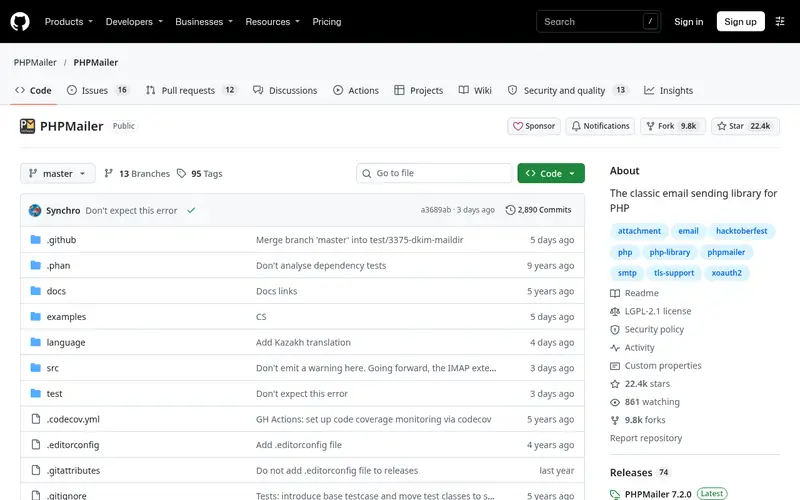
PHPMailer is a standalone class library for sending email from PHP. It handles SMTP with authentication and TLS, HTML and plain-text bodies, attachments, inline images and multiple recipients. It runs anywhere PHP runs, so it fits shared hosting, CLI scripts and older applications that do not use a framework.
The project is open source under the LGPL licence and is available through Composer. There is no paid tier and no account to create. You configure a transport yourself, either SMTP or the built-in mail function, and you manage templates and logging in your own code.
Choose PHPMailer when you want one library that works across projects. Skip it if you want framework integration, events or a mailer abstraction, since those come from Symfony Mailer or Laravel Mail instead.
Standout: Works without a framework
Free (open source), as listed by the vendor (PHPMailer website). Confirm the current plan price before you buy.
Free plan. Plans change, so confirm on the vendor's pricing page before you buy.
Benefits
- Works without a framework
- supports SMTP, attachments and HTML mail
Drawbacks
- No templating layer
- configuration is manual
Skip it if this limit matters to you: no templating layer.
Verdict. A sensible pick for plain PHP apps and legacy codebases that need SMTP.
Alternatives in this guide: Symfony Mailer, Laravel Mail, Nette Mail
Symfony Mailer
Best for symfony apps and projects that want a reusable mailer component
What it is and where it fits
Symfony Mailer is the mail component maintained by the Symfony project. It sends email over SMTP, sendmail or HTTP APIs from providers such as Mailgun, Postmark and SendGrid. It supports Twig templates, attachments, signed messages and events, and it can be used outside Symfony as a standalone Composer package.
The component is open source under the MIT licence. It has no paid tier. Setup involves configuring a DSN that describes the transport, which keeps credentials out of code when you use environment variables.
Pick Symfony Mailer for new applications that want a maintained, framework-neutral mailer with good testing support. Skip it if you need the simplest possible setup for a small script, where PHPMailer is quicker.
Standout: Framework-independent component
Free (open source), as listed by the vendor (Symfony Mailer website). Confirm the current plan price before you buy.
Free plan. Plans change, so confirm on the vendor's pricing page before you buy.
Benefits
- Framework-independent component
- supports SMTP, sendmail and HTTP transports
Drawbacks
- More setup than a single class
- tied to Symfony conventions
Skip it if this limit matters to you: more setup than a single class.
Verdict. A sensible pick for symfony apps and projects that want a reusable mailer component.
Alternatives in this guide: PHPMailer, Laravel Mail, Nette Mail
Laravel Mail
Best for laravel applications that send mail through the framework
What it is and where it fits
Laravel Mail is the mail layer included with the Laravel framework. It builds on Symfony Mailer and adds Laravel-specific features: mailables, Blade and Markdown templates, multiple drivers and queue integration for sending in the background. Configuration lives in the framework's config files and environment variables.
Laravel is open source under the MIT licence, so the mail features cost nothing beyond your hosting and any email provider you use. The trade-off is coupling: the API is designed for Laravel and does not make sense in a non-Laravel project.
Use Laravel Mail if your application already runs on Laravel. Skip it for standalone scripts or other frameworks, where PHPMailer or Symfony Mailer are the direct options.
Standout: Built into Laravel with drivers and Blade templates
Free (open source), as listed by the vendor (Laravel Mail website). Confirm the current plan price before you buy.
Free plan. Plans change, so confirm on the vendor's pricing page before you buy.
Benefits
- Built into Laravel with drivers and Blade templates
- queue support for background sending
Drawbacks
- Only useful inside Laravel
- adds framework dependency
Skip it if this limit matters to you: only useful inside Laravel.
Verdict. A sensible pick for laravel applications that send mail through the framework.
Alternatives in this guide: PHPMailer, Symfony Mailer, Nette Mail
Nette Mail
Best for nette Framework projects and small PHP apps
What it is and where it fits
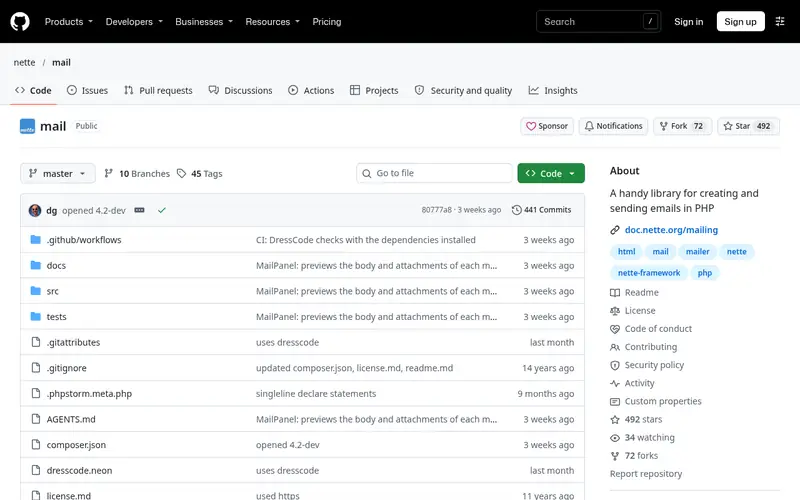
Nette Mail is the mail component from the Nette Framework. It provides a message object, SMTP transport and support for attachments and HTML bodies. The API is compact, which makes it easy to read in small applications.
The package is open source under a BSD-style licence and installs through Composer. It can be used outside Nette, but most of its documentation and examples assume the framework. There is no paid tier.
Consider Nette Mail if you already use Nette or want a minimal library with a clear API. Skip it if you need broad community resources in English, where PHPMailer has more examples.
Standout: Small and simple API
Free (open source), as listed by the vendor (Nette Mail website). Confirm the current plan price before you buy.
Free plan. Plans change, so confirm on the vendor's pricing page before you buy.
Benefits
- Small and simple API
- supports SMTP and attachments
Drawbacks
- Smaller ecosystem
- less documentation in English
Skip it if this limit matters to you: smaller ecosystem.
Verdict. A sensible pick for nette Framework projects and small PHP apps.
Alternatives in this guide: PHPMailer, Symfony Mailer, Laravel Mail
Laminas Mail
Best for laminas and Mezzio projects that need a mail component
What it is and where it fits
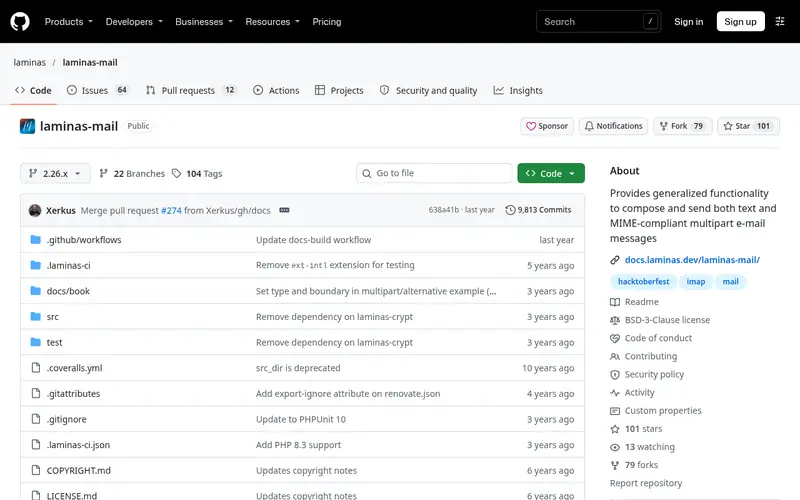
Laminas Mail is the mail package from the Laminas project, the continuation of Zend Framework. It provides message objects, SMTP and other transports, attachments and MIME handling. It fits applications built on Laminas MVC or Mezzio.
The package is open source under a BSD-style licence and installs through Composer. It is maintained as part of the Laminas organisation, but its user base is smaller than PHPMailer's, so fewer tutorials and answers exist.
Choose Laminas Mail if your project already depends on Laminas components. Skip it for greenfield projects with no Laminas dependency, where a smaller library is easier to maintain.
Standout: Part of the Laminas component set
Free (open source), as listed by the vendor (Laminas Mail website). Confirm the current plan price before you buy.
Free plan. Plans change, so confirm on the vendor's pricing page before you buy.
Benefits
- Part of the Laminas component set
- supports SMTP and multiple transports
Drawbacks
- Heavier API
- smaller user base than PHPMailer
Skip it if this limit matters to you: heavier API.
Verdict. A sensible pick for laminas and Mezzio projects that need a mail component.
Alternatives in this guide: PHPMailer, Symfony Mailer, Laravel Mail
SendGrid PHP SDK
Best for teams sending at volume through SendGrid
What it is and where it fits
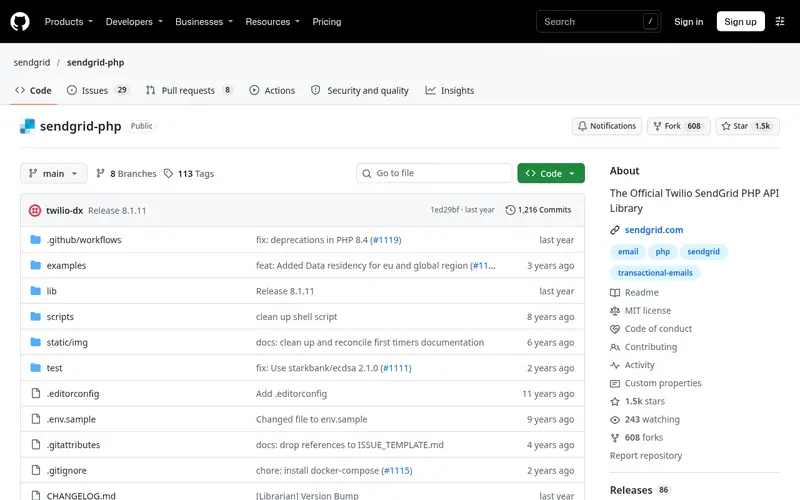
The official SendGrid PHP SDK sends mail through the SendGrid v3 API rather than SMTP. It supports personalizations, dynamic templates, attachments and category tracking. Because it calls an HTTP API, it can be faster to integrate than SMTP in some hosting environments.
The SDK itself is free and open source. Sending requires a SendGrid account, and the free tier and paid plans change over time, so check the vendor pricing page before you commit. The library is only useful if you send through SendGrid.
Pick this SDK if you have standardized on SendGrid and want its template and analytics features in code. Skip it if you want to switch providers without rewriting code.
Standout: Official SDK for the SendGrid API
See vendor pricing page, as listed by the vendor (SendGrid PHP SDK website). Confirm the current plan price before you buy.
Free trial (see vendor page). Plans change, so confirm on the vendor's pricing page before you buy.
Benefits
- Official SDK for the SendGrid API
- handles templates and categories
Drawbacks
- Tied to one provider
- sending costs depend on your plan
Skip it if this limit matters to you: tied to one provider.
Verdict. A sensible pick for teams sending at volume through SendGrid.
Alternatives in this guide: PHPMailer, Symfony Mailer, Laravel Mail
Postmark PHP library
Best for transactional email through Postmark
What it is and where it fits
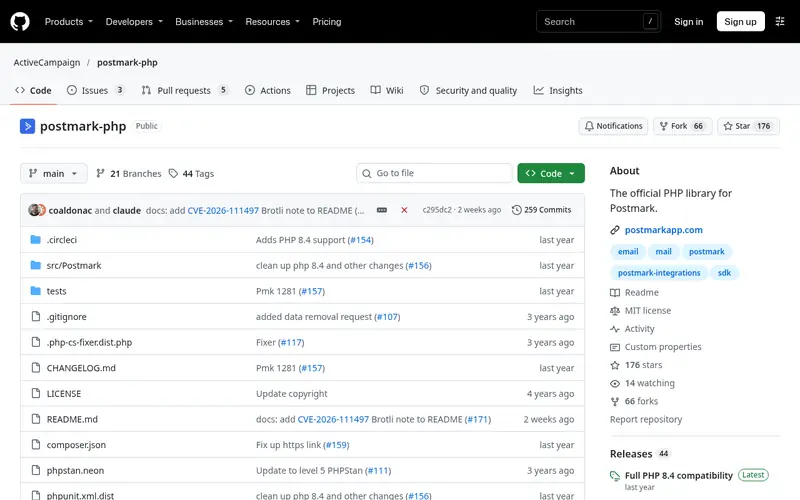
The Postmark PHP library is the official client for the Postmark API. It sends transactional email, supports templates and attachments, and exposes message events. Postmark is aimed at transactional mail rather than bulk marketing.
The library is free and open source. Sending requires a Postmark account, and plans and limits are set by the vendor, so confirm current terms on the pricing page. The code is specific to Postmark's API.
Use it if Postmark is your provider and you want its delivery features in PHP. Skip it if you need a provider-neutral library, where PHPMailer or Symfony Mailer fit better.
Standout: Official client for the Postmark API
See vendor pricing page, as listed by the vendor (Postmark PHP library website). Confirm the current plan price before you buy.
Free trial (see vendor page). Plans change, so confirm on the vendor's pricing page before you buy.
Benefits
- Official client for the Postmark API
- focused on transactional mail
Drawbacks
- Provider lock-in
- no SMTP-only fallback in the same API
Skip it if this limit matters to you: provider lock-in.
Verdict. A sensible pick for transactional email through Postmark.
Alternatives in this guide: PHPMailer, Symfony Mailer, Laravel Mail
Who should use what
If you maintain plain PHP or legacy code, PHPMailer gives you SMTP, attachments and HTML mail without a framework. If you build on Symfony or want a reusable component, Symfony Mailer fits. If your app runs on Laravel, use Laravel Mail and its templates and queues. If you send high volume through one provider, a provider SDK such as sendgrid-php or Postmark's library gives you that vendor's features directly. Projects on Nette or Laminas should use their own mail packages to stay consistent with the framework.
Questions to settle before you buy
What to check before you buy
- Confirm the library supports the transport you need: SMTP, a local mail binary or an HTTP API.
- Check the licence and whether it fits your project's distribution model.
- Verify PHP version support against your runtime.
- Review how credentials are configured, and keep them in environment variables.
- Check that the project is actively maintained and has recent releases.
FAQ
Is PHPMailer still maintained?
Yes. PHPMailer is actively maintained on GitHub and installs through Composer. It remains a common choice for plain PHP projects that send mail over SMTP.
Can I use Symfony Mailer without Symfony?
Yes. Symfony Mailer is a standalone component you can install with Composer and use in any PHP project. You configure a transport DSN and send messages without the full framework.
Should I use an SMTP library or a provider SDK?
Use an SMTP library such as PHPMailer or Symfony Mailer if you want to switch providers without code changes. Use a provider SDK if you rely on that vendor's templates, analytics or delivery features.
Is Laravel Mail free?
Yes. Laravel and its mail features are open source under the MIT licence. Your costs come from hosting and any email delivery provider you connect.
Do these libraries store my email credentials?
The libraries read credentials from your configuration at runtime. Keep them in environment variables or a secrets manager, and avoid committing them to your repository.
Sources we checked
Method: how we score · editorial policy.
Change log. First published 28 Nov 2026.