Stage 02 · Test · Researched comparison
Best Java Email Libraries in 2026
Jakarta Mail (with the Eclipse Angus implementation) is the first pick for most teams. It is the standard API, it is open source, and it handles SMTP, IMAP and MIME. Simple Java Mail is a good alternative when you want a simpler builder API on top of Jakarta Mail. Spring's JavaMailSender suits projects already on Spring. GreenMail is the pick for testing mail flows without a real server.

By Shihab Mia
Published 28 Nov 2026 · 6 tools compared
We run no ads and no affiliate links at launch. The order of a list follows our published method. See how we score.
Prices are the starting prices vendors list publicly. Plans change, so confirm the current price on the vendor page before you buy.
Key takeaways
- Jakarta Mail and Eclipse Angus are free and open source and form the base that several other libraries build on.
- Simple Java Mail wraps Jakarta Mail with a fluent builder and adds features like batch sending and templates.
- Spring JavaMailSender is free and open source but only makes sense inside a Spring application.
- GreenMail is a free, open-source test server for mail; it is not a library for sending production email.
Who each pick is for
- Teams that want the standard Java mail APIJakarta Mail (Eclipse Angus)
- Developers who want a simpler builder API for mailSimple Java Mail
- Spring applications that need mail sendingSpring Framework JavaMailSender
- Small Java projects that want a simple send APIApache Commons Email
- Testing mail sending and receiving in JavaGreenMail
- Teams sending through the SendGrid email serviceSendGrid Java SDK
Comparison
| Tool | Best for | Standout feature | Listed starting price | Free plan or trial |
|---|---|---|---|---|
| 1Jakarta Mail (Eclipse Angus) | Teams that want the standard Java mail API | Standard API with broad documentation | Free (open source) | Free plan |
| 2Simple Java Mail | Developers who want a simpler builder API for mail | Fluent builder for messages and attachments | Free (open source) | Free plan |
| 3Spring Framework JavaMailSender | Spring applications that need mail sending | Integrates with Spring configuration and dependency injection | Free (open source) | Free plan |
| 4Apache Commons Email | Small Java projects that want a simple send API | Simple classes for common message types | Free (open source) | Free plan |
| 5GreenMail | Testing mail sending and receiving in Java | Runs an in-process mail server for tests | Free (open source) | Free plan |
| 6SendGrid Java SDK | Teams sending through the SendGrid email service | Official SDK for the SendGrid API | See vendor pricing page | Free trial (varies by plan) |
How we picked
We picked libraries that genuinely send or test email from Java and are currently maintained. Criteria were fit for the job, platforms supported, price and licence, and main limits. Sources are vendor documentation, project repositories and public pricing pages. We did not run benchmarks or collect user reviews. Prices and free plan limits change, so confirm them on the vendor site before you commit.
The tools, one by one
Jakarta Mail (Eclipse Angus)
Best for teams that want the standard Java mail API
What it is and where it fits
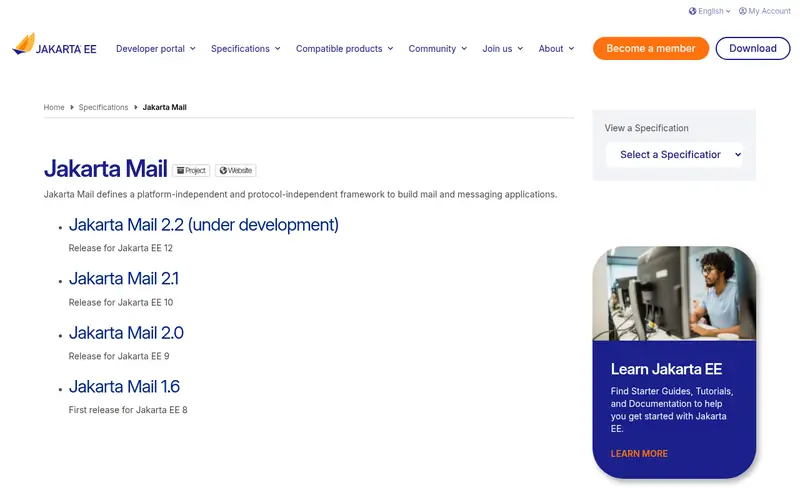
Jakarta Mail is the specification that replaced JavaMail under the Jakarta EE name. The Eclipse Angus project provides the reference implementation. It sends mail over SMTP and reads mail over IMAP and POP3, and it builds and parses MIME messages, including attachments and HTML bodies. It is a plain Java library, so it runs anywhere a JVM runs, including servers, desktop apps and Android with care.
The API is the standard one, so examples and answers you find online usually apply. The trade-off is verbosity: creating a message with attachments and an HTML part takes a fair amount of code. You manage sessions, transports and message parts yourself. Licensing is open source under the Eclipse and Jakarta terms.
Choose it when you want a stable, standard dependency with no framework tie-in. Skip it if you want a one-line send call or built-in templating; a wrapper library will save you code.
Standout: Standard API with broad documentation
Free (open source), as listed by the vendor (Jakarta Mail (Eclipse Angus) website). Confirm the current plan price before you buy.
Free plan. Plans change, so confirm on the vendor's pricing page before you buy.
Benefits
- Standard API with broad documentation
- supports SMTP, IMAP, POP3 and MIME
Drawbacks
- Verbose API for common tasks
- MIME building takes boilerplate
Skip it if this limit matters to you: verbose API for common tasks.
Verdict. A sensible pick for teams that want the standard Java mail API.
Alternatives in this guide: Simple Java Mail, Spring Framework JavaMailSender, Apache Commons Email
Simple Java Mail
Best for developers who want a simpler builder API for mail
What it is and where it fits
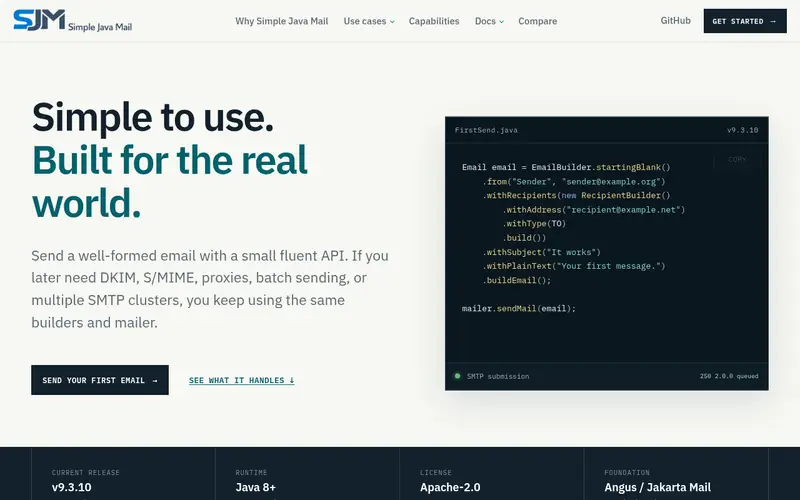
Simple Java Mail is an open-source library that wraps Jakarta Mail behind a fluent builder. You create a mailer, build an email with chained calls, and send it. It supports HTML and plain-text bodies, attachments, embedded images, custom headers and multiple recipients. It also adds features the base API does not have out of the box, such as batch sending with connection reuse and template support.
It runs on the JVM and depends on Jakarta Mail underneath, so you still get the standard transport. The library handles the MIME assembly for you, which cuts boilerplate for messages with attachments or mixed content. Documentation lives on the project site and the GitHub repository.
Choose it when you send mail often and want readable code. Skip it if you prefer to stay close to the standard API or your team already has its own wrapper.
Standout: Fluent builder for messages and attachments
Free (open source), as listed by the vendor (Simple Java Mail website). Confirm the current plan price before you buy.
Free plan. Plans change, so confirm on the vendor's pricing page before you buy.
Benefits
- Fluent builder for messages and attachments
- adds batch sending and templating
Drawbacks
- Extra abstraction over Jakarta Mail
- smaller community than the standard API
Skip it if this limit matters to you: extra abstraction over Jakarta Mail.
Verdict. A sensible pick for developers who want a simpler builder API for mail.
Alternatives in this guide: Jakarta Mail (Eclipse Angus), Spring Framework JavaMailSender, Apache Commons Email
Spring Framework JavaMailSender
Best for spring applications that need mail sending
What it is and where it fits
Spring Framework includes the JavaMailSender interface and a MimeMessageHelper class for building messages. If your application already uses Spring or Spring Boot, you get mail support with a few properties for host, port and credentials, and you inject the sender where you need it. It builds on Jakarta Mail underneath.
MimeMessageHelper handles HTML bodies, attachments and inline resources with less code than raw Jakarta Mail. Spring Boot's mail starter wires the sender automatically from configuration. The library is open source under the Apache License 2.0.
Choose it when you are on Spring and want mail to follow the same configuration and injection patterns as the rest of your code. Skip it if you are not using Spring; the dependency is not worth it for mail alone.
Standout: Integrates with Spring configuration and dependency injection
Free (open source), as listed by the vendor (Spring Framework JavaMailSender website). Confirm the current plan price before you buy.
Free plan. Plans change, so confirm on the vendor's pricing page before you buy.
Benefits
- Integrates with Spring configuration and dependency injection
- simple interface for common sends
Drawbacks
- Only useful inside Spring
- adds framework weight for small apps
Skip it if this limit matters to you: only useful inside Spring.
Verdict. A sensible pick for spring applications that need mail sending.
Alternatives in this guide: Jakarta Mail (Eclipse Angus), Simple Java Mail, Apache Commons Email
Apache Commons Email
Best for small Java projects that want a simple send API
What it is and where it fits
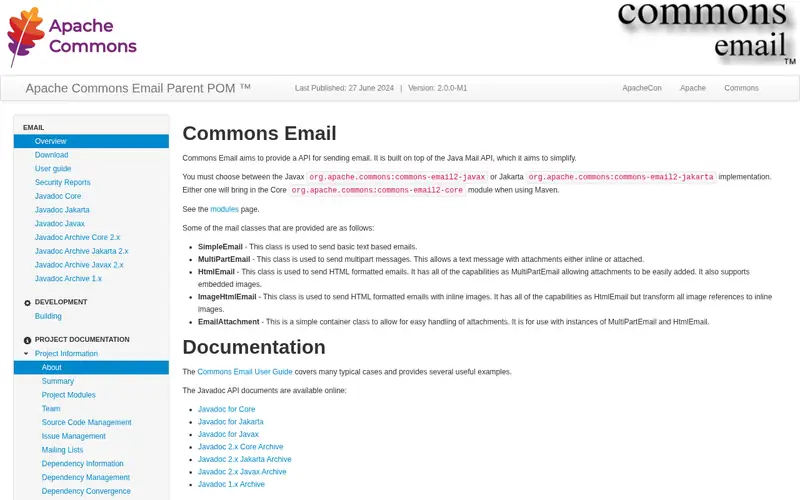
Apache Commons Email is a small library that simplifies sending mail from Java. It offers classes for simple text email, HTML email, email with attachments and multi-part messages. You configure a host and credentials, then call send. It sits on top of Jakarta Mail and hides most of the MIME setup.
It is open source under the Apache License 2.0 and runs on the JVM. The API is easy to read for basic cases. For advanced needs such as batch sending, templating or connection pooling, you will likely need to add code or pick a different library.
Choose it for small tools, scripts and internal apps where a short send call is enough. Skip it if you need features beyond basic message types or want a library with frequent releases.
Standout: Simple classes for common message types
Free (open source), as listed by the vendor (Apache Commons Email website). Confirm the current plan price before you buy.
Free plan. Plans change, so confirm on the vendor's pricing page before you buy.
Benefits
- Simple classes for common message types
- part of the well-known Commons family
Drawbacks
- Fewer features than newer wrappers
- less active than the standard API
Skip it if this limit matters to you: fewer features than newer wrappers.
Verdict. A sensible pick for small Java projects that want a simple send API.
Alternatives in this guide: Jakarta Mail (Eclipse Angus), Simple Java Mail, Spring Framework JavaMailSender
GreenMail
Best for testing mail sending and receiving in Java
What it is and where it fits
GreenMail is an open-source test library that starts an in-memory mail server inside your test process. You point your code at it instead of a real SMTP server, send messages, and then assert on what arrived. It supports SMTP, IMAP and POP3, so you can test both sending and retrieval. It integrates with JUnit and similar frameworks.
It is not a library for sending production email. It is the tool you use to check that your Jakarta Mail, Simple Java Mail or Spring code sends what you expect without hitting a real server or a paid service. That keeps tests fast and offline.
Choose it when you write automated tests for mail code. Skip it for anything in production; use a real SMTP provider or server there.
Standout: Runs an in-process mail server for tests
Free (open source), as listed by the vendor (GreenMail website). Confirm the current plan price before you buy.
Free plan. Plans change, so confirm on the vendor's pricing page before you buy.
Benefits
- Runs an in-process mail server for tests
- supports SMTP, IMAP and POP3
Drawbacks
- A test tool, not for production sending
- setup differs from real servers
Skip it if this limit matters to you: A test tool, not for production sending.
Verdict. A sensible pick for testing mail sending and receiving in Java.
Alternatives in this guide: Jakarta Mail (Eclipse Angus), Simple Java Mail, Spring Framework JavaMailSender
SendGrid Java SDK
Best for teams sending through the SendGrid email service
What it is and where it fits
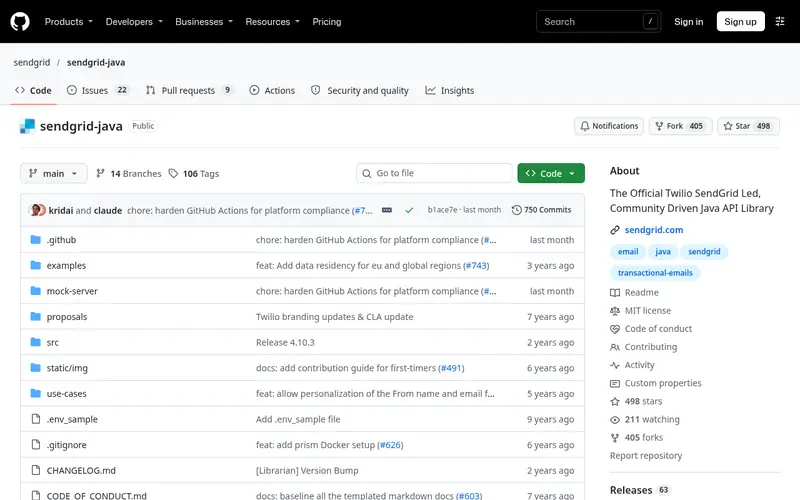
The SendGrid Java SDK is the official client for the SendGrid email API. Instead of SMTP, you call the API with an API key. The SDK builds requests for single sends, templates, attachments and categories. It runs on the JVM and is open source on GitHub, but sending requires a SendGrid account and a plan.
This is a vendor SDK, so it is the right choice only if you have decided to send through SendGrid. It gives you the provider's delivery tooling, but it couples your code to that service. Free plan limits and paid prices change, so check the vendor pricing page before you commit.
Choose it when SendGrid is your sending provider and you want the official client. Skip it if you want provider-neutral code; Jakarta Mail over SMTP keeps your options open.
Standout: Official SDK for the SendGrid API
See vendor pricing page, as listed by the vendor (SendGrid Java SDK website). Confirm the current plan price before you buy.
Free trial (varies by plan). Plans change, so confirm on the vendor's pricing page before you buy.
Benefits
- Official SDK for the SendGrid API
- handles templates and delivery features
Drawbacks
- Ties your code to one vendor
- sending needs a SendGrid account and API key
Skip it if this limit matters to you: ties your code to one vendor.
Verdict. A sensible pick for teams sending through the SendGrid email service.
Alternatives in this guide: Jakarta Mail (Eclipse Angus), Simple Java Mail, Spring Framework JavaMailSender
Who should use what
If you want the standard, provider-neutral API and full control, start with Jakarta Mail and Eclipse Angus. If you send mail often and want less boilerplate, Simple Java Mail gives you a fluent builder on top of it. If your app is on Spring, use Spring's JavaMailSender so mail follows your existing configuration. For automated tests, add GreenMail so your suite runs offline. Pick the SendGrid SDK only after you have chosen SendGrid as your provider.
Questions to settle before you buy
What to check before you buy
- Confirm the library supports the Jakarta Mail version your runtime provides.
- Check the licence matches your project's distribution model.
- Verify it handles the message types you need: HTML, attachments, inline images.
- For tests, confirm the tool runs offline and supports the protocols you use.
- Check the release history and issue tracker for recent activity.
FAQ
Is Jakarta Mail the same as JavaMail?
Jakarta Mail is the current name for the API formerly called JavaMail. The package names changed from javax.mail to jakarta.mail when the specification moved to the Jakarta EE project. Eclipse Angus is the reference implementation. Older code using javax.mail needs migration to the jakarta.mail packages.
Can I send email without an SMTP server?
You still need something to deliver the message. That can be an SMTP server, a relay, or a provider API such as SendGrid's. Libraries like Jakarta Mail and Simple Java Mail send over SMTP. Provider SDKs call an HTTP API instead. In tests, GreenMail acts as the server so nothing leaves your machine.
Which library is easiest for attachments?
Simple Java Mail and Spring's MimeMessageHelper both make attachments short to write. Apache Commons Email also has dedicated classes for attachments. Raw Jakarta Mail works but needs more MIME code. Pick based on whether you are already on Spring or want a standalone wrapper.
Do these libraries work with Spring Boot?
Jakarta Mail, Simple Java Mail and Apache Commons Email work in a Spring Boot app as normal dependencies. Spring Boot also has its own mail starter that configures JavaMailSender from properties. If you use that starter, you usually do not need a separate wrapper for basic sends.
Are these libraries free?
Jakarta Mail, Simple Java Mail, Spring Framework, Apache Commons Email and GreenMail are free and open source. The SendGrid Java SDK is open source, but sending through SendGrid requires an account and a plan. Check the vendor pricing page for current limits and prices.
Sources we checked
Method: how we score · editorial policy.
Change log. First published 28 Nov 2026.