Stage 02 · Test · Researched comparison
Best PHP Validation Libraries in 2026
Respect\Validation is the first pick for projects that want a standalone, framework-agnostic validation library with a large rule set. Symfony Validator suits teams already on Symfony components or building on its constraints and metadata. Laravel Validation is the natural choice inside a Laravel application. All three are free and open source, so the decision comes down to framework fit and how much you want to configure.

By Shihab Mia
Published 27 Nov 2026 · 5 tools compared
We run no ads and no affiliate links at launch. The order of a list follows our published method. See how we score.
Prices are the starting prices vendors list publicly. Plans change, so confirm the current price on the vendor page before you buy.
Key takeaways
- Respect\Validation, Symfony Validator, Laravel Validation, webmozart/assert and Laminas Validator are all free and open source.
- Symfony Validator and Laminas Validator can be installed on their own through Composer, without the full framework.
- Laravel Validation is tied to the Laravel framework and its service container, so it fits best inside a Laravel app.
- webmozart/assert is for internal invariant checks, not for validating user input forms.
Who each pick is for
- Framework-agnostic projects that need a broad rule setRespect\Validation
- Symfony projects and apps using its constraints and metadataSymfony Validator
- Applications built on the Laravel frameworkLaravel Validation
- Guarding internal invariants in library and service codewebmozart/assert
- Laminas and Mezzio projects, or standalone validator chainsLaminas Validator
Comparison
| Tool | Best for | Standout feature | Listed starting price | Free plan or trial |
|---|---|---|---|---|
| 1Respect\Validation | Framework-agnostic projects that need a broad rule set | Large catalog of built-in rules | Free (open source) | Free plan |
| 2Symfony Validator | Symfony projects and apps using its constraints and metadata | Works standalone or with the full framework | Free (open source) | Free plan |
| 3Laravel Validation | Applications built on the Laravel framework | Simple rule strings and a large rule set | Free (open source) | Free plan |
| 4webmozart/assert | Guarding internal invariants in library and service code | Static assertion methods with clear exception messages | Free (open source) | Free plan |
| 5Laminas Validator | Laminas and Mezzio projects, or standalone validator chains | Large set of validators with chain support | Free (open source) | Free plan |
How we picked
We picked libraries that are currently maintained, install through Composer and genuinely handle PHP validation. Criteria were fit for the job (form and data validation versus internal assertions), framework coupling, licence and price, and the main limits of each. Sources are vendor documentation, project repositories and public pricing pages. All listed tools are free and open source. Prices and maintenance status change, so confirm details on the vendor or repository page before you commit.
The tools, one by one
Respect\Validation
Best for framework-agnostic projects that need a broad rule set
What it is and where it fits
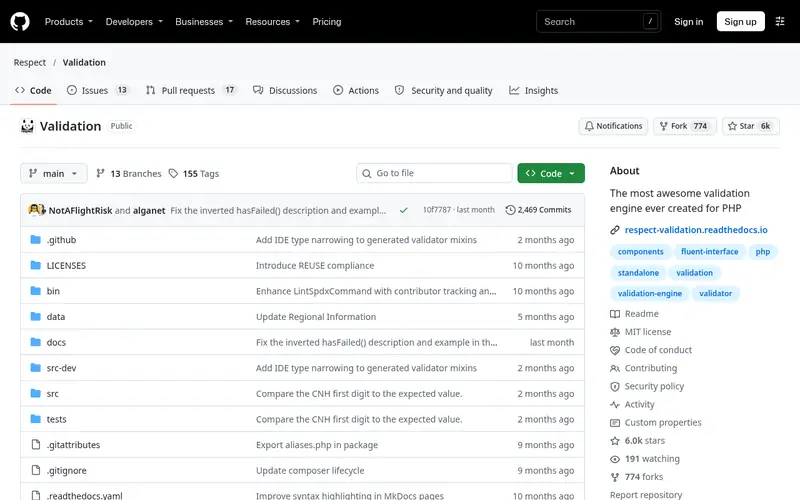
Respect\Validation is a standalone library for validating and asserting data. You build rules by chaining methods such as stringType, length, email and notEmpty, then call validate or assert on a value. It ships with a wide set of rules for strings, numbers, dates, files and nested structures, and it supports custom rules. It does not depend on a framework, so it works in plain PHP scripts, CLI tools and any framework.
The library is installed with Composer and licensed under MIT. Errors can be collected as exceptions or read as a list of messages. Because rules are composed in code, very large forms can produce long chains, and you may want to group rules into reusable classes. Teams that want a small dependency and full control over rule composition should look at it first.
Standout: Large catalog of built-in rules
Free (open source), as listed by the vendor (Respect\Validation website). Confirm the current plan price before you buy.
Free plan. Plans change, so confirm on the vendor's pricing page before you buy.
Benefits
- Large catalog of built-in rules
- readable chainable syntax
Drawbacks
- Rule chaining can get long for complex forms
- error message customization takes extra work
Skip it if this limit matters to you: rule chaining can get long for complex forms.
Verdict. A sensible pick for framework-agnostic projects that need a broad rule set.
Alternatives in this guide: Symfony Validator, Laravel Validation, webmozart/assert
Symfony Validator
Best for symfony projects and apps using its constraints and metadata
What it is and where it fits
Symfony Validator validates objects and arrays against constraints. You can declare constraints with PHP attributes, YAML, XML or plain PHP, then validate an object and read a constraint violation list. It includes constraints for common cases such as NotBlank, Length, Email, Regex, Choice and nested object validation, and you can write custom constraints.
It is a Symfony component but can be installed alone with Composer and used in any PHP project. It is MIT licensed. The main cost is conceptual: you need to understand constraints, metadata mapping and validation groups. That structure pays off in larger applications where validation rules live next to the model. Teams that want a minimal, code-only rule chain may find it heavier than needed.
Standout: Works standalone or with the full framework
Free (open source), as listed by the vendor (Symfony Validator website). Confirm the current plan price before you buy.
Free plan. Plans change, so confirm on the vendor's pricing page before you buy.
Benefits
- Works standalone or with the full framework
- constraints via attributes, YAML or XML
Drawbacks
- More concepts to learn (constraints, metadata, groups)
- heavier setup than a single-file library
Skip it if this limit matters to you: more concepts to learn (constraints, metadata, groups).
Verdict. A sensible pick for symfony projects and apps using its constraints and metadata.
Alternatives in this guide: Respect\Validation, Laravel Validation, webmozart/assert
Laravel Validation
Best for applications built on the Laravel framework
What it is and where it fits
Laravel Validation is the validation layer built into the Laravel framework. You define rules as arrays or pipe-delimited strings, such as required, email, max:255 and unique:users, then validate request data and redirect back with errors. It includes rules for presence, size, formats, database uniqueness, nested arrays and conditional rules, plus support for custom rule objects.
It is MIT licensed and free. The trade-off is coupling: the validator expects Laravel's container, request and session pieces, so pulling it into a non-Laravel project takes effort. If your application is already Laravel, it is the shortest path from request to validated data and error messages. Projects outside Laravel should prefer a standalone library.
Standout: Simple rule strings and a large rule set
Free (open source), as listed by the vendor (Laravel Validation website). Confirm the current plan price before you buy.
Free plan. Plans change, so confirm on the vendor's pricing page before you buy.
Benefits
- Simple rule strings and a large rule set
- tight integration with requests and error bags
Drawbacks
- Tied to Laravel and its container
- awkward to reuse outside a Laravel app
Skip it if this limit matters to you: tied to Laravel and its container.
Verdict. A sensible pick for applications built on the Laravel framework.
Alternatives in this guide: Respect\Validation, Symfony Validator, webmozart/assert
webmozart/assert
Best for guarding internal invariants in library and service code
What it is and where it fits
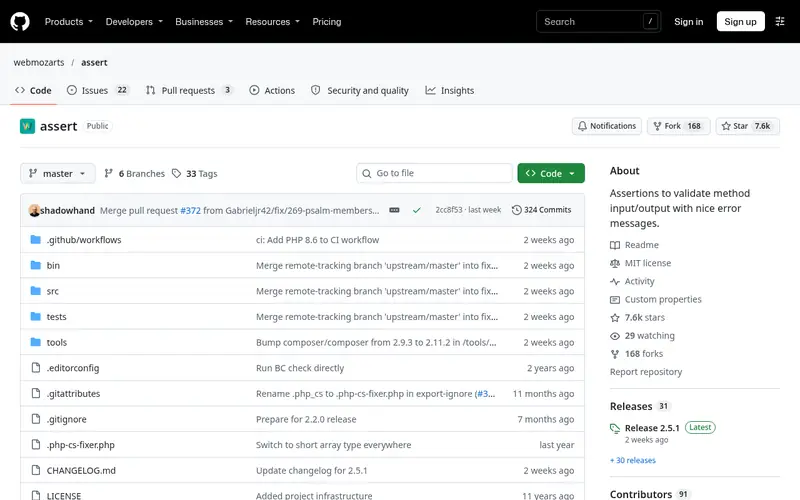
webmozart/assert provides static methods that check a value and throw an InvalidArgumentException when the check fails. Methods cover string, integer, boolean, array, object and class checks, plus null and empty checks. It is meant for asserting assumptions inside your own code, such as method arguments and return values, not for collecting validation errors from a form.
It installs with Composer and is MIT licensed. Because it throws on the first failure, it does not produce a list of field errors. Use it to fail fast in service layers and libraries, and pair it with a form validation library for user input. Teams looking for a single tool to validate request data should skip it.
Standout: Static assertion methods with clear exception messages
Free (open source), as listed by the vendor (webmozart/assert website). Confirm the current plan price before you buy.
Free plan. Plans change, so confirm on the vendor's pricing page before you buy.
Benefits
- Static assertion methods with clear exception messages
- very small dependency
Drawbacks
- Not designed for user-facing form validation
- throws exceptions rather than collecting errors
Skip it if this limit matters to you: not designed for user-facing form validation.
Verdict. A sensible pick for guarding internal invariants in library and service code.
Alternatives in this guide: Respect\Validation, Symfony Validator, Laravel Validation
Laminas Validator
Best for laminas and Mezzio projects, or standalone validator chains
What it is and where it fits
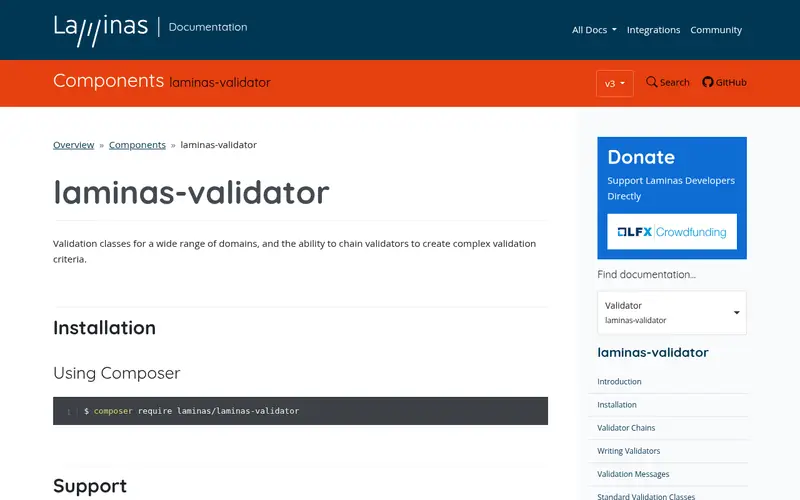
Laminas Validator is the validation component of the Laminas project. It provides individual validator classes for email addresses, hostnames, IP addresses, dates, regex patterns, file uploads and more. You can chain validators so a value must pass several checks, and each validator returns its own error messages.
It installs with Composer and is BSD-3-Clause licensed. It works inside Laminas and Mezzio applications and can be used standalone, though the object-per-rule style is more verbose than chainable or array-based libraries. It suits teams already in the Laminas ecosystem or projects that want discrete validator objects. New projects without Laminas experience may prefer a lighter option.
Standout: Large set of validators with chain support
Free (open source), as listed by the vendor (Laminas Validator website). Confirm the current plan price before you buy.
Free plan. Plans change, so confirm on the vendor's pricing page before you buy.
Benefits
- Large set of validators with chain support
- usable outside the framework
Drawbacks
- Verbose object-based setup
- documentation assumes Laminas familiarity
Skip it if this limit matters to you: verbose object-based setup.
Verdict. A sensible pick for laminas and Mezzio projects, or standalone validator chains.
Alternatives in this guide: Respect\Validation, Symfony Validator, Laravel Validation
Who should use what
If you are building a plain PHP service with no framework, start with Respect\Validation for its broad rule set. If your project already uses Symfony components, Symfony Validator keeps rules close to your models. Inside a Laravel application, Laravel Validation is the shortest path from request to errors. Use webmozart/assert for internal invariants, and Laminas Validator if you are already in that ecosystem.
Questions to settle before you buy
What to check before you buy
- Confirm the library supports your PHP version and is still receiving releases.
- Check whether it can run standalone or requires a full framework.
- Review the licence (MIT, BSD-3-Clause) against your project's requirements.
- Test how it reports errors: exception, error list or both.
- Check that custom rules and nested data validation are supported for your forms.
FAQ
Are these PHP validation libraries free?
Yes. Respect\Validation, Symfony Validator, Laravel Validation, webmozart/assert and Laminas Validator are all free and open source. They install through Composer. You pay only in setup time and maintenance, not licence fees.
Can I use Symfony Validator without Symfony?
Yes. Symfony Validator is a standalone component you can install with Composer and use in any PHP project. You declare constraints and validate objects or arrays without running the full framework. It does require learning constraints, metadata mapping and validation groups.
What is the difference between validation and assertion?
Validation collects errors from user input so you can show messages. Assertion checks an internal assumption and throws an exception when it fails. webmozart/assert is for assertions. Respect\Validation, Symfony Validator and Laravel Validation are for input validation.
Which library works best with Laravel?
Laravel Validation is built into the framework and integrates with requests, sessions and error bags. It is the shortest path inside a Laravel app. Using it outside Laravel takes extra work because it expects the framework's container and request handling.
Do I need to send data to a third-party service?
No. All the libraries listed run locally in your PHP process. Nothing is sent to an external service, which matters when you validate sensitive or production data.
Sources we checked
Method: how we score · editorial policy.
Change log. First published 27 Nov 2026.