Stage 02 · Test · Researched comparison
Best PHP Testing Frameworks in 2026
PHPUnit is the default choice for most PHP teams because it is mature, widely documented and supported by most editors and CI systems. Pest suits teams that want a cleaner, more readable syntax on top of PHPUnit. Codeception fits projects that need full-stack tests covering HTTP, database and browser layers in one tool.

By Shihab Mia
Published 22 Nov 2026 · 7 tools compared
We run no ads and no affiliate links at launch. The order of a list follows our published method. See how we score.
Prices are the starting prices vendors list publicly. Plans change, so confirm the current price on the vendor page before you buy.
Key takeaways
- PHPUnit, Pest, Codeception, Behat, PHPSpec, Kahlan and ParaTest are all free and open source, so cost is not the deciding factor.
- Pest runs on top of PHPUnit, so existing PHPUnit tests keep working when you switch.
- Codeception and Behat cover acceptance and behavior-driven testing, while PHPUnit and PHPSpec focus on unit-level checks.
- ParaTest is a parallel test runner rather than a full framework, so pair it with PHPUnit or Pest.
Who each pick is for
- Teams that want the standard, widely supported unit testing frameworkPHPUnit
- Developers who want readable tests built on top of PHPUnitPest
- Projects needing unit, functional and acceptance tests in one suiteCodeception
- Teams practicing behavior-driven development with plain-language scenariosBehat
- Developers who prefer specification-style, design-first unit testsPHPSpec
- Developers who want a BDD-style unit testing framework for PHPKahlan
- Teams running large PHPUnit or Pest suites that need parallel executionParaTest
Comparison
| Tool | Best for | Standout feature | Listed starting price | Free plan or trial |
|---|---|---|---|---|
| 1PHPUnit | Teams that want the standard, widely supported unit testing framework | Mature and widely documented | Free (open source) | Free plan |
| 2Pest | Developers who want readable tests built on top of PHPUnit | Concise, expressive syntax | Free (open source) | Free plan |
| 3Codeception | Projects needing unit, functional and acceptance tests in one suite | Covers unit, functional and acceptance layers | Free (open source) | Free plan |
| 4Behat | Teams practicing behavior-driven development with plain-language scenarios | Scenarios written in readable Gherkin | Free (open source) | Free plan |
| 5PHPSpec | Developers who prefer specification-style, design-first unit tests | Encourages designing classes before implementation | Free (open source) | Free plan |
| 6Kahlan | Developers who want a BDD-style unit testing framework for PHP | BDD-style describe/it syntax | Free (open source) | Free plan |
| 7ParaTest | Teams running large PHPUnit or Pest suites that need parallel execution | Runs PHPUnit and Pest tests in parallel | Free (open source) | Free plan |
How we picked
We compared tools on fit for common PHP testing jobs (unit, integration, acceptance and behavior-driven testing), supported platforms and PHP versions, license and pricing, and the main practical limits such as configuration overhead and ecosystem size. Sources are vendor pages, official documentation and project repositories. Prices and plan details change, so confirm current terms on the vendor site before you commit.
The tools, one by one
PHPUnit
Best for teams that want the standard, widely supported unit testing framework
What it is and where it fits
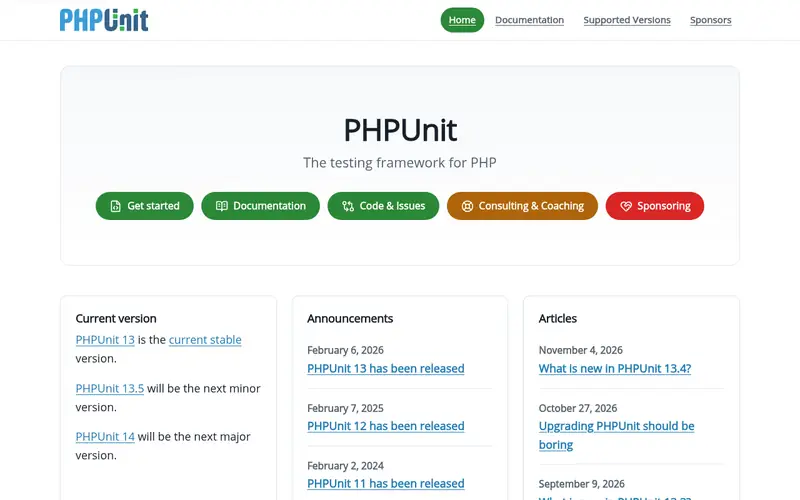
PHPUnit is the most established testing framework for PHP. It provides assertions, test doubles, data providers, fixtures and code coverage integration. Most PHP frameworks, including Laravel and Symfony, build their testing layers on it. It runs on the command line and integrates with common CI services.
The project is open source under the BSD 3-Clause license. There is no paid tier and no hosted service. You install it with Composer and run tests with the vendor binary. Coverage reports need a coverage driver such as Xdebug or PCOV.
PHPUnit suits teams that want a stable, conventional base with broad tooling support. Teams that prefer a terser syntax often layer Pest on top. Skip it if you need browser-driven acceptance tests out of the box; that requires additional tools.
Standout: Mature and widely documented
Free (open source), as listed by the vendor (PHPUnit website). Confirm the current plan price before you buy.
Free plan. Plans change, so confirm on the vendor's pricing page before you buy.
Benefits
- Mature and widely documented
- Supported by most editors, CI systems and other tools
Drawbacks
- Verbose assertion syntax
- Browser and full-stack testing need extra packages
Skip it if this limit matters to you: verbose assertion syntax.
Verdict. A sensible pick for teams that want the standard, widely supported unit testing framework.
Alternatives in this guide: Pest, Codeception, Behat
Pest
Best for developers who want readable tests built on top of PHPUnit
What it is and where it fits
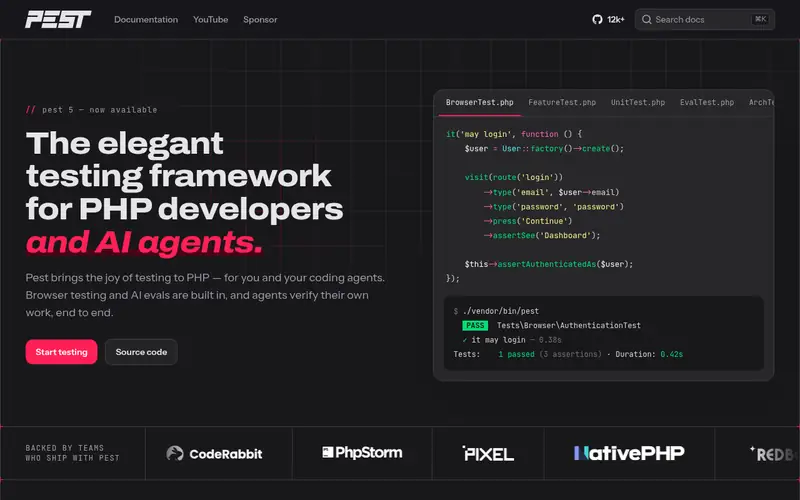
Pest is a testing framework that runs on top of PHPUnit. It offers a functional syntax with higher-order expectations, so tests read closer to plain language. Because it uses PHPUnit underneath, existing PHPUnit test classes continue to run alongside Pest tests.
The core framework is free and open source under the MIT license. The project also offers optional paid plugins and a commercial tool for architecture testing and other extras; check the vendor site for current pricing. Installation is through Composer.
Pest suits teams that value readable test files and are comfortable with an extra dependency. It works well for new Laravel projects, where it is a common default. Teams with large legacy PHPUnit suites and strict dependency policies may prefer to stay on PHPUnit directly.
Standout: Concise, expressive syntax
Free (open source), as listed by the vendor (Pest website). Confirm the current plan price before you buy.
Free plan. Plans change, so confirm on the vendor's pricing page before you buy.
Benefits
- Concise, expressive syntax
- Runs existing PHPUnit tests without changes
Drawbacks
- Adds an abstraction layer over PHPUnit
- Smaller ecosystem than PHPUnit alone
Skip it if this limit matters to you: adds an abstraction layer over PHPUnit.
Verdict. A sensible pick for developers who want readable tests built on top of PHPUnit.
Alternatives in this guide: PHPUnit, Codeception, Behat
Codeception
Best for projects needing unit, functional and acceptance tests in one suite
What it is and where it fits
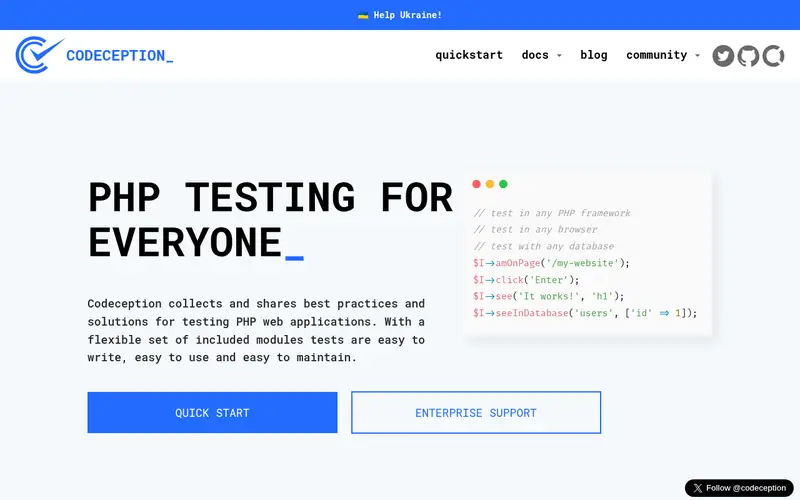
Codeception is a full-stack testing framework for PHP. It organizes tests into suites such as unit, functional and acceptance, and uses modules to connect to frameworks, databases and browser automation tools. This lets a single project cover several test layers with one tool.
The framework is open source under the MIT license. Browser-driven acceptance tests rely on external tools such as Selenium or Playwright-style drivers, which you install and maintain separately. Setup takes more configuration than a plain unit testing framework.
Codeception suits teams that want end-to-end coverage from one runner and are willing to invest in configuration. Teams that only need unit tests will find PHPUnit or Pest simpler.
Standout: Covers unit, functional and acceptance layers
Free (open source), as listed by the vendor (Codeception website). Confirm the current plan price before you buy.
Free plan. Plans change, so confirm on the vendor's pricing page before you buy.
Benefits
- Covers unit, functional and acceptance layers
- Modules for frameworks, databases and browsers
Drawbacks
- More configuration than PHPUnit alone
- Browser tests need extra drivers
Skip it if this limit matters to you: more configuration than PHPUnit alone.
Verdict. A sensible pick for projects needing unit, functional and acceptance tests in one suite.
Behat
Best for teams practicing behavior-driven development with plain-language scenarios
What it is and where it fits
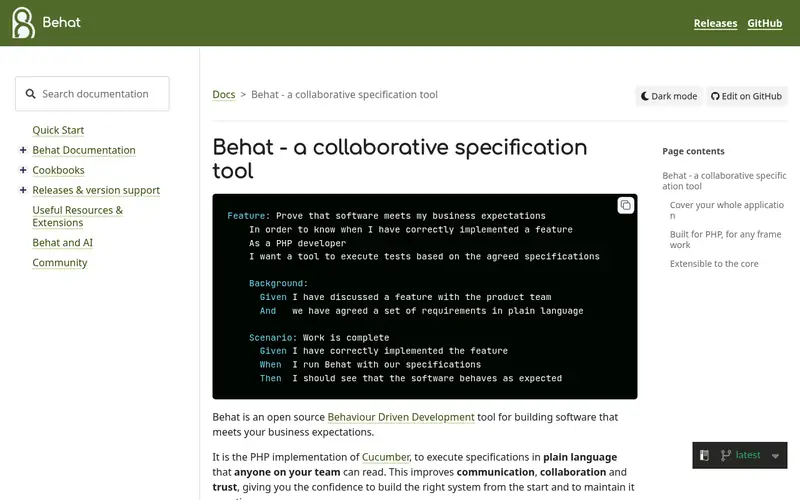
Behat is a behavior-driven development framework for PHP. Tests are written as Gherkin scenarios in plain language, and PHP step definitions connect each step to application code. This makes scenarios readable to people outside the development team.
Behat is open source under the MIT license and installs through Composer. It works with browser automation and HTTP tools for acceptance testing. Writing and maintaining step definitions takes ongoing effort, and the plain-language layer adds little value for low-level unit tests.
Behat suits teams that want shared, readable specifications and are prepared to maintain step definitions. Teams that only need unit tests should use PHPUnit or Pest.
Standout: Scenarios written in readable Gherkin
Free (open source), as listed by the vendor (Behat website). Confirm the current plan price before you buy.
Free plan. Plans change, so confirm on the vendor's pricing page before you buy.
Benefits
- Scenarios written in readable Gherkin
- Encourages collaboration between developers and stakeholders
Drawbacks
- Requires step definitions for every scenario
- Adds overhead for pure unit testing
Skip it if this limit matters to you: requires step definitions for every scenario.
Verdict. A sensible pick for teams practicing behavior-driven development with plain-language scenarios.
Alternatives in this guide: PHPUnit, Pest, Codeception
PHPSpec
Best for developers who prefer specification-style, design-first unit tests
What it is and where it fits
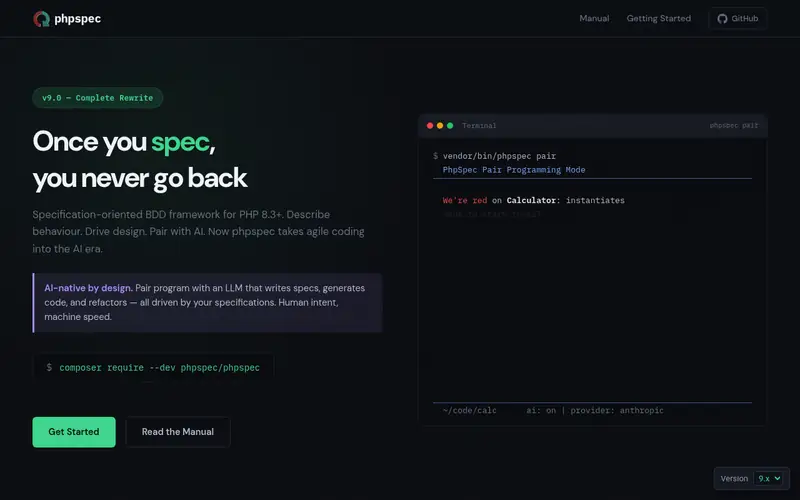
PHPSpec is a specification-oriented testing tool for PHP. It focuses on describing how objects should behave and is often used in a design-first workflow where specs are written before the class exists. It generates class skeletons from specs.
The tool is open source under the MIT license and installs through Composer. It is not a replacement for a full test runner: it does not aim to cover integration, database or browser testing. Many teams use it alongside PHPUnit rather than instead of it.
PHPSpec suits developers who like specification-style unit tests and object design. Teams that need one tool for all test layers should look at PHPUnit or Codeception.
Standout: Encourages designing classes before implementation
Free (open source), as listed by the vendor (PHPSpec website). Confirm the current plan price before you buy.
Free plan. Plans change, so confirm on the vendor's pricing page before you buy.
Benefits
- Encourages designing classes before implementation
- Compact, expressive syntax
Drawbacks
- Not a general-purpose test runner
- Less suitable for integration or acceptance tests
Skip it if this limit matters to you: not a general-purpose test runner.
Verdict. A sensible pick for developers who prefer specification-style, design-first unit tests.
Alternatives in this guide: PHPUnit, Pest, Codeception
Kahlan
Best for developers who want a BDD-style unit testing framework for PHP
What it is and where it fits
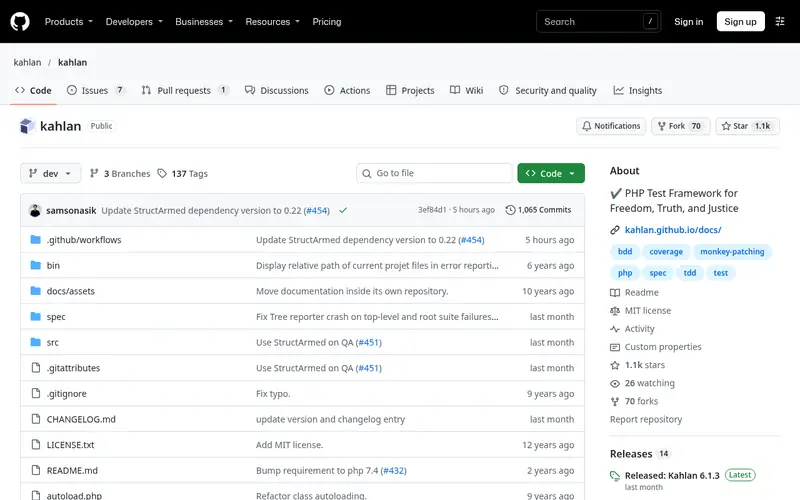
Kahlan is a unit testing framework for PHP with a BDD-style syntax built around describe and it blocks. It includes mocking and code coverage support and runs on the command line. It installs through Composer.
The project is open source under the MIT license with no paid tier. Its community and documentation are smaller than PHPUnit's, so expect fewer examples and integrations. Check the repository for recent releases before relying on it for a long project.
Kahlan suits developers who like Jasmine-style syntax in PHP and want a single unit testing tool. Teams that need the widest tooling support should use PHPUnit or Pest.
Standout: BDD-style describe/it syntax
Free (open source), as listed by the vendor (Kahlan website). Confirm the current plan price before you buy.
Free plan. Plans change, so confirm on the vendor's pricing page before you buy.
Benefits
- BDD-style describe/it syntax
- Built-in mocking and code coverage
Drawbacks
- Smaller user base than PHPUnit
- Fewer integrations with frameworks and CI templates
Skip it if this limit matters to you: smaller user base than PHPUnit.
Verdict. A sensible pick for developers who want a BDD-style unit testing framework for PHP.
Alternatives in this guide: PHPUnit, Pest, Codeception
ParaTest
Best for teams running large PHPUnit or Pest suites that need parallel execution
What it is and where it fits
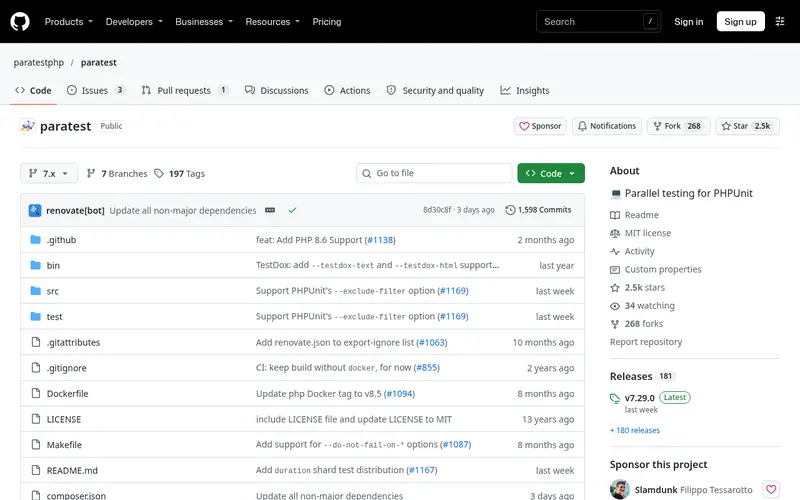
ParaTest is a parallel test runner for PHPUnit and Pest. It splits test files across worker processes so large suites finish faster. It is a companion tool, not a replacement for a testing framework.
The project is open source under the MIT license and installs through Composer. Parallel execution can expose shared-state problems such as database collisions, so tests need to be isolated. It adds little benefit to small suites where process startup outweighs the gain.
ParaTest suits teams with slow suites that already run PHPUnit or Pest and can isolate test data. Teams with small suites or heavy shared state may not gain much.
Standout: Runs PHPUnit and Pest tests in parallel
Free (open source), as listed by the vendor (ParaTest website). Confirm the current plan price before you buy.
Free plan. Plans change, so confirm on the vendor's pricing page before you buy.
Benefits
- Runs PHPUnit and Pest tests in parallel
- Cuts wall-clock time on large suites
Drawbacks
- Not a standalone testing framework
- Parallel runs need care with shared databases
Skip it if this limit matters to you: not a standalone testing framework.
Verdict. A sensible pick for teams running large PHPUnit or Pest suites that need parallel execution.
Alternatives in this guide: PHPUnit, Pest, Codeception
Who should use what
Teams starting a new PHP project with standard unit tests should pick PHPUnit for its broad support. Teams that want more readable test files can use Pest, which runs on top of PHPUnit. Projects that need HTTP, database and browser coverage in one suite should look at Codeception, while teams practicing behavior-driven development with shared plain-language scenarios should use Behat. Teams with large, slow suites can add ParaTest once their tests are isolated.
Questions to settle before you buy
What to check before you buy
- Confirm the tool supports your PHP version and framework version.
- Check that your CI service and editor have integrations or documented setup.
- Verify the license fits your project and distribution model.
- For browser or acceptance tests, confirm which external drivers you must install and maintain.
- Run a small pilot suite first, especially before adopting parallel execution.
FAQ
Is PHPUnit still the standard PHP testing framework?
Yes. PHPUnit remains the most widely used PHP testing framework, and most frameworks and CI tools document support for it. Other tools such as Pest build on top of it, so PHPUnit skills transfer well.
Is Pest free?
The Pest core framework is free and open source under the MIT license. The project also offers optional paid plugins and commercial extras. Check the vendor site for current pricing before you rely on those features.
Can I use Pest and PHPUnit together?
Yes. Pest runs on top of PHPUnit, so existing PHPUnit test classes can run alongside Pest tests in the same project. This makes gradual adoption possible without rewriting a whole suite.
Do I need Codeception if I already use PHPUnit?
Not necessarily. Codeception is useful when you want unit, functional and acceptance tests in one suite with modules for frameworks and browsers. If you only need unit tests, PHPUnit or Pest is simpler.
What is ParaTest used for?
ParaTest runs PHPUnit and Pest tests in parallel across multiple processes to shorten run time on large suites. It is a companion runner, not a standalone framework, and works best when tests are isolated from shared state.
Sources we checked
Method: how we score · editorial policy.
Change log. First published 22 Nov 2026.