Stage 02 · Test · Researched comparison
Best PHP HTTP Clients in 2026
Guzzle is the first pick for most teams because it is the most widely used PHP HTTP client, supports PSR-7 and PSR-18, and has a large middleware ecosystem. Symfony HttpClient suits projects already on Symfony components or anyone wanting a lighter dependency with native async support. For minimal setups, the built-in cURL extension or a small wrapper like PHP HTTP is enough. All three are free and open source.

By Shihab Mia
Published 27 Nov 2026 · 7 tools compared
We run no ads and no affiliate links at launch. The order of a list follows our published method. See how we score.
Prices are the starting prices vendors list publicly. Plans change, so confirm the current price on the vendor page before you buy.
Key takeaways
- Guzzle is the default choice for most PHP projects and works with any framework, not just Laravel or Symfony.
- Symfony HttpClient offers async requests and a smaller footprint if you already use Symfony components.
- The native cURL extension ships with PHP and needs no Composer package, but you write more boilerplate.
- All clients listed here are free and open source, so cost is not a deciding factor.
Who each pick is for
- Most PHP projects needing a mature, feature-rich clientGuzzle
- Symfony projects and developers wanting native asyncSymfony HttpClient
- Minimal setups and full control over the requestcURL extension
- Teams wanting a thin PSR-18 abstraction over multiple clientsPHP HTTP
- Laravel applications wanting a fluent, tested wrapperLaravel HTTP client
- Fully async applications built on the Amp event loopAmp HTTP client
- Event-driven services already using ReactPHPReactPHP HTTP client
Comparison
| Tool | Best for | Standout feature | Listed starting price | Free plan or trial |
|---|---|---|---|---|
| 1Guzzle | Most PHP projects needing a mature, feature-rich client | Large middleware ecosystem | Free (open source) | Free plan |
| 2Symfony HttpClient | Symfony projects and developers wanting native async | Native async and concurrency | Free (open source) | Free plan |
| 3cURL extension | Minimal setups and full control over the request | Bundled with PHP, no Composer dependency | Free | Free plan |
| 4PHP HTTP | Teams wanting a thin PSR-18 abstraction over multiple clients | Client-agnostic interface | Free (open source) | Free plan |
| 5Laravel HTTP client | Laravel applications wanting a fluent, tested wrapper | Fluent API with testing helpers | Free (open source) | Free plan |
| 6Amp HTTP client | Fully async applications built on the Amp event loop | True non-blocking concurrency | Free (open source) | Free plan |
| 7ReactPHP HTTP client | Event-driven services already using ReactPHP | Non-blocking requests on the ReactPHP loop | Free (open source) | Free plan |
How we picked
We compared clients on fit for common PHP HTTP tasks, supported PHP versions, dependency weight, async and concurrency support, PSR compliance, and licence. We also weighed documentation quality and how each client handles retries, timeouts, and streaming. Sources are vendor documentation, project repositories, and public package pages. All listed clients are free and open source. Prices and version support change, so confirm current details on the vendor or repository page before you commit.
The tools, one by one
Guzzle
Best for most PHP projects needing a mature, feature-rich client
What it is and where it fits
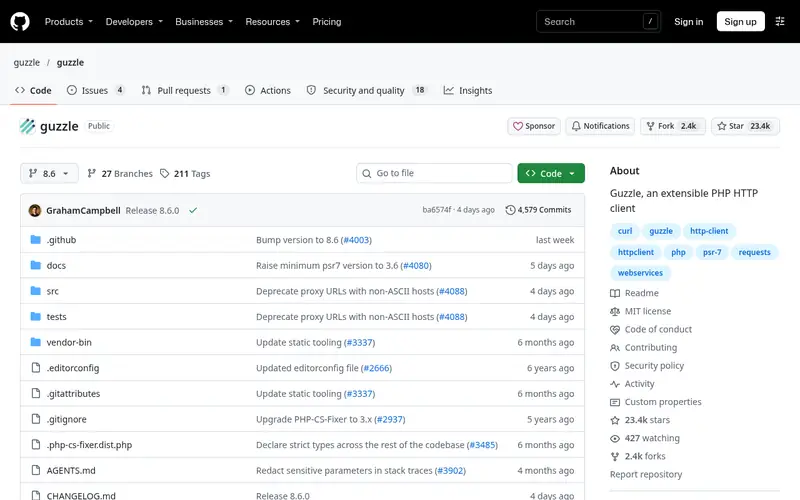
Guzzle is the most widely adopted PHP HTTP client. It sends synchronous and asynchronous requests, supports PSR-7 request and response objects, and implements PSR-18, so it plugs into any framework that depends on those interfaces. Middleware handles retries, logging, cookies, and redirects without custom code. It runs on PHP 7.2 and later and installs through Composer.
The main cost is dependency weight. Guzzle pulls in PSR-7 implementations and promise libraries, which matters on tight shared hosting. Its async API uses promises, which some developers find harder to read than Symfony's approach. For a typical API integration or webhook sender, Guzzle is the safe default. Skip it if you want a near-zero dependency footprint or prefer a simpler async style.
Standout: Large middleware ecosystem
Free (open source), as listed by the vendor (Guzzle website). Confirm the current plan price before you buy.
Free plan. Plans change, so confirm on the vendor's pricing page before you buy.
Benefits
- Large middleware ecosystem
- PSR-7 and PSR-18 compliant
Drawbacks
- Heavier dependency tree
- async model is promise-based and less intuitive
Skip it if this limit matters to you: heavier dependency tree.
Verdict. A sensible pick for most PHP projects needing a mature, feature-rich client.
Alternatives in this guide: Symfony HttpClient, cURL extension, PHP HTTP
Symfony HttpClient
Best for symfony projects and developers wanting native async
What it is and where it fits
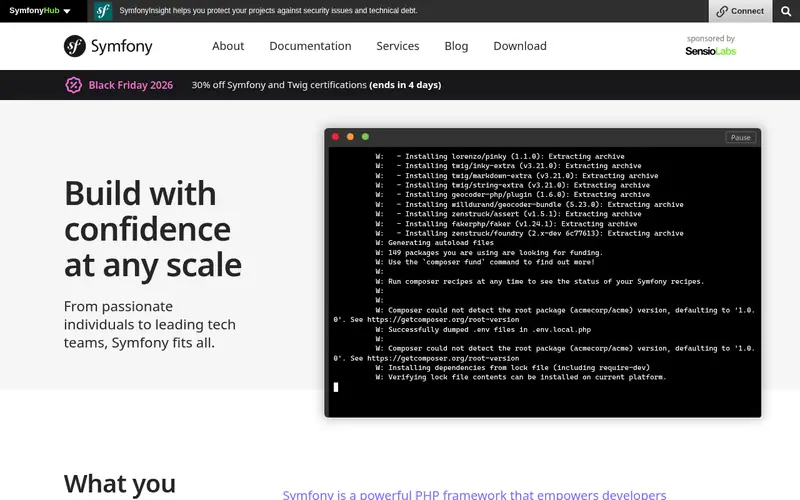
Symfony HttpClient is a standalone component that also ships with the Symfony framework. It supports synchronous and asynchronous requests, connection pooling, and streaming responses. The async API uses a straightforward interface rather than promises, which many developers find easier to reason about. It implements PSR-18 through an adapter and works outside Symfony with Composer.
The component has fewer third-party middleware packages than Guzzle, though it covers retries, caching, and scoping natively. Documentation is thorough but assumes you know Symfony conventions. It is a strong pick for new projects and for anyone sending many concurrent requests, such as a scraper or a service that fans out to several APIs. If your team already standardizes on Guzzle, switching has little upside.
Standout: Native async and concurrency
Free (open source), as listed by the vendor (Symfony HttpClient website). Confirm the current plan price before you buy.
Free plan. Plans change, so confirm on the vendor's pricing page before you buy.
Benefits
- Native async and concurrency
- small dependency footprint
Drawbacks
- Best documentation assumes some Symfony familiarity
- fewer third-party middleware packages
Skip it if this limit matters to you: best documentation assumes some Symfony familiarity.
Verdict. A sensible pick for symfony projects and developers wanting native async.
Alternatives in this guide: Guzzle, cURL extension, PHP HTTP
cURL extension
Best for minimal setups and full control over the request
What it is and where it fits
The cURL extension is built into most PHP installations and needs no package manager. You get direct access to every cURL option, which helps with edge cases like custom TLS settings, proxies, or unusual protocols. For a single script or a small internal tool, it avoids pulling in a dependency tree.
The tradeoff is boilerplate. You manage handles, set options, check errors, and close resources yourself. There is no PSR-7 request or response object, so code that mixes cURL with framework components needs adapters. Testing is harder because you must mock the extension or wrap it. Use cURL when dependencies are tightly controlled or you need an option no higher-level client exposes. For application code with many endpoints, a wrapper saves time.
Standout: Bundled with PHP, no Composer dependency
Free, as listed by the vendor (cURL extension website). Confirm the current plan price before you buy.
Free plan. Plans change, so confirm on the vendor's pricing page before you buy.
Benefits
- Bundled with PHP, no Composer dependency
- exposes every cURL option
Drawbacks
- Verbose boilerplate
- no PSR-7 or PSR-18 interfaces out of the box
Skip it if this limit matters to you: verbose boilerplate.
Verdict. A sensible pick for minimal setups and full control over the request.
Alternatives in this guide: Guzzle, Symfony HttpClient, PHP HTTP
PHP HTTP
Best for teams wanting a thin PSR-18 abstraction over multiple clients
What it is and where it fits
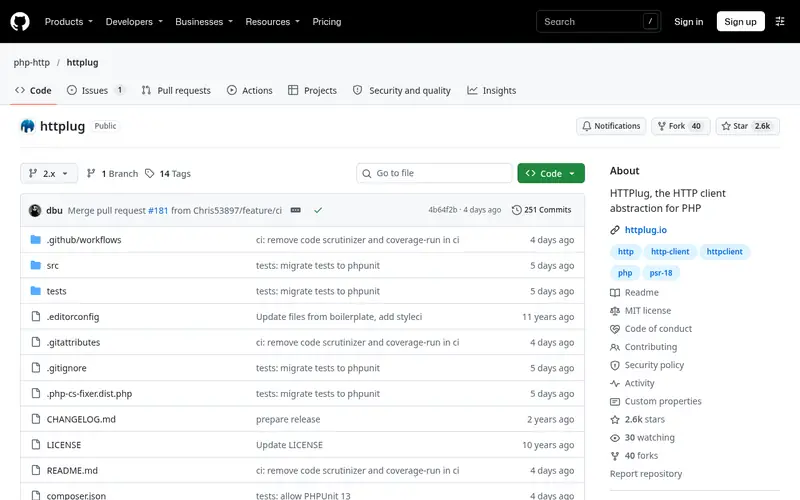
HTTPlug is an abstraction layer, not a client itself. It defines interfaces and lets you plug in Guzzle, Symfony HttpClient, or another PSR-18 implementation behind them. That helps when a library needs to send HTTP requests without forcing a specific client on the host application. It is common in the PHP ecosystem for SDKs and packages.
You still install a concrete client, so HTTPlug adds a small layer rather than replacing one. The benefit is portability: an application can swap clients without touching call sites. The cost is one more concept to learn and a slightly deeper stack trace when debugging. Choose it if you maintain a library or SDK that must work across environments. For a single application with a known stack, calling Guzzle or Symfony HttpClient directly is simpler.
Standout: Client-agnostic interface
Free (open source), as listed by the vendor (PHP HTTP website). Confirm the current plan price before you buy.
Free plan. Plans change, so confirm on the vendor's pricing page before you buy.
Benefits
- Client-agnostic interface
- swap underlying clients without rewriting code
Drawbacks
- Abstraction adds a layer to learn
- you still install a concrete client
Skip it if this limit matters to you: abstraction adds a layer to learn.
Verdict. A sensible pick for teams wanting a thin PSR-18 abstraction over multiple clients.
Alternatives in this guide: Guzzle, Symfony HttpClient, cURL extension
Laravel HTTP client
Best for laravel applications wanting a fluent, tested wrapper
What it is and where it fits
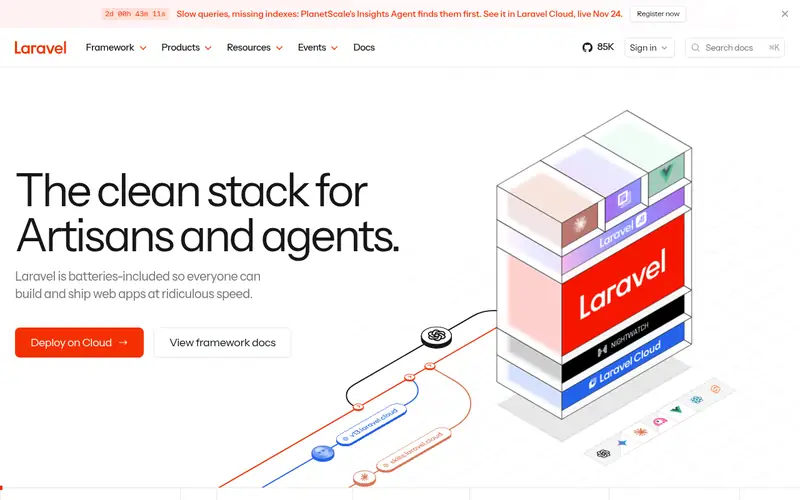
Laravel's HTTP client is a thin, fluent wrapper around Guzzle. It offers methods like get, post, and withHeaders, plus built-in retry and timeout handling. Its testing helpers let you fake responses without hitting the network, which simplifies test suites. It ships with the framework, so Laravel projects get it without an extra install.
Because it wraps Guzzle, it inherits Guzzle's behavior and dependency weight. It is not usable outside Laravel without pulling in framework pieces. If you are on Laravel, it is the natural choice and reduces boilerplate. If you are on another framework or plain PHP, use Guzzle directly or Symfony HttpClient instead. The wrapper does not add capabilities beyond what Guzzle provides, so the value is mostly ergonomics and test support.
Standout: Fluent API with testing helpers
Free (open source), as listed by the vendor (Laravel HTTP client website). Confirm the current plan price before you buy.
Free plan. Plans change, so confirm on the vendor's pricing page before you buy.
Benefits
- Fluent API with testing helpers
- integrates with Laravel features
Drawbacks
- Requires Laravel
- wraps Guzzle rather than replacing it
Skip it if this limit matters to you: requires Laravel.
Verdict. A sensible pick for laravel applications wanting a fluent, tested wrapper.
Alternatives in this guide: Guzzle, Symfony HttpClient, cURL extension
Amp HTTP client
Best for fully async applications built on the Amp event loop
What it is and where it fits
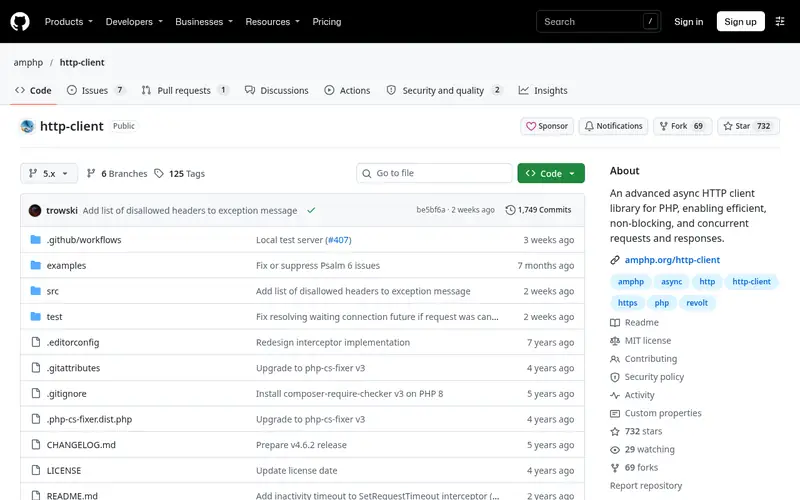
Amp's HTTP client is built for non-blocking, event-loop-driven applications. It handles many concurrent requests efficiently and integrates with other Amp libraries for sockets, databases, and servers. If you are building a long-running service that must handle high concurrency without threads, it fits well.
The catch is the programming model. Amp code runs inside its event loop, and blocking calls stall everything. That means your whole application, not just the HTTP layer, needs to follow async conventions. For a typical request-response web app, this is unnecessary complexity. Choose Amp when concurrency is the core problem, such as a crawler or a proxy. Otherwise, Guzzle or Symfony HttpClient with async support covers most needs with less disruption.
Standout: True non-blocking concurrency
Free (open source), as listed by the vendor (Amp HTTP client website). Confirm the current plan price before you buy.
Free plan. Plans change, so confirm on the vendor's pricing page before you buy.
Benefits
- True non-blocking concurrency
- integrates with the Amp ecosystem
Drawbacks
- Requires an async runtime model
- steeper learning curve
Skip it if this limit matters to you: requires an async runtime model.
Verdict. A sensible pick for fully async applications built on the Amp event loop.
Alternatives in this guide: Guzzle, Symfony HttpClient, cURL extension
ReactPHP HTTP client
Best for event-driven services already using ReactPHP
What it is and where it fits
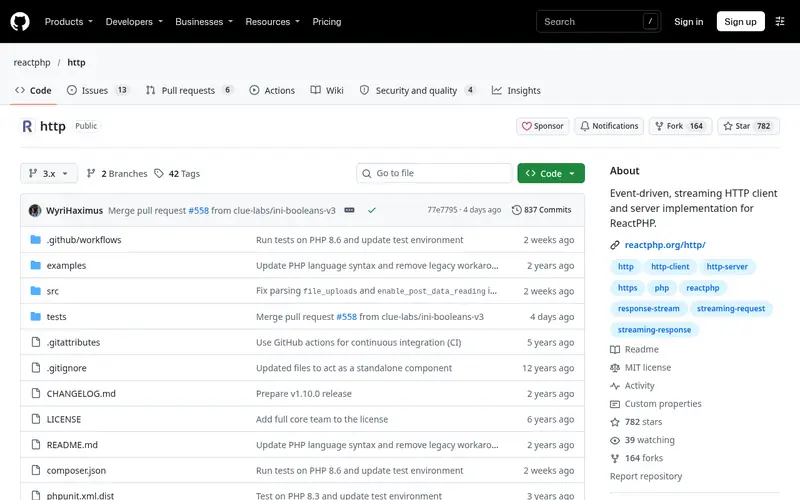
ReactPHP's HTTP client sends non-blocking requests on its event loop. It is a good fit for long-running daemons, chat servers, and other services already built on ReactPHP. It supports streaming request and response bodies, which helps with large payloads.
Like Amp, it requires an event-driven architecture. Mixing it with blocking code causes stalls, and debugging async flows takes practice. Most web applications do not need it. Pick it when you are already on ReactPHP and want HTTP calls that do not block the loop. For new async projects, compare Amp and ReactPHP based on the libraries you need, since both are viable.
Standout: Non-blocking requests on the ReactPHP loop
Free (open source), as listed by the vendor (ReactPHP HTTP client website). Confirm the current plan price before you buy.
Free plan. Plans change, so confirm on the vendor's pricing page before you buy.
Benefits
- Non-blocking requests on the ReactPHP loop
- mature ecosystem
Drawbacks
- Tied to ReactPHP's model
- not suited to standard request-response apps
Skip it if this limit matters to you: tied to ReactPHP's model.
Verdict. A sensible pick for event-driven services already using ReactPHP.
Alternatives in this guide: Guzzle, Symfony HttpClient, cURL extension
Who should use what
If you are building a typical Laravel or framework app, use the Laravel HTTP client or Guzzle directly. If you want native async with a small footprint and are on Symfony or plain PHP, choose Symfony HttpClient. If you maintain a library that must not force a client on users, use HTTPlug. If you are building a high-concurrency daemon, evaluate Amp or ReactPHP based on the surrounding ecosystem. For a one-off script with tight dependency limits, the cURL extension is enough.
Questions to settle before you buy
What to check before you buy
- Confirm the client supports your PHP version and any PSR interfaces your framework requires.
- Check whether you need async or concurrent requests, and whether the client's model fits your codebase.
- Review the dependency tree, since some clients pull in several packages.
- Verify retry, timeout, and redirect behavior matches your integration needs.
- Check that testing helpers or mocks exist so you can avoid real network calls in tests.
FAQ
Which PHP HTTP client is best for beginners?
Guzzle is the most documented and widely used, so examples and answers are easy to find. Symfony HttpClient is also approachable if you follow its docs. The cURL extension is fine for learning but requires more manual error handling.
Do I need an async client?
Only if you send many requests concurrently or run a long-lived service. For typical request-response apps, synchronous calls from Guzzle or Symfony HttpClient are simpler and sufficient.
Are these clients free?
Yes. All clients listed here are free and open source. You pay only in dependency weight and learning time, not licence fees.
Can I switch clients later?
Yes, especially if you code against PSR-18 interfaces or use an abstraction like HTTPlug. Direct calls to a specific client's API are harder to port.
Is it safe to send credentials through these clients?
The client itself does not change transport security. Use HTTPS, keep secrets out of logs, and avoid logging full requests. The risk is in your configuration, not the library.
Sources we checked
Method: how we score · editorial policy.
Change log. First published 27 Nov 2026.