Stage 02 · Test · Researched comparison
Best OpenAPI Diff Tools to Compare Specs in 2026
oasdiff is the first pick for most teams. It is a free, open-source Go CLI that compares two OpenAPI specs and reports breaking changes, with output formats for CI. For a hosted workflow with change history, Bump.sh tracks API diffs over time. For a Node.js pipeline, openapi-changes by pb33f and the Atlassian openapi-diff npm package are solid alternatives.

By Shihab Mia
Published 22 Nov 2026 · 5 tools compared
We run no ads and no affiliate links at launch. The order of a list follows our published method. See how we score.
Prices are the starting prices vendors list publicly. Plans change, so confirm the current price on the vendor page before you buy.
Key takeaways
- oasdiff is free and open source, runs locally, and flags breaking changes with exit codes for CI.
- Bump.sh is a hosted service; check its pricing page for current plan limits before relying on it.
- Local CLI tools keep your spec files off third-party servers, which matters for private APIs.
- Most tools here compare OpenAPI 3.x; confirm your spec version and format support first.
Who each pick is for
- CI pipelines that need breaking-change detectionoasdiff
- Go and Node teams wanting a local report and HTML viewopenapi-changes by pb33f
- Hosted API change tracking with a visual diffBump.sh
- Linting and diffing specs in one Node.js toolchainRedocly CLI
- Node.js projects wanting a library and CLIAtlassian openapi-diff
Comparison
| Tool | Best for | Standout feature | Listed starting price | Free plan or trial |
|---|---|---|---|---|
| 1oasdiff | CI pipelines that need breaking-change detection | Fast Go binary with no runtime dependencies | Free (open source) | Free plan |
| 2openapi-changes by pb33f | Go and Node teams wanting a local report and HTML view | Produces a readable HTML report | Free (open source) | Free plan |
| 3Bump.sh | Hosted API change tracking with a visual diff | Stores spec history and shows changes over time | See vendor pricing page | Free trial (14 days) |
| 4Redocly CLI | Linting and diffing specs in one Node.js toolchain | Combines linting, bundling and diffing in one CLI | Free (open source) | Free plan |
| 5Atlassian openapi-diff | Node.js projects wanting a library and CLI | Usable as a library inside custom tooling | Free (open source) | Free plan |
How we picked
We picked tools that compare two OpenAPI documents and report changes, especially breaking ones. Criteria were fit for that job, supported platforms, licence and price, whether specs are processed locally or uploaded, and known limits. Sources are vendor pages, project repositories and public pricing pages. Prices and plan limits change, so confirm them on the vendor site before you commit.
The tools, one by one
oasdiff
Best for cI pipelines that need breaking-change detection
What it is and where it fits
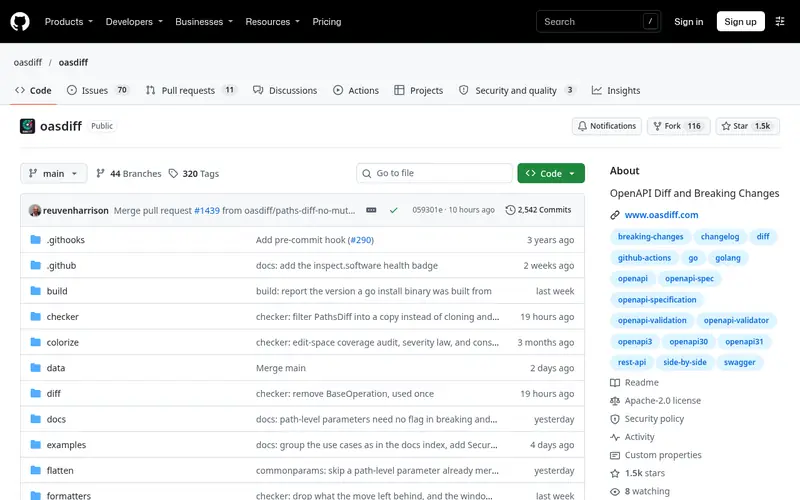
oasdiff is a command-line tool written in Go. It loads two OpenAPI 3 specs and reports additions, removals and modifications, with a dedicated breaking-changes check. You can run it as a standalone binary or wire it into a pipeline so a pull request fails when a change breaks compatibility.
It supports several output formats, including text, JSON, YAML and Markdown, so you can post a diff as a comment or store it as an artifact. Because it runs locally or in your CI runner, spec contents stay inside your infrastructure. There is no account, no upload step and no server component.
The trade-off is that oasdiff is a CLI only. There is no web UI or stored history of past comparisons; you build that around it with your own CI logs. Teams that want a visual, hosted view of API changes over time should look at Bump.sh instead. Teams comfortable with scripts and pipelines get a focused, free tool.
Standout: Fast Go binary with no runtime dependencies
Free (open source), as listed by the vendor (oasdiff website). Confirm the current plan price before you buy.
Free plan. Plans change, so confirm on the vendor's pricing page before you buy.
Benefits
- Fast Go binary with no runtime dependencies
- reports breaking changes and supports CI exit codes
Drawbacks
- Command-line only, no hosted dashboard
- changelog output needs extra setup
Skip it if this limit matters to you: command-line only, no hosted dashboard.
Verdict. A sensible pick for CI pipelines that need breaking-change detection.
Alternatives in this guide: openapi-changes by pb33f, Bump.sh, Redocly CLI
openapi-changes by pb33f
Best for go and Node teams wanting a local report and HTML view
What it is and where it fits
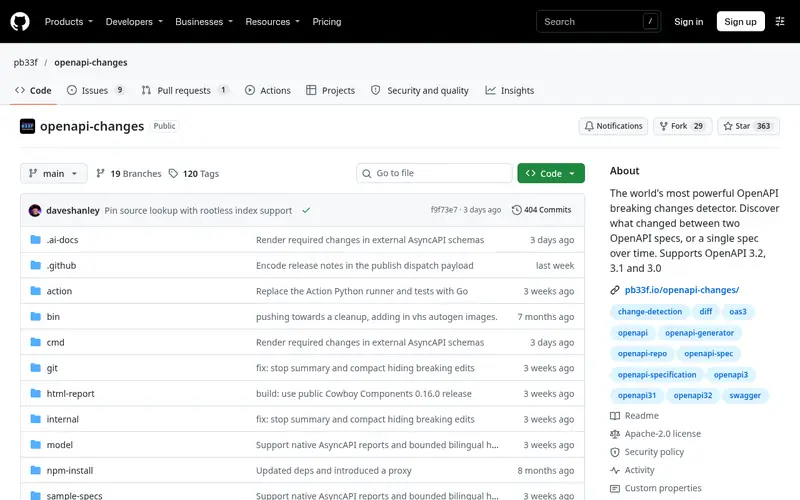
openapi-changes is part of the pb33f toolset, the same project family behind the libopenapi library. It compares two OpenAPI documents and produces a summary of what changed, including breaking changes, plus an HTML report you can open in a browser. It ships as a Go binary and as an npm package, so it fits both Go and Node.js pipelines.
The HTML output is useful when you want a human-readable diff to attach to a release or share with a team that does not read terminal output. It runs entirely on your machine, so private specs are not uploaded anywhere. You can also use it as a library through libopenapi if you need to build custom checks.
The main drawback is scope. It is a focused diff tool, not a full API governance platform, and its community is smaller than oasdiff's. On very large specs the report can get long. It suits teams that want a local, scriptable diff with a presentable HTML artifact.
Standout: Produces a readable HTML report
Free (open source), as listed by the vendor (openapi-changes by pb33f website). Confirm the current plan price before you buy.
Free plan. Plans change, so confirm on the vendor's pricing page before you buy.
Benefits
- Produces a readable HTML report
- also available as an npm package
Drawbacks
- Report detail can be verbose on large specs
- smaller community than oasdiff
Skip it if this limit matters to you: report detail can be verbose on large specs.
Verdict. A sensible pick for go and Node teams wanting a local report and HTML view.
Alternatives in this guide: oasdiff, Bump.sh, Redocly CLI
Bump.sh
Best for hosted API change tracking with a visual diff
What it is and where it fits
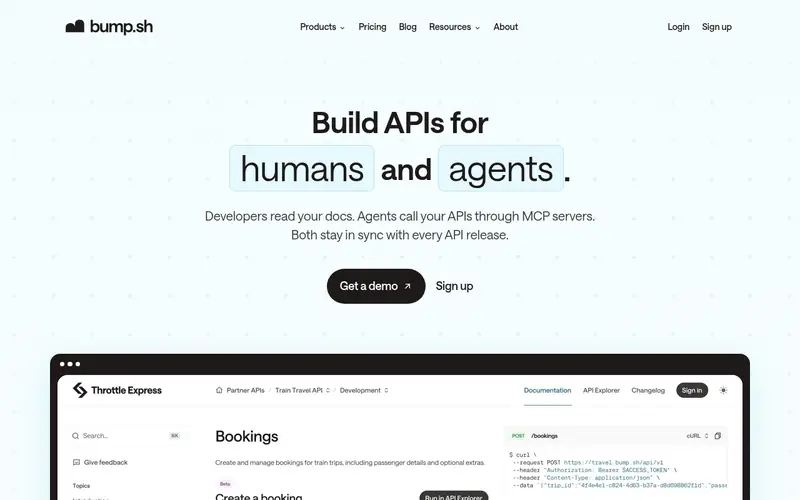
Bump.sh is a hosted platform for API documentation and change tracking. You push an OpenAPI document, and it keeps a history of versions and shows a diff between them, including breaking changes. It also publishes documentation from the same spec, so docs and change tracking stay in sync.
Because it is hosted, your spec is uploaded to Bump.sh's servers. That is convenient for teams that want a shared, visual record of API changes without building their own tooling, but it is a consideration for private or regulated APIs. The free trial is time-limited; ongoing use and team features depend on a paid plan.
Check the vendor pricing page for current plan limits, seat counts and CI integration details before committing. Bump.sh fits teams that want a managed changelog and docs site. Teams that must keep specs fully in-house should prefer a local CLI like oasdiff.
Standout: Stores spec history and shows changes over time
See vendor pricing page, as listed by the vendor (Bump.sh website). Confirm the current plan price before you buy.
Free trial (14 days). Plans change, so confirm on the vendor's pricing page before you buy.
Benefits
- Stores spec history and shows changes over time
- generates hosted API docs
Drawbacks
- Hosted service, so specs leave your infrastructure
- paid plans needed for team features
Skip it if this limit matters to you: hosted service, so specs leave your infrastructure.
Verdict. A sensible pick for hosted API change tracking with a visual diff.
Alternatives in this guide: oasdiff, openapi-changes by pb33f, Redocly CLI
Redocly CLI
Best for linting and diffing specs in one Node.js toolchain
What it is and where it fits
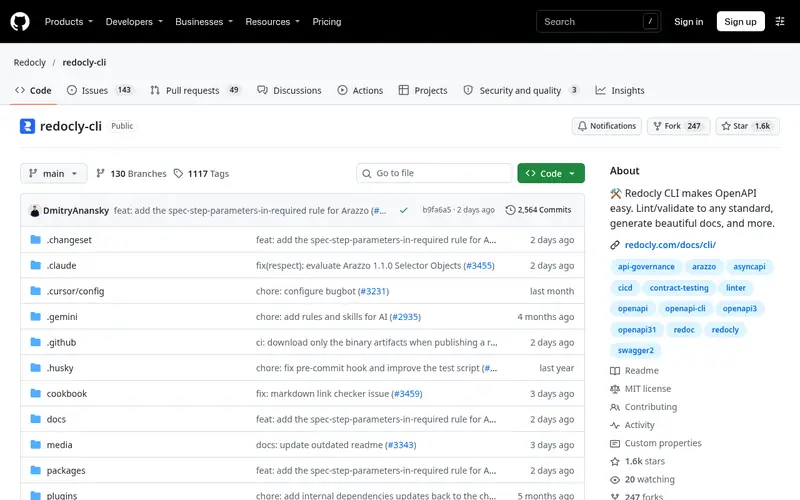
Redocly CLI is an open-source Node.js command-line tool. Among its commands is a diff that compares two OpenAPI documents and reports changes, including breaking ones. It also lints, bundles and validates specs, so a single tool can cover several API quality checks in a pipeline.
The diff is one feature among many rather than the core focus. Teams that want the most detailed breaking-change report may prefer oasdiff or openapi-changes, but those already using Redocly for linting get diffing without adding another dependency. It runs locally, so specs are not uploaded.
Redocly also offers a paid platform with hosted features, but the CLI itself is free and open source. Confirm current command names and flags in the project documentation, since the CLI has changed over time. It suits teams already in the Redocly ecosystem or wanting one tool for lint and diff.
Standout: Combines linting, bundling and diffing in one CLI
Free (open source), as listed by the vendor (Redocly CLI website). Confirm the current plan price before you buy.
Free plan. Plans change, so confirm on the vendor's pricing page before you buy.
Benefits
- Combines linting, bundling and diffing in one CLI
- integrates with Redoc docs
Drawbacks
- Diff output is less detailed than dedicated diff tools
- the CLI is large
Skip it if this limit matters to you: diff output is less detailed than dedicated diff tools.
Verdict. A sensible pick for linting and diffing specs in one Node.js toolchain.
Alternatives in this guide: oasdiff, openapi-changes by pb33f, Bump.sh
Atlassian openapi-diff
Best for node.js projects wanting a library and CLI
What it is and where it fits
Atlassian openapi-diff is an npm package that compares two OpenAPI documents and reports differences, including breaking changes. It works as a command-line tool for quick checks and as a library you can call from your own Node.js code to build custom reporting or gating logic.
Being a library is its main advantage. If you need to embed diff logic in a build script, a bot or a custom dashboard, you can call it directly instead of shelling out to a binary. It runs locally, so specs stay on your machine.
The project is less actively developed than some alternatives, and its output options are narrower than oasdiff's. Check the repository for recent commits and open issues before adopting it for critical pipelines. It fits Node.js teams that want a small, embeddable diff library rather than a full platform.
Standout: Usable as a library inside custom tooling
Free (open source), as listed by the vendor (Atlassian openapi-diff website). Confirm the current plan price before you buy.
Free plan. Plans change, so confirm on the vendor's pricing page before you buy.
Benefits
- Usable as a library inside custom tooling
- simple CLI for quick comparisons
Drawbacks
- Less active than some alternatives
- fewer output formats than oasdiff
Skip it if this limit matters to you: less active than some alternatives.
Verdict. A sensible pick for node.js projects wanting a library and CLI.
Alternatives in this guide: oasdiff, openapi-changes by pb33f, Bump.sh
Who should use what
If you run CI and want a free tool that fails a build on a breaking change, use oasdiff. If you want a presentable HTML diff artifact and work in Go or Node, use openapi-changes. If you need a hosted history of API changes and published docs, use Bump.sh. If you already lint with Redocly, add its diff command rather than a new tool. Node.js teams that want to embed diff logic should look at Atlassian openapi-diff.
Questions to settle before you buy
What to check before you buy
- Confirm the tool supports your spec version (OpenAPI 3.0, 3.1 or Swagger 2).
- Check whether specs are processed locally or uploaded to a hosted service.
- Verify the diff output flags breaking changes, not just textual differences.
- Confirm CI integration: exit codes, output formats and pipeline examples.
- Review the licence and current pricing on the vendor or repository page.
FAQ
What is an OpenAPI diff tool?
It compares two versions of an OpenAPI document and reports what changed. Good tools separate breaking changes, which can break existing clients, from safe additions. Most run as a CLI in a pipeline or as a hosted service that keeps a history of spec versions.
Are these tools free?
oasdiff, openapi-changes, Redocly CLI and Atlassian openapi-diff are free and open source. Bump.sh is a commercial service with a trial period; check its pricing page for current plans, since limits and prices change.
Can I run a diff in CI?
Yes. CLI tools like oasdiff and openapi-changes return exit codes you can use to fail a build when a breaking change appears. Hosted services like Bump.sh also integrate with pipelines, but they upload specs to their servers.
Is it safe to upload private API specs?
Only if you accept the vendor's data handling terms. Local CLI tools keep specs on your machine or CI runner, which is safer for private APIs. For hosted services, review the vendor's security and retention documentation before uploading production specs.
Do these tools support OpenAPI 3.1?
Support varies. oasdiff and openapi-changes track recent OpenAPI versions, but confirm 3.1 support in each project's documentation before relying on it. Some tools still focus on 3.0, so test with a real spec from your project.
Sources we checked
Method: how we score · editorial policy.
Change log. First published 22 Nov 2026.