Stage 02 · Test · Researched comparison
Best Node.js WebSocket Libraries in 2026
ws is the first pick for most teams that want a small, fast WebSocket server or client in Node.js with no extra protocol layer. Socket.IO suits projects that need rooms, reconnection and fallbacks built in. uWebSockets.js fits teams that need maximum throughput and can accept a lower-level API. All three are open source and free to use.

By Shihab Mia
Published 27 Nov 2026 · 5 tools compared
We run no ads and no affiliate links at launch. The order of a list follows our published method. See how we score.
Prices are the starting prices vendors list publicly. Plans change, so confirm the current price on the vendor page before you buy.
Key takeaways
- ws is a minimal, widely used WebSocket implementation for Node.js and is free under the MIT licence.
- Socket.IO adds rooms, events, acknowledgements and reconnection on top of WebSocket, with a free open-source core.
- uWebSockets.js is a high-performance HTTP and WebSocket server for Node.js, free under Apache 2.0.
- SockJS and similar libraries target older browsers and proxies that do not support WebSocket directly.
Who each pick is for
- Minimal WebSocket servers and clients in Node.jsws
- Apps that need rooms, events and reconnectionSocket.IO
- High-throughput WebSocket servers in Node.jsuWebSockets.js
- Fallback transports for old browsers and proxiesSockJS
- Real-time APIs with services and channelsFeathersJS
Comparison
| Tool | Best for | Standout feature | Listed starting price | Free plan or trial |
|---|---|---|---|---|
| 1ws | Minimal WebSocket servers and clients in Node.js | Small API surface | Free (open source) | Free plan |
| 2Socket.IO | Apps that need rooms, events and reconnection | Rooms and namespaces built in | Free (open source) | Free plan |
| 3uWebSockets.js | High-throughput WebSocket servers in Node.js | Very high message throughput | Free (open source) | Free plan |
| 4SockJS | Fallback transports for old browsers and proxies | Falls back when WebSocket is blocked | Free (open source) | Free plan |
| 5FeathersJS | Real-time APIs with services and channels | Services and real-time events in one framework | Free (open source) | Free plan |
How we picked
We picked libraries that implement WebSocket transport for Node.js and are actively maintained, with a public repository or vendor documentation. We compared the API level, supported platforms, licence and pricing, and the built-in features such as rooms, reconnection and fallbacks. We did not run benchmarks or collect user reviews. Prices and licences change, so confirm the current terms on each project page before you commit.
The tools, one by one
ws
Best for minimal WebSocket servers and clients in Node.js
What it is and where it fits
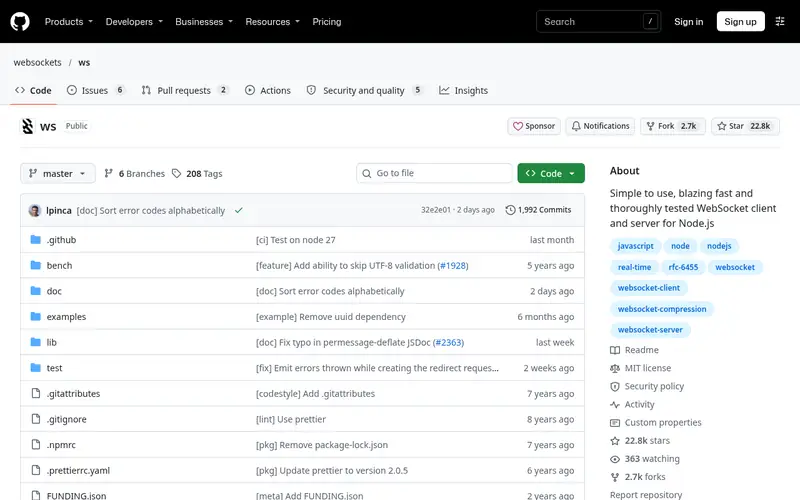
ws is a plain WebSocket client and server for Node.js. It implements the WebSocket protocol directly and gives you the raw connection, message and close events. There is no room model, no event names and no automatic reconnection, so you build those parts yourself. That makes it a good base for custom protocols and for services that only need to push messages.
It runs on Node.js and has no browser bundle for the server side; for browsers you use the native WebSocket object. The project is MIT licensed and free. The main limit is scope: if you want fallbacks, namespaces or reconnection, you either add code or pick a higher-level library. Teams that want full control over the wire format should start here.
Standout: Small API surface
Free (open source), as listed by the vendor (ws website). Confirm the current plan price before you buy.
Free plan. Plans change, so confirm on the vendor's pricing page before you buy.
Benefits
- Small API surface
- Widely used and actively maintained
Drawbacks
- No rooms or reconnection built in
- You handle the protocol details
Skip it if this limit matters to you: no rooms or reconnection built in.
Verdict. A sensible pick for minimal WebSocket servers and clients in Node.js.
Alternatives in this guide: Socket.IO, uWebSockets.js, SockJS
Socket.IO
Best for apps that need rooms, events and reconnection
What it is and where it fits
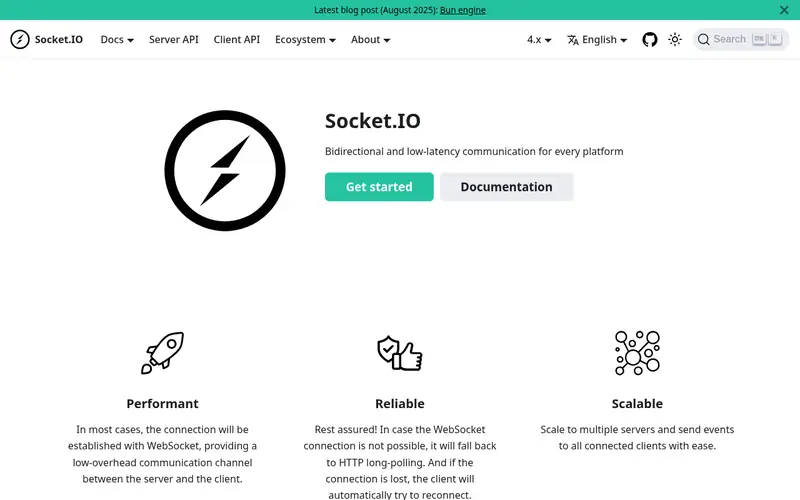
Socket.IO is a real-time engine with a WebSocket transport. It adds named events, rooms, acknowledgements, automatic reconnection and HTTP long-polling fallback. The server runs on Node.js and the client runs in browsers and on Node.js. The core is MIT licensed and free.
The trade-off is that Socket.IO is not plain WebSocket. A standard WebSocket client cannot talk to a Socket.IO server without the Socket.IO client or a compatible implementation. The client bundle is larger than a bare WebSocket wrapper. It also carries its own protocol version, so client and server versions must match. Teams that need plain WebSocket interoperability should use ws instead.
Standout: Rooms and namespaces built in
Free (open source), as listed by the vendor (Socket.IO website). Confirm the current plan price before you buy.
Free plan. Plans change, so confirm on the vendor's pricing page before you buy.
Benefits
- Rooms and namespaces built in
- Automatic reconnection and fallbacks
Drawbacks
- Custom protocol on top of WebSocket
- Larger client bundle than plain ws
Skip it if this limit matters to you: custom protocol on top of WebSocket.
Verdict. A sensible pick for apps that need rooms, events and reconnection.
Alternatives in this guide: ws, uWebSockets.js, SockJS
uWebSockets.js
Best for high-throughput WebSocket servers in Node.js
What it is and where it fits
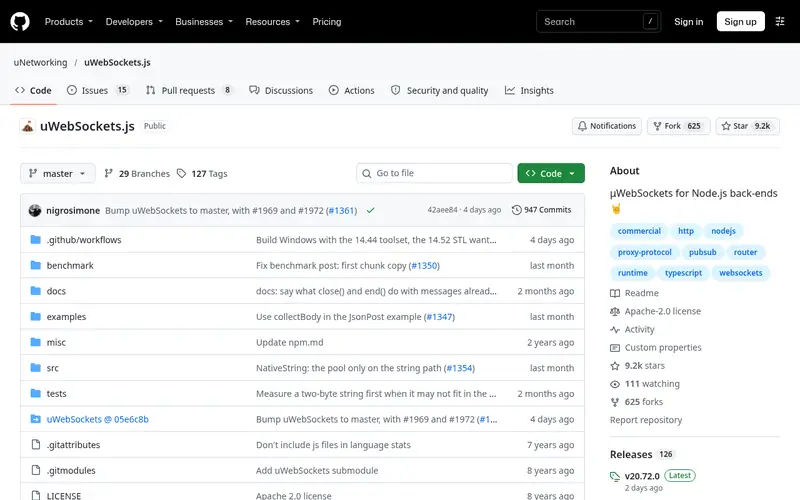
uWebSockets.js is a Node.js binding to the uWebSockets C++ library. It serves HTTP and WebSocket traffic from the same server and is designed for high throughput and low memory use. The API is callback-based and closer to the metal than ws, so you manage routes, upgrades and backpressure more directly.
It is Apache 2.0 licensed and free. The project ships prebuilt binaries for common platforms, and you may need a build toolchain on others. The main limit is ecosystem fit: fewer middleware packages and tutorials exist compared with ws or Socket.IO. Teams with extreme connection counts and engineers who can read the source should consider it.
Standout: Very high message throughput
Free (open source), as listed by the vendor (uWebSockets.js website). Confirm the current plan price before you buy.
Free plan. Plans change, so confirm on the vendor's pricing page before you buy.
Benefits
- Very high message throughput
- Built on a C++ core
Drawbacks
- Lower-level API than ws
- Fewer examples and integrations
Skip it if this limit matters to you: lower-level API than ws.
Verdict. A sensible pick for high-throughput WebSocket servers in Node.js.
SockJS
Best for fallback transports for old browsers and proxies
What it is and where it fits
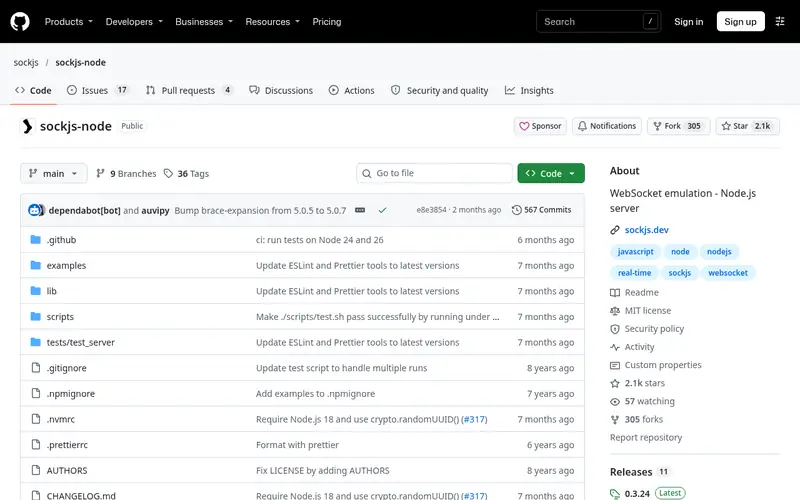
SockJS is a WebSocket-like API with fallback transports. When a browser or proxy blocks WebSocket, SockJS falls back to HTTP streaming or polling so the connection still works. The Node.js server package pairs with a browser client. It is MIT licensed and free.
The project is older and in maintenance mode, so treat it as a compatibility layer rather than a new build target. Fallback transports add latency and server load. For modern browsers that support WebSocket, plain ws or Socket.IO is simpler. Keep SockJS for legacy environments where WebSocket cannot be relied on.
Standout: Falls back when WebSocket is blocked
Free (open source), as listed by the vendor (SockJS website). Confirm the current plan price before you buy.
Free plan. Plans change, so confirm on the vendor's pricing page before you buy.
Benefits
- Falls back when WebSocket is blocked
- Works through restrictive proxies
Drawbacks
- Extra latency from fallback transports
- Project is in maintenance mode
Skip it if this limit matters to you: extra latency from fallback transports.
Verdict. A sensible pick for fallback transports for old browsers and proxies.
Alternatives in this guide: ws, Socket.IO, uWebSockets.js
FeathersJS
Best for real-time APIs with services and channels
What it is and where it fits
FeathersJS is a lightweight framework for real-time APIs. It exposes services over REST and WebSocket and lets you publish events to channels. The WebSocket transport is one option among several, so you get real-time updates without writing the socket layer yourself. It runs on Node.js and is MIT licensed and free.
The trade-off is scope. FeathersJS brings its own service, hook and authentication model, which is more than a socket library. If you only need a WebSocket server, ws is lighter. Choose FeathersJS when you want a structured backend with real-time events built in and are willing to adopt its conventions.
Standout: Services and real-time events in one framework
Free (open source), as listed by the vendor (FeathersJS website). Confirm the current plan price before you buy.
Free plan. Plans change, so confirm on the vendor's pricing page before you buy.
Benefits
- Services and real-time events in one framework
- Pluggable transports including WebSocket
Drawbacks
- Framework lock-in
- More concepts to learn than a library
Skip it if this limit matters to you: framework lock-in.
Verdict. A sensible pick for real-time APIs with services and channels.
Alternatives in this guide: ws, Socket.IO, uWebSockets.js
Who should use what
If you need a small WebSocket server with full control over the protocol, start with ws. If your app needs rooms, named events and automatic reconnection, Socket.IO saves you that work. If throughput and memory are the main constraints and your team can handle a lower-level API, look at uWebSockets.js. If you must support old browsers or restrictive proxies, SockJS can bridge the gap. Teams building a structured real-time backend should weigh FeathersJS against a plain library.
Questions to settle before you buy
What to check before you buy
- Confirm the library speaks plain WebSocket if you need interoperability with non-Node clients.
- Check the licence and whether the project is actively maintained.
- Verify client and server protocol versions match, especially with Socket.IO.
- Test reconnection and backpressure behavior under your expected load.
- Review the API level against your team's experience and the size of the dependency.
FAQ
Is ws or Socket.IO better for Node.js?
It depends on what you need. ws is a plain WebSocket implementation with a small API and no extra features. Socket.IO adds rooms, events, acknowledgements and reconnection, but uses its own protocol. Pick ws for control and interoperability, Socket.IO for built-in features.
Are these Node.js WebSocket libraries free?
The libraries listed here are open source and free to use under their respective licences, such as MIT or Apache 2.0. Check each project's repository for the exact licence terms. Some vendors offer paid hosting or support separately, but the libraries themselves do not require payment.
Can I use these libraries in the browser?
ws and uWebSockets.js are server-side packages for Node.js. Browsers use the native WebSocket API. Socket.IO and SockJS ship browser clients. If you need a browser client, check that the library provides one or pair a Node.js server with the native browser WebSocket object.
Do I need to worry about secrets with these libraries?
These are server libraries, not online web tools, so you are not pasting data into a third-party page. Still, keep tokens and credentials out of client-side code and logs. Terminate TLS at your server or proxy, and validate and authorize every message on the server.
What about performance and connection limits?
Performance depends on your workload, hardware and configuration. We did not run benchmarks. Libraries like uWebSockets.js are designed for high throughput, but you should test your own scenario. Watch memory, backpressure and file descriptor limits as connection counts grow.
Sources we checked
Method: how we score · editorial policy.
Change log. First published 27 Nov 2026.