Stage 02 · Test · Researched comparison
Best Node JS Email Libraries in 2026
Nodemailer is the first pick for most teams because it sends mail over SMTP and many provider APIs with no vendor lock-in, and it is free and open source. React Email suits teams that want to build templates as React components. MJML is the better fit when you need responsive HTML that renders well across email clients.

By Shihab Mia
Published 27 Nov 2026 · 7 tools compared
We run no ads and no affiliate links at launch. The order of a list follows our published method. See how we score.
Prices are the starting prices vendors list publicly. Plans change, so confirm the current price on the vendor page before you buy.
Key takeaways
- Nodemailer, MJML, email-templates and React Email are free and open source; you still pay the sending provider.
- Resend, SendGrid and AWS SES are sending services with Node SDKs; their prices depend on volume, so confirm on the vendor page.
- Template libraries and sending libraries solve different problems, and many teams use one of each together.
- Keep API keys and SMTP credentials in environment variables, never in template files or client-side code.
Who each pick is for
- Sending mail over SMTP or provider APIsNodemailer
- Building email templates as React componentsReact Email
- Responsive HTML email that renders across clientsMJML
- Rendering templates with a sender in one packageemail-templates
- Sending mail through the Resend APIResend Node SDK
- Sending mail through the Twilio SendGrid APISendGrid Node library
- Sending mail through Amazon SES from AWS-hosted appsAWS SDK for JavaScript SES client
Comparison
| Tool | Best for | Standout feature | Listed starting price | Free plan or trial |
|---|---|---|---|---|
| 1Nodemailer | Sending mail over SMTP or provider APIs | Works with any SMTP server | Free (open source) | Free plan |
| 2React Email | Building email templates as React components | Reuses React skills and components | Free (open source) | Free plan |
| 3MJML | Responsive HTML email that renders across clients | Semantic markup compiles to responsive HTML | Free (open source) | Free plan |
| 4email-templates | Rendering templates with a sender in one package | Combines template rendering with sending | Free (open source) | Free plan |
| 5Resend Node SDK | Sending mail through the Resend API | Small SDK with a simple send call | See vendor pricing page | Free plan |
| 6SendGrid Node library | Sending mail through the Twilio SendGrid API | Covers the full SendGrid API including templates | See vendor pricing page | Free plan |
| 7AWS SDK for JavaScript SES client | Sending mail through Amazon SES from AWS-hosted apps | Fits existing AWS IAM and billing | See vendor pricing page | No free plan |
How we picked
We picked libraries that genuinely send or build email in Node.js and are currently maintained. Criteria were fit for the job, supported platforms, license and price model, and the main limits users hit. Sources are vendor documentation pages, project repositories and public pricing pages. Prices and free-tier limits change, so confirm them on the vendor site before you commit.
The tools, one by one
Nodemailer
Best for sending mail over SMTP or provider APIs
What it is and where it fits
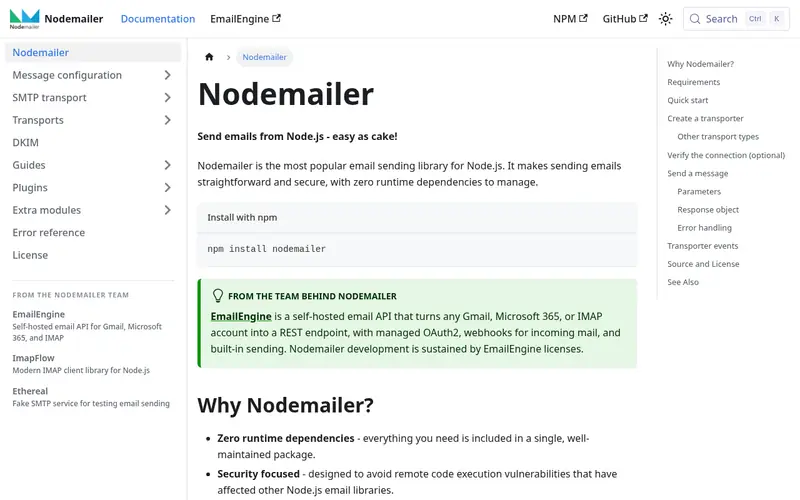
Nodemailer is the most widely used Node.js library for sending email. It connects to any SMTP server and also supports transports for several hosted providers. It handles attachments, embedded images, HTML and plain-text bodies, and common authentication methods. It runs on Node.js and needs no external service of its own.
The project is MIT licensed and free. There is no hosted tier and no per-message fee from the library itself; your cost is whatever your SMTP or API provider charges. Because it does not include a template engine, most teams pair it with MJML, React Email or a simple template function. Skip it if you want a fully managed sending dashboard bundled with the library, since Nodemailer is transport only.
Standout: Works with any SMTP server
Free (open source), as listed by the vendor (Nodemailer website). Confirm the current plan price before you buy.
Free plan. Plans change, so confirm on the vendor's pricing page before you buy.
Benefits
- Works with any SMTP server
- broad transport support including provider APIs
Drawbacks
- No template engine built in
- you assemble HTML yourself or pair it with another tool
Skip it if this limit matters to you: no template engine built in.
Verdict. A sensible pick for sending mail over SMTP or provider APIs.
Alternatives in this guide: React Email, MJML, email-templates
React Email
Best for building email templates as React components

What it is and where it fits
React Email lets you write email templates as React components and render them to HTML. It includes a preview server so you can view templates in the browser while you work, and it ships components for common layout and content blocks. It is aimed at teams already using React who want templates to live in the same codebase and review flow as the rest of the app.
The library is open source and free. It does not send email by itself; you render the template and pass the HTML to a sender such as Nodemailer or a provider SDK. Some components and tooling are maintained alongside the Resend service, but the template library works independently. Skip it if your team does not use React or prefers plain HTML templates.
Standout: Reuses React skills and components
Free (open source), as listed by the vendor (React Email website). Confirm the current plan price before you buy.
Free plan. Plans change, so confirm on the vendor's pricing page before you buy.
Benefits
- Reuses React skills and components
- includes a local preview server
Drawbacks
- Requires a React setup
- you still need a separate sender
Skip it if this limit matters to you: requires a React setup.
Verdict. A sensible pick for building email templates as React components.
Alternatives in this guide: Nodemailer, MJML, email-templates
MJML
Best for responsive HTML email that renders across clients
What it is and where it fits
MJML is a markup language and compiler for responsive email. You write short semantic tags and MJML outputs HTML tables that render more consistently across email clients, which is the part most hand-written email HTML gets wrong. It runs in Node.js and can be used from the command line or as a library inside a build step.
The project is MIT licensed and free. It does not send mail; you compile the markup and hand the HTML to a sender. The main cost is a build step and learning the tag set. Complex designs sometimes need raw HTML blocks inside MJML. Skip it if your templates are very simple or you already have a design system that outputs tested email HTML.
Standout: Semantic markup compiles to responsive HTML
Free (open source), as listed by the vendor (MJML website). Confirm the current plan price before you buy.
Free plan. Plans change, so confirm on the vendor's pricing page before you buy.
Benefits
- Semantic markup compiles to responsive HTML
- strong handling of client quirks
Drawbacks
- Adds a compile step
- custom designs can need raw HTML fallbacks
Skip it if this limit matters to you: adds a compile step.
Verdict. A sensible pick for responsive HTML email that renders across clients.
Alternatives in this guide: Nodemailer, React Email, email-templates
email-templates
Best for rendering templates with a sender in one package
What it is and where it fits
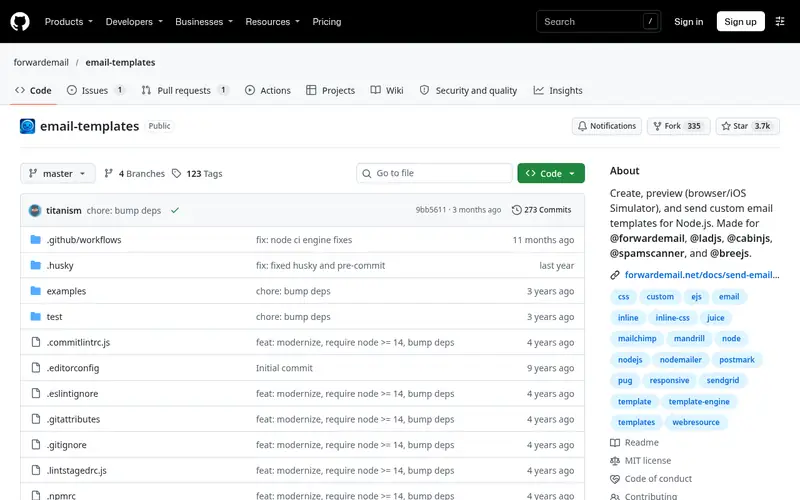
email-templates renders templates and sends them through Nodemailer in a single package. It supports several template engines, handles layouts and partials, and can render text versions alongside HTML. It is a practical choice when you want one dependency to cover rendering and delivery instead of wiring two libraries together.
The package is open source and free. Sending still depends on your SMTP or provider account, so delivery costs come from that provider. The trade-off is configuration: there are more options to set than with Nodemailer alone, and the community is smaller. Skip it if you want a minimal dependency or already have a template pipeline you like.
Standout: Combines template rendering with sending
Free (open source), as listed by the vendor (email-templates website). Confirm the current plan price before you buy.
Free plan. Plans change, so confirm on the vendor's pricing page before you buy.
Benefits
- Combines template rendering with sending
- supports multiple template engines
Drawbacks
- More configuration surface
- smaller community than Nodemailer alone
Skip it if this limit matters to you: more configuration surface.
Verdict. A sensible pick for rendering templates with a sender in one package.
Alternatives in this guide: Nodemailer, React Email, MJML
Resend Node SDK
Best for sending mail through the Resend API
What it is and where it fits
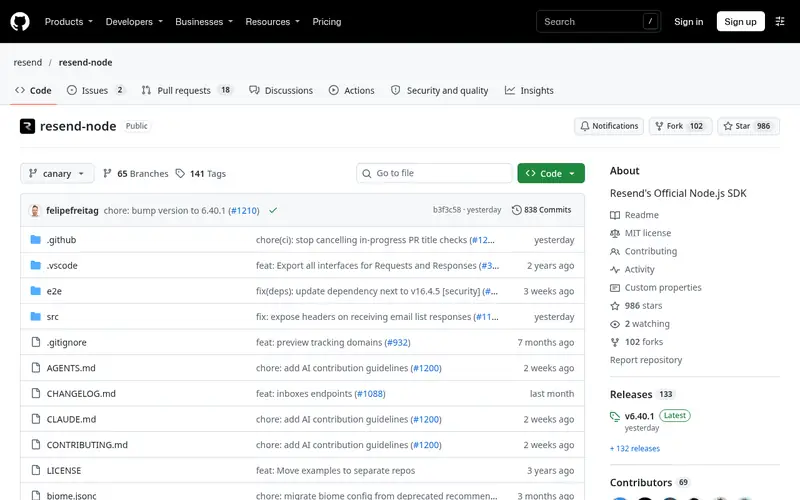
The Resend Node SDK is the official client for the Resend email API. You install the package, set an API key, and send mail with a short call that accepts HTML, text or a React component. It is designed to work closely with React Email, so teams building templates in React can send them without extra glue code.
The SDK is open source, but sending runs through Resend, which is a paid service with a free tier. Check the vendor pricing page for current limits and rates, since they change. The main constraint is lock-in: your sending depends on Resend's API and deliverability. Skip it if you need to send through your own SMTP server or another provider.
Standout: Small SDK with a simple send call
See vendor pricing page, as listed by the vendor (Resend Node SDK website). Confirm the current plan price before you buy.
Free plan. Plans change, so confirm on the vendor's pricing page before you buy.
Benefits
- Small SDK with a simple send call
- pairs well with React Email templates
Drawbacks
- Tied to the Resend service
- free tier has sending limits
Skip it if this limit matters to you: tied to the Resend service.
Verdict. A sensible pick for sending mail through the Resend API.
Alternatives in this guide: Nodemailer, React Email, MJML
SendGrid Node library
Best for sending mail through the Twilio SendGrid API
What it is and where it fits
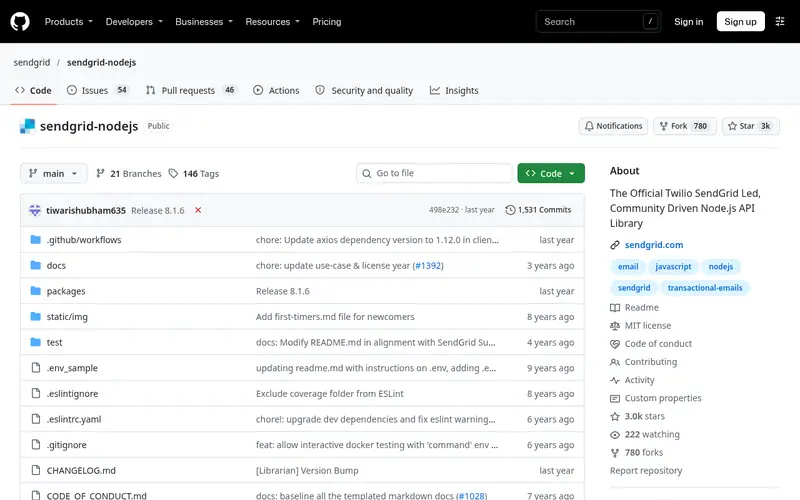
The SendGrid Node library is the official client for the Twilio SendGrid email API. It covers sending, dynamic templates, contacts and other account features, so it fits teams that already use SendGrid for delivery and want to manage everything from Node.js. The library is maintained by SendGrid and documented alongside the API reference.
The client is open source, but sending requires a SendGrid account, which is a paid service with a free tier. Confirm current limits and prices on the vendor pricing page. The API surface is broad, which is useful for full account control but heavy if you only need to send a single message. Skip it if you are not using SendGrid for delivery.
Standout: Covers the full SendGrid API including templates
See vendor pricing page, as listed by the vendor (SendGrid Node library website). Confirm the current plan price before you buy.
Free plan. Plans change, so confirm on the vendor's pricing page before you buy.
Benefits
- Covers the full SendGrid API including templates
- long-standing official library
Drawbacks
- Tied to SendGrid
- API surface is large for simple sends
Skip it if this limit matters to you: tied to SendGrid.
Verdict. A sensible pick for sending mail through the Twilio SendGrid API.
Alternatives in this guide: Nodemailer, React Email, MJML
AWS SDK for JavaScript SES client
Best for sending mail through Amazon SES from AWS-hosted apps
What it is and where it fits
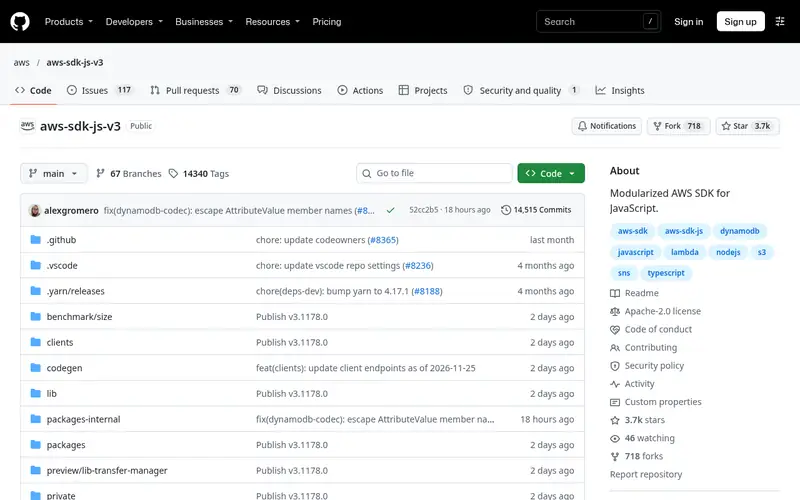
The AWS SDK for JavaScript v3 includes a client for Amazon Simple Email Service. It sends mail through SES using your AWS credentials and IAM policies, which suits teams already running on AWS and wanting email on the same billing and access model. The v3 SDK is modular, so you install only the SES client package you need.
SES is a paid AWS service, and new accounts start in a sandbox that limits recipients until you request production access. You also verify sending domains or addresses. Pricing is usage-based; check the AWS pricing page for current rates. Skip it if you are not on AWS or want to avoid IAM setup for a small project.
Standout: Fits existing AWS IAM and billing
See vendor pricing page, as listed by the vendor (AWS SDK for JavaScript SES client website). Confirm the current plan price before you buy.
No free plan. Plans change, so confirm on the vendor's pricing page before you buy.
Benefits
- Fits existing AWS IAM and billing
- modular v3 client
Drawbacks
- More setup than a simple SMTP library
- SES sandbox and verification rules apply
Skip it if this limit matters to you: more setup than a simple SMTP library.
Verdict. A sensible pick for sending mail through Amazon SES from AWS-hosted apps.
Alternatives in this guide: Nodemailer, React Email, MJML
Who should use what
If you send through your own SMTP server, start with Nodemailer. If your team writes React, pair React Email for templates with a sender. If you need responsive HTML that holds up in Outlook and Gmail, use MJML as a build step. If you want a managed API and simple calls, Resend or SendGrid fit, and AWS SES fits teams already on AWS.
Questions to settle before you buy
What to check before you buy
- Confirm the library is still maintained by checking recent commits and releases.
- Check which sending providers or SMTP servers it supports.
- Verify the license fits your project and any redistribution plans.
- Read the provider's current pricing and free-tier limits before you rely on them.
- Keep API keys and SMTP credentials in environment variables, not in code or templates.
FAQ
Do I need both a template library and a sending library?
Often yes. Nodemailer, Resend and SendGrid send mail; MJML and React Email build the HTML. Some packages, like email-templates, combine both. Pick a sender first, then add a template tool only if plain HTML is not enough.
Are these libraries free?
Nodemailer, React Email, MJML and email-templates are free and open source. The SDKs for Resend, SendGrid and AWS SES are open source, but sending runs through paid services with their own pricing and free-tier limits. Confirm current rates on each vendor page.
Can I send email without a third-party service?
Yes. Nodemailer can send through any SMTP server you control. Deliverability then depends on your server setup, domain authentication and reputation, which is why many teams use a hosted provider instead.
Which library works best with React?
React Email is built for React templates and includes a preview server. It pairs with Resend directly or with Nodemailer and other senders after rendering to HTML.
Is it safe to put API keys in my email code?
No. Store keys and SMTP passwords in environment variables or a secrets manager, and keep them out of version control. Rotate any key that has been committed or shared.
Sources we checked
Method: how we score · editorial policy.
Change log. First published 27 Nov 2026.