Stage 02 · Test · Researched comparison
Best Kotlin HTTP Clients in 2026
Ktor Client is the first pick for most Kotlin teams because it is multiplatform, coroutine-native and maintained by JetBrains. Choose OkHttp if you need a mature JVM-only engine with broad Android support. Choose Retrofit if you want declarative, annotation-based API interfaces on top of OkHttp. Spring WebClient fits projects already built on Spring WebFlux.

By Shihab Mia
Published 27 Nov 2026 · 7 tools compared
We run no ads and no affiliate links at launch. The order of a list follows our published method. See how we score.
Prices are the starting prices vendors list publicly. Plans change, so confirm the current price on the vendor page before you buy.
Key takeaways
- Ktor Client, OkHttp, Retrofit, http4k and Fuel are free and open source; Spring WebClient is free under the Apache 2.0 licence as part of Spring Framework.
- Ktor Client and Fuel support Kotlin Multiplatform targets; OkHttp, Retrofit and Spring WebClient target the JVM and Android.
- java.net.http.HttpClient ships with the JDK, so it adds no dependency but requires Java 11 or later.
- None of these libraries sends your request data to a third party; review each project's licence and release cadence before adopting it.
Who each pick is for
- Kotlin Multiplatform and coroutine-based projectsKtor Client
- JVM and Android apps that need a mature engineOkHttp
- Declarative REST API clients on Android and JVMRetrofit
- Functional-style Kotlin with testable HTTP layershttp4k client
- JVM projects that want no extra HTTP dependencyjava.net.http.HttpClient from Kotlin
- Simple Kotlin and multiplatform requestsFuel
- Spring WebFlux applications that need a reactive clientSpring WebClient
Comparison
| Tool | Best for | Standout feature | Listed starting price | Free plan or trial |
|---|---|---|---|---|
| 1Ktor Client | Kotlin Multiplatform and coroutine-based projects | Multiplatform engines for JVM, Android, iOS, JS and Native | Free (open source) | Free plan |
| 2OkHttp | JVM and Android apps that need a mature engine | Widely used on Android | Free (open source) | Free plan |
| 3Retrofit | Declarative REST API clients on Android and JVM | Annotation-based interfaces keep API code short | Free (open source) | Free plan |
| 4http4k client | Functional-style Kotlin with testable HTTP layers | Uniform request and response model | Free (open source) | Free plan |
| 5java.net.http.HttpClient from Kotlin | JVM projects that want no extra HTTP dependency | Ships with the JDK | Free | Free plan |
| 6Fuel | Simple Kotlin and multiplatform requests | Concise Kotlin DSL | Free (open source) | Free plan |
| 7Spring WebClient | Spring WebFlux applications that need a reactive client | Reactive and non-blocking | Free (open source) | Free plan |
How we picked
We compared libraries on fit for Kotlin work, platform support, API style, licence, maintenance activity and main limits. Sources are official project sites, vendor documentation and public repositories. We did not run benchmarks or collect user reviews. Prices and licence terms can change, so confirm them on the vendor or repository page before you commit.
The tools, one by one
Ktor Client
Best for kotlin Multiplatform and coroutine-based projects
What it is and where it fits
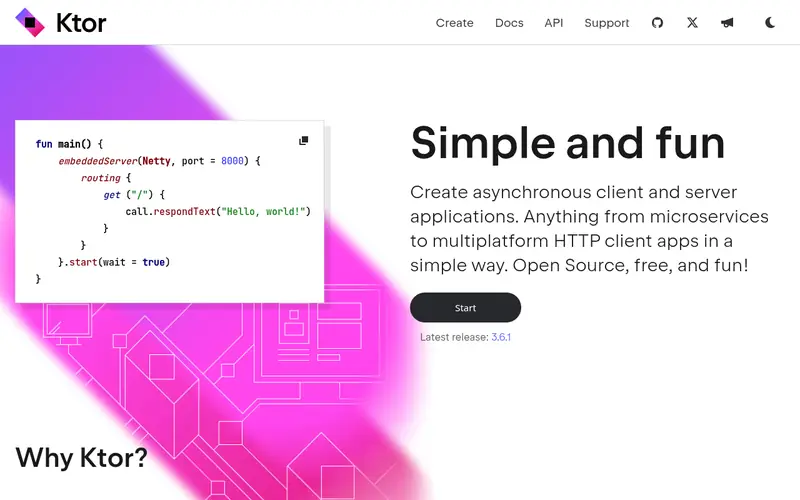
Ktor Client is the HTTP client from the Ktor framework, maintained by JetBrains. It exposes a suspend-function API that fits Kotlin coroutines, and it runs on JVM, Android, iOS, JavaScript and Kotlin/Native targets through pluggable engines such as CIO, OkHttp, Apache and Darwin. Content negotiation, logging, auth and retry are added as plugins rather than built into the core.
The library is Apache 2.0 licensed with no paid tier. Its main limit is that each platform needs a compatible engine, and plugin configuration takes more setup than a single-jar client. Teams that only target the JVM may find OkHttp simpler. Teams sharing networking code across platforms get the most value here.
Standout: Multiplatform engines for JVM, Android, iOS, JS and Native
Free (open source), as listed by the vendor (Ktor Client website). Confirm the current plan price before you buy.
Free plan. Plans change, so confirm on the vendor's pricing page before you buy.
Benefits
- Multiplatform engines for JVM, Android, iOS, JS and Native
- coroutine-first suspend API
Drawbacks
- Plugin setup adds configuration
- engine choice can confuse newcomers
Skip it if this limit matters to you: plugin setup adds configuration.
Verdict. A sensible pick for kotlin Multiplatform and coroutine-based projects.
Alternatives in this guide: OkHttp, Retrofit, http4k client
OkHttp
Best for jVM and Android apps that need a mature engine
What it is and where it fits
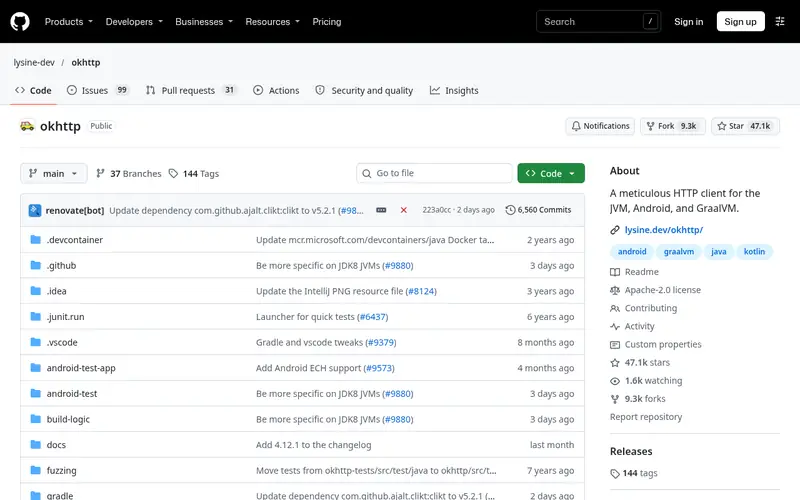
OkHttp from Square is a low-level HTTP client for Java and Kotlin on the JVM and Android. It handles connection pooling, transparent gzip, response caching, interceptors and HTTP/2. Many Kotlin projects use it directly with suspend wrappers, or indirectly as the engine under Retrofit and Ktor Client.
It is Apache 2.0 licensed and free. The API is callback and blocking based, so coroutine users typically add a small adapter or use the Ktor OkHttp engine. It does not target Kotlin/Native or JavaScript. Pick it when you want a stable JVM engine with a large amount of public documentation and Android tooling support.
Standout: Widely used on Android
Free (open source), as listed by the vendor (OkHttp website). Confirm the current plan price before you buy.
Free plan. Plans change, so confirm on the vendor's pricing page before you buy.
Benefits
- Widely used on Android
- connection pooling, interceptors and HTTP/2 support
Drawbacks
- JVM and Android only
- callback API needs bridging for coroutines
Skip it if this limit matters to you: JVM and Android only.
Verdict. A sensible pick for JVM and Android apps that need a mature engine.
Alternatives in this guide: Ktor Client, Retrofit, http4k client
Retrofit
Best for declarative REST API clients on Android and JVM
What it is and where it fits
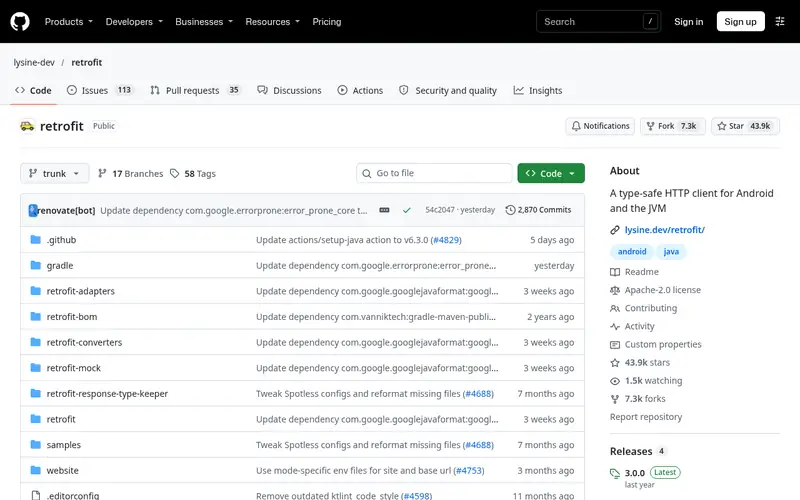
Retrofit from Square turns HTTP APIs into Kotlin or Java interfaces using annotations. You declare endpoints and parameters, and Retrofit generates the implementation. It uses OkHttp as its transport and supports converters for common serialization formats, plus call adapters for coroutines and reactive types.
It is Apache 2.0 licensed and free. The trade-off is that Retrofit is opinionated toward REST-style APIs; raw streaming, custom protocols or fine-grained connection control are better handled with OkHttp directly. It targets the JVM and Android only. It suits teams that want typed API definitions and less boilerplate per endpoint.
Standout: Annotation-based interfaces keep API code short
Free (open source), as listed by the vendor (Retrofit website). Confirm the current plan price before you buy.
Free plan. Plans change, so confirm on the vendor's pricing page before you buy.
Benefits
- Annotation-based interfaces keep API code short
- converters for JSON and other formats
Drawbacks
- Built around OkHttp
- less suited to non-REST or streaming work
Skip it if this limit matters to you: built around OkHttp.
Verdict. A sensible pick for declarative REST API clients on Android and JVM.
Alternatives in this guide: Ktor Client, OkHttp, http4k client
http4k client
Best for functional-style Kotlin with testable HTTP layers
What it is and where it fits
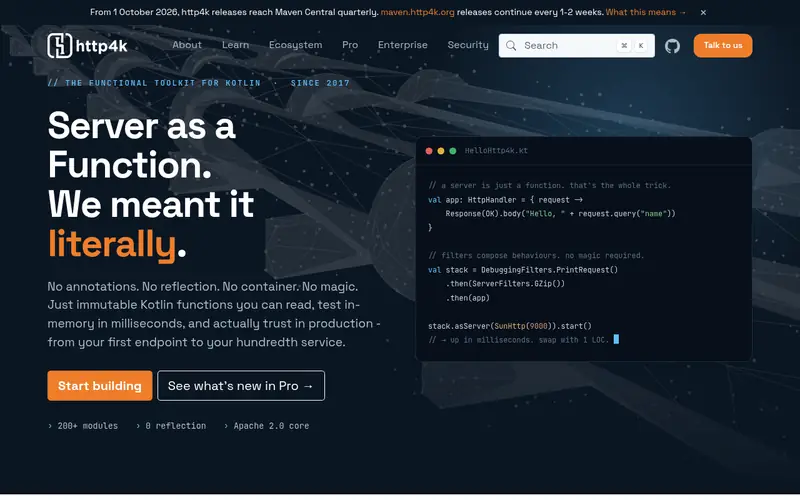
http4k provides an HTTP client built on a functional model where requests and responses are plain values. That makes it straightforward to test handlers and swap between real and fake clients. It offers several backends, including Java HttpClient, OkHttp and Apache, and integrates with its server and contract modules.
The core library is open source under Apache 2.0. Some http4k add-on modules are sold commercially, so check which parts you need. The community is smaller than Ktor or OkHttp, which means fewer third-party examples. It fits teams that like explicit, function-based code and want the same abstractions on client and server.
Standout: Uniform request and response model
Free (open source), as listed by the vendor (http4k client website). Confirm the current plan price before you buy.
Free plan. Plans change, so confirm on the vendor's pricing page before you buy.
Benefits
- Uniform request and response model
- easy to swap real and test clients
Drawbacks
- Smaller community than Ktor or OkHttp
- some modules are commercial
Skip it if this limit matters to you: smaller community than Ktor or OkHttp.
Verdict. A sensible pick for functional-style Kotlin with testable HTTP layers.
Alternatives in this guide: Ktor Client, OkHttp, Retrofit
java.net.http.HttpClient from Kotlin
Best for jVM projects that want no extra HTTP dependency
What it is and where it fits
The JDK's java.net.http.HttpClient, added in Java 11, is usable directly from Kotlin. It supports HTTP/1.1 and HTTP/2, synchronous and asynchronous requests, and a builder-based configuration. Because it is part of the JDK, it adds no library dependency and no separate version to track.
It is free with the JDK. The catch is that its API is Java-shaped: CompletableFuture instead of suspend functions, and no built-in JSON conversion or coroutine integration. You write small adapters yourself. It targets the JVM only. It suits small services, command-line tools and projects that want to keep the dependency list short.
Standout: Ships with the JDK
Free, as listed by the vendor (java.net.http.HttpClient from Kotlin website). Confirm the current plan price before you buy.
Free plan. Plans change, so confirm on the vendor's pricing page before you buy.
Benefits
- Ships with the JDK
- supports HTTP/2 and async requests
Drawbacks
- Java API from Kotlin
- no Kotlin-specific conveniences
Skip it if this limit matters to you: java API from Kotlin.
Verdict. A sensible pick for JVM projects that want no extra HTTP dependency.
Alternatives in this guide: Ktor Client, OkHttp, Retrofit
Fuel
Best for simple Kotlin and multiplatform requests
What it is and where it fits
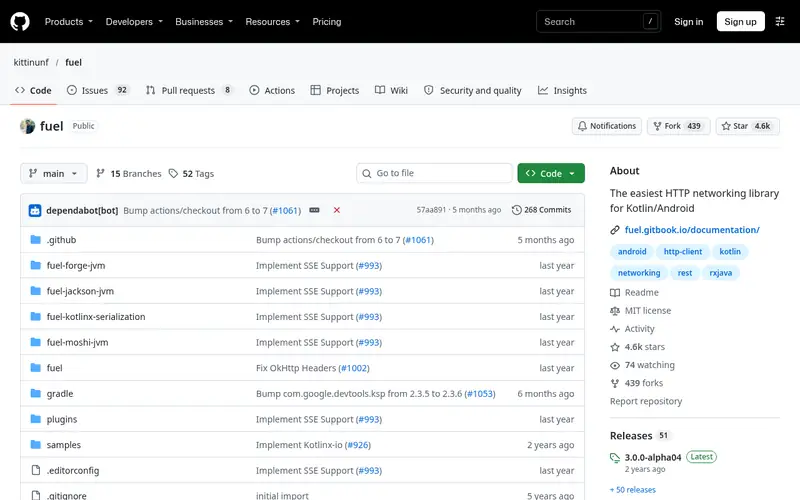
Fuel is a Kotlin HTTP client with a concise DSL and support for Kotlin Multiplatform targets. It covers common request types, serialization hooks and coroutine support. The project is open source and free.
Its ecosystem is smaller than Ktor's, and release activity has been slower at times, so check the repository for current maintenance status before adopting it for a long-lived project. It targets JVM, Android and multiplatform setups. It suits small projects and scripts where a short DSL matters more than a large plugin ecosystem.
Standout: Concise Kotlin DSL
Free (open source), as listed by the vendor (Fuel website). Confirm the current plan price before you buy.
Free plan. Plans change, so confirm on the vendor's pricing page before you buy.
Benefits
- Concise Kotlin DSL
- multiplatform support
Drawbacks
- Smaller maintainer base
- fewer integrations than Ktor
Skip it if this limit matters to you: smaller maintainer base.
Verdict. A sensible pick for simple Kotlin and multiplatform requests.
Alternatives in this guide: Ktor Client, OkHttp, Retrofit
Spring WebClient
Best for spring WebFlux applications that need a reactive client
What it is and where it fits
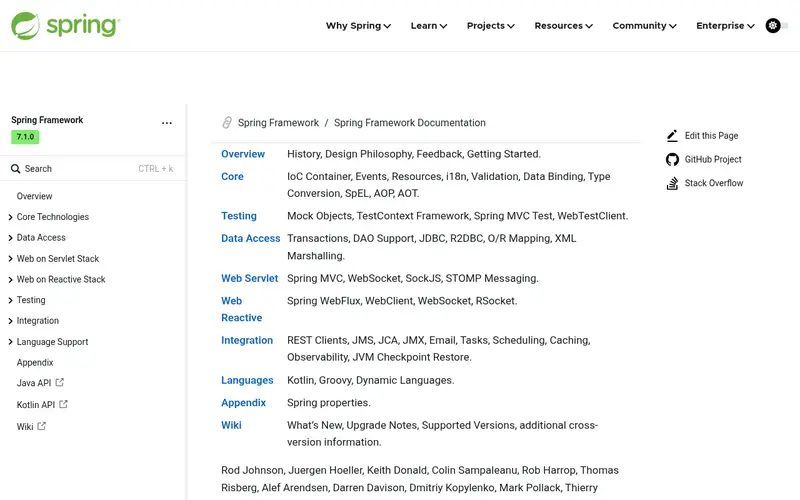
WebClient is the non-blocking HTTP client in Spring WebFlux. It offers a fluent API, supports reactive streams, and works with Spring's codecs and configuration. Kotlin code can use it with coroutines through Spring's Kotlin extensions.
It is part of Spring Framework and free under Apache 2.0. The cost is weight: it brings Spring dependencies and expects familiarity with reactive types. For a plain Kotlin service without Spring, Ktor Client or OkHttp is a lighter choice. It fits teams already running Spring WebFlux that want one HTTP stack across the application.
Standout: Reactive and non-blocking
Free (open source), as listed by the vendor (Spring WebClient website). Confirm the current plan price before you buy.
Free plan. Plans change, so confirm on the vendor's pricing page before you buy.
Benefits
- Reactive and non-blocking
- integrates with the Spring ecosystem
Drawbacks
- Pulls in Spring dependencies
- reactive model has a learning curve
Skip it if this limit matters to you: pulls in Spring dependencies.
Verdict. A sensible pick for spring WebFlux applications that need a reactive client.
Alternatives in this guide: Ktor Client, OkHttp, Retrofit
Who should use what
Use Ktor Client for a Kotlin Multiplatform app that shares networking code across Android, iOS and the JVM. Use OkHttp or Retrofit for an Android app that needs a mature JVM engine or typed REST interfaces. Use java.net.http.HttpClient for a small JVM service that should avoid extra dependencies. Use Spring WebClient only when the project already runs on Spring WebFlux and you want one HTTP stack throughout.
Questions to settle before you buy
What to check before you buy
- Confirm the client supports every target platform your project builds for.
- Check that the coroutine or reactive model matches your codebase.
- Review the licence and any commercial add-on modules.
- Verify the repository shows recent releases and issue activity.
- Test timeout, retry and error handling behavior in a small spike before adopting.
FAQ
Is Ktor Client the best Kotlin HTTP client?
It is the strongest general pick for multiplatform Kotlin because it is coroutine-native and maintained by JetBrains. It is not automatically best for every case: JVM-only Android projects often do well with OkHttp or Retrofit, and Spring projects may prefer WebClient.
Can I use OkHttp with Kotlin coroutines?
Yes, but OkHttp's API is callback and blocking based. You add a small adapter or use the Ktor OkHttp engine to call it from suspend functions. Retrofit also offers coroutine call adapters on top of OkHttp.
Is java.net.http.HttpClient enough for a Kotlin project?
For small JVM services and tools, yes. It ships with the JDK and supports HTTP/2 and async requests. It lacks Kotlin conveniences such as suspend functions and built-in serialization, so larger projects often prefer Ktor Client or OkHttp.
Does Retrofit work without OkHttp?
Retrofit uses OkHttp as its default transport and is built around it. You can supply a custom call factory, but in practice most projects use OkHttp underneath. If you want to avoid OkHttp, use Ktor Client or the JDK client instead.
Are these HTTP clients free to use?
Ktor Client, OkHttp, Retrofit, http4k, Fuel and Spring WebClient are open source and free under their respective licences. java.net.http.HttpClient is free with the JDK. Some http4k add-on modules are commercial, so check which modules you need.
Sources we checked
Method: how we score · editorial policy.
Change log. First published 27 Nov 2026.