Stage 02 · Test · Researched comparison
Best JavaScript UUID Libraries in 2026
The `uuid` npm package is the first pick for most teams. It covers v1, v3, v4, v5 and v7, runs in Node and browsers, and is the most widely used option. If you want smaller IDs or shorter strings, `nanoid` is the alternative. If you need sortable, time-ordered IDs for database keys, look at the `uuidv7` package or `ulid`/`ulidx`. The built-in `crypto.randomUUID()` needs no dependency at all.

By Shihab Mia
Published 27 Nov 2026 · 6 tools compared
We run no ads and no affiliate links at launch. The order of a list follows our published method. See how we score.
Prices are the starting prices vendors list publicly. Plans change, so confirm the current price on the vendor page before you buy.
Key takeaways
- `uuid` is free and open source (MIT) and supports v1, v3, v4, v5 and v7 in one package.
- `crypto.randomUUID()` ships with modern Node and browsers, so it adds no dependency, but it only generates v4.
- `nanoid` produces shorter IDs and is free under MIT; `@paralleldrive/cuid2` is free under MIT and designed for collision-resistant, non-sequential IDs.
- v4 IDs are random and not sortable; v7 and ULID IDs embed a timestamp so they sort by creation time, which helps database indexes.
Who each pick is for
- General-purpose UUID generation across Node and browsersuuid
- Zero-dependency v4 UUIDs in modern Node and browserscrypto.randomUUID (built-in)
- Short, URL-safe random IDs with a small footprintnanoid
- Collision-resistant IDs that avoid sequential patterns@paralleldrive/cuid2
- Lexicographically sortable IDs for database keysulid / ulidx
- Standard v7 UUIDs with timestamp orderinguuidv7
Comparison
| Tool | Best for | Standout feature | Listed starting price | Free plan or trial |
|---|---|---|---|---|
| 1uuid | General-purpose UUID generation across Node and browsers | Supports v1, v3, v4, v5 and v7 in one package | Free (open source) | Free plan |
| 2crypto.randomUUID (built-in) | Zero-dependency v4 UUIDs in modern Node and browsers | No dependency or install step | Free | Free plan |
| 3nanoid | Short, URL-safe random IDs with a small footprint | Short default IDs and small bundle | Free (open source) | Free plan |
| 4@paralleldrive/cuid2 | Collision-resistant IDs that avoid sequential patterns | Designed for horizontal scaling and non-sequential IDs | Free (open source) | Free plan |
| 5ulid / ulidx | Lexicographically sortable IDs for database keys | Time-ordered and sortable as strings | Free (open source) | Free plan |
| 6uuidv7 | Standard v7 UUIDs with timestamp ordering | Produces RFC 9562 v7 UUIDs that sort by time | Free (open source) | Free plan |
How we picked
We picked libraries that are actively maintained, have a clear official repository or documentation page, and genuinely generate unique identifiers in JavaScript. We compared runtime support (Node, browsers, React Native), ID format (standard UUID versus ULID or custom), sortability, licence and bundle size. Sources are vendor documentation, project repositories and public package pages. Prices and plan details can change, so confirm on the vendor site before you commit.
The tools, one by one
uuid
Best for general-purpose UUID generation across Node and browsers
What it is and where it fits
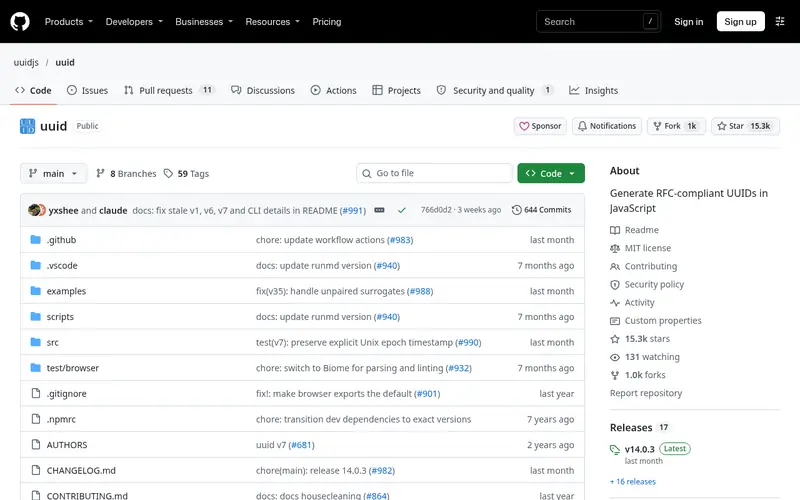
The `uuid` package is the reference implementation many projects start with. It generates RFC-compatible UUIDs across versions: v4 for random IDs, v7 for time-ordered IDs, and v3/v5 for name-based IDs. It ships TypeScript types and works in Node, browsers and bundlers. The project is MIT licensed.
For this job, `uuid` covers the common cases without extra dependencies. If you only need v4 in a modern runtime, the built-in `crypto.randomUUID()` may be enough. If you need v7 for sortable keys, `uuid` includes it. The main tradeoff is bundle size versus single-purpose libraries. Teams that want the smallest possible client bundle may prefer `nanoid` or the built-in API.
Standout: Supports v1, v3, v4, v5 and v7 in one package
Free (open source), as listed by the vendor (uuid website). Confirm the current plan price before you buy.
Free plan. Plans change, so confirm on the vendor's pricing page before you buy.
Benefits
- Supports v1, v3, v4, v5 and v7 in one package
- works in Node and browsers with TypeScript types
Drawbacks
- Larger than single-purpose libraries
- v4 output is not sortable
Skip it if this limit matters to you: larger than single-purpose libraries.
Verdict. A sensible pick for general-purpose UUID generation across Node and browsers.
Alternatives in this guide: crypto.randomUUID (built-in), nanoid, @paralleldrive/cuid2
crypto.randomUUID (built-in)
Best for zero-dependency v4 UUIDs in modern Node and browsers

What it is and where it fits
`crypto.randomUUID()` is part of the Web Crypto API and is exposed in modern Node versions and browsers. It returns a v4 UUID string and needs no package. For server code on a current Node release or client code in a modern browser, it is the simplest way to get a random UUID.
The limits are clear. It only produces v4, so it does not give you sortable v7 or ULID-style IDs. It is not present in older runtimes, so check your target environments. If you need multiple UUID versions, name-based IDs or a consistent API across old and new runtimes, a library like `uuid` is the safer choice.
Standout: No dependency or install step
Free, as listed by the vendor (crypto.randomUUID (built-in) website). Confirm the current plan price before you buy.
Free plan. Plans change, so confirm on the vendor's pricing page before you buy.
Benefits
- No dependency or install step
- available in modern Node and browser runtimes
Drawbacks
- Only generates v4
- not available in older runtimes without a polyfill
Skip it if this limit matters to you: only generates v4.
Verdict. A sensible pick for zero-dependency v4 UUIDs in modern Node and browsers.
Alternatives in this guide: uuid, nanoid, @paralleldrive/cuid2
nanoid
Best for short, URL-safe random IDs with a small footprint
What it is and where it fits
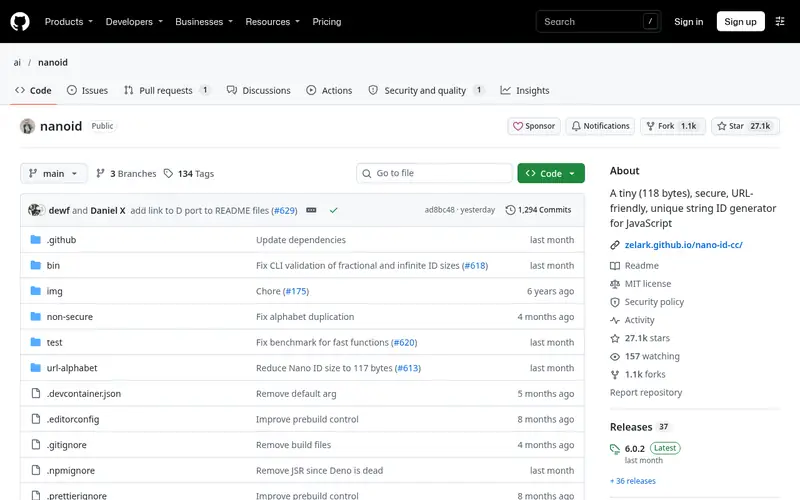
`nanoid` generates short, URL-safe random strings. The default alphabet and length produce compact IDs that suit URLs, filenames and client-side keys. It is MIT licensed and works in Node, browsers and React Native. The library is small, which matters for client bundles.
`nanoid` is not a UUID library in the RFC sense. Its output does not match the 8-4-4-4-12 UUID format, so skip it if a system expects standard UUIDs. It also does not embed a timestamp, so IDs are not sortable. For sortable IDs, use `uuidv7`, `ulid` or `@paralleldrive/cuid2` instead. For short random keys where format does not matter, `nanoid` is a good fit.
Standout: Short default IDs and small bundle
Free (open source), as listed by the vendor (nanoid website). Confirm the current plan price before you buy.
Free plan. Plans change, so confirm on the vendor's pricing page before you buy.
Benefits
- Short default IDs and small bundle
- works in Node, browsers and React Native
Drawbacks
- Not a standard UUID format
- IDs are not time-sortable by default
Skip it if this limit matters to you: not a standard UUID format.
Verdict. A sensible pick for short, URL-safe random IDs with a small footprint.
Alternatives in this guide: uuid, crypto.randomUUID (built-in), @paralleldrive/cuid2
@paralleldrive/cuid2
Best for collision-resistant IDs that avoid sequential patterns
What it is and where it fits
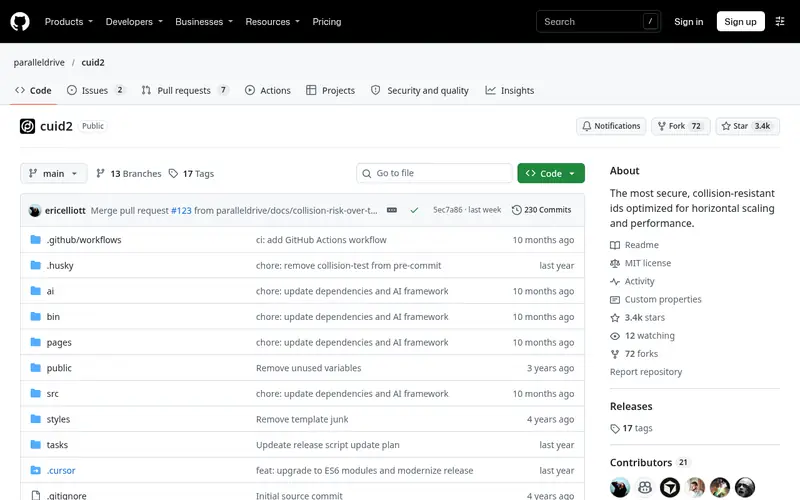
`@paralleldrive/cuid2` is the second generation of the cuid library. It produces IDs that are hard to guess and not sequential, which suits public-facing identifiers where you do not want to leak counts or ordering. It is MIT licensed and works in Node and browsers.
The output is not a standard UUID, so it does not fit systems that require RFC UUIDs. The IDs are also longer than `nanoid` defaults. Choose `cuid2` when collision resistance and non-guessability matter more than standard format. If you need sortable keys, use a v7 or ULID library instead.
Standout: Designed for horizontal scaling and non-sequential IDs
Free (open source), as listed by the vendor (@paralleldrive/cuid2 website). Confirm the current plan price before you buy.
Free plan. Plans change, so confirm on the vendor's pricing page before you buy.
Benefits
- Designed for horizontal scaling and non-sequential IDs
- works in Node and browsers
Drawbacks
- Not a standard UUID format
- longer than nanoid defaults
Skip it if this limit matters to you: not a standard UUID format.
Verdict. A sensible pick for collision-resistant IDs that avoid sequential patterns.
Alternatives in this guide: uuid, crypto.randomUUID (built-in), nanoid
ulid / ulidx
Best for lexicographically sortable IDs for database keys

What it is and where it fits
ULID (Universally Unique Lexicographically Sortable Identifier) combines a timestamp with randomness. The string form sorts by creation time, which helps with database indexes and log ordering. The `ulid` JavaScript package implements the spec, and `ulidx` is a maintained fork with similar behavior. Both are open source.
ULIDs are not UUIDs, so they will not pass a UUID validator. If your schema or API requires UUID format, use `uuid` v7 instead. ULIDs are shorter than UUID strings and sort well. Check which package your project uses, since the original `ulid` package and `ulidx` have separate maintenance histories.
Standout: Time-ordered and sortable as strings
Free (open source), as listed by the vendor (ulid / ulidx website). Confirm the current plan price before you buy.
Free plan. Plans change, so confirm on the vendor's pricing page before you buy.
Benefits
- Time-ordered and sortable as strings
- compact Crockford base32 format
Drawbacks
- Not a standard UUID format
- the original ulid package is less actively updated than ulidx
Skip it if this limit matters to you: not a standard UUID format.
Verdict. A sensible pick for lexicographically sortable IDs for database keys.
Alternatives in this guide: uuid, crypto.randomUUID (built-in), nanoid
uuidv7
Best for standard v7 UUIDs with timestamp ordering
What it is and where it fits
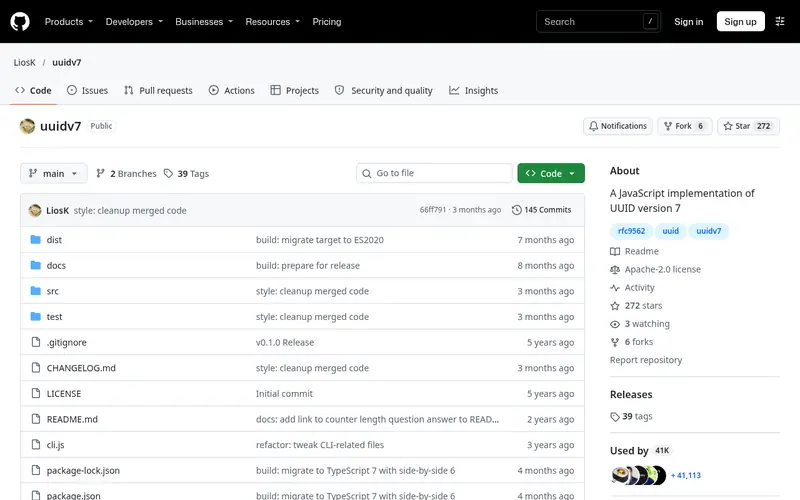
The `uuidv7` package focuses on one job: generating version 7 UUIDs. v7 UUIDs embed a Unix timestamp in the leading bits, so they sort by creation time while keeping the standard UUID string format. That makes them useful as primary keys where insert order matters.
If you already use the `uuid` package, it also supports v7, so a separate package may be redundant. Choose `uuidv7` when you want a small dependency that does one thing. The limit is scope: it does not generate v4, v3 or v5. For mixed needs, use `uuid`. For v7 only, this package is a focused option.
Standout: Produces RFC 9562 v7 UUIDs that sort by time
Free (open source), as listed by the vendor (uuidv7 website). Confirm the current plan price before you buy.
Free plan. Plans change, so confirm on the vendor's pricing page before you buy.
Benefits
- Produces RFC 9562 v7 UUIDs that sort by time
- small single-purpose package
Drawbacks
- Only generates v7
- fewer features than the full uuid package
Skip it if this limit matters to you: only generates v7.
Verdict. A sensible pick for standard v7 UUIDs with timestamp ordering.
Alternatives in this guide: uuid, crypto.randomUUID (built-in), nanoid
Who should use what
If you need standard UUIDs across versions and runtimes, use `uuid`. If you only need random v4 IDs in a modern runtime, use the built-in `crypto.randomUUID()` and skip the dependency. If you need sortable database keys in standard UUID format, use `uuid` v7 or the `uuidv7` package. If you want short URL-safe IDs and format does not matter, use `nanoid`. If you need non-sequential, hard-to-guess IDs, use `@paralleldrive/cuid2`. If your schema accepts ULIDs, use `ulid` or `ulidx` for compact sortable strings.
Questions to settle before you buy
What to check before you buy
- Confirm the ID format your database, API or validator expects (standard UUID versus ULID or custom).
- Decide whether you need sortable IDs; if so, choose v7, ULID or cuid2 rather than v4.
- Check runtime support for your Node version, browsers and any React Native targets.
- Review the licence and bundle size impact for client-side code.
- Generate IDs locally in your own code; do not paste secrets or production data into third-party web pages.
FAQ
What is the difference between UUID v4 and v7?
v4 UUIDs are random, so they do not sort by creation time. v7 UUIDs embed a Unix timestamp in the leading bits, so they sort by time while keeping the standard UUID format. Use v4 for general random IDs and v7 when insert order or index locality matters.
Do I need a library if crypto.randomUUID() exists?
Not always. `crypto.randomUUID()` is built into modern Node and browsers and returns v4 UUIDs with no dependency. Use a library if you need v7, v3 or v5, support for older runtimes, or a consistent API across environments.
Is nanoid a UUID?
No. `nanoid` generates short, URL-safe random strings that do not match the standard UUID format. It is a good choice when format does not matter and you want compact IDs, but not when a system requires RFC UUIDs.
Are ULIDs better than UUIDs?
They solve different problems. ULIDs are shorter and sort by time, which helps with database indexes. UUIDs are a standard format with wider tooling support. Choose based on what your schema and validators accept, not on a general ranking.
Can I generate UUIDs safely in the browser?
Yes, with `crypto.randomUUID()` or a bundled library. Avoid pasting secrets, tokens or production data into third-party web pages that generate IDs. Prefer local generation in your own code or tools that run offline in the browser.
Sources we checked
Method: how we score · editorial policy.
Change log. First published 27 Nov 2026.