Stage 02 · Test · Researched comparison
Best JavaScript Mocking Libraries in 2026
Jest is the first pick for most teams because its built-in mocking, spies, and module mocks ship with the test runner and need no extra setup. If you already use another runner, choose Sinon.js for standalone spies, stubs, and fake timers, or Vitest for a Vite-native runner with a Jest-compatible mocking API. All three are free and open source.

By Shihab Mia
Published 22 Nov 2026 · 7 tools compared
We run no ads and no affiliate links at launch. The order of a list follows our published method. See how we score.
Prices are the starting prices vendors list publicly. Plans change, so confirm the current price on the vendor page before you buy.
Key takeaways
- Jest, Vitest, Sinon.js, and the other picks here are free and open source, so cost is not the deciding factor.
- Jest and Vitest bundle mocking into the test runner, while Sinon.js, Nock, and MSW work alongside almost any runner.
- MSW and Nock intercept HTTP at the network layer, which keeps tests free of real API calls and credentials.
- Mocking libraries run locally in your test process, so test data stays on your machine rather than a third-party web page.
Who each pick is for
- Teams that want mocking built into the test runnerJest
- Vite projects that want a Jest-style mocking APIVitest
- Standalone spies, stubs, and fake timers in any runnerSinon.js
- Mocking HTTP APIs in tests and in the browserMock Service Worker (MSW)
- Mocking HTTP requests in Node.js testsNock
- Teams that want a strict, opinionated test double libraryTestDouble.js
- Mocking APIs for front-end development and testsMirage JS
Comparison
| Tool | Best for | Standout feature | Listed starting price | Free plan or trial |
|---|---|---|---|---|
| 1Jest | Teams that want mocking built into the test runner | Built-in jest.fn, jest.spyOn, and module mocks | Free (open source) | Free plan |
| 2Vitest | Vite projects that want a Jest-style mocking API | Jest-compatible vi.fn and vi.mock APIs | Free (open source) | Free plan |
| 3Sinon.js | Standalone spies, stubs, and fake timers in any runner | Works with Mocha, Jasmine, and other runners | Free (open source) | Free plan |
| 4Mock Service Worker (MSW) | Mocking HTTP APIs in tests and in the browser | Intercepts requests at the network level with one handler set | Free (open source) | Free plan |
| 5Nock | Mocking HTTP requests in Node.js tests | Simple API for intercepting Node HTTP requests | Free (open source) | Free plan |
| 6TestDouble.js | Teams that want a strict, opinionated test double library | Clear API for stubs and mocks with helpful error messages | Free (open source) | Free plan |
| 7Mirage JS | Mocking APIs for front-end development and tests | In-browser API mocking with routes and models | Free (open source) | Free plan |
How we picked
We compared libraries on fit for common mocking jobs (function doubles, module mocks, timers, and HTTP interception), the platforms and runners they support, licence and price, and whether they keep test data local rather than sending it to a third-party page. We also weighed main limits such as runner lock-in and Node-only scope. Sources are vendor documentation, project repositories, and public pricing pages. Prices and licences can change, so confirm details on the vendor site before you commit.
The tools, one by one
Jest
Best for teams that want mocking built into the test runner
What it is and where it fits
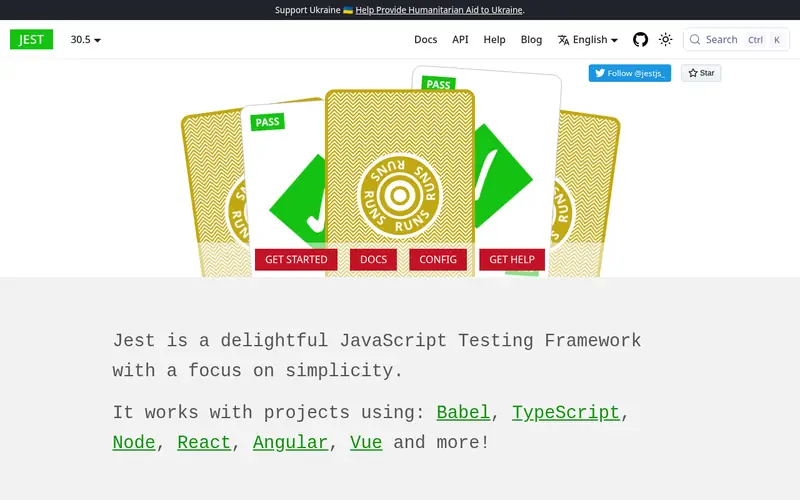
Jest is a JavaScript test runner that includes mocking as a core feature. You create mock functions with jest.fn(), watch calls with jest.spyOn(), replace modules with jest.mock(), and control time with fake timers. Because these APIs ship with the runner, there is no separate mocking dependency to install or configure. It runs on Node.js and works with JavaScript and TypeScript projects.
Jest is maintained by the OpenJS Foundation and released under the MIT licence. Mock state resets between tests when you enable the reset options, which keeps tests isolated. The main limit is that its mocking API is designed for Jest itself; if you run tests in another runner, you cannot use jest.mock() directly. Teams already on Jest get the most value, and teams on other runners should look at standalone options.
Standout: Built-in jest.fn, jest.spyOn, and module mocks
Free (open source), as listed by the vendor (Jest website). Confirm the current plan price before you buy.
Free plan. Plans change, so confirm on the vendor's pricing page before you buy.
Benefits
- Built-in jest.fn, jest.spyOn, and module mocks
- large ecosystem and documentation
Drawbacks
- Mocking is tied to the Jest runner
- ESM mocking has extra configuration steps
Skip it if this limit matters to you: mocking is tied to the Jest runner.
Verdict. A sensible pick for teams that want mocking built into the test runner.
Alternatives in this guide: Vitest, Sinon.js, Mock Service Worker (MSW)
Vitest
Best for vite projects that want a Jest-style mocking API
What it is and where it fits
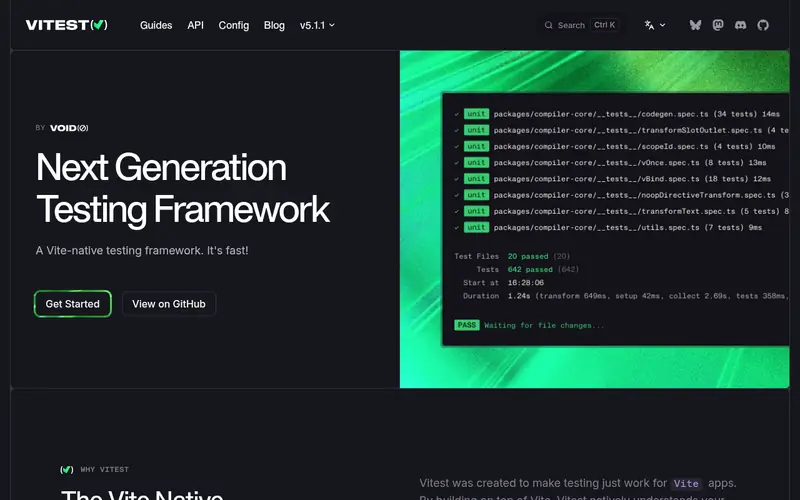
Vitest is a test runner built for Vite projects. Its mocking API mirrors Jest: vi.fn() creates mock functions, vi.spyOn() tracks method calls, vi.mock() replaces modules, and vi.useFakeTimers() controls time. Developers moving from Jest can reuse most of their mocking patterns with a prefix change from jest to vi. It runs on Node.js and supports JavaScript and TypeScript.
Vitest is open source under the MIT licence. It handles ESM projects natively, which avoids some of the configuration work that ESM mocking needs in Jest. The main limit is fit: it is most useful in Vite-based projects, and teams without Vite may prefer Jest or a standalone library. It is a good choice for new front-end projects that already use Vite for builds.
Standout: Jest-compatible vi.fn and vi.mock APIs
Free (open source), as listed by the vendor (Vitest website). Confirm the current plan price before you buy.
Free plan. Plans change, so confirm on the vendor's pricing page before you buy.
Benefits
- Jest-compatible vi.fn and vi.mock APIs
- fast runs in Vite projects
Drawbacks
- Best fit for Vite-based setups
- less common outside that ecosystem
Skip it if this limit matters to you: best fit for Vite-based setups.
Verdict. A sensible pick for vite projects that want a Jest-style mocking API.
Alternatives in this guide: Jest, Sinon.js, Mock Service Worker (MSW)
Sinon.js
Best for standalone spies, stubs, and fake timers in any runner
What it is and where it fits
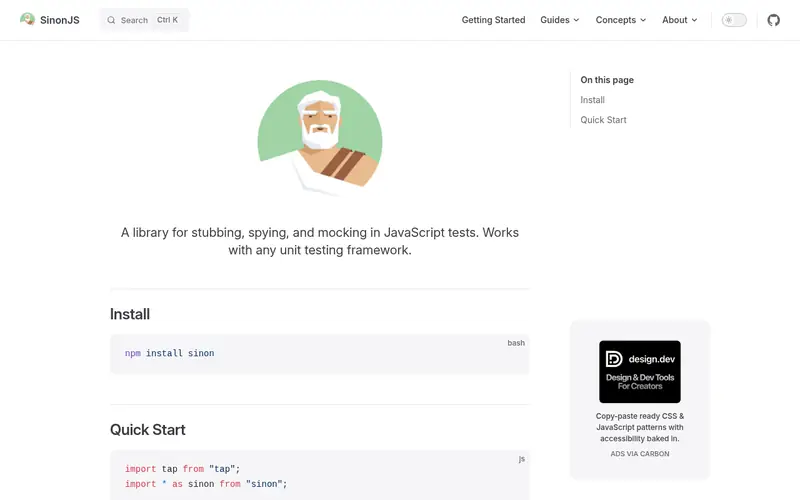
Sinon.js is a standalone library for test doubles. It provides spies, stubs, and mocks, plus fake timers and a fake XMLHttpRequest server for network tests. Because it does not include a test runner, you pair it with Mocha, Jasmine, or another runner and an assertion library. This makes it a common choice when you want mocking that is independent of the runner.
Sinon.js is open source under the BSD licence. It runs in Node.js and in browsers. Its fake timers let you advance time without waiting, which is useful for testing retries and timeouts. The main limit is scope: it does not replace modules by itself, so module-level mocking needs a runner feature or a separate tool. Teams that want one dependency for spies and stubs across runners should consider it.
Standout: Works with Mocha, Jasmine, and other runners
Free (open source), as listed by the vendor (Sinon.js website). Confirm the current plan price before you buy.
Free plan. Plans change, so confirm on the vendor's pricing page before you buy.
Benefits
- Works with Mocha, Jasmine, and other runners
- rich fake timers and HTTP fake server
Drawbacks
- No module mocking on its own
- needs a runner and assertions library
Skip it if this limit matters to you: no module mocking on its own.
Verdict. A sensible pick for standalone spies, stubs, and fake timers in any runner.
Alternatives in this guide: Jest, Vitest, Mock Service Worker (MSW)
Mock Service Worker (MSW)
Best for mocking HTTP APIs in tests and in the browser
What it is and where it fits
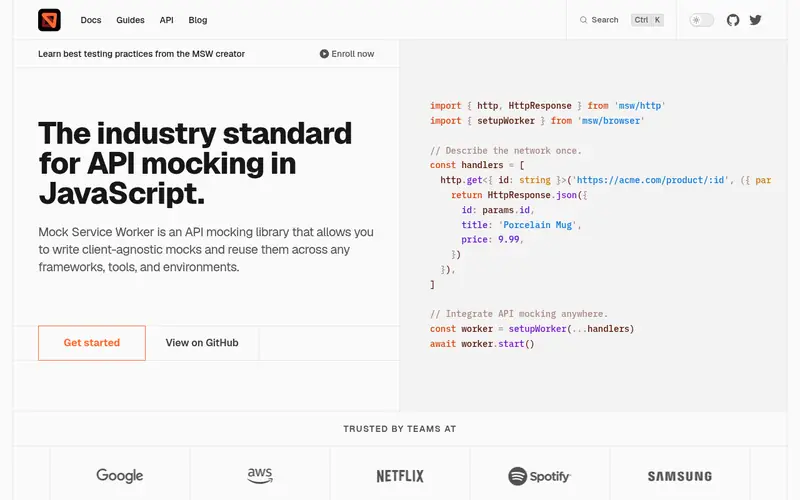
Mock Service Worker intercepts HTTP requests using a Service Worker in the browser and request interception in Node.js. You define handlers that describe how each endpoint responds, and the same handlers work in unit tests, integration tests, and a running app. This keeps tests free of real API calls and avoids hard-coded credentials in test code. It works with most runners and frameworks.
MSW is open source under the MIT licence. It runs in Node.js and modern browsers. The main limit is scope: it mocks network traffic, not arbitrary functions or modules, so you still need a runner's mocking API or Sinon.js for function-level doubles. Teams that test components against APIs benefit most. It is a strong fit when you want realistic request handling without a live server.
Standout: Intercepts requests at the network level with one handler set
Free (open source), as listed by the vendor (Mock Service Worker (MSW) website). Confirm the current plan price before you buy.
Free plan. Plans change, so confirm on the vendor's pricing page before you buy.
Benefits
- Intercepts requests at the network level with one handler set
- works in tests, browser, and Node
Drawbacks
- Focused on HTTP, not general function mocking
- requires handler setup per endpoint
Skip it if this limit matters to you: focused on HTTP, not general function mocking.
Verdict. A sensible pick for mocking HTTP APIs in tests and in the browser.
Nock
Best for mocking HTTP requests in Node.js tests
What it is and where it fits
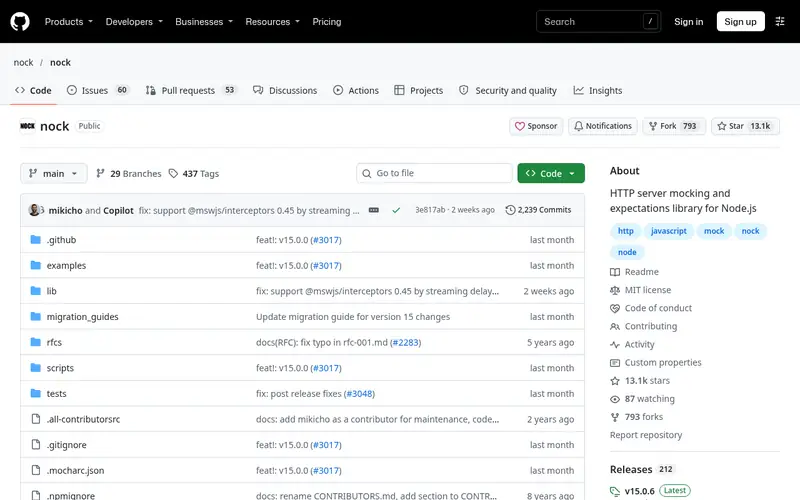
Nock intercepts HTTP requests made by Node.js code, letting tests define expected requests and canned responses. It works with the built-in http and https modules and with libraries built on them, and it runs alongside Mocha, Jest, or other runners. Tests can assert that an expected request was made, which catches calls that should not happen.
Nock is open source under the MIT licence. It runs only in Node.js, so it does not mock browser requests; use MSW for browser-side network mocking. The main limit is that it targets the Node HTTP stack, and some newer fetch implementations need extra setup. Backend teams that test service clients and API wrappers will find it a small, focused tool.
Standout: Simple API for intercepting Node HTTP requests
Free (open source), as listed by the vendor (Nock website). Confirm the current plan price before you buy.
Free plan. Plans change, so confirm on the vendor's pricing page before you buy.
Benefits
- Simple API for intercepting Node HTTP requests
- works with many test runners
Drawbacks
- Node.js only
- does not cover browser fetch or Service Worker scope
Skip it if this limit matters to you: node.js only.
Verdict. A sensible pick for mocking HTTP requests in Node.js tests.
TestDouble.js
Best for teams that want a strict, opinionated test double library
What it is and where it fits
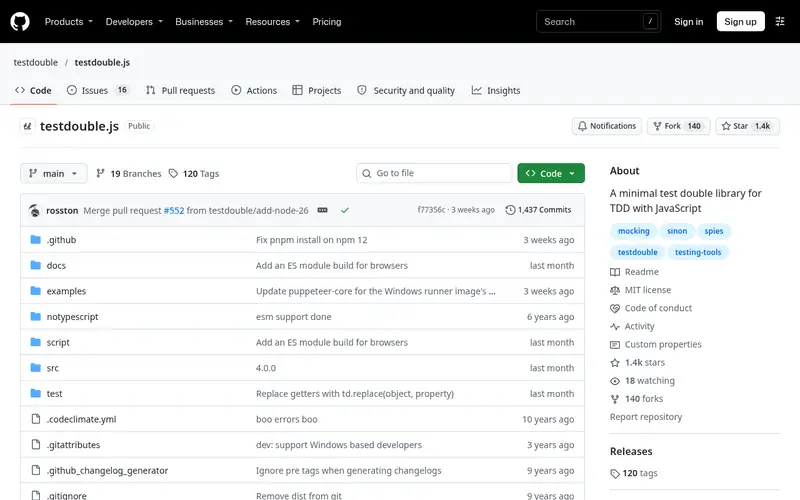
TestDouble.js is a standalone library for creating test doubles. It provides functions to replace dependencies, stub return values, and verify calls, with error messages that explain common mistakes. It works with any test runner and focuses on replacing real dependencies rather than patching objects. This suits teams that want tests to depend on explicit doubles.
TestDouble.js is open source under the MIT licence. It runs in Node.js and browsers. The main limit is adoption: it has a smaller community than Jest or Sinon.js, so examples and answers are fewer. It also does not include a runner or assertions, so you bring those. Teams that value a guided, opinionated API over a large ecosystem may prefer it.
Standout: Clear API for stubs and mocks with helpful error messages
Free (open source), as listed by the vendor (TestDouble.js website). Confirm the current plan price before you buy.
Free plan. Plans change, so confirm on the vendor's pricing page before you buy.
Benefits
- Clear API for stubs and mocks with helpful error messages
- encourages isolated tests
Drawbacks
- Smaller community than Jest or Sinon
- not a test runner itself
Skip it if this limit matters to you: smaller community than Jest or Sinon.
Verdict. A sensible pick for teams that want a strict, opinionated test double library.
Mirage JS
Best for mocking APIs for front-end development and tests
What it is and where it fits
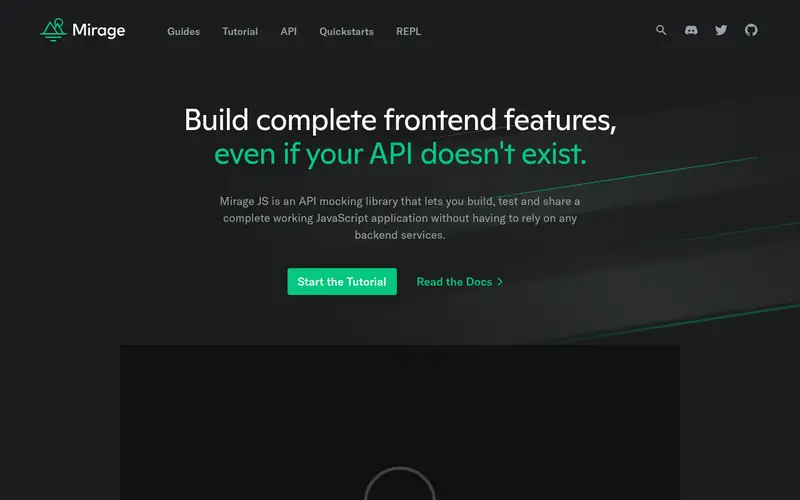
Mirage JS is an in-browser API mocking library. You define routes, models, and factories, and it responds to requests from your front-end code during development and in tests. It can simulate latency and errors, which helps test loading and failure states without a real backend. It works with most front-end frameworks and test runners.
Mirage JS is open source under the MIT licence. It runs in the browser and in Node.js test environments. The main limit is scope: it is built for front-end API mocking, not function or module doubles, and its community is smaller than MSW's. Teams building front-end features before an API exists may find it useful, while teams that only need request interception in tests may prefer MSW.
Standout: In-browser API mocking with routes and models
Free (open source), as listed by the vendor (Mirage JS website). Confirm the current plan price before you buy.
Free plan. Plans change, so confirm on the vendor's pricing page before you buy.
Benefits
- In-browser API mocking with routes and models
- works during development and in tests
Drawbacks
- Focused on front-end apps
- smaller ecosystem than MSW
Skip it if this limit matters to you: focused on front-end apps.
Verdict. A sensible pick for mocking APIs for front-end development and tests.
Who should use what
If you already run Jest, use its built-in mocking and add MSW for HTTP. If you build with Vite, choose Vitest and reuse Jest-style patterns. If you use Mocha or another runner and want standalone spies and stubs, pick Sinon.js, and add Nock for Node HTTP or MSW for browser requests. If you test components against APIs, pair MSW with your runner's built-in doubles or Vitest for function-level mocks.
Questions to settle before you buy
What to check before you buy
- Confirm the library works with your current test runner and module system, including ESM.
- Check whether you need function doubles, module mocks, timers, or HTTP interception, and pick a tool for each.
- Verify the licence and maintenance activity on the project repository.
- Make sure network mocks keep API keys and tokens out of test code and logs.
- Test that mock state resets between tests so failures do not leak into other cases.
FAQ
Do I need a separate mocking library if I use Jest?
No. Jest includes mock functions, spies, module mocks, and fake timers. Add a network tool such as MSW or Nock only when you need to mock HTTP requests. A standalone library like Sinon.js is useful mainly when you want doubles outside the Jest runner.
Can I use Sinon.js with any test runner?
Yes. Sinon.js does not include a runner, so it works with Mocha, Jasmine, and other runners alongside an assertion library. It provides spies, stubs, mocks, and fake timers. It does not replace modules by itself, so module-level mocking needs a runner feature or another tool.
What is the difference between MSW and Nock?
MSW intercepts requests with a Service Worker in the browser and request interception in Node.js, so one handler set can serve tests and a running app. Nock intercepts HTTP requests in Node.js only. Use MSW for browser and cross-environment mocking, and Nock for focused Node.js service tests.
Are these mocking libraries free?
Yes. All the libraries listed here are free and open source under licences such as MIT and BSD. There is no paid tier for the libraries themselves. Costs may come from related services or CI minutes, not from the mocking library.
Is it safe to mock APIs with real credentials?
Avoid putting real tokens or production data in test code and mock handlers. Use fake values and local fixtures instead. These libraries run in your test process, so data stays on your machine, but committed test files can still expose secrets if you paste real ones.
Sources we checked
Method: how we score · editorial policy.
Change log. First published 22 Nov 2026.