Stage 02 · Test · Researched comparison
Best JavaScript JWT Libraries in 2026
jose is the first pick for most teams. It signs and verifies tokens across Node, browsers, Deno, Bun and edge runtimes using the Web Crypto API, and it supports JWS, JWE, JWK and JWKS. If you only work in Node and want the most widely used option, jsonwebtoken is a common alternative. If you need to read token claims on a client without checking the signature, jwt-decode is the lighter choice.

By Shihab Mia
Published 27 Nov 2026 · 6 tools compared
We run no ads and no affiliate links at launch. The order of a list follows our published method. See how we score.
Prices are the starting prices vendors list publicly. Plans change, so confirm the current price on the vendor page before you buy.
Key takeaways
- jose works across runtimes and covers signing, verification, encryption and key sets, which suits mixed Node and edge codebases.
- jsonwebtoken is Node only and is the most established option for server-side signing and verification.
- jwt-decode only decodes tokens. It does not verify signatures, so never use it to make trust decisions.
- All libraries listed here are free and open source, and verification should happen on your server or trusted runtime, not in a third-party web page.
Who each pick is for
- Cross-runtime signing and verification with Web Cryptojose
- Node servers that sign and verify tokensjsonwebtoken
- Node services that want a fast, focused verifierfast-jwt
- Reading token claims on the clientjwt-decode
- JWT signing and verification in Cloudflare Workers@tsndr/cloudflare-worker-jwt
- JWT auth inside Hono web appshono/jwt helper
Comparison
| Tool | Best for | Standout feature | Listed starting price | Free plan or trial |
|---|---|---|---|---|
| 1jose | Cross-runtime signing and verification with Web Crypto | Works in Node, browsers, Deno, Bun and edge runtimes | Free (open source) | Free plan |
| 2jsonwebtoken | Node servers that sign and verify tokens | Long-established and widely used in Node projects | Free (open source) | Free plan |
| 3fast-jwt | Node services that want a fast, focused verifier | Focused API for signing and verification | Free (open source) | Free plan |
| 4jwt-decode | Reading token claims on the client | Small and simple for reading header and payload | Free (open source) | Free plan |
| 5@tsndr/cloudflare-worker-jwt | JWT signing and verification in Cloudflare Workers | Built for the Workers runtime | Free (open source) | Free plan |
| 6hono/jwt helper | JWT auth inside Hono web apps | Built into the Hono framework with middleware support | Free (open source) | Free plan |
How we picked
We picked libraries that genuinely sign, verify or decode JWTs and are currently maintained. Criteria were fit for the job, supported runtimes, licence and price, how verification is handled, and main limits such as Node-only support or decode-only scope. Sources are vendor pages, project documentation and public repositories. Prices and features change, so confirm details on the project site before you commit.
The tools, one by one
jose
Best for cross-runtime signing and verification with Web Crypto
What it is and where it fits
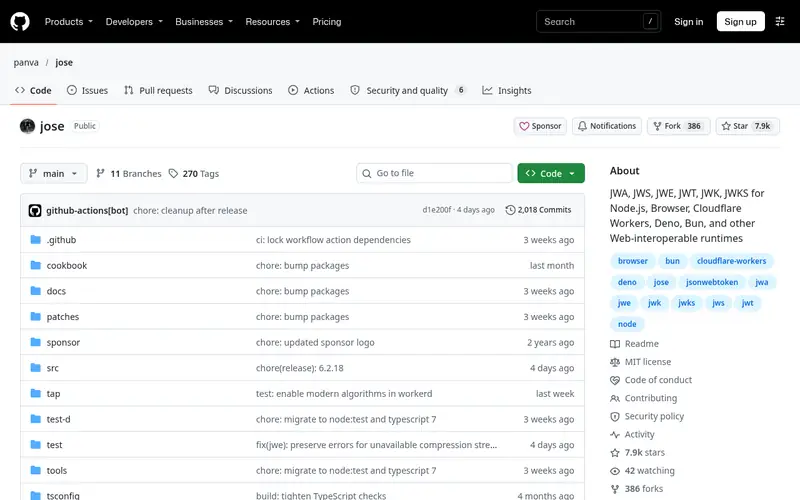
jose is a JavaScript module for JSON Object Signing and Encryption. It handles JWS signing and verification, JWE encryption and decryption, and JWK and JWKS key handling. It relies on the Web Crypto API, so the same code runs in Node, browsers, Deno, Bun, Cloudflare Workers and similar edge runtimes.
Verification is a core part of the library. You pass the key or key set, set the expected algorithm, and check claims such as issuer and audience. The API is promise-based, which fits modern async code but differs from older callback or synchronous libraries.
The project is open source and free to use. It does not ship a hosted service or paid tier. Teams that only need to decode a token on the client, or that want a minimal Node-only dependency, may prefer a smaller library.
Standout: Works in Node, browsers, Deno, Bun and edge runtimes
Free (open source), as listed by the vendor (jose website). Confirm the current plan price before you buy.
Free plan. Plans change, so confirm on the vendor's pricing page before you buy.
Benefits
- Works in Node, browsers, Deno, Bun and edge runtimes
- supports JWS, JWE, JWK and JWKS
Drawbacks
- Async API takes adjustment if you expect synchronous calls
- broad feature set takes reading to use well
Skip it if this limit matters to you: async API takes adjustment if you expect synchronous calls.
Verdict. A sensible pick for cross-runtime signing and verification with Web Crypto.
Alternatives in this guide: jsonwebtoken, fast-jwt, jwt-decode
jsonwebtoken
Best for node servers that sign and verify tokens
What it is and where it fits
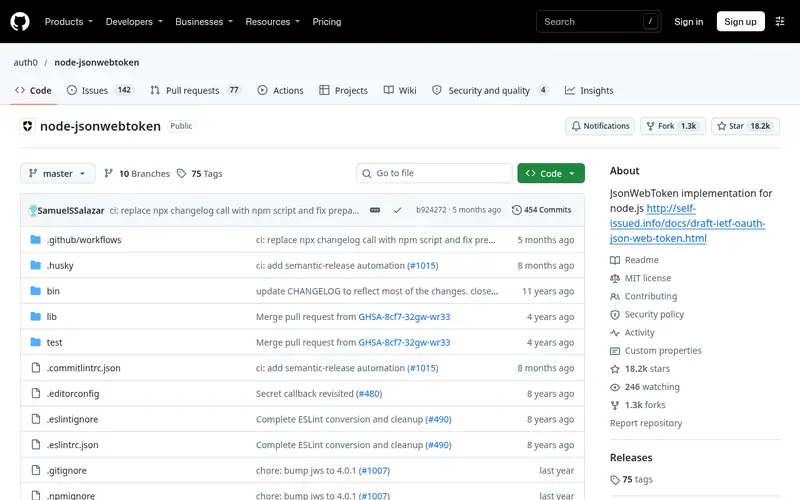
jsonwebtoken is a Node library for signing and verifying JSON Web Tokens. It offers `sign` and `verify` functions, supports HMAC and RSA algorithms, and lets you set expiry, issuer and audience claims. It is one of the most referenced JWT packages in Node codebases.
Verification is the part to get right. The library lets you restrict accepted algorithms and validate standard claims. Passing an explicit algorithm list and checking issuer and audience avoids common token confusion problems.
The package runs only in Node, not in browsers or edge runtimes. It is free and open source with no paid tier. Teams building for multiple runtimes, or moving code to edge functions, should look at jose instead.
Standout: Long-established and widely used in Node projects
Free (open source), as listed by the vendor (jsonwebtoken website). Confirm the current plan price before you buy.
Free plan. Plans change, so confirm on the vendor's pricing page before you buy.
Benefits
- Long-established and widely used in Node projects
- simple sign and verify calls
Drawbacks
- Node only, so it does not run in browsers or edge runtimes
- sync and callback styles can hide mistakes
Skip it if this limit matters to you: node only, so it does not run in browsers or edge runtimes.
Verdict. A sensible pick for node servers that sign and verify tokens.
Alternatives in this guide: jose, fast-jwt, jwt-decode
fast-jwt
Best for node services that want a fast, focused verifier
What it is and where it fits
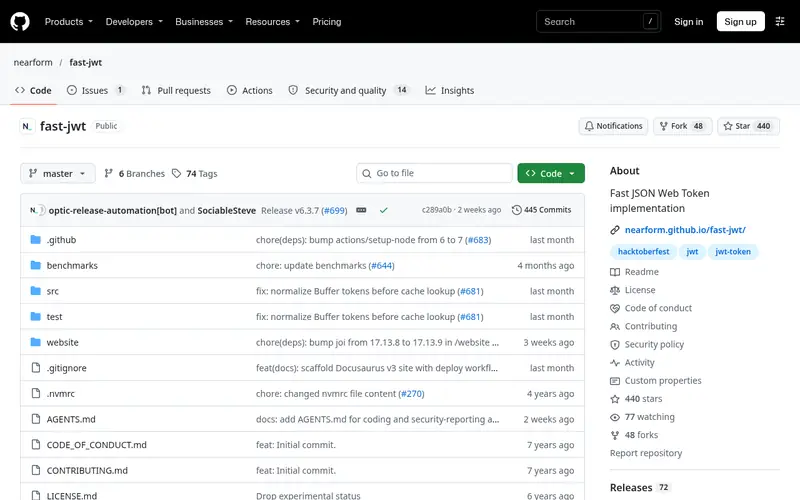
fast-jwt is a Node library for signing and verifying JWTs, built with performance in mind. It provides signer and verifier functions, supports common HMAC and RSA algorithms, and lets you set allowed algorithms, issuer, audience and clock tolerance.
The verifier is configurable. You can require specific claims, set a maximum token age, and reject tokens that fail checks. That makes it a practical choice for API gateways and services that verify many tokens.
It runs in Node and does not target browsers or edge runtimes. The project is free and open source. Teams that need encryption or key-set handling should use jose, and teams that want the most common package may stay with jsonwebtoken.
Standout: Focused API for signing and verification
Free (open source), as listed by the vendor (fast-jwt website). Confirm the current plan price before you buy.
Free plan. Plans change, so confirm on the vendor's pricing page before you buy.
Benefits
- Focused API for signing and verification
- lets you restrict algorithms and validate claims
Drawbacks
- Node only
- smaller ecosystem than jsonwebtoken
Skip it if this limit matters to you: node only.
Verdict. A sensible pick for node services that want a fast, focused verifier.
Alternatives in this guide: jose, jsonwebtoken, jwt-decode
jwt-decode
Best for reading token claims on the client
What it is and where it fits
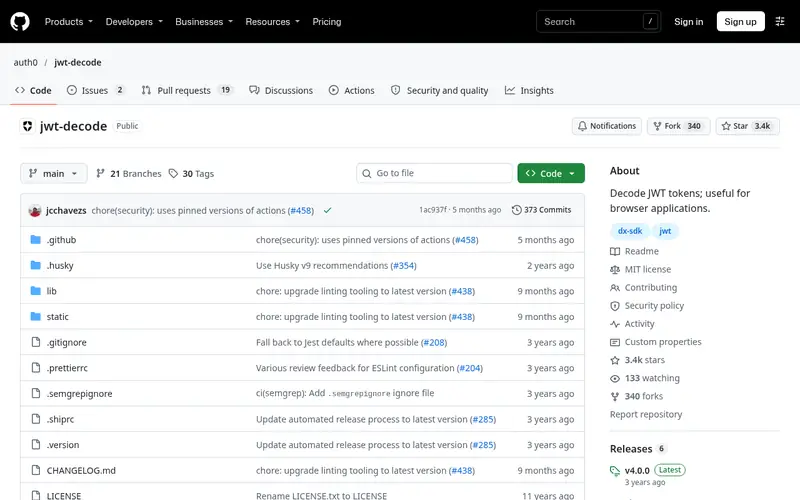
jwt-decode is a small library that decodes a JWT and returns its header and payload. It does not check the signature and does not validate claims. It is meant for reading data such as a display name or expiry time on the client.
Because it skips verification, it must not be used to decide whether a user is allowed to do something. Any access decision belongs on the server, where the signature is checked with a library such as jose or jsonwebtoken.
The package is free and open source and runs in browsers and Node. It is a good fit for front-end code that needs to read claims from a token it already received. It is the wrong tool for authentication or authorization checks.
Standout: Small and simple for reading header and payload
Free (open source), as listed by the vendor (jwt-decode website). Confirm the current plan price before you buy.
Free plan. Plans change, so confirm on the vendor's pricing page before you buy.
Benefits
- Small and simple for reading header and payload
- works in browsers and Node
Drawbacks
- Does not verify signatures, so it cannot be trusted for access control
- decode only
Skip it if this limit matters to you: does not verify signatures, so it cannot be trusted for access control.
Verdict. A sensible pick for reading token claims on the client.
Alternatives in this guide: jose, jsonwebtoken, fast-jwt
@tsndr/cloudflare-worker-jwt
Best for jWT signing and verification in Cloudflare Workers
What it is and where it fits
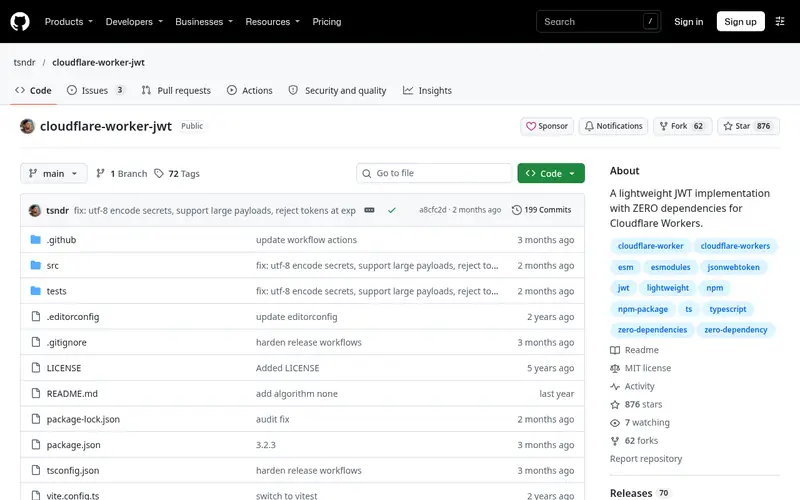
@tsndr/cloudflare-worker-jwt is a small library for signing and verifying JWTs in Cloudflare Workers. It uses the Web Crypto API available in the Workers runtime and provides sign and verify functions with support for common algorithms.
Verification lets you pass a secret or key and check the token. It fits Workers-based APIs and middleware where you want a lightweight dependency rather than a full JOSE implementation.
The library targets the Workers environment. It is free and open source with no paid tier. Teams that also run Node services, or that need JWE encryption and JWKS handling, should use jose, which covers Workers and other runtimes in one package.
Standout: Built for the Workers runtime
Free (open source), as listed by the vendor (@tsndr/cloudflare-worker-jwt website). Confirm the current plan price before you buy.
Free plan. Plans change, so confirm on the vendor's pricing page before you buy.
Benefits
- Built for the Workers runtime
- small API for sign and verify
Drawbacks
- Aimed at Cloudflare Workers rather than general Node use
- narrower feature set than jose
Skip it if this limit matters to you: aimed at Cloudflare Workers rather than general Node use.
Verdict. A sensible pick for JWT signing and verification in Cloudflare Workers.
Alternatives in this guide: jose, jsonwebtoken, fast-jwt
hono/jwt helper
Best for jWT auth inside Hono web apps
What it is and where it fits
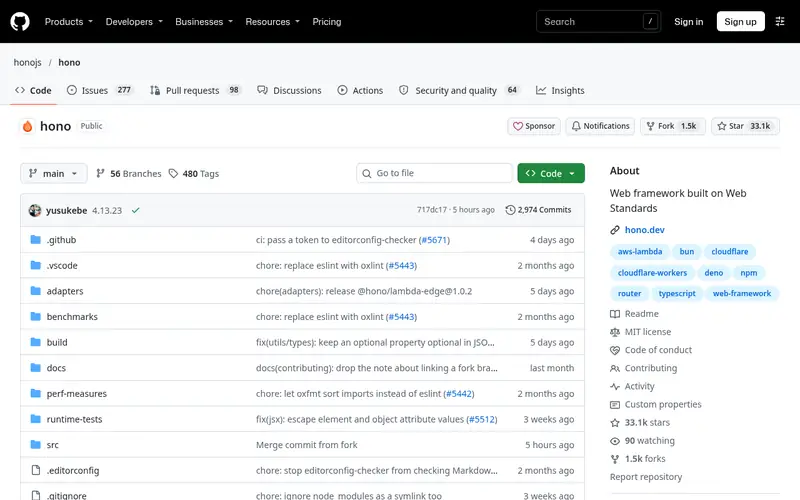
Hono is a small web framework that runs on Node, Deno, Bun, Cloudflare Workers and other runtimes. Its built-in jwt helper signs and verifies tokens, and its jwt middleware checks the Authorization header before a route runs.
The helper uses the Web Crypto API, so it works across the runtimes Hono supports. You can set a secret, choose an algorithm, and validate claims during verification. The middleware makes it easy to protect routes in a Hono app.
It is part of Hono, not a separate package for general use. If you already build on Hono, the helper keeps auth code close to your routes. If you use another framework, a standalone library such as jose is a better fit. Hono is free and open source.
Standout: Built into the Hono framework with middleware support
Free (open source), as listed by the vendor (hono/jwt helper website). Confirm the current plan price before you buy.
Free plan. Plans change, so confirm on the vendor's pricing page before you buy.
Benefits
- Built into the Hono framework with middleware support
- works across Hono's supported runtimes
Drawbacks
- Tied to using Hono
- not a standalone general-purpose JWT package
Skip it if this limit matters to you: tied to using Hono.
Verdict. A sensible pick for JWT auth inside Hono web apps.
Alternatives in this guide: jose, jsonwebtoken, fast-jwt
Who should use what
If you build across Node, browsers and edge runtimes, use jose so one library covers signing, verification and key sets. If you work only in Node and want the most established package, jsonwebtoken is a safe default. If you need to read claims in a browser without checking the signature, jwt-decode is enough, but keep all access checks on the server. If you build on Cloudflare Workers or Hono, the dedicated helper keeps auth code close to your routes.
Questions to settle before you buy
What to check before you buy
- Confirm the library verifies signatures and lets you restrict accepted algorithms.
- Check that it validates issuer, audience and expiry claims, not just the signature.
- Make sure it runs on every runtime you deploy to, including edge functions.
- Never paste real tokens, secrets or production keys into third-party web pages.
- Read the licence and confirm the project is still maintained before adding it.
FAQ
Does jwt-decode verify tokens?
No. jwt-decode only reads the header and payload. It does not check the signature or validate claims. Use jose or jsonwebtoken on the server for verification, and treat jwt-decode as a way to display data on the client.
Can I use jsonwebtoken in the browser?
No. jsonwebtoken is a Node library. For browser or edge runtimes, use jose, which relies on the Web Crypto API and works across those environments.
Which library should I use to verify JWTs on the server?
jose is a good default because it works across runtimes and supports JWS, JWE and key sets. In Node-only projects, jsonwebtoken and fast-jwt are also common choices. Always restrict accepted algorithms and check issuer and audience.
Are these JWT libraries free?
Yes. All the libraries listed here are free and open source. None require a paid licence. Check each project's licence terms if you redistribute the code.
Is it safe to decode a JWT on a third-party website?
Avoid it. Tokens can contain personal data or grant access. Use a library that runs locally in your browser or offline, and never paste production tokens or secrets into a web page you do not control.
Sources we checked
Method: how we score · editorial policy.
Change log. First published 27 Nov 2026.