Stage 02 · Test · Researched comparison
Best JavaScript Cryptography Libraries in 2026
The Web Crypto API is the first pick for most browser and Node work because it is built into the platform, runs locally and needs no dependency. Teams that want a single high-level API across browsers and Node should look at libsodium.js. Projects that need modern primitives in pure JavaScript with no native build step should look at @noble/curves and @noble/ciphers. All three keep keys and plaintext on the device.

By Shihab Mia
Published 27 Nov 2026 · 8 tools compared
We run no ads and no affiliate links at launch. The order of a list follows our published method. See how we score.
Prices are the starting prices vendors list publicly. Plans change, so confirm the current price on the vendor page before you buy.
Key takeaways
- The Web Crypto API is free, built into browsers and Node, and runs locally, so no data leaves the machine.
- libsodium.js and TweetNaCl.js are free open-source ports of well-known C libraries and work in browser and Node.
- @noble/curves and @noble/ciphers are free open-source, pure JavaScript and audited, with no native build step.
- jose is free open source and focused on JWT, JWS and JWE, not general-purpose encryption.
Who each pick is for
- Browser and Node apps that need standard crypto with no dependencyWeb Crypto API
- Teams that want one high-level crypto API in browser and Nodelibsodium.js
- Pure JavaScript elliptic-curve crypto with no native build step@noble/curves
- Pure JavaScript symmetric encryption and AEAD in any runtime@noble/ciphers
- Small, audited NaCl-style crypto in browser and NodeTweetNaCl.js
- Pure JavaScript TLS, X.509 and PKI work in Node and browsernode-forge
- JWT, JWS, JWE and JWK handling in Node and browserjose
- Server-side Node apps that need native crypto and key managementNode.js crypto module
Comparison
| Tool | Best for | Standout feature | Listed starting price | Free plan or trial |
|---|---|---|---|---|
| 1Web Crypto API | Browser and Node apps that need standard crypto with no dependency | Built into browsers and Node | Free | Free plan |
| 2libsodium.js | Teams that want one high-level crypto API in browser and Node | High-level API with safe defaults | Free (open source) | Free plan |
| 3@noble/curves | Pure JavaScript elliptic-curve crypto with no native build step | Audited pure JavaScript | Free (open source) | Free plan |
| 4@noble/ciphers | Pure JavaScript symmetric encryption and AEAD in any runtime | Audited pure JavaScript | Free (open source) | Free plan |
| 5TweetNaCl.js | Small, audited NaCl-style crypto in browser and Node | Small codebase | Free (open source) | Free plan |
| 6node-forge | Pure JavaScript TLS, X.509 and PKI work in Node and browser | X.509, PKI and TLS helpers | Free (open source) | Free plan |
| 7jose | JWT, JWS, JWE and JWK handling in Node and browser | Focused JOSE implementation | Free (open source) | Free plan |
| 8Node.js crypto module | Server-side Node apps that need native crypto and key management | Built into Node | Free | Free plan |
How we picked
We compared libraries on fit for common JavaScript crypto jobs, runtime support (browser, Node, workers), licence and price, whether operations run locally, and the main limits of each. We also noted whether a project is maintained and whether it states an audit. Sources are vendor pages, official documentation and project repositories. Prices and free-plan limits can change, so confirm on the vendor site before you commit.
The tools, one by one
Web Crypto API
Best for browser and Node apps that need standard crypto with no dependency

What it is and where it fits
The Web Crypto API is part of the platform. It provides hashing, HMAC, AES-GCM, RSA, ECDSA and key derivation through `crypto.subtle`. In browsers it is available in secure contexts (HTTPS or localhost). In Node it is exposed through `globalThis.crypto` and the `node:crypto` webcrypto module. Because it ships with the runtime, there is nothing to install and no supply-chain surface from a crypto package.
The main limits are ergonomic. The API is asynchronous and uses ArrayBuffer and CryptoKey objects, so wrappers help. Algorithm support differs slightly between browsers and Node versions, so test on your targets. Key storage is your responsibility. It suits teams that want standard primitives and can live with the platform API. Skip it if you need algorithms it does not offer, such as Argon2 or XChaCha20-Poly1305.
Standout: Built into browsers and Node
Free, as listed by the vendor (Web Crypto API website). Confirm the current plan price before you buy.
Free plan. Plans change, so confirm on the vendor's pricing page before you buy.
Benefits
- Built into browsers and Node
- keys can be non-extractable
- runs locally
Drawbacks
- Callback and Promise API is verbose
- some algorithms vary by runtime
Skip it if this limit matters to you: callback and Promise API is verbose.
Verdict. A sensible pick for browser and Node apps that need standard crypto with no dependency.
Alternatives in this guide: libsodium.js, @noble/curves, @noble/ciphers
libsodium.js
Best for teams that want one high-level crypto API in browser and Node
What it is and where it fits
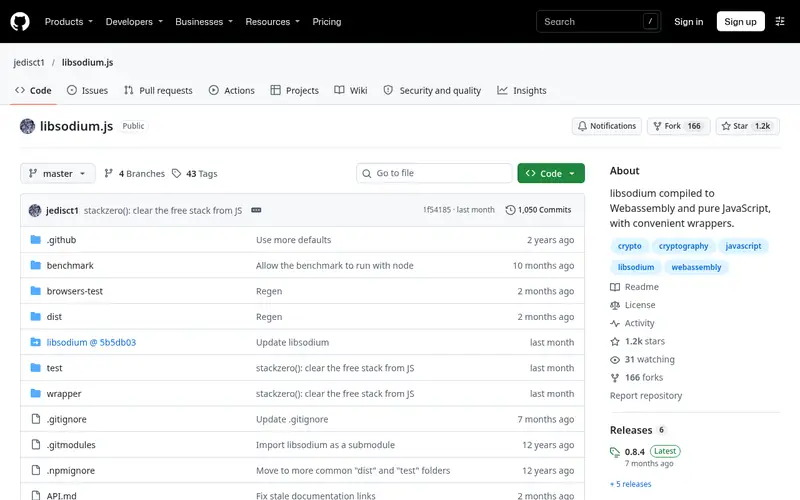
libsodium.js is a JavaScript and WebAssembly port of libsodium, the widely used C library. It offers a high-level API (secretbox, box, sealed box, sign, password hashing with Argon2) plus lower-level primitives. It runs in browsers and Node and keeps all operations on the device. The library is maintained and open source under the ISC license.
The tradeoff is bundle size. The WebAssembly build is larger than a thin wrapper, and the asm.js fallback is larger still. The API also differs from Web Crypto, so you cannot swap them without code changes. It suits applications that want misuse-resistant defaults and algorithms the platform API lacks. Skip it for tiny scripts where the platform API already covers your needs.
Standout: High-level API with safe defaults
Free (open source), as listed by the vendor (libsodium.js website). Confirm the current plan price before you buy.
Free plan. Plans change, so confirm on the vendor's pricing page before you buy.
Benefits
- High-level API with safe defaults
- broad algorithm set including Argon2 and XChaCha20
Drawbacks
- Wasm or asm.js bundle adds size
- API differs from Web Crypto
Skip it if this limit matters to you: wasm or asm.js bundle adds size.
Verdict. A sensible pick for teams that want one high-level crypto API in browser and Node.
Alternatives in this guide: Web Crypto API, @noble/curves, @noble/ciphers
@noble/curves
Best for pure JavaScript elliptic-curve crypto with no native build step
What it is and where it fits
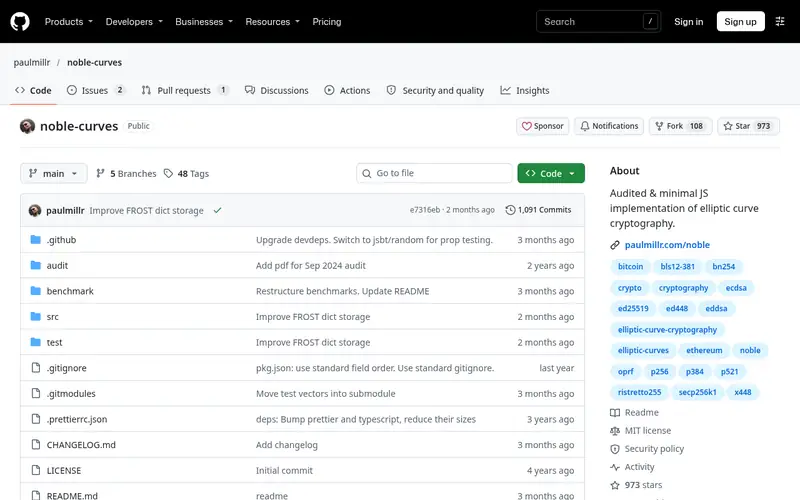
@noble/curves is a pure JavaScript implementation of elliptic-curve cryptography, including secp256k1, P-256, ed25519 and x25519. It has no native dependencies, so it runs in browsers, Node, Deno and workers without a build step. The project states it has been audited. It is open source under the MIT license and maintained by Paul Miller.
Because it is low-level, you handle key encoding, nonce and message formatting yourself. That gives control but raises the chance of mistakes if you are new to the primitives. It pairs well with @noble/ciphers for symmetric work. It suits wallet, signing and protocol developers who want audited pure JavaScript. Skip it if you want a single high-level API and do not need its specific curves.
Standout: Audited pure JavaScript
Free (open source), as listed by the vendor (@noble/curves website). Confirm the current plan price before you buy.
Free plan. Plans change, so confirm on the vendor's pricing page before you buy.
Benefits
- Audited pure JavaScript
- works in browsers, Node and workers
- no native build
Drawbacks
- Low-level API
- you assemble the higher-level flow yourself
Skip it if this limit matters to you: low-level API.
Verdict. A sensible pick for pure JavaScript elliptic-curve crypto with no native build step.
Alternatives in this guide: Web Crypto API, libsodium.js, @noble/ciphers
@noble/ciphers
Best for pure JavaScript symmetric encryption and AEAD in any runtime
What it is and where it fits
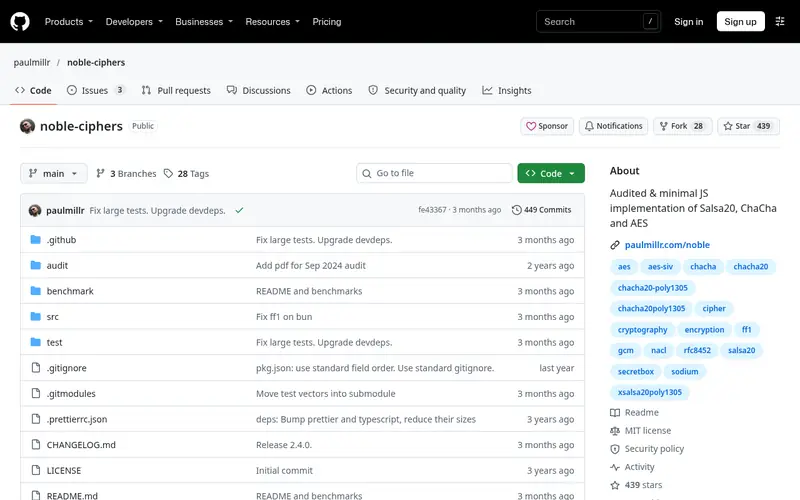
@noble/ciphers provides symmetric ciphers and authenticated encryption in pure JavaScript. It covers AES-GCM, AES-CBC, ChaCha20-Poly1305, XChaCha20-Poly1305 and Salsa20. Like @noble/curves it has no native dependencies and runs in browsers, Node and workers. It is open source under the MIT license and the project states it has been audited.
The library gives you the cipher, not the full scheme. You choose nonces, manage keys and handle associated data. That is fine for experienced developers and risky for newcomers. It is often used alongside @noble/curves for a complete pure JavaScript stack. It suits teams that need XChaCha20 or want to avoid native modules. Skip it if the Web Crypto API already covers your algorithms and you prefer the platform.
Standout: Audited pure JavaScript
Free (open source), as listed by the vendor (@noble/ciphers website). Confirm the current plan price before you buy.
Free plan. Plans change, so confirm on the vendor's pricing page before you buy.
Benefits
- Audited pure JavaScript
- AES-GCM, ChaCha20-Poly1305 and more
- no native build
Drawbacks
- Low-level API
- no key management or storage helpers
Skip it if this limit matters to you: low-level API.
Verdict. A sensible pick for pure JavaScript symmetric encryption and AEAD in any runtime.
Alternatives in this guide: Web Crypto API, libsodium.js, @noble/curves
TweetNaCl.js
Best for small, audited NaCl-style crypto in browser and Node
What it is and where it fits
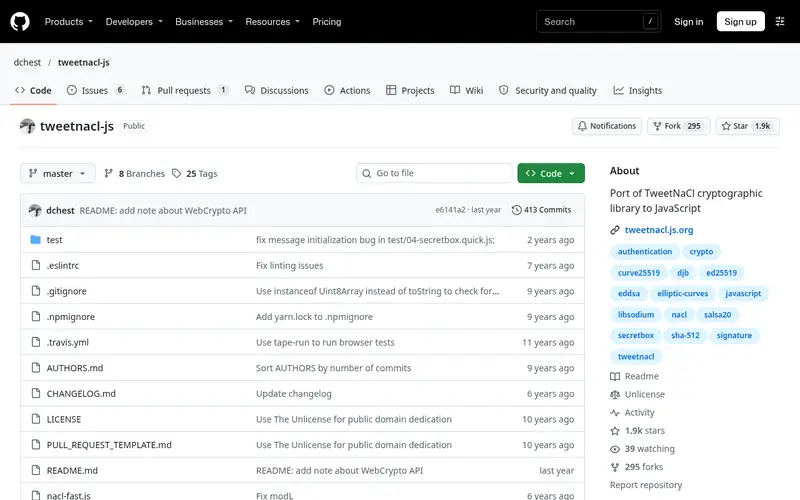
TweetNaCl.js is a JavaScript port of TweetNaCl, a compact implementation of the NaCl crypto library. It provides secretbox, box, sign and scalar multiplication, plus hashing. It runs in browsers and Node and keeps operations on the device. The codebase is small, which makes it easier to review, and it is open source under the Unlicense.
The algorithm set is narrow compared with libsodium.js. It does not include Argon2 or the wider set of modern AEAD options. Pure JavaScript is also slower than native or WebAssembly builds for large inputs. It suits projects that want a small, familiar NaCl API and can work within its primitives. Skip it if you need password hashing or newer ciphers.
Standout: Small codebase
Free (open source), as listed by the vendor (TweetNaCl.js website). Confirm the current plan price before you buy.
Free plan. Plans change, so confirm on the vendor's pricing page before you buy.
Benefits
- Small codebase
- well-known NaCl API
- runs locally in browser and Node
Drawbacks
- Narrow algorithm set
- slower than native or Wasm builds
Skip it if this limit matters to you: narrow algorithm set.
Verdict. A sensible pick for small, audited NaCl-style crypto in browser and Node.
Alternatives in this guide: Web Crypto API, libsodium.js, @noble/curves
node-forge
Best for pure JavaScript TLS, X.509 and PKI work in Node and browser
What it is and where it fits
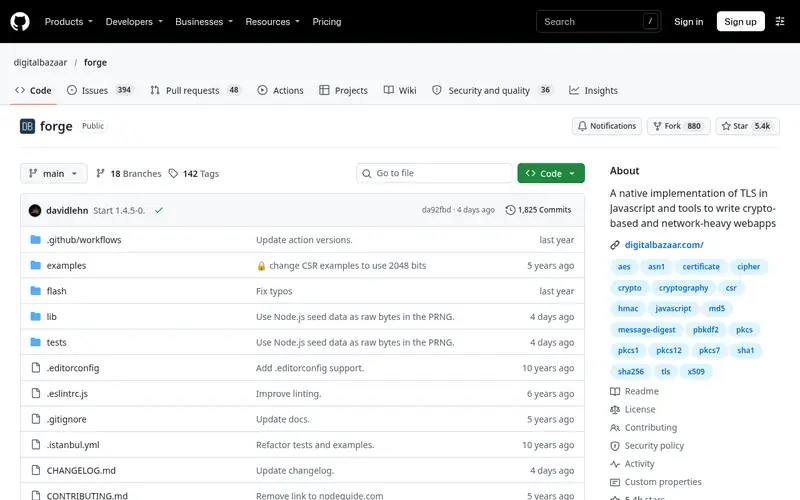
node-forge is a pure JavaScript implementation of TLS and various crypto tools. It is best known for X.509 certificate parsing and generation, PKI helpers and TLS in JavaScript. It also provides RSA, AES, SHA and related primitives. It runs in Node and browsers and is open source under a BSD-style license.
Its strength is certificate and PKI work, where few JavaScript libraries compete. For general encryption it is not the first choice: the API is large and older in style, and some primitives have been superseded by the Web Crypto API and newer libraries. It suits teams that must parse or build certificates in JavaScript. Skip it for new application-level encryption where a focused library fits better.
Standout: X.509, PKI and TLS helpers
Free (open source), as listed by the vendor (node-forge website). Confirm the current plan price before you buy.
Free plan. Plans change, so confirm on the vendor's pricing page before you buy.
Benefits
- X.509, PKI and TLS helpers
- pure JavaScript
- runs in Node and browser
Drawbacks
- Large API surface
- not a general high-level crypto recommendation
Skip it if this limit matters to you: large API surface.
Verdict. A sensible pick for pure JavaScript TLS, X.509 and PKI work in Node and browser.
Alternatives in this guide: Web Crypto API, libsodium.js, @noble/curves
jose
Best for jWT, JWS, JWE and JWK handling in Node and browser
What it is and where it fits
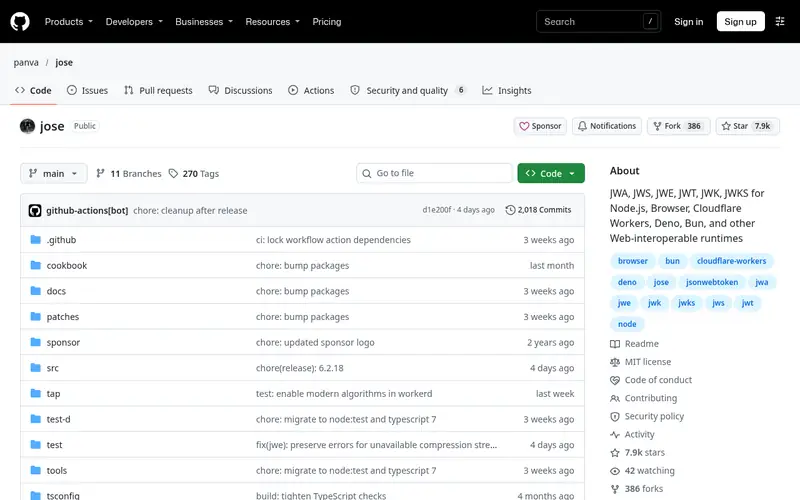
jose is a JavaScript implementation of JOSE: JSON Web Tokens, JSON Web Signature, JSON Web Encryption and JSON Web Keys. It runs in Node, browsers, Deno and workers, and it is open source under the MIT license. It is maintained by Filip Skokan and is widely used for token signing and verification.
It does one job well and does not try to be a general crypto library. If you need AES-GCM for data at rest or elliptic-curve signing outside a token format, use another library. It suits API and identity developers who work with JWT and JWK. Skip it if your problem is not token or key format related.
Standout: Focused JOSE implementation
Free (open source), as listed by the vendor (jose website). Confirm the current plan price before you buy.
Free plan. Plans change, so confirm on the vendor's pricing page before you buy.
Benefits
- Focused JOSE implementation
- works across runtimes
- well-documented
Drawbacks
- Scope is JOSE only
- not a general encryption library
Skip it if this limit matters to you: scope is JOSE only.
Verdict. A sensible pick for JWT, JWS, JWE and JWK handling in Node and browser.
Alternatives in this guide: Web Crypto API, libsodium.js, @noble/curves
Node.js crypto module
Best for server-side Node apps that need native crypto and key management
What it is and where it fits
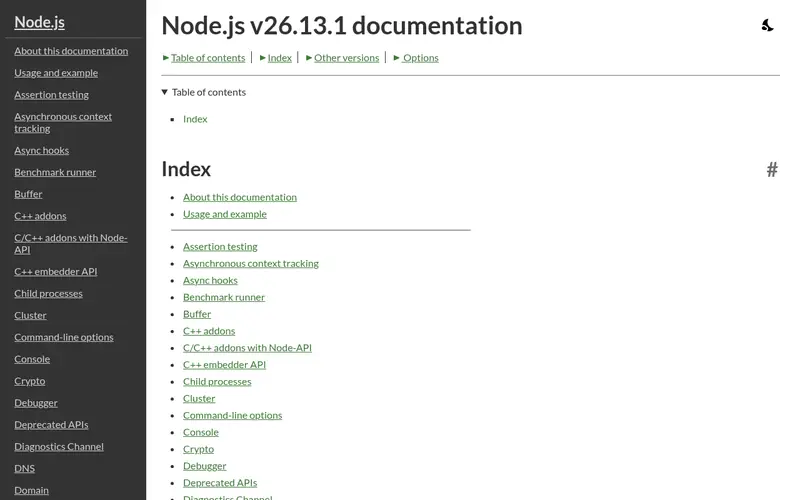
The `node:crypto` module is built into Node.js. It provides hashing, HMAC, ciphers, key generation, key derivation and certificate helpers, backed by the platform's native crypto. It also exposes the Web Crypto API through `webcrypto`. It is free with Node and needs no install.
It is server-side only: browser code cannot use it directly, so shared code needs a browser path. Its API is callback and stream based in places, which differs from Web Crypto. It suits backend services that need native performance and full algorithm coverage. Skip it for code that must run in the browser; use the Web Crypto API there instead.
Standout: Built into Node
Free, as listed by the vendor (Node.js crypto module website). Confirm the current plan price before you buy.
Free plan. Plans change, so confirm on the vendor's pricing page before you buy.
Benefits
- Built into Node
- native performance
- broad algorithm coverage
Drawbacks
- Node only
- not available in browsers
Skip it if this limit matters to you: node only.
Verdict. A sensible pick for server-side Node apps that need native crypto and key management.
Alternatives in this guide: Web Crypto API, libsodium.js, @noble/curves
Who should use what
Browser apps that need standard crypto should start with the Web Crypto API and add a thin wrapper if the API feels verbose. Teams that want one high-level API across browser and Node, with Argon2 and XChaCha20, should use libsodium.js. Wallet, signing and protocol developers who want audited pure JavaScript should use @noble/curves with @noble/ciphers. API and identity teams working with JWT and JWK should use jose. Backend services that need native performance should use the Node.js crypto module.
Questions to settle before you buy
What to check before you buy
- Confirm the library supports the exact algorithms you need, not just the category.
- Check that it runs where your code runs: browser, Node, workers or edge runtimes.
- Read the licence and confirm it fits your distribution model.
- Check whether the project is maintained and whether it states an audit.
- For browser tools, confirm operations run locally and no plaintext or keys are sent to a server.
- Never paste production keys or secrets into third-party web pages; use local or offline tools.
FAQ
Is the Web Crypto API enough for most projects?
For standard hashing, AES-GCM, RSA and ECDSA, yes. It is built in, runs locally and needs no dependency. It lacks some newer algorithms such as Argon2 and XChaCha20-Poly1305, so projects that need those should add a library like libsodium.js or @noble/ciphers.
Is crypto-js still recommended?
No. The crypto-js project is discontinued, so it should not be used for new work. Use the Web Crypto API, libsodium.js, @noble or another maintained library instead, and check the project repository for maintenance status before adopting any crypto package.
Can I use these libraries in both browser and Node?
The Web Crypto API, libsodium.js, TweetNaCl.js, @noble/curves, @noble/ciphers, node-forge and jose run in both browser and Node. The Node.js crypto module is Node only. Test on your target runtimes because algorithm support can differ between browsers and Node versions.
Are these libraries safe for handling secrets in the browser?
The libraries themselves run locally, but safety depends on your code. Do not paste production keys or secrets into third-party web pages. Prefer tools that run locally in the browser or offline, and keep keys out of client code where possible.
Do I need a paid licence for any of these?
No. All the libraries listed here are free or free and open source. Some are platform APIs that ship with the runtime. Check each project's licence terms if you redistribute code, since licences differ between projects.
Sources we checked
Method: how we score · editorial policy.
Change log. First published 27 Nov 2026.