Stage 02 · Test · Researched comparison
Best Java Validation Libraries in 2026
Hibernate Validator is the first pick for most teams because it is the reference implementation of Jakarta Bean Validation and works with any Java framework. Choose the Jakarta Bean Validation API if you only need the standard annotations and want a portable contract. Spring Validation suits projects already built on Spring, and YAVI fits code that prefers a fluent, programmatic API over annotations.

By Shihab Mia
Published 27 Nov 2026 · 6 tools compared
We run no ads and no affiliate links at launch. The order of a list follows our published method. See how we score.
Prices are the starting prices vendors list publicly. Plans change, so confirm the current price on the vendor page before you buy.
Key takeaways
- Hibernate Validator is the reference implementation of Jakarta Bean Validation and is free and open source.
- The Jakarta Bean Validation API is a specification, so it needs a runtime provider such as Hibernate Validator or Apache BVal.
- Spring Validation builds on Bean Validation and adds method validation inside the Spring Framework.
- YAVI offers a fluent, annotation-free API and is free and open source.
Who each pick is for
- Teams that want the standard Bean Validation implementationHibernate Validator
- Projects that need a portable validation contractJakarta Bean Validation API
- Teams that want an alternative Bean Validation providerApache BVal
- Spring applications that need method and bean validationSpring Validation
- Developers who prefer a fluent, annotation-free validation APIYAVI
- Simple field checks such as emails and URLsApache Commons Validator
Comparison
| Tool | Best for | Standout feature | Listed starting price | Free plan or trial |
|---|---|---|---|---|
| 1Hibernate Validator | Teams that want the standard Bean Validation implementation | Reference implementation of Jakarta Bean Validation | Free (open source) | Free plan |
| 2Jakarta Bean Validation API | Projects that need a portable validation contract | Standard specification with a stable annotation set | Free (open source) | Free plan |
| 3Apache BVal | Teams that want an alternative Bean Validation provider | Apache-hosted implementation of the Bean Validation API | Free (open source) | Free plan |
| 4Spring Validation | Spring applications that need method and bean validation | Integrates Bean Validation into Spring beans and controllers | Free (open source) | Free plan |
| 5YAVI | Developers who prefer a fluent, annotation-free validation API | Fluent programmatic API without annotations | Free (open source) | Free plan |
| 6Apache Commons Validator | Simple field checks such as emails and URLs | Lightweight helpers for common field formats | Free (open source) | Free plan |
How we picked
We picked libraries that genuinely perform Java validation and are currently maintained. Criteria were fit for the job, supported platforms, licence and price, and main limits. Sources are vendor pages, official documentation and project repositories. All listed projects are free and open source. Prices and versions change, so confirm details on the vendor or project site before you commit.
The tools, one by one
Hibernate Validator
Best for teams that want the standard Bean Validation implementation
What it is and where it fits
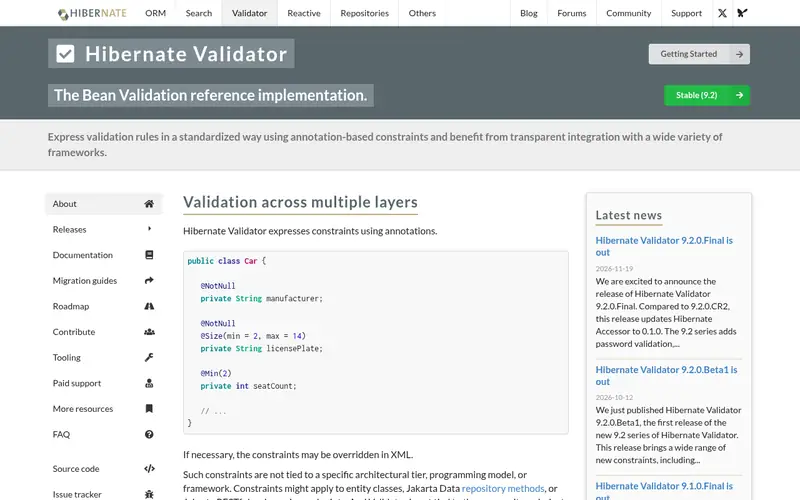
Hibernate Validator is the reference implementation of Jakarta Bean Validation. It provides the standard constraint annotations such as @NotNull, @Size and @Email, plus extra constraints and support for writing custom validators. It runs on any Java application and integrates with frameworks that consume Bean Validation.
The project is open source under the Apache License 2.0. You add it as a dependency and use it directly or through a framework. Version alignment matters: the library tracks the Jakarta Bean Validation specification, so check which spec version your stack expects. Teams that want validation without annotations should look at YAVI instead.
Standout: Reference implementation of Jakarta Bean Validation
Free (open source), as listed by the vendor (Hibernate Validator website). Confirm the current plan price before you buy.
Free plan. Plans change, so confirm on the vendor's pricing page before you buy.
Benefits
- Reference implementation of Jakarta Bean Validation
- broad constraint set and custom constraint support
Drawbacks
- Annotation model can feel indirect for simple checks
- tied to the Bean Validation version it implements
Skip it if this limit matters to you: annotation model can feel indirect for simple checks.
Verdict. A sensible pick for teams that want the standard Bean Validation implementation.
Alternatives in this guide: Jakarta Bean Validation API, Apache BVal, Spring Validation
Jakarta Bean Validation API
Best for projects that need a portable validation contract
What it is and where it fits
Jakarta Bean Validation is the specification that defines the annotation set and the Validator API used across Java frameworks. It is not a runtime by itself. You depend on the API for compilation and add a provider such as Hibernate Validator or Apache BVal to execute validation.
The specification is developed in the open and is free to use. It is the right choice when you want your code to depend on the standard contract rather than a specific vendor. Because it defines behavior rather than implementing it, you still need to pick and configure a provider. Teams that want a single dependency with everything included should start with Hibernate Validator.
Standout: Standard specification with a stable annotation set
Free (open source), as listed by the vendor (Jakarta Bean Validation API website). Confirm the current plan price before you buy.
Free plan. Plans change, so confirm on the vendor's pricing page before you buy.
Benefits
- Standard specification with a stable annotation set
- portable across providers
Drawbacks
- Specification only, so it needs a runtime provider
- no built-in implementation
Skip it if this limit matters to you: specification only, so it needs a runtime provider.
Verdict. A sensible pick for projects that need a portable validation contract.
Alternatives in this guide: Hibernate Validator, Apache BVal, Spring Validation
Apache BVal
Best for teams that want an alternative Bean Validation provider
What it is and where it fits
Apache BVal is an implementation of the Jakarta Bean Validation specification maintained by the Apache Software Foundation. It provides the standard constraints and the Validator API, so it can serve as a provider wherever your code targets Bean Validation.
The project is open source under the Apache License 2.0. It is a reasonable choice if your organization standardizes on Apache projects or you want a second provider for comparison. The feature set follows the specification, so expect fewer extras than Hibernate Validator. Check the supported specification version before adopting it in a new project.
Standout: Apache-hosted implementation of the Bean Validation API
Free (open source), as listed by the vendor (Apache BVal website). Confirm the current plan price before you buy.
Free plan. Plans change, so confirm on the vendor's pricing page before you buy.
Benefits
- Apache-hosted implementation of the Bean Validation API
- usable as a drop-in provider
Drawbacks
- Smaller community than Hibernate Validator
- fewer extensions beyond the specification
Skip it if this limit matters to you: smaller community than Hibernate Validator.
Verdict. A sensible pick for teams that want an alternative Bean Validation provider.
Alternatives in this guide: Hibernate Validator, Jakarta Bean Validation API, Spring Validation
Spring Validation
Best for spring applications that need method and bean validation
What it is and where it fits
Spring Validation is part of the Spring Framework. It wires a Bean Validation provider into Spring beans, supports validating method arguments and return values, and integrates with Spring MVC for request validation. You still need a provider such as Hibernate Validator on the classpath.
The Spring Framework is open source under the Apache License 2.0. Spring Validation is not a standalone validator; it is the integration layer. That makes it a poor fit for non-Spring code. For teams already on Spring, it removes boilerplate and keeps validation close to the framework's programming model.
Standout: Integrates Bean Validation into Spring beans and controllers
Free (open source), as listed by the vendor (Spring Validation website). Confirm the current plan price before you buy.
Free plan. Plans change, so confirm on the vendor's pricing page before you buy.
Benefits
- Integrates Bean Validation into Spring beans and controllers
- supports method validation
Drawbacks
- Only useful inside Spring applications
- adds framework coupling
Skip it if this limit matters to you: only useful inside Spring applications.
Verdict. A sensible pick for spring applications that need method and bean validation.
Alternatives in this guide: Hibernate Validator, Jakarta Bean Validation API, Apache BVal
YAVI
Best for developers who prefer a fluent, annotation-free validation API
What it is and where it fits
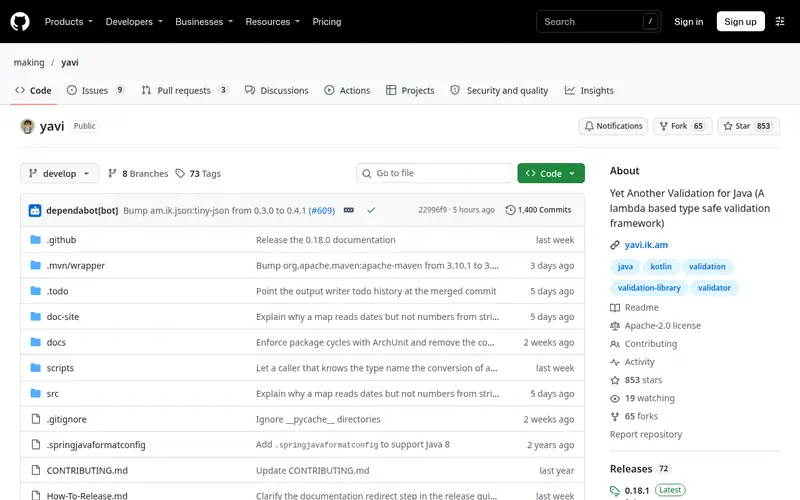
YAVI is a validation library built around a fluent, functional API. You define validators in code rather than with annotations, which suits teams that want validation logic to be explicit and easy to compose. It targets Java and works without a framework.
The project is open source under the Apache License 2.0. Because it does not implement Jakarta Bean Validation, it will not plug into frameworks that expect a Bean Validation provider. It is a good fit for new code where you control the validation design and want to avoid annotation processing. Teams standardized on Bean Validation should stay with Hibernate Validator.
Standout: Fluent programmatic API without annotations
Free (open source), as listed by the vendor (YAVI website). Confirm the current plan price before you buy.
Free plan. Plans change, so confirm on the vendor's pricing page before you buy.
Benefits
- Fluent programmatic API without annotations
- supports composing and reusing validators
Drawbacks
- Not a Bean Validation provider
- smaller ecosystem than the standard stack
Skip it if this limit matters to you: not a Bean Validation provider.
Verdict. A sensible pick for developers who prefer a fluent, annotation-free validation API.
Alternatives in this guide: Hibernate Validator, Jakarta Bean Validation API, Apache BVal
Apache Commons Validator
Best for simple field checks such as emails and URLs
What it is and where it fits
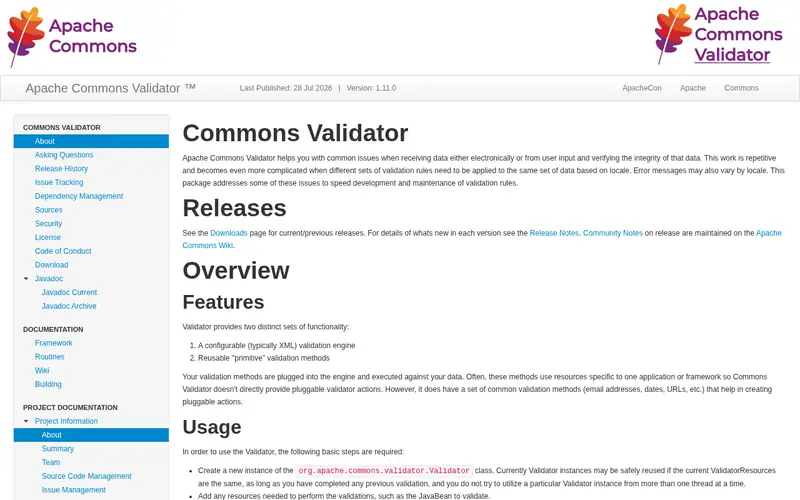
Apache Commons Validator provides reusable routines for common checks such as email addresses, URLs and other field formats. It is a small utility library rather than a bean validation framework, so it does not replace Jakarta Bean Validation for object graphs.
The project is open source under the Apache License 2.0. It fits scripts, small services and legacy code that need a quick format check without adding a full validation stack. For structured validation with constraints, groups and messages, use Hibernate Validator or another Bean Validation provider.
Standout: Lightweight helpers for common field formats
Free (open source), as listed by the vendor (Apache Commons Validator website). Confirm the current plan price before you buy.
Free plan. Plans change, so confirm on the vendor's pricing page before you buy.
Benefits
- Lightweight helpers for common field formats
- no framework required
Drawbacks
- Not a bean validation framework
- limited to basic format checks
Skip it if this limit matters to you: not a bean validation framework.
Verdict. A sensible pick for simple field checks such as emails and URLs.
Alternatives in this guide: Hibernate Validator, Jakarta Bean Validation API, Apache BVal
Who should use what
If you are starting a new service and want the standard annotation model, use Hibernate Validator. If you want your code to depend only on the specification, target the Jakarta Bean Validation API and add a provider. If your application is built on Spring, Spring Validation keeps validation close to the framework. If you prefer explicit code over annotations, YAVI is the fit. For quick format checks in small code, Apache Commons Validator is enough.
Questions to settle before you buy
What to check before you buy
- Confirm which Jakarta Bean Validation specification version your stack supports.
- Check that a runtime provider is on the classpath, not just the API.
- Review how validation messages are localized for your users.
- Decide whether you need method validation or only bean validation.
- Check the project's release activity before adopting it for new code.
FAQ
Do I need both the API and an implementation?
Yes. The Jakarta Bean Validation API defines the annotations and interfaces. A provider such as Hibernate Validator or Apache BVal executes the validation at runtime. Depending on only the API compiles but fails at runtime without a provider.
Is Hibernate Validator the same as Hibernate ORM?
No. Hibernate Validator implements Jakarta Bean Validation. Hibernate ORM is a persistence framework. They are separate projects under the same organization and can be used independently.
Can I use Bean Validation outside Spring?
Yes. Hibernate Validator and Apache BVal work in plain Java applications. You create a Validator instance and validate objects directly, with no framework required.
Does YAVI work with Jakarta Bean Validation annotations?
No. YAVI uses its own fluent API and does not implement the Bean Validation specification. If your framework expects a Bean Validation provider, use Hibernate Validator or Apache BVal instead.
Are these libraries free?
Yes. All six projects listed here are open source and free to use. Check each project's licence, which is the Apache License 2.0 for the projects listed, before distributing your application.
Sources we checked
Method: how we score · editorial policy.
Change log. First published 27 Nov 2026.