Stage 02 · Test · Researched comparison
Best Java Mocking Frameworks in 2026
Mockito is the first pick for most teams because it is widely adopted, well documented and works with JUnit and TestNG. EasyMock suits developers who want a strict, record-and-replay model. WireMock is the better choice when you need to mock HTTP services rather than Java objects. All three are open source and free to use.

By Shihab Mia
Published 22 Nov 2026 · 5 tools compared
We run no ads and no affiliate links at launch. The order of a list follows our published method. See how we score.
Prices are the starting prices vendors list publicly. Plans change, so confirm the current price on the vendor page before you buy.
Key takeaways
- Mockito, EasyMock, WireMock, MockServer and Testcontainers are all free and open source.
- Mockito and EasyMock mock Java objects; WireMock and MockServer mock HTTP APIs over the network.
- None of these tools require sending code or data to a third-party web page; they run inside your build.
Who each pick is for
- General-purpose mocking for JUnit and TestNG unit testsMockito
- Teams that prefer a strict record-and-replay mocking styleEasyMock
- Mocking HTTP APIs in integration and contract testsWireMock
- Mocking and proxying HTTP and HTTPS services in testsMockServer
- Running real dependencies in Docker for integration testsTestcontainers
Comparison
| Tool | Best for | Standout feature | Listed starting price | Free plan or trial |
|---|---|---|---|---|
| 1Mockito | General-purpose mocking for JUnit and TestNG unit tests | Large API and wide documentation | Free (open source) | Free plan |
| 2EasyMock | Teams that prefer a strict record-and-replay mocking style | Clear record-and-replay model | Free (open source) | Free plan |
| 3WireMock | Mocking HTTP APIs in integration and contract tests | Mocks HTTP services with request matching and response stubs | Free (open source) | Free plan |
| 4MockServer | Mocking and proxying HTTP and HTTPS services in tests | Supports mocking and proxying | Free (open source) | Free plan |
| 5Testcontainers | Running real dependencies in Docker for integration tests | Uses real databases and services instead of mocks | Free (open source) | Free plan |
How we picked
We picked projects that are currently maintained and genuinely used for Java mocking or test doubles. Criteria were fit for the job, supported platforms and build tools, license and price, and the main practical limits such as Java agent requirements or Docker dependencies. Sources are vendor pages, official documentation and project repositories. Prices and licenses can change, so confirm details on the vendor site before you commit.
The tools, one by one
Mockito
Best for general-purpose mocking for JUnit and TestNG unit tests
What it is and where it fits
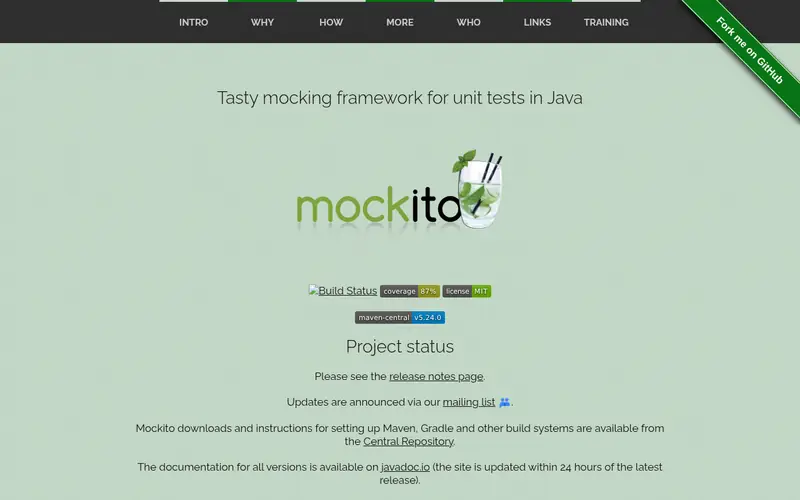
Mockito creates test doubles for interfaces and classes and verifies interactions. It runs on the JVM and works with Maven, Gradle and most IDEs. The project is open source under the MIT license. Mockito supports argument matchers, captors, spies and stubbing of default methods. Static and final mocking is available through the inline mock maker, which is included in recent versions.
Mockito does not mock constructors or static initializers in the same way some other tools do, so code that depends heavily on those patterns may need another tool. It is the default choice for most Spring and plain Java projects. Teams that need strict ordering should look at EasyMock or use Mockito's InOrder verification.
Standout: Large API and wide documentation
Free (open source), as listed by the vendor (Mockito website). Confirm the current plan price before you buy.
Free plan. Plans change, so confirm on the vendor's pricing page before you buy.
Benefits
- Large API and wide documentation
- integrates with JUnit 5, JUnit 4 and TestNG
Drawbacks
- Cannot mock static methods or constructors without the separate mockito-inline setup
- strict stubs can surprise beginners
Skip it if this limit matters to you: cannot mock static methods or constructors without the separate mockito-inline setup.
Verdict. A sensible pick for general-purpose mocking for JUnit and TestNG unit tests.
Alternatives in this guide: EasyMock, WireMock, MockServer
EasyMock
Best for teams that prefer a strict record-and-replay mocking style
What it is and where it fits
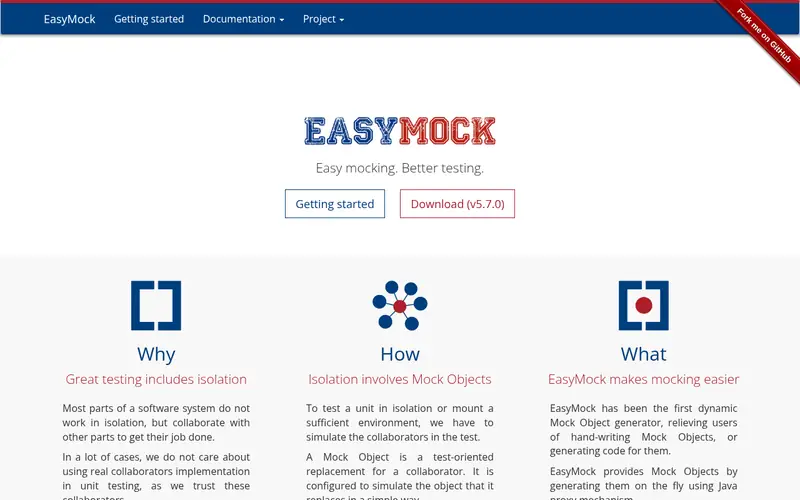
EasyMock uses a record-and-replay approach: you record expected calls, switch to replay mode, then verify. It runs on the JVM and integrates with JUnit and TestNG through extensions. The library is open source under the Apache License 2.0. It supports mocking interfaces and classes, partial mocks and argument matchers.
EasyMock is a good fit for developers who want explicit expectations and fail-fast behavior. It has fewer integrations than Mockito and less community content, so onboarding new team members may take longer. Projects that already use Mockito rarely switch to EasyMock.
Standout: Clear record-and-replay model
Free (open source), as listed by the vendor (EasyMock website). Confirm the current plan price before you buy.
Free plan. Plans change, so confirm on the vendor's pricing page before you buy.
Benefits
- Clear record-and-replay model
- strict and nice mock modes
Drawbacks
- Smaller community than Mockito
- less material for newer Java versions
Skip it if this limit matters to you: smaller community than Mockito.
Verdict. A sensible pick for teams that prefer a strict record-and-replay mocking style.
Alternatives in this guide: Mockito, WireMock, MockServer
WireMock
Best for mocking HTTP APIs in integration and contract tests
What it is and where it fits
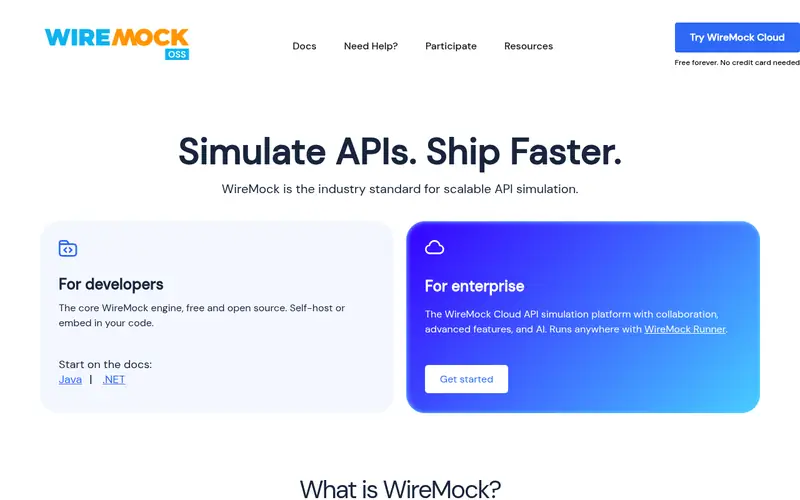
WireMock mocks HTTP APIs by matching requests and returning stubbed responses. It runs as a standalone server, as a JUnit rule or embedded in a Java test. The core project is open source under the Apache License 2.0. It supports request matching, response templating, delays and fault injection.
WireMock is not an object mocking framework, so it complements Mockito rather than replacing it. The project also offers a hosted cloud service with separate pricing; check the vendor pricing page for that product. Teams testing microservices and third-party API clients get the most value from it.
Standout: Mocks HTTP services with request matching and response stubs
Free (open source), as listed by the vendor (WireMock website). Confirm the current plan price before you buy.
Free plan. Plans change, so confirm on the vendor's pricing page before you buy.
Benefits
- Mocks HTTP services with request matching and response stubs
- can run standalone or embedded
Drawbacks
- Not a replacement for object mocking
- the hosted cloud product is separate and paid
Skip it if this limit matters to you: not a replacement for object mocking.
Verdict. A sensible pick for mocking HTTP APIs in integration and contract tests.
Alternatives in this guide: Mockito, EasyMock, MockServer
MockServer
Best for mocking and proxying HTTP and HTTPS services in tests
What it is and where it fits
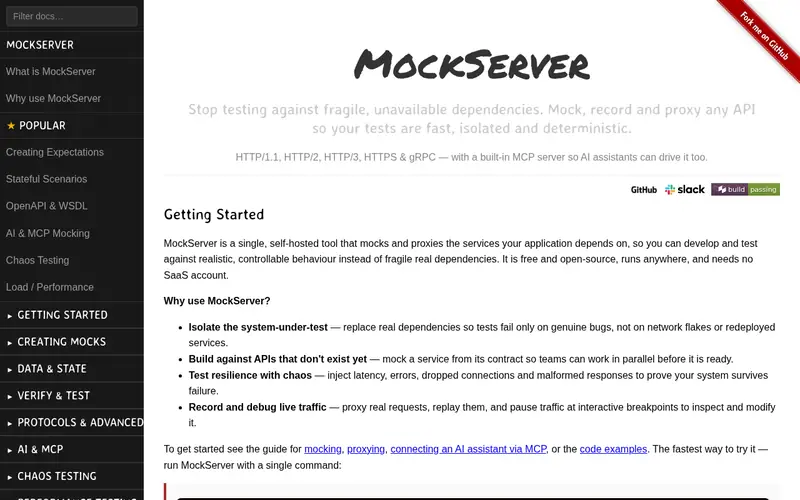
MockServer mocks and proxies HTTP and HTTPS services. It runs standalone, embedded in Java tests or through a Docker image. The project is open source under the Apache License 2.0. It supports request matching, verification, proxying and recording of live traffic.
MockServer is a good fit when you need both mocking and proxying in one tool. Its configuration can be verbose, and it has fewer Java-specific integrations than WireMock. Teams that only need simple HTTP stubs may find WireMock quicker to set up.
Standout: Supports mocking and proxying
Free (open source), as listed by the vendor (MockServer website). Confirm the current plan price before you buy.
Free plan. Plans change, so confirm on the vendor's pricing page before you buy.
Benefits
- Supports mocking and proxying
- can verify requests and record traffic
Drawbacks
- Configuration can be verbose
- fewer Java-specific integrations than WireMock
Skip it if this limit matters to you: configuration can be verbose.
Verdict. A sensible pick for mocking and proxying HTTP and HTTPS services in tests.
Testcontainers
Best for running real dependencies in Docker for integration tests
What it is and where it fits
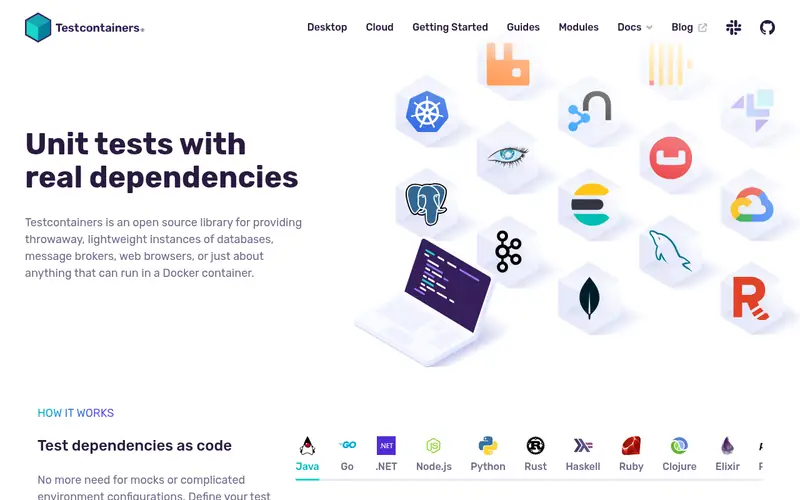
Testcontainers runs real dependencies such as databases, message brokers and HTTP services in Docker containers during tests. It is not a mocking framework in the classic sense, but it is a common alternative when mocks would hide integration problems. The core project is open source under the MIT license and works with JUnit, Maven and Gradle.
Testcontainers requires a Docker-compatible runtime, which adds setup and startup time. It is slower than in-process mocks and is best used for integration tests rather than unit tests. Teams that need realistic database behavior often pair it with Mockito for the rest of the test.
Standout: Uses real databases and services instead of mocks
Free (open source), as listed by the vendor (Testcontainers website). Confirm the current plan price before you buy.
Free plan. Plans change, so confirm on the vendor's pricing page before you buy.
Benefits
- Uses real databases and services instead of mocks
- works with JUnit and most JVM build tools
Drawbacks
- Requires Docker
- slower than in-process mocks
Skip it if this limit matters to you: requires Docker.
Verdict. A sensible pick for running real dependencies in Docker for integration tests.
Who should use what
Most teams writing unit tests should start with Mockito. If you prefer explicit record-and-replay expectations, use EasyMock. For HTTP APIs, use WireMock or MockServer alongside your object mocking framework. If mocks would hide real integration problems, run the actual dependency with Testcontainers.
Questions to settle before you buy
What to check before you buy
- Confirm the framework supports your JDK version and JUnit or TestNG version.
- Check whether you need static, constructor or final class mocking, and whether the tool supports it.
- Verify the license fits your organization's policy.
- Test the build setup, including any Java agent or custom runner, in a small branch first.
- Decide whether you need object mocking, HTTP mocking or real dependencies, and pick tools per layer.
FAQ
Is Mockito free to use?
Yes. Mockito is open source under the MIT license and free to use in commercial and open-source projects.
Can Mockito mock static methods?
Recent Mockito versions include the inline mock maker, which supports static and final mocking. Older setups may need extra configuration, so check the documentation for your version.
What is the difference between Mockito and WireMock?
Mockito mocks Java objects inside a test. WireMock mocks HTTP services over the network. They solve different problems and are often used together.
When should I use Testcontainers instead of a mocking framework?
Use Testcontainers when mocks would hide real integration problems, such as database behavior or network protocols. It runs the actual dependency in Docker, which is slower than in-process mocks, so it fits integration tests rather than unit tests.
Do these tools send my code to a third party?
No. These frameworks run inside your build and test process. They do not require pasting code or data into a third-party web page.
Sources we checked
Method: how we score · editorial policy.
Change log. First published 22 Nov 2026.