Stage 02 · Test · Researched comparison
Best Java HTTP Clients in 2026
The JDK's built-in java.net.http.HttpClient is the first pick for most teams because it ships with Java 11 and later and needs no extra dependency. OkHttp suits Android apps and projects that want HTTP/2 and connection pooling out of the box. Apache HttpClient 5 fits enterprise code that needs fine-grained connection and retry control. All three are free and open source.

By Shihab Mia
Published 27 Nov 2026 · 8 tools compared
We run no ads and no affiliate links at launch. The order of a list follows our published method. See how we score.
Prices are the starting prices vendors list publicly. Plans change, so confirm the current price on the vendor page before you buy.
Key takeaways
- The JDK HttpClient is free, built into Java 11+, and covers HTTP/1.1, HTTP/2 and WebSocket without adding a dependency.
- OkHttp and Apache HttpClient 5 are free open-source libraries with different strengths: OkHttp for Android and HTTP/2, Apache for connection control.
- Retrofit and Feign are declarative wrappers that build on other clients, so they add a layer rather than replace the transport.
- All the clients here run locally in your JVM, so no request data leaves your machine through a third-party web page.
Who each pick is for
- Teams on Java 11+ that want no extra dependencyJDK HttpClient (java.net.http)
- Android apps and JVM services needing HTTP/2 and poolingOkHttp
- Enterprise code needing connection and retry controlApache HttpClient 5
- Android and JVM apps calling typed REST APIsRetrofit
- Spring and microservice teams wanting declarative clientsOpenFeign
- JVM apps needing high-concurrency async HTTPAsyncHttpClient
- Projects already using Jetty or needing async HTTP/2Jetty HttpClient
- Spring applications wanting a modern synchronous clientSpring RestClient
Comparison
| Tool | Best for | Standout feature | Listed starting price | Free plan or trial |
|---|---|---|---|---|
| 1JDK HttpClient (java.net.http) | Teams on Java 11+ that want no extra dependency | Ships with the JDK | Free (open source) | Free plan |
| 2OkHttp | Android apps and JVM services needing HTTP/2 and pooling | Connection pooling and HTTP/2 by default | Free (open source) | Free plan |
| 3Apache HttpClient 5 | Enterprise code needing connection and retry control | Detailed connection management | Free (open source) | Free plan |
| 4Retrofit | Android and JVM apps calling typed REST APIs | Declarative API interfaces | Free (open source) | Free plan |
| 5OpenFeign | Spring and microservice teams wanting declarative clients | Declarative interfaces | Free (open source) | Free plan |
| 6AsyncHttpClient | JVM apps needing high-concurrency async HTTP | Non-blocking API built on Netty | Free (open source) | Free plan |
| 7Jetty HttpClient | Projects already using Jetty or needing async HTTP/2 | Async and HTTP/2 support | Free (open source) | Free plan |
| 8Spring RestClient | Spring applications wanting a modern synchronous client | Fluent API in Spring Framework 6.1+ | Free (open source) | Free plan |
How we picked
We picked clients that are maintained, documented and genuinely used for HTTP calls in Java. Criteria were fit for the job, platform support (JVM and Android), price and licence, whether requests run locally rather than through a third-party web page, and the main limits of each. Sources are vendor pages, official documentation and project repositories. Prices and licences can change, so confirm details on the vendor or project site before you commit.
The tools, one by one
JDK HttpClient (java.net.http)
Best for teams on Java 11+ that want no extra dependency
What it is and where it fits
The JDK HttpClient is part of the standard library from Java 11 onward. It handles HTTP/1.1 and HTTP/2, supports synchronous and asynchronous calls through CompletableFuture, and includes a WebSocket client. You configure it with a builder for timeouts, redirects, proxies and an executor.
Because it is in the JDK, there is nothing to add to your build file and no version to track separately from your Java runtime. The trade-off is a lower-level API: you build requests and read responses yourself, and features like automatic retries or JSON binding are not included. Teams that want a small dependency footprint and standard-library stability should start here.
Standout: Ships with the JDK
Free (open source), as listed by the vendor (JDK HttpClient (java.net.http) website). Confirm the current plan price before you buy.
Free plan. Plans change, so confirm on the vendor's pricing page before you buy.
Benefits
- Ships with the JDK
- supports HTTP/1.1, HTTP/2 and WebSocket
Drawbacks
- Synchronous and async APIs need care
- fewer convenience features than some libraries
Skip it if this limit matters to you: synchronous and async APIs need care.
Verdict. A sensible pick for teams on Java 11+ that want no extra dependency.
Alternatives in this guide: OkHttp, Apache HttpClient 5, Retrofit
OkHttp
Best for android apps and JVM services needing HTTP/2 and pooling
What it is and where it fits
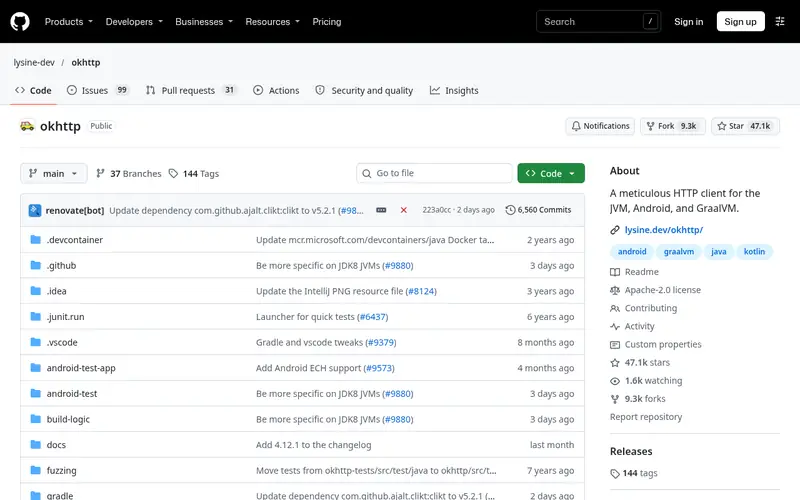
OkHttp is a widely used HTTP client from Square. It supports HTTP/1.1 and HTTP/2, reuses connections through a pool, and handles transparent gzip, caching and interceptors. It runs on the JVM and is the common choice for Android networking. Interceptors let you add logging, auth headers or retry logic in one place.
The library is free under the Apache 2.0 licence. Its API is broader than the JDK client, which means more to learn, and some documentation and defaults lean toward Android. For a JVM backend that wants HTTP/2 without extra setup, OkHttp is a solid pick. Teams that want zero dependencies should skip it and use the JDK client.
Standout: Connection pooling and HTTP/2 by default
Free (open source), as listed by the vendor (OkHttp website). Confirm the current plan price before you buy.
Free plan. Plans change, so confirm on the vendor's pricing page before you buy.
Benefits
- Connection pooling and HTTP/2 by default
- strong Android support
Drawbacks
- API surface is larger
- some features are Android-oriented
Skip it if this limit matters to you: API surface is larger.
Verdict. A sensible pick for android apps and JVM services needing HTTP/2 and pooling.
Alternatives in this guide: JDK HttpClient (java.net.http), Apache HttpClient 5, Retrofit
Apache HttpClient 5
Best for enterprise code needing connection and retry control
What it is and where it fits
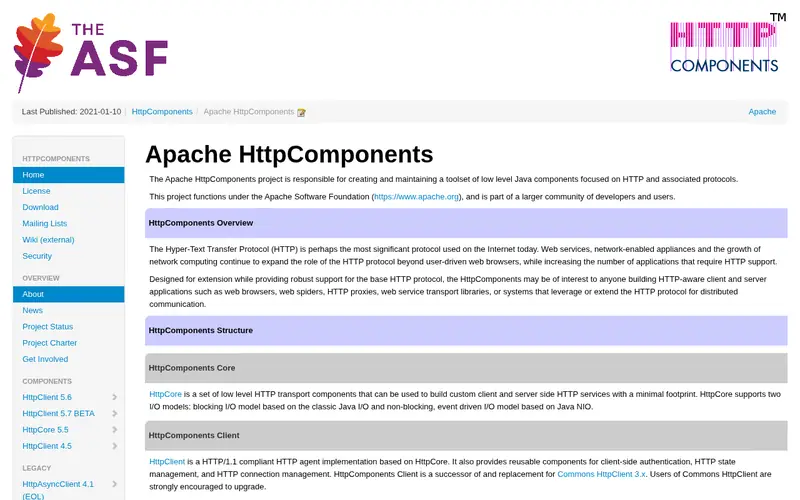
Apache HttpClient 5 is the current line of the long-running Apache HTTP Components client. It gives you control over connection pools, per-route limits, retry handlers, redirects, proxies and timeouts. It supports HTTP/1.1 and HTTP/2 and runs on the JVM.
The library is free under the Apache 2.0 licence. It is a good fit for server-side code that needs precise control over connections and retries, and for projects already using Apache components. The cost is configuration: you write more setup code than with the JDK client or OkHttp. Small scripts and simple services may find it heavier than needed.
Standout: Detailed connection management
Free (open source), as listed by the vendor (Apache HttpClient 5 website). Confirm the current plan price before you buy.
Free plan. Plans change, so confirm on the vendor's pricing page before you buy.
Benefits
- Detailed connection management
- mature and widely deployed
Drawbacks
- More configuration than simpler clients
- older API style
Skip it if this limit matters to you: more configuration than simpler clients.
Verdict. A sensible pick for enterprise code needing connection and retry control.
Alternatives in this guide: JDK HttpClient (java.net.http), OkHttp, Retrofit
Retrofit
Best for android and JVM apps calling typed REST APIs
What it is and where it fits
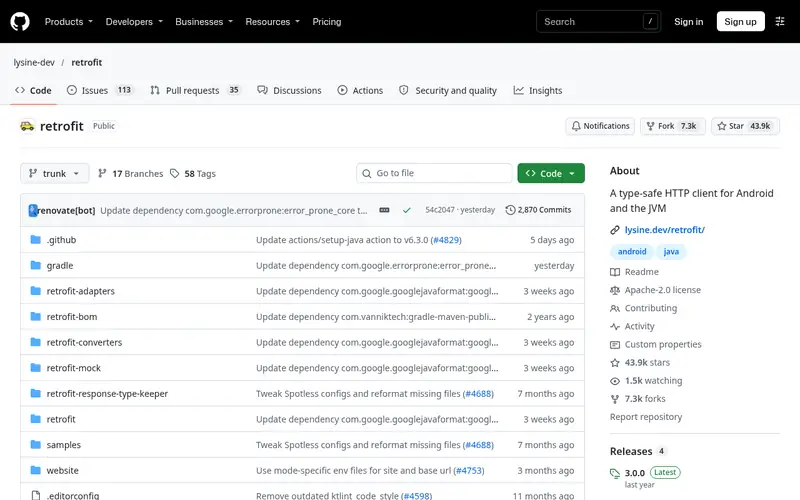
Retrofit turns an HTTP API into a Java or Kotlin interface. You annotate methods with the HTTP verb and path, and Retrofit builds the requests. It runs on Android and the JVM and uses OkHttp as its default transport, with converters for JSON and other formats.
The library is free under the Apache 2.0 licence. It is a wrapper, not a transport, so it does not replace OkHttp or the JDK client. That layering is the point: you get typed calls and less boilerplate. Teams that need full control over raw requests, or that avoid code generation and annotation processing, may prefer a lower-level client.
Standout: Declarative API interfaces
Free (open source), as listed by the vendor (Retrofit website). Confirm the current plan price before you buy.
Free plan. Plans change, so confirm on the vendor's pricing page before you buy.
Benefits
- Declarative API interfaces
- works with OkHttp and converters
Drawbacks
- Adds a layer over the transport
- needs converter setup for JSON
Skip it if this limit matters to you: adds a layer over the transport.
Verdict. A sensible pick for android and JVM apps calling typed REST APIs.
Alternatives in this guide: JDK HttpClient (java.net.http), OkHttp, Apache HttpClient 5
OpenFeign
Best for spring and microservice teams wanting declarative clients
What it is and where it fits
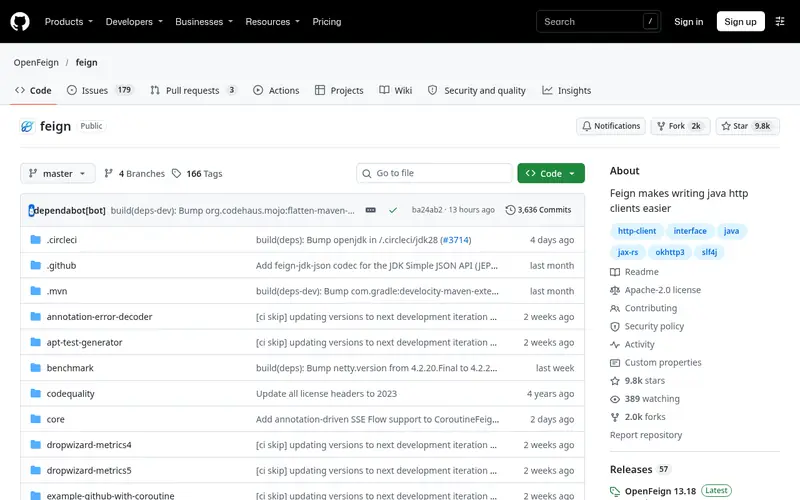
OpenFeign is a declarative HTTP client for Java. You define an interface with annotations, and Feign generates the implementation. It integrates closely with Spring Cloud, where it is a common way to call other services, and it can use different underlying clients.
The project is free under the Apache 2.0 licence. Outside the Spring ecosystem it works but needs more manual wiring. Teams not using Spring, or that want a single small dependency, may find the JDK client or OkHttp simpler. Inside a Spring microservice stack, Feign reduces boilerplate for service-to-service calls.
Standout: Declarative interfaces
Free (open source), as listed by the vendor (OpenFeign website). Confirm the current plan price before you buy.
Free plan. Plans change, so confirm on the vendor's pricing page before you buy.
Benefits
- Declarative interfaces
- integrates with Spring Cloud
Drawbacks
- Best value inside Spring
- extra setup outside it
Skip it if this limit matters to you: best value inside Spring.
Verdict. A sensible pick for spring and microservice teams wanting declarative clients.
Alternatives in this guide: JDK HttpClient (java.net.http), OkHttp, Apache HttpClient 5
AsyncHttpClient
Best for jVM apps needing high-concurrency async HTTP
What it is and where it fits
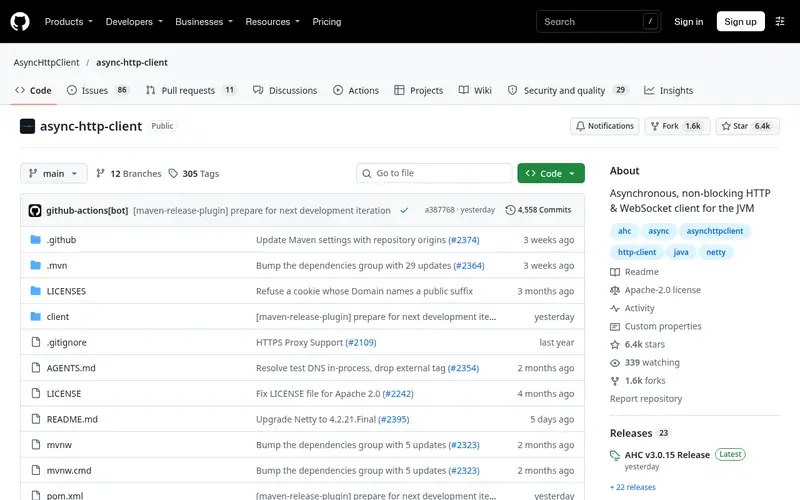
AsyncHttpClient is a non-blocking HTTP client built on Netty. It targets JVM applications that make many concurrent requests and want to avoid blocking threads. It supports HTTP/1.1 and HTTP/2 and offers a callback and Future-based API.
The library is free under the Apache 2.0 licence. It brings Netty as a dependency, which matters if you want a small footprint. Its community is smaller than OkHttp's, so fewer examples and third-party integrations exist. It suits high-throughput services and tools that already use Netty. Simple request-response code is easier with the JDK client.
Standout: Non-blocking API built on Netty
Free (open source), as listed by the vendor (AsyncHttpClient website). Confirm the current plan price before you buy.
Free plan. Plans change, so confirm on the vendor's pricing page before you buy.
Benefits
- Non-blocking API built on Netty
- good for many concurrent calls
Drawbacks
- Netty dependency
- smaller community than OkHttp
Skip it if this limit matters to you: netty dependency.
Verdict. A sensible pick for JVM apps needing high-concurrency async HTTP.
Alternatives in this guide: JDK HttpClient (java.net.http), OkHttp, Apache HttpClient 5
Jetty HttpClient
Best for projects already using Jetty or needing async HTTP/2
What it is and where it fits
Jetty's HttpClient is part of the Eclipse Jetty project. It offers asynchronous and synchronous requests, HTTP/2 and WebSocket support, and connection pooling. It runs on the JVM and is a natural fit if your server or tooling already uses Jetty.
The client is free under the Apache 2.0 and Eclipse Public Licences. It is less commonly chosen as a standalone client than OkHttp or Apache HttpClient, so examples are fewer. Teams outside the Jetty ecosystem may prefer a client with broader documentation. Inside a Jetty stack, reusing the same project reduces dependency sprawl.
Standout: Async and HTTP/2 support
Free (open source), as listed by the vendor (Jetty HttpClient website). Confirm the current plan price before you buy.
Free plan. Plans change, so confirm on the vendor's pricing page before you buy.
Benefits
- Async and HTTP/2 support
- fits Jetty-based stacks
Drawbacks
- Tied to Jetty ecosystem
- more setup than the JDK client
Skip it if this limit matters to you: tied to Jetty ecosystem.
Verdict. A sensible pick for projects already using Jetty or needing async HTTP/2.
Alternatives in this guide: JDK HttpClient (java.net.http), OkHttp, Apache HttpClient 5
Spring RestClient
Best for spring applications wanting a modern synchronous client
What it is and where it fits
Spring RestClient is a synchronous HTTP client introduced in Spring Framework 6.1. It offers a fluent API, works with Spring's message converters, and can sit on top of different underlying clients. It is the modern replacement path for RestTemplate in Spring applications.
The client is free under the Apache 2.0 licence. It only makes sense inside a Spring application; outside Spring, use the JDK client or OkHttp. Teams on older Spring versions should check which client their version supports. For new Spring code, RestClient gives a consistent API without extra dependencies beyond Spring itself.
Standout: Fluent API in Spring Framework 6.1+
Free (open source), as listed by the vendor (Spring RestClient website). Confirm the current plan price before you buy.
Free plan. Plans change, so confirm on the vendor's pricing page before you buy.
Benefits
- Fluent API in Spring Framework 6.1+
- integrates with Spring converters
Drawbacks
- Requires Spring
- newer than older RestTemplate code
Skip it if this limit matters to you: requires Spring.
Verdict. A sensible pick for spring applications wanting a modern synchronous client.
Alternatives in this guide: JDK HttpClient (java.net.http), OkHttp, Apache HttpClient 5
Who should use what
If you are on Java 11 or later and want no extra dependency, start with the JDK HttpClient. If you build Android apps or want HTTP/2 and connection pooling with minimal setup, use OkHttp. If you need precise control over connection pools and retries in server-side code, Apache HttpClient 5 fits. If you call typed REST APIs from Android or the JVM, Retrofit or OpenFeign cuts boilerplate. Spring teams should look at RestClient for new code.
Questions to settle before you buy
What to check before you buy
- Confirm the client supports the HTTP versions you need, such as HTTP/2 or WebSocket.
- Check the minimum Java version and whether it runs on Android if that matters.
- Review the licence and whether the dependency tree stays acceptable for your build.
- Test timeout, retry and connection-pool settings against your real traffic patterns.
- Check documentation and release activity, since a quiet project can mean slower fixes.
FAQ
Is the JDK HttpClient enough for most projects?
For many services, yes. It supports HTTP/1.1, HTTP/2 and WebSocket and needs no extra dependency on Java 11 or later. You write more request and response code yourself, and features like retries or JSON binding are not included. Teams that want those conveniences often add a library.
Do I need OkHttp if I already use Retrofit?
Retrofit uses OkHttp as its default transport, so you get OkHttp either way. You can configure OkHttp directly for interceptors, timeouts and connection pooling. If you only use Retrofit's typed calls, you may not interact with OkHttp much, but it is still on the classpath.
Are these Java HTTP clients free?
All the clients listed here are free and open source under licences such as Apache 2.0 or the Eclipse Public Licence. There is no paid tier for the client libraries themselves. Costs come from your infrastructure and any commercial support you choose separately.
Which client is best for high-concurrency async calls?
AsyncHttpClient and Jetty HttpClient are built for non-blocking, high-concurrency work. The JDK client also offers asynchronous calls through CompletableFuture. The right choice depends on your existing stack and whether adding Netty or Jetty as a dependency is acceptable.
Do these clients send my data to a third party?
No. These are libraries that run inside your JVM and send requests to the endpoints you choose. Unlike online formatters or encoders, there is no third-party web page in the path. Your request data goes only to the servers you call, subject to your own configuration.
Sources we checked
Method: how we score · editorial policy.
Change log. First published 27 Nov 2026.