Stage 02 · Test · Researched comparison
Best Java Cryptography Libraries in 2026
The Java Cryptography Architecture (JCA/JCE) is the default pick for most teams because it ships with the JDK and needs no extra dependency. Bouncy Castle suits projects that need algorithms the JDK does not provide, such as newer post-quantum options. Google Tink is a good fit when you want safe defaults and key management without picking primitives by hand. All three are free and open source.

By Shihab Mia
Published 28 Nov 2026 · 5 tools compared
We run no ads and no affiliate links at launch. The order of a list follows our published method. See how we score.
Prices are the starting prices vendors list publicly. Plans change, so confirm the current price on the vendor page before you buy.
Key takeaways
- JCA/JCE is built into the JDK, so it adds no dependency and no licence cost.
- Bouncy Castle is the widest single provider for algorithm coverage, including post-quantum work.
- Google Tink wraps primitives in higher-level APIs to reduce misuse, but it covers fewer algorithms than Bouncy Castle.
- Conscrypt and Amazon Corretto Crypto Provider focus on TLS and performance rather than general-purpose crypto APIs.
Who each pick is for
- Teams that want standard crypto with no extra dependencyJava Cryptography Architecture (JCA/JCE)
- Projects needing broad algorithm coverage, including post-quantumBouncy Castle
- Teams that want safe defaults and managed key rotationGoogle Tink
- Teams needing a modern TLS provider on the JVMConscrypt
- JVM services that want faster crypto through a drop-in providerAmazon Corretto Crypto Provider
Comparison
| Tool | Best for | Standout feature | Listed starting price | Free plan or trial |
|---|---|---|---|---|
| 1Java Cryptography Architecture (JCA/JCE) | Teams that want standard crypto with no extra dependency | Ships with the JDK | Free | Free plan |
| 2Bouncy Castle | Projects needing broad algorithm coverage, including post-quantum | Very wide algorithm set | Free (open source) | Free plan |
| 3Google Tink | Teams that want safe defaults and managed key rotation | High-level APIs with safe defaults | Free (open source) | Free plan |
| 4Conscrypt | Teams needing a modern TLS provider on the JVM | TLS-focused provider with native BoringSSL backing | Free (open source) | Free plan |
| 5Amazon Corretto Crypto Provider | JVM services that want faster crypto through a drop-in provider | Drop-in JCA provider | Free (open source) | Free plan |
How we picked
We picked libraries that genuinely provide cryptography for Java and are currently maintained, based on vendor documentation, project repositories and public licence pages. Criteria were fit for common Java crypto jobs, supported platforms and JDKs, licence and cost, how the library handles keys and defaults, and the main limits users hit. We did not benchmark performance or test the libraries ourselves. Prices and licences can change, so confirm details on the vendor or repository page before you commit.
The tools, one by one
Java Cryptography Architecture (JCA/JCE)
Best for teams that want standard crypto with no extra dependency
What it is and where it fits
JCA and JCE are the cryptography framework built into the Java platform. They define the provider model, the `Cipher`, `KeyStore`, `Signature` and `MessageDigest` APIs, and the policy rules for algorithm availability. Because they ship with the JDK, there is nothing to add to your build and no separate licence to review.
The practical limit is coverage. The default SunJCE provider covers common algorithms such as AES, RSA and SHA-2, but newer or less common algorithms may be missing or restricted by JDK version. You can plug in another provider, which is how Bouncy Castle and Conscrypt are usually used. Teams that only need standard algorithms and want the smallest dependency surface should start here.
Standout: Ships with the JDK
Free, as listed by the vendor (Java Cryptography Architecture (JCA/JCE) website). Confirm the current plan price before you buy.
Free plan. Plans change, so confirm on the vendor's pricing page before you buy.
Benefits
- Ships with the JDK
- standard provider and algorithm interfaces
Drawbacks
- Algorithm set depends on the JDK version and vendor
- no high-level key management
Skip it if this limit matters to you: algorithm set depends on the JDK version and vendor.
Verdict. A sensible pick for teams that want standard crypto with no extra dependency.
Alternatives in this guide: Bouncy Castle, Google Tink, Conscrypt
Bouncy Castle
Best for projects needing broad algorithm coverage, including post-quantum
What it is and where it fits
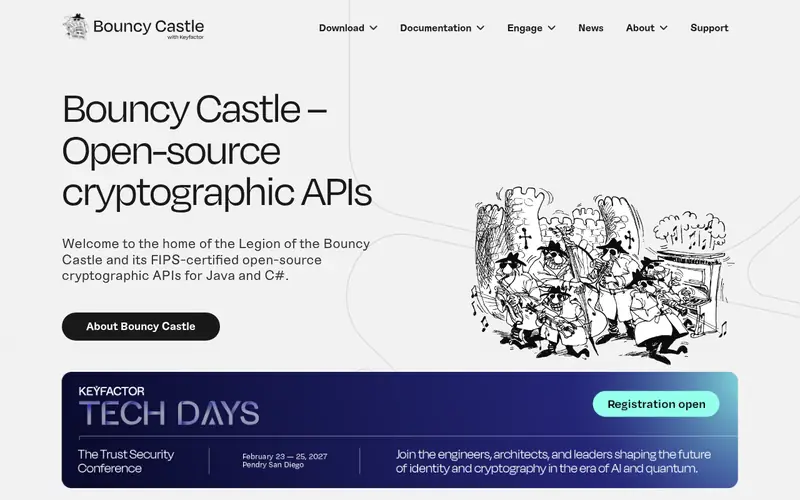
Bouncy Castle is a long-running open-source cryptography library available for Java and C#. In Java it works two ways: as a JCA provider registered with `Security.addProvider`, or through its own lightweight API that does not depend on the JCA provider model. The provider route lets existing JCA code pick up algorithms the JDK lacks.
Coverage is the main reason teams choose it. It includes a large set of ciphers, digests, signature schemes and key formats, plus post-quantum algorithm work in recent releases. The trade-off is size and complexity: the API is broad, and you need to manage provider ordering and, on older JDKs, policy files for unlimited strength. Skip it if the JDK already covers your algorithms and you want minimal dependencies.
Standout: Very wide algorithm set
Free (open source), as listed by the vendor (Bouncy Castle website). Confirm the current plan price before you buy.
Free plan. Plans change, so confirm on the vendor's pricing page before you buy.
Benefits
- Very wide algorithm set
- works as a JCA provider or standalone API
Drawbacks
- Large API surface
- provider setup and policy files add configuration work
Skip it if this limit matters to you: large API surface.
Verdict. A sensible pick for projects needing broad algorithm coverage, including post-quantum.
Alternatives in this guide: Java Cryptography Architecture (JCA/JCE), Google Tink, Conscrypt
Google Tink
Best for teams that want safe defaults and managed key rotation
What it is and where it fits
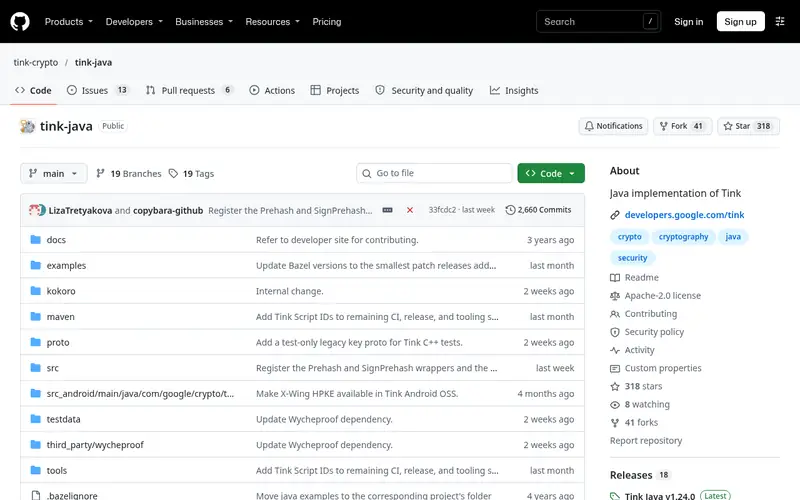
Tink is a multi-language cryptography library from Google, with a Java implementation. Instead of exposing raw primitives, it offers high-level APIs such as AEAD, hybrid encryption, digital signatures and streaming AEAD, each tied to a keyset. The design goal is to make common misuse, like reusing a nonce or picking a weak mode, harder to do by accident.
Keysets can be stored and rotated, and Tink supports key management through integrations such as Google Cloud KMS and AWS KMS. The library covers fewer algorithms than Bouncy Castle and focuses on ones the maintainers consider safe. Major versions have changed APIs, so pin your version and read the release notes. It suits application developers more than teams that need exotic algorithms.
Standout: High-level APIs with safe defaults
Free (open source), as listed by the vendor (Google Tink website). Confirm the current plan price before you buy.
Free plan. Plans change, so confirm on the vendor's pricing page before you buy.
Benefits
- High-level APIs with safe defaults
- built-in key rotation and key set handling
Drawbacks
- Fewer algorithms than Bouncy Castle
- API changes across major versions
Skip it if this limit matters to you: fewer algorithms than Bouncy Castle.
Verdict. A sensible pick for teams that want safe defaults and managed key rotation.
Alternatives in this guide: Java Cryptography Architecture (JCA/JCE), Bouncy Castle, Conscrypt
Conscrypt
Best for teams needing a modern TLS provider on the JVM
What it is and where it fits
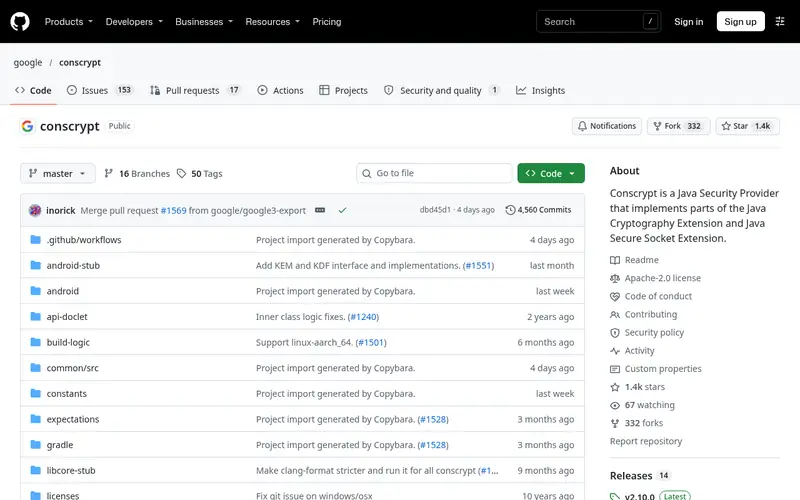
Conscrypt is Google's Java security provider, built on BoringSSL. It is best known as the TLS stack on Android, and it also runs on the JVM as a JCA provider. You register it and use it for TLS sockets, and it can supply other algorithms through the standard provider interfaces.
Its strength is TLS behavior and cipher suite support rather than general-purpose cryptography. Because it relies on native code, packaging and platform support need attention, especially in containers and on unusual architectures. Choose it when TLS interoperability or specific cipher suites matter. For general encryption and signing, JCA/JCE or Bouncy Castle are simpler picks.
Standout: TLS-focused provider with native BoringSSL backing
Free (open source), as listed by the vendor (Conscrypt website). Confirm the current plan price before you buy.
Free plan. Plans change, so confirm on the vendor's pricing page before you buy.
Benefits
- TLS-focused provider with native BoringSSL backing
- usable as a JCA provider
Drawbacks
- Narrower scope than general crypto libraries
- native library packaging adds build steps
Skip it if this limit matters to you: narrower scope than general crypto libraries.
Verdict. A sensible pick for teams needing a modern TLS provider on the JVM.
Alternatives in this guide: Java Cryptography Architecture (JCA/JCE), Bouncy Castle, Google Tink
Amazon Corretto Crypto Provider
Best for jVM services that want faster crypto through a drop-in provider
What it is and where it fits
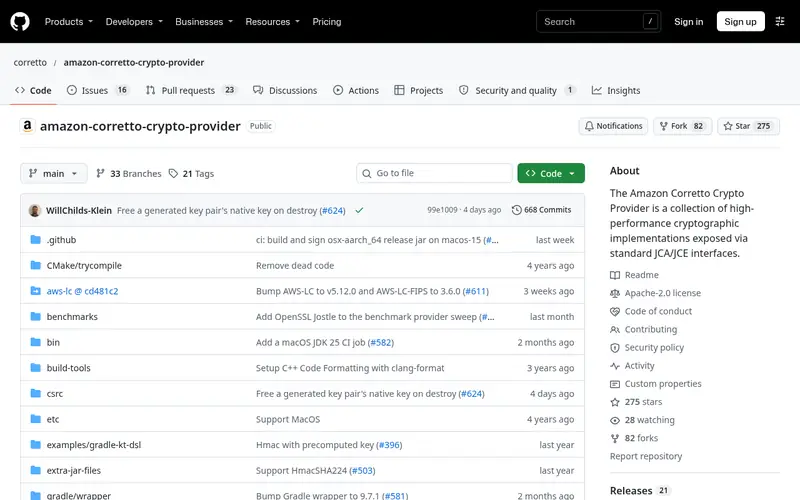
Amazon Corretto Crypto Provider (ACCP) is an open-source JCA provider that replaces the default JDK crypto implementations with optimized native code, based on OpenSSL. You install it and register it as a provider; existing JCA code then uses it without API changes.
The benefit is performance on common operations such as AES and RSA, which matters for high-throughput services. The limits are platform and scope: it ships native binaries for specific platforms, and it covers the algorithms it implements rather than the full range Bouncy Castle offers. Check the supported platforms and JDK versions in the repository before adopting it, and test under your own workload.
Standout: Drop-in JCA provider
Free (open source), as listed by the vendor (Amazon Corretto Crypto Provider website). Confirm the current plan price before you buy.
Free plan. Plans change, so confirm on the vendor's pricing page before you buy.
Benefits
- Drop-in JCA provider
- uses optimized native implementations
Drawbacks
- Platform-specific native builds
- scope limited to the algorithms it implements
Skip it if this limit matters to you: platform-specific native builds.
Verdict. A sensible pick for JVM services that want faster crypto through a drop-in provider.
Alternatives in this guide: Java Cryptography Architecture (JCA/JCE), Bouncy Castle, Google Tink
Who should use what
If you need standard algorithms and want zero extra dependencies, start with JCA/JCE. If you need algorithms the JDK lacks, including post-quantum options, add Bouncy Castle as a provider. If you want safe defaults and keyset rotation for application-level encryption, use Google Tink. If your concern is TLS behavior or cipher suite coverage, look at Conscrypt, and if you want a drop-in speed-up for common operations, evaluate Amazon Corretto Crypto Provider.
Questions to settle before you buy
What to check before you buy
- Confirm the library is actively maintained and supports your JDK version.
- Check the licence terms against your distribution and redistribution plans.
- Verify the algorithms you need are available and not restricted by JDK policy.
- Review how the library handles keys, nonces and random number generation.
- Test native-dependent providers on every platform and container image you deploy.
FAQ
Is Bouncy Castle a replacement for JCA/JCE?
No. Bouncy Castle usually plugs into the JCA provider model, or you call its lightweight API directly. JCA/JCE is the framework; Bouncy Castle adds algorithms and implementations on top of it.
Which library should I use for post-quantum algorithms in Java?
Bouncy Castle has the broadest post-quantum work among these options. Check the current release notes for which algorithms are included and their status, since this area changes quickly.
Is Google Tink suitable for encrypting database fields?
Yes, its AEAD and streaming AEAD APIs fit field and stream encryption, and keysets support rotation. You still need to manage where keysets are stored and who can access them.
Do these libraries cost anything?
All five listed here are free or open source. Support, managed key services and commercial distributions may cost money, so check the vendor pages.
Can I paste secrets into online crypto tools?
Avoid pasting real keys, tokens or production data into third-party web pages. Prefer local tools or offline libraries for anything sensitive.
Sources we checked
Method: how we score · editorial policy.
Change log. First published 28 Nov 2026.