Stage 02 · Test · Researched comparison
Best Haskell Testing Libraries in 2026
Hspec is the first pick for most teams because it gives a readable describe-and-it style and a single runner that can host unit, property and doctest suites. Choose QuickCheck if property-based testing is your main need, or Tasty if you want one runner that combines several test styles with fine control over filtering and parallelism. All of these libraries are open source and free to use.

By Shihab Mia
Published 28 Nov 2026 · 7 tools compared
We run no ads and no affiliate links at launch. The order of a list follows our published method. See how we score.
Prices are the starting prices vendors list publicly. Plans change, so confirm the current price on the vendor page before you buy.
Key takeaways
- Hspec, QuickCheck, Tasty, HUnit, Hedgehog, doctest and sydtest are all free and open source.
- Hspec and Tasty act as runners that can call other libraries, so they are often combined rather than picked alone.
- QuickCheck and Hedgehog both do property-based testing but differ in how they generate data and report failures.
- These libraries run locally through Cabal or Stack, so test data stays on your machine.
Who each pick is for
- Teams that want readable unit tests and one runnerHspec
- Projects centered on property-based testingQuickCheck
- Projects that mix several test styles in one runnerTasty
- Simple assertion-based unit testsHUnit
- Property tests with integrated shrinkingHedgehog
- Checking examples in Haddock commentsdoctest
- Suites that need resource setup and cleanupsydtest
Comparison
| Tool | Best for | Standout feature | Listed starting price | Free plan or trial |
|---|---|---|---|---|
| 1Hspec | Teams that want readable unit tests and one runner | Clear describe-and-it syntax | Free (open source) | Free plan |
| 2QuickCheck | Projects centered on property-based testing | Mature property testing with automatic shrinking | Free (open source) | Free plan |
| 3Tasty | Projects that mix several test styles in one runner | One runner for HUnit, QuickCheck, Hedgehog and more | Free (open source) | Free plan |
| 4HUnit | Simple assertion-based unit tests | Small and easy to learn | Free (open source) | Free plan |
| 5Hedgehog | Property tests with integrated shrinking | Shrinking built into generation | Free (open source) | Free plan |
| 6doctest | Checking examples in Haddock comments | Keeps documentation examples correct | Free (open source) | Free plan |
| 7sydtest | Suites that need resource setup and cleanup | Built-in support for setup and teardown around tests | Free (open source) | Free plan |
How we picked
We picked libraries that are actively maintained, published on Hackage, and documented through official sites or repositories. We looked at fit for common testing jobs (unit, property, documentation and combined runners), how each integrates with Cabal and Stack, licence terms, and the main limits users hit in practice. All entries are open source and free. Sources are vendor pages, project repositories and package documentation. Prices and licences can change, so confirm details on the project site before you commit.
The tools, one by one
Hspec
Best for teams that want readable unit tests and one runner
What it is and where it fits
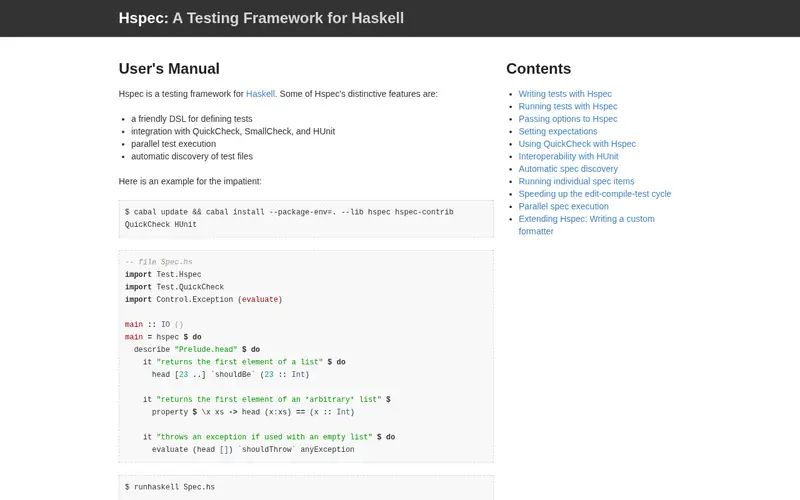
Hspec is a testing framework built around a behavior-driven style. You write nested `describe` and `it` blocks, and the runner prints a readable tree of results. It ships with its own expectation combinators for common checks such as equality, exceptions and IO.
Hspec works with any GHC-based project on Cabal or Stack. It can run QuickCheck properties through `Test.Hspec.QuickCheck`, HUnit assertions through `Test.Hspec.HUnit`, and doctests through `Test.Hspec.doctest`. That makes it a practical default for a project that wants one command for all tests.
The library is open source under the MIT licence and has no paid tier. Its main limit is that property generation and shrinking come from the companion library, not Hspec itself. Teams that need heavy property testing often pair Hspec with QuickCheck or Hedgehog. Skip it if you need fine-grained test selection and parallel scheduling, which Tasty handles more directly.
Standout: Clear describe-and-it syntax
Free (open source), as listed by the vendor (Hspec website). Confirm the current plan price before you buy.
Free plan. Plans change, so confirm on the vendor's pricing page before you buy.
Benefits
- Clear describe-and-it syntax
- Can host QuickCheck, HUnit and doctest suites
Drawbacks
- Property support depends on other libraries
- Less control over test filtering than Tasty
Skip it if this limit matters to you: property support depends on other libraries.
Verdict. A sensible pick for teams that want readable unit tests and one runner.
Alternatives in this guide: QuickCheck, Tasty, HUnit
QuickCheck
Best for projects centered on property-based testing
What it is and where it fits
QuickCheck is the long-standing property-based testing library for Haskell. You state a property as a function, and QuickCheck generates random inputs, checks the property, and shrinks a failing case to a smaller counterexample.
It runs on GHC through Cabal or Stack and integrates with Hspec and Tasty as a test provider. The library includes generators for numbers, lists, text and functions, plus combinators for building custom generators with `Arbitrary` instances.
QuickCheck is open source under a BSD-style licence and free to use. The main limits are that you must write `Arbitrary` instances for your own types, and the default output for a failure can be hard to read until you add labels or counters. It is the right pick when properties are the core of your suite. If you want integrated shrinking and clearer failure reports by default, look at Hedgehog.
Standout: Mature property testing with automatic shrinking
Free (open source), as listed by the vendor (QuickCheck website). Confirm the current plan price before you buy.
Free plan. Plans change, so confirm on the vendor's pricing page before you buy.
Benefits
- Mature property testing with automatic shrinking
- Large set of built-in generators
Drawbacks
- Failure output can be terse
- Random generation needs care for complex types
Skip it if this limit matters to you: failure output can be terse.
Verdict. A sensible pick for projects centered on property-based testing.
Tasty
Best for projects that mix several test styles in one runner
What it is and where it fits
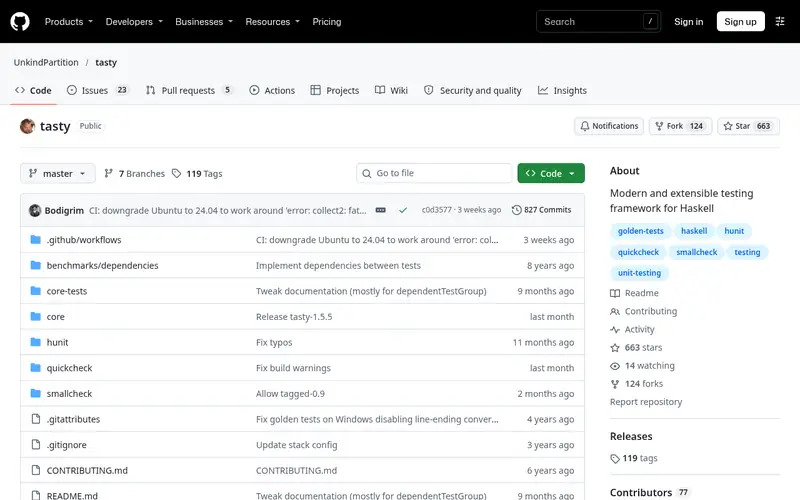
Tasty is a test framework that focuses on the runner. It defines a common interface, and separate packages plug in HUnit, QuickCheck, Hedgehog, SmallCheck and golden tests. You list test groups in one `main`, and Tasty runs them together.
It works on GHC with Cabal or Stack. The command line supports pattern-based filtering, listing tests, and controlling the number of parallel jobs. That control is useful in large suites where you want to rerun only failed tests.
Tasty is open source under the BSD-3-Clause licence and free. The tradeoff is structure: you assemble the suite from provider packages, which takes more code than a single Hspec file. Output is functional but less readable than Hspec's nested tree. Choose Tasty when you want one runner across many test styles and need precise control over what runs.
Standout: One runner for HUnit, QuickCheck, Hedgehog and more
Free (open source), as listed by the vendor (Tasty website). Confirm the current plan price before you buy.
Free plan. Plans change, so confirm on the vendor's pricing page before you buy.
Benefits
- One runner for HUnit, QuickCheck, Hedgehog and more
- Strong filtering and parallel options
Drawbacks
- More setup than a single-library suite
- Output is plainer than Hspec's tree
Skip it if this limit matters to you: more setup than a single-library suite.
Verdict. A sensible pick for projects that mix several test styles in one runner.
Alternatives in this guide: Hspec, QuickCheck, HUnit
HUnit
Best for simple assertion-based unit tests
What it is and where it fits
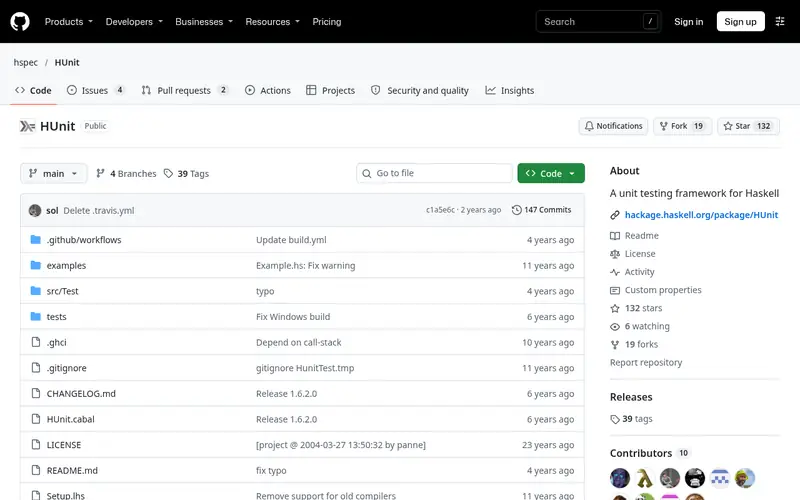
HUnit is a unit testing library in the xUnit style. You write assertions with `assertEqual`, `assertBool` and `assertFailure`, group them into tests, and run them. It is one of the oldest testing libraries in the Haskell ecosystem.
It runs on GHC through Cabal or Stack. HUnit is often used as a provider inside Hspec or Tasty rather than on its own, which gives you its assertions with a better runner and reporting layer.
HUnit is open source and free. Its scope is deliberately small: it checks expected values and raises failures. It has no random generation, shrinking or golden-file support. That makes it a good fit for straightforward example-based tests and a poor fit for property testing. Many projects keep HUnit assertions inside a Hspec or Tasty suite.
Standout: Small and easy to learn
Free (open source), as listed by the vendor (HUnit website). Confirm the current plan price before you buy.
Free plan. Plans change, so confirm on the vendor's pricing page before you buy.
Benefits
- Small and easy to learn
- Works as a provider for Hspec and Tasty
Drawbacks
- No property generation
- Limited reporting on its own
Skip it if this limit matters to you: no property generation.
Verdict. A sensible pick for simple assertion-based unit tests.
Alternatives in this guide: Hspec, QuickCheck, Tasty
Hedgehog
Best for property tests with integrated shrinking
What it is and where it fits
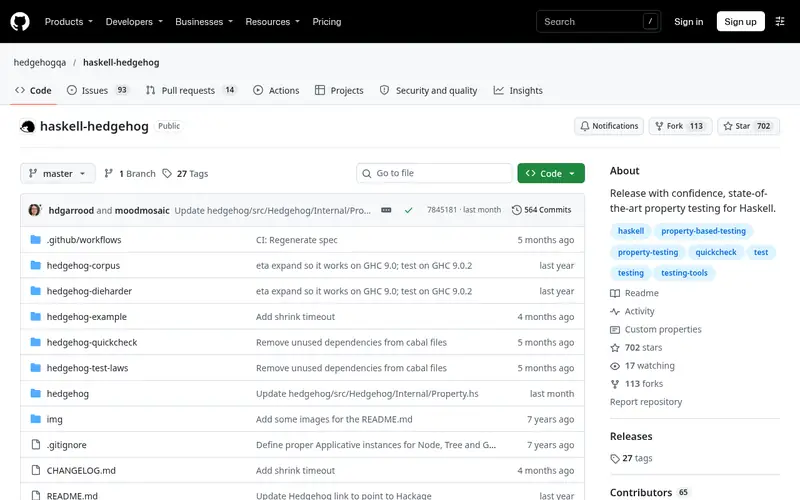
Hedgehog is a property-based testing library that builds shrinking into its generators. Instead of generating a value and shrinking afterward, Hedgehog generates a value together with a tree of smaller variants, so a failure reduces to a minimal case by construction.
It runs on GHC with Cabal or Stack and integrates with Hspec and Tasty as a provider. Failure output shows the shrunk input and the range it came from, which helps when debugging.
Hedgehog is open source under the BSD-3-Clause licence and free. The main limit is ecosystem size: fewer third-party packages ship Hedgehog generators compared with QuickCheck, so you may write more of your own. The API also differs enough that moving an existing QuickCheck suite takes work. Pick Hedgehog for new property suites where clear shrinking and output matter.
Standout: Shrinking built into generation
Free (open source), as listed by the vendor (Hedgehog website). Confirm the current plan price before you buy.
Free plan. Plans change, so confirm on the vendor's pricing page before you buy.
Benefits
- Shrinking built into generation
- Readable failure output with ranges
Drawbacks
- Smaller generator ecosystem than QuickCheck
- Different API to learn
Skip it if this limit matters to you: smaller generator ecosystem than QuickCheck.
Verdict. A sensible pick for property tests with integrated shrinking.
Alternatives in this guide: Hspec, QuickCheck, Tasty
doctest
Best for checking examples in Haddock comments
What it is and where it fits
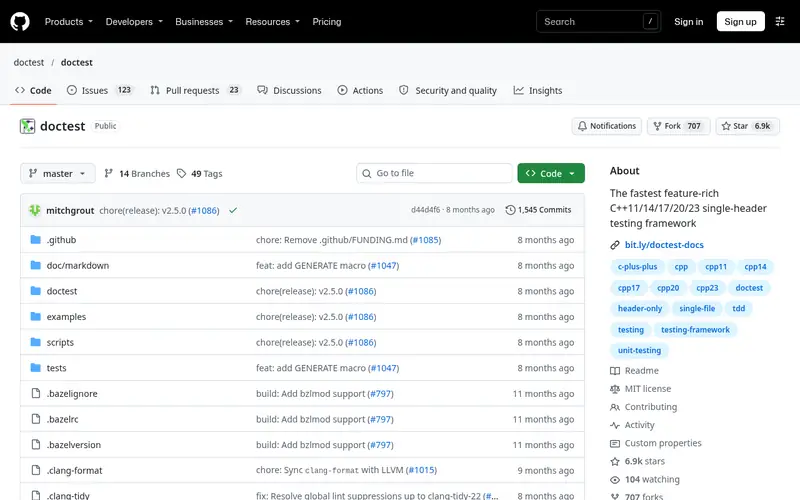
doctest extracts examples from Haddock comments and runs them as tests. An example written as a GHCi session in a comment is executed, and the output is compared with what the comment claims.
It runs on GHC through Cabal or Stack. You can call it from a standalone executable or through Hspec's doctest support, which lets documentation tests run alongside the rest of your suite.
doctest is open source under the MIT licence and free. Its scope is narrow by design: it checks comment examples and nothing else. Setup can be sensitive to GHC versions and package environments, and examples that need external resources are awkward to test. Use it to keep documentation honest, not as a replacement for a unit or property suite.
Standout: Keeps documentation examples correct
Free (open source), as listed by the vendor (doctest website). Confirm the current plan price before you buy.
Free plan. Plans change, so confirm on the vendor's pricing page before you buy.
Benefits
- Keeps documentation examples correct
- Runs examples as real tests
Drawbacks
- Only tests what appears in comments
- Setup needs care with GHC versions
Skip it if this limit matters to you: only tests what appears in comments.
Verdict. A sensible pick for checking examples in Haddock comments.
Alternatives in this guide: Hspec, QuickCheck, Tasty
sydtest
Best for suites that need resource setup and cleanup
What it is and where it fits
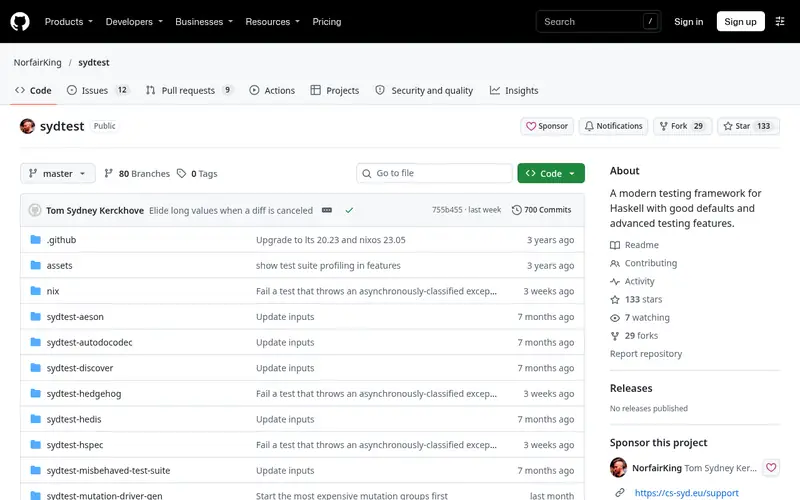
sydtest is a modern testing framework that puts emphasis on managing resources around tests. It provides hooks to acquire and release resources, so tests that need a database, a temp directory or a server can share setup and cleanup logic.
It runs on GHC with Cabal or Stack. It integrates property testing through companion packages for QuickCheck and Hedgehog, and it supports golden tests. Output is structured and includes timing information.
sydtest is open source and free. The main limits are community size and documentation: there are fewer examples and answers online than for Hspec or Tasty, so you rely more on the project's own docs. It suits projects where test resources are the hard part. For a small suite with no shared setup, Hspec or Tasty is simpler.
Standout: Built-in support for setup and teardown around tests
Free (open source), as listed by the vendor (sydtest website). Confirm the current plan price before you buy.
Free plan. Plans change, so confirm on the vendor's pricing page before you buy.
Benefits
- Built-in support for setup and teardown around tests
- Integrates QuickCheck and Hedgehog
Drawbacks
- Smaller community than Hspec or Tasty
- Fewer tutorials available
Skip it if this limit matters to you: smaller community than Hspec or Tasty.
Verdict. A sensible pick for suites that need resource setup and cleanup.
Alternatives in this guide: Hspec, QuickCheck, Tasty
Who should use what
A team starting a new Haskell project with mostly example-based tests should use Hspec, adding HUnit assertions where needed. A project where correctness depends on invariants across many inputs should use QuickCheck or Hedgehog, with Hspec or Tasty as the runner. A large codebase that already mixes test styles should use Tasty for its filtering and parallel control. A library with rich Haddock examples should add doctest so the docs stay accurate. A suite that needs database or server setup around tests should look at sydtest.
Questions to settle before you buy
What to check before you buy
- Confirm the library builds with your GHC version and your Cabal or Stack setup.
- Decide whether you need a runner (Hspec, Tasty, sydtest) or a provider (QuickCheck, Hedgehog, HUnit).
- Check that property libraries you pick have generators for your core types, or plan to write them.
- Run doctest against your actual package environment before relying on it in CI.
- Review the licence terms if you distribute code that links the library.
FAQ
Do I need more than one testing library?
Often yes. A runner such as Hspec or Tasty handles structure and reporting, while QuickCheck, Hedgehog or HUnit supply the actual checks. Many Haskell projects combine two or three of these libraries in one suite.
Is Hspec or Tasty better?
It depends on your needs. Hspec gives readable output and a simple style for unit tests. Tasty gives stronger control over filtering, parallelism and mixing providers. Both are free and open source, and both can host property and unit tests.
Can QuickCheck and Hedgehog be used together?
Yes. They are separate libraries with different APIs, and both can run inside Hspec or Tasty. Some projects keep QuickCheck for existing properties and write new ones in Hedgehog, though maintaining two property styles adds overhead.
Does doctest replace unit tests?
No. doctest only checks examples written in Haddock comments. It is useful for keeping documentation correct, but it does not cover code paths that are not shown in examples. Pair it with a unit or property suite.
Are these libraries free for commercial use?
All seven are open source and free to use. Licences differ: Hspec and doctest use MIT, Tasty and Hedgehog use BSD-3-Clause, and QuickCheck uses a BSD-style licence. Check the licence file in each repository for the exact terms.
Sources we checked
Method: how we score · editorial policy.
Change log. First published 28 Nov 2026.