Stage 02 · Test · Researched comparison
Best Go Testing Frameworks in 2026
The standard library `testing` package is the first pick for most Go teams. It ships with the toolchain, runs with `go test`, and needs no dependencies. Teams that want richer assertions and readable failure output often add Testify. Teams that prefer BDD-style specs reach for Ginkgo with Gomega, while GoMock and mockery cover generated mocks for interface-heavy code.

By Shihab Mia
Published 22 Nov 2026 · 7 tools compared
We run no ads and no affiliate links at launch. The order of a list follows our published method. See how we score.
Prices are the starting prices vendors list publicly. Plans change, so confirm the current price on the vendor page before you buy.
Key takeaways
- Go's built-in `testing` package is free, maintained by the Go team, and covers unit tests, table tests, benchmarks and fuzzing without extra dependencies.
- Testify, Ginkgo, Gomega and GoMock are all free open-source projects, so cost is not a deciding factor between them.
- Most of these tools are Go modules you add with `go get`, so tests run locally and in CI without sending code to a third-party service.
- Fuzzing support is built into the standard library since Go 1.18, so a separate fuzzing framework is often unnecessary.
Who each pick is for
- Teams that want zero dependencies and full toolchain supportGo testing package (standard library)
- Go developers who want readable assertions and mock helpersTestify
- Teams that prefer BDD-style specs and nested test structureGinkgo
- Matcher library for Ginkgo or standalone assertion useGomega
- Generating interface mocks for unit testsGoMock
- Teams that want configurable mock generation across many packagesmockery
- Finding edge cases in parsers and input-handling codeGo fuzzing (native)
Comparison
| Tool | Best for | Standout feature | Listed starting price | Free plan or trial |
|---|---|---|---|---|
| 1Go testing package (standard library) | Teams that want zero dependencies and full toolchain support | Ships with Go and needs no install | Free (open source) | Free plan |
| 2Testify | Go developers who want readable assertions and mock helpers | Widely used assert and require packages | Free (open source) | Free plan |
| 3Ginkgo | Teams that prefer BDD-style specs and nested test structure | Descriptive BDD syntax with nested containers | Free (open source) | Free plan |
| 4Gomega | Matcher library for Ginkgo or standalone assertion use | Rich set of matchers with clear failure messages | Free (open source) | Free plan |
| 5GoMock | Generating interface mocks for unit tests | Generates mocks from interfaces with a CLI | Free (open source) | Free plan |
| 6mockery | Teams that want configurable mock generation across many packages | Generates mocks for many interfaces from config | Free (open source) | Free plan |
| 7Go fuzzing (native) | Finding edge cases in parsers and input-handling code | Built into the toolchain with no dependencies | Free (open source) | Free plan |
How we picked
We compared tools on fit for common Go testing jobs, how they run with the standard toolchain, licence and price, and where code executes. All picks are free or open source, and all run locally through `go test` or a companion CLI, so no test code is sent to a third-party service. We looked at documented features, maintenance activity and stated limits on vendor pages, documentation and project repositories. Prices and features can change, so confirm details on each project page before adopting.
The tools, one by one
Go testing package (standard library)
Best for teams that want zero dependencies and full toolchain support
What it is and where it fits
The `testing` package is part of the Go standard library and is driven by the `go test` command. It supports unit tests, table-driven tests, benchmarks, runnable examples and native fuzzing, which arrived in Go 1.18. Because it is maintained by the Go team and versioned with the toolchain, there is nothing to install and no compatibility risk.
Its main limit is verbosity. Checking a value requires manual `if` statements and `t.Errorf` calls, and there are no assertion matchers. There is also no mocking support, so interface fakes are written by hand or generated with a separate tool. Teams that want minimal dependencies and predictable output should start here and add libraries only when the verbosity becomes a real cost.
Standout: Ships with Go and needs no install
Free (open source), as listed by the vendor (Go testing package (standard library) website). Confirm the current plan price before you buy.
Free plan. Plans change, so confirm on the vendor's pricing page before you buy.
Benefits
- Ships with Go and needs no install
- covers tests, benchmarks, examples and fuzzing
Drawbacks
- Verbose assertions with no built-in matchers
- no built-in mocking helpers
Skip it if this limit matters to you: verbose assertions with no built-in matchers.
Verdict. A sensible pick for teams that want zero dependencies and full toolchain support.
Testify
Best for go developers who want readable assertions and mock helpers
What it is and where it fits
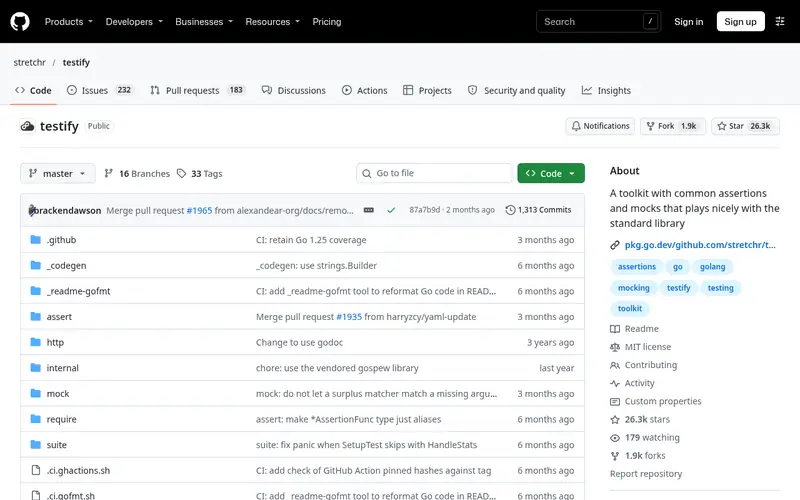
Testify adds assertion helpers through its `assert` and `require` packages. `assert` records a failure and continues, while `require` stops the test immediately, which suits setup steps. It also includes a `mock` package for building test doubles and a `suite` package for grouping tests with setup and teardown methods.
Testify works with any Go project and runs through `go test`, so it fits existing CI pipelines without changes. It is a library, not a runner, so it does not replace the standard tooling. The trade-off is an added dependency and failure messages that sometimes hide the exact line. Teams that prefer explicit `if` checks may find the standard library enough. Testify is the most common first addition for teams new to Go testing.
Standout: Widely used assert and require packages
Free (open source), as listed by the vendor (Testify website). Confirm the current plan price before you buy.
Free plan. Plans change, so confirm on the vendor's pricing page before you buy.
Benefits
- Widely used assert and require packages
- includes a mock package
Drawbacks
- Assertion failures can be less precise than plain checks
- extra dependency to manage
Skip it if this limit matters to you: assertion failures can be less precise than plain checks.
Verdict. A sensible pick for go developers who want readable assertions and mock helpers.
Alternatives in this guide: Go testing package (standard library), Ginkgo, Gomega
Ginkgo
Best for teams that prefer BDD-style specs and nested test structure
What it is and where it fits
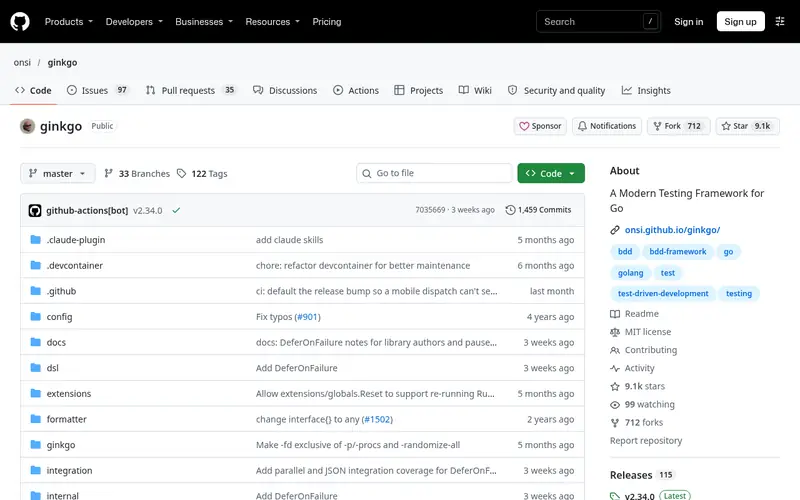
Ginkgo is a BDD-style testing framework for Go. It provides `Describe`, `Context` and `It` blocks, plus setup and teardown hooks at each level. It ships its own `ginkgo` command for running suites, filtering specs and generating reports, and it integrates with `go test` so standard tooling still works.
Ginkgo is usually paired with Gomega, a matcher library that provides readable expectations like `Expect(err).NotTo(HaveOccurred())`. The combination suits integration and acceptance tests where describing behavior matters. The cost is a second DSL on top of Go and a runner to learn. Small unit tests may read more clearly in plain Go. Teams already comfortable with RSpec or Jasmine-style syntax tend to adopt it quickly.
Standout: Descriptive BDD syntax with nested containers
Free (open source), as listed by the vendor (Ginkgo website). Confirm the current plan price before you buy.
Free plan. Plans change, so confirm on the vendor's pricing page before you buy.
Benefits
- Descriptive BDD syntax with nested containers
- pairs with the Gomega matcher library
Drawbacks
- Adds its own runner and DSL to learn
- style can feel heavy for small units
Skip it if this limit matters to you: adds its own runner and DSL to learn.
Verdict. A sensible pick for teams that prefer BDD-style specs and nested test structure.
Alternatives in this guide: Go testing package (standard library), Testify, Gomega
Gomega
Best for matcher library for Ginkgo or standalone assertion use
What it is and where it fits
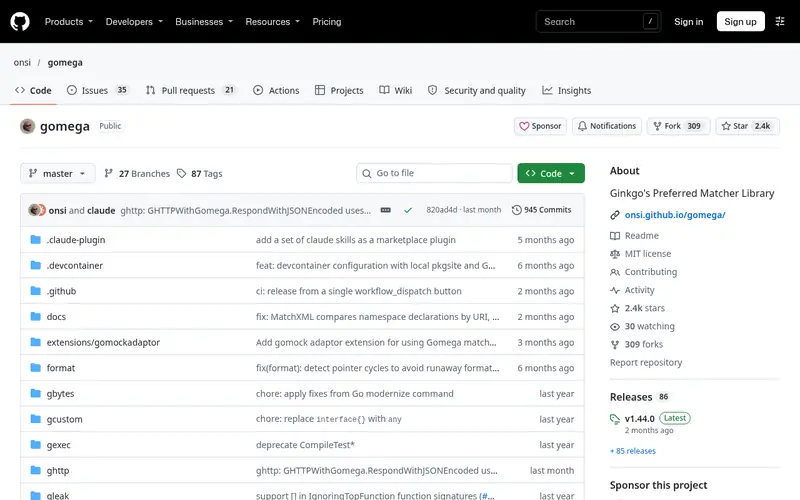
Gomega is a matcher and assertion library. It provides `Expect` and `Eventually` along with matchers for errors, collections, strings, numbers and HTTP responses. It can be used on its own with the standard `testing` package, though it is most often seen alongside Ginkgo.
`Eventually` and `Consistently` help with asynchronous code by polling until a condition holds or a timeout expires. That is useful for goroutines, channels and network calls, but it also means tests can pass slowly if timeouts are set loosely. Gomega is free and open source, runs locally through `go test`, and adds no external service. Teams that want matchers without a BDD runner can use it directly.
Standout: Rich set of matchers with clear failure messages
Free (open source), as listed by the vendor (Gomega website). Confirm the current plan price before you buy.
Free plan. Plans change, so confirm on the vendor's pricing page before you buy.
Benefits
- Rich set of matchers with clear failure messages
- works with or without Ginkgo
Drawbacks
- Most natural inside Ginkgo suites
- async matchers need care with timeouts
Skip it if this limit matters to you: most natural inside Ginkgo suites.
Verdict. A sensible pick for matcher library for Ginkgo or standalone assertion use.
Alternatives in this guide: Go testing package (standard library), Testify, Ginkgo
GoMock
Best for generating interface mocks for unit tests
What it is and where it fits
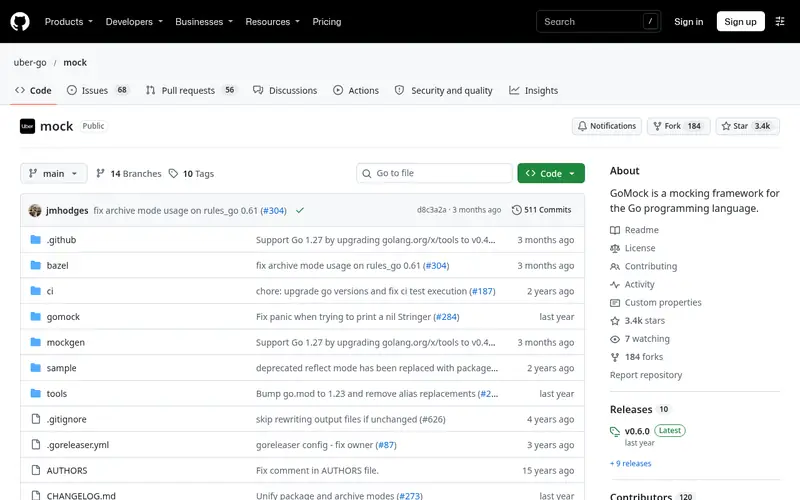
GoMock generates mock implementations of Go interfaces. You run the `mockgen` tool against a source file or a compiled package, and it writes mock types that record calls and verify expectations. Tests then set expected calls and return values, and the mock reports mismatches.
The project is maintained under the uber-go organization after the original golang/mock repository was archived, so check that you import the maintained module path. GoMock suits codebases with many interfaces and layered dependencies. For small projects, hand-written fakes are often simpler and easier to read. Generation adds a build step, and mocks must be regenerated whenever an interface changes, which is a real maintenance cost.
Standout: Generates mocks from interfaces with a CLI
Free (open source), as listed by the vendor (GoMock website). Confirm the current plan price before you buy.
Free plan. Plans change, so confirm on the vendor's pricing page before you buy.
Benefits
- Generates mocks from interfaces with a CLI
- strict expectation checking
Drawbacks
- Generated code needs regeneration when interfaces change
- setup is heavier than hand-written fakes
Skip it if this limit matters to you: generated code needs regeneration when interfaces change.
Verdict. A sensible pick for generating interface mocks for unit tests.
Alternatives in this guide: Go testing package (standard library), Testify, Ginkgo
mockery
Best for teams that want configurable mock generation across many packages
What it is and where it fits
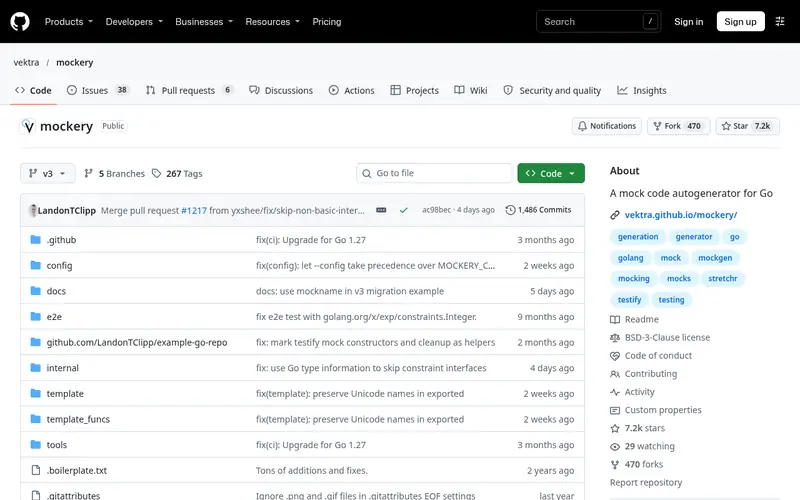
mockery is a mock code generator for Go. It scans packages and writes mock implementations for interfaces, either in GoMock style or in Testify style. A configuration file lets you point it at packages, set output locations and choose the mock flavor, which helps in larger repositories with many interfaces.
It runs as a CLI and can be wired into `go generate` or CI to keep mocks current. The main cost is configuration: the options are numerous and a wrong setting produces mocks in unexpected places. Generated code also needs regeneration when interfaces change. mockery is free and open source and runs locally. Teams already using Testify often prefer its Testify-style output so assertions and mocks share one library.
Standout: Generates mocks for many interfaces from config
Free (open source), as listed by the vendor (mockery website). Confirm the current plan price before you buy.
Free plan. Plans change, so confirm on the vendor's pricing page before you buy.
Benefits
- Generates mocks for many interfaces from config
- supports Testify-style mocks
Drawbacks
- Configuration has a learning curve
- generated output can drift from interfaces
Skip it if this limit matters to you: configuration has a learning curve.
Verdict. A sensible pick for teams that want configurable mock generation across many packages.
Alternatives in this guide: Go testing package (standard library), Testify, Ginkgo
Go fuzzing (native)
Best for finding edge cases in parsers and input-handling code
What it is and where it fits
Fuzzing became part of the Go toolchain in Go 1.18. A fuzz test is written like a normal test with an `F` parameter, and `go test -fuzz` generates inputs and reports crashes. Failing inputs are saved to a corpus directory so they can be replayed as regular tests.
Native fuzzing suits parsers, decoders and any code that handles untrusted input. It is free, needs no extra module, and runs locally or in CI. The limits are practical: fuzzing finds crashes, not logic errors, and long runs consume CPU. Corpus files should be committed selectively. Teams that only need example-based tests do not need a separate fuzzing framework, since this is already in the standard library.
Standout: Built into the toolchain with no dependencies
Free (open source), as listed by the vendor (Go fuzzing (native) website). Confirm the current plan price before you buy.
Free plan. Plans change, so confirm on the vendor's pricing page before you buy.
Benefits
- Built into the toolchain with no dependencies
- integrates with `go test`
Drawbacks
- Not a substitute for unit tests
- corpus management needs attention
Skip it if this limit matters to you: not a substitute for unit tests.
Verdict. A sensible pick for finding edge cases in parsers and input-handling code.
Alternatives in this guide: Go testing package (standard library), Testify, Ginkgo
Who should use what
New Go projects and small teams should start with the standard `testing` package and add Testify when assertions get repetitive. Teams writing integration or acceptance tests with behavior-focused specs should pair Ginkgo with Gomega. Codebases with many interfaces and layered dependencies should generate mocks with GoMock or mockery, choosing the flavor that matches their assertion library. Anyone parsing untrusted input should add native Go fuzzing alongside unit tests.
Questions to settle before you buy
What to check before you buy
- Confirm the library supports your Go version and is actively maintained.
- Check whether the tool replaces `go test` or runs alongside it, since CI scripts depend on this.
- Review how mocks are regenerated when interfaces change, and wire that into `go generate` or CI.
- Read the failure output format, since readable errors save debugging time.
- Verify the licence and module path, especially for projects that moved between organizations.
FAQ
Do I need a third-party framework to test Go code?
No. The standard `testing` package covers unit tests, table tests, benchmarks, examples and fuzzing. Add a library like Testify or Gomega only when assertion verbosity or matcher needs justify the dependency.
Is Testify a replacement for `go test`?
No. Testify is an assertion and mock library that runs inside tests executed by `go test`. It does not provide its own runner, so your existing commands and CI setup stay the same.
Can I use Ginkgo and Testify together?
You can, but it is uncommon. Ginkgo usually pairs with Gomega for matchers, and Testify brings its own assert and mock packages. Mixing them adds dependencies without much benefit, so pick one assertion style per project.
Are these tools free?
Yes. All the tools listed here are free and open source. Cost is not a differentiator; choose based on syntax, runner behavior and maintenance needs.
Does fuzzing replace unit tests?
No. Fuzzing generates inputs to find crashes and panics, while unit tests check expected behavior. Use both: unit tests for known cases and fuzzing for edge cases in input-handling code.
Sources we checked
Method: how we score · editorial policy.
Change log. First published 22 Nov 2026.