Stage 02 · Test · Researched comparison
Best Go RPC Frameworks in 2026
grpc-go is the first pick for most teams that need a mature, widely adopted RPC stack with HTTP/2, streaming and code generation. Connect RPC suits teams that want gRPC compatibility plus plain HTTP and browser clients from one handler set. Twirp is a lighter choice for simple HTTP/JSON and Protobuf services. All three are open source and free.

By Shihab Mia
Published 27 Nov 2026 · 6 tools compared
We run no ads and no affiliate links at launch. The order of a list follows our published method. See how we score.
Prices are the starting prices vendors list publicly. Plans change, so confirm the current price on the vendor page before you buy.
Key takeaways
- grpc-go, Connect RPC, Twirp, DRPC and Kratos are free and open source; net/rpc ships with Go but is frozen.
- grpc-go supports unary and streaming RPC over HTTP/2 and generates code from .proto files.
- Connect RPC serves gRPC, gRPC-Web and its own HTTP/JSON protocol from the same Go handlers.
- Check the commit history and release tags before adopting a framework, since maintenance varies.
Who each pick is for
- Teams needing mature gRPC with streaming in Gogrpc-go
- Teams wanting gRPC compatibility plus HTTP/JSONConnect RPC (connect-go)
- Simple Protobuf RPC over HTTP with minimal toolingTwirp
- Lightweight Protobuf RPC without HTTP/2 dependencyDRPC (storj)
- Legacy Go-to-Go RPC code already in usenet/rpc (Go standard library)
- Teams wanting a full Go microservice framework with RPCKratos
Comparison
| Tool | Best for | Standout feature | Listed starting price | Free plan or trial |
|---|---|---|---|---|
| 1grpc-go | Teams needing mature gRPC with streaming in Go | Mature and widely adopted | Free (open source) | Free plan |
| 2Connect RPC (connect-go) | Teams wanting gRPC compatibility plus HTTP/JSON | One handler set serves gRPC, gRPC-Web and Connect protocol | Free (open source) | Free plan |
| 3Twirp | Simple Protobuf RPC over HTTP with minimal tooling | Small runtime with a simple HTTP model | Free (open source) | Free plan |
| 4DRPC (storj) | Lightweight Protobuf RPC without HTTP/2 dependency | Small codebase with generated stubs | Free (open source) | Free plan |
| 5net/rpc (Go standard library) | Legacy Go-to-Go RPC code already in use | Ships with Go with no extra dependency | Free | Free plan |
| 6Kratos | Teams wanting a full Go microservice framework with RPC | Includes gRPC and HTTP transports plus code generation | Free (open source) | Free plan |
How we picked
We picked projects that are real, currently maintained and genuinely used for RPC in Go. Criteria were fit for the job, supported platforms, licence and price, and the main limits each one carries, such as streaming support, code generation requirements and ecosystem size. Sources are vendor pages, official documentation and project repositories. Prices and maintenance status change, so confirm details on the vendor or repository page before you commit.
The tools, one by one
grpc-go
Best for teams needing mature gRPC with streaming in Go
What it is and where it fits
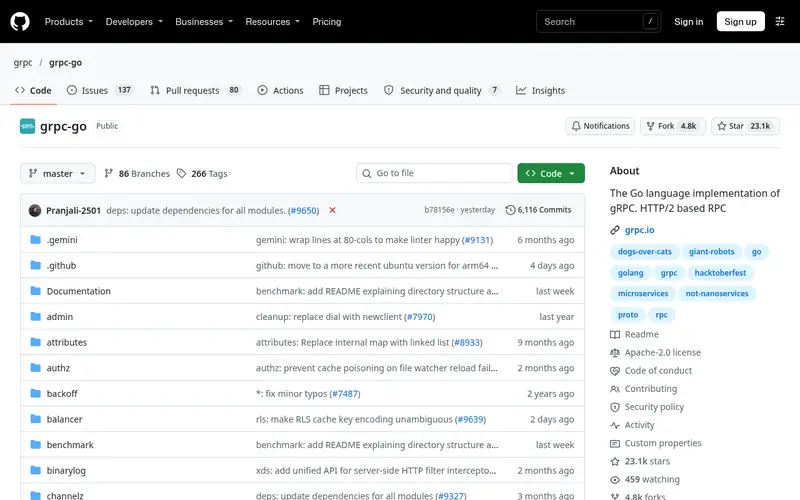
grpc-go is the official Go implementation of gRPC. You define services in .proto files, generate Go code with protoc and the Go plugin, and implement the server and client stubs. It runs on any platform Go supports and uses HTTP/2 as the transport. Unary calls, client streaming, server streaming and bidirectional streaming are all supported.
The project is maintained under the grpc organization on GitHub and is released under the Apache 2.0 licence. There is no paid tier. The main cost is setup: you need a Protobuf toolchain, and browser clients cannot call a gRPC server directly without gRPC-Web and a proxy. Teams that want a single protocol across many languages and heavy streaming use often pick it. Teams that want plain HTTP endpoints with no code generation should look at Connect or Twirp instead.
Standout: Mature and widely adopted
Free (open source), as listed by the vendor (grpc-go website). Confirm the current plan price before you buy.
Free plan. Plans change, so confirm on the vendor's pricing page before you buy.
Benefits
- Mature and widely adopted
- Supports unary and streaming RPC over HTTP/2
Drawbacks
- Protobuf and code generation add setup work
- Browser clients need a proxy or gRPC-Web
Skip it if this limit matters to you: protobuf and code generation add setup work.
Verdict. A sensible pick for teams needing mature gRPC with streaming in Go.
Alternatives in this guide: Connect RPC (connect-go), Twirp, DRPC (storj)
Connect RPC (connect-go)
Best for teams wanting gRPC compatibility plus HTTP/JSON
What it is and where it fits
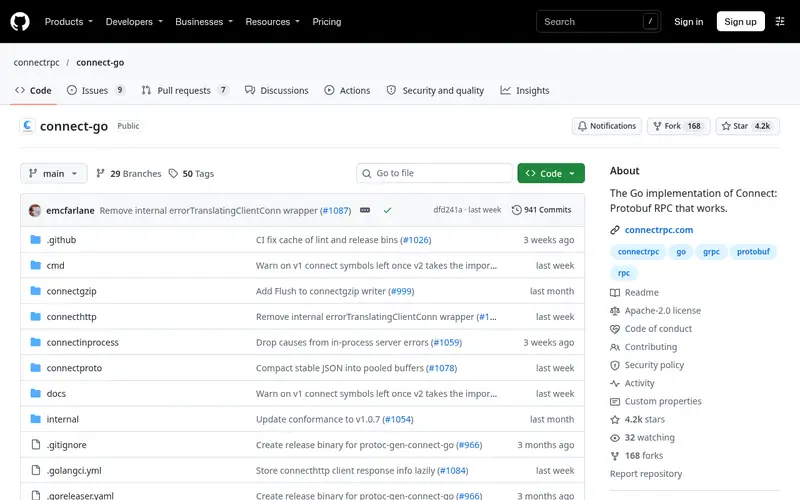
connect-go is the Go implementation of the Connect protocol. A single generated handler can answer gRPC, gRPC-Web and the Connect protocol, which is plain HTTP with JSON or Protobuf payloads. That means browser clients and simple curl calls work without a separate proxy. Handlers plug into net/http, so standard middleware and routers apply.
The project lives under the connectrpc organization and is released under the Apache 2.0 licence. It is free with no paid tier. Code generation uses the standard Protobuf plugins plus the Connect plugin. Streaming is supported, but some gRPC-specific behaviors depend on which protocol a client uses. Teams that already run grpc-go and need nothing beyond it have little reason to switch. Teams that want HTTP-friendly RPC and browser support from one codebase should evaluate it.
Standout: One handler set serves gRPC, gRPC-Web and Connect protocol
Free (open source), as listed by the vendor (Connect RPC (connect-go) website). Confirm the current plan price before you buy.
Free plan. Plans change, so confirm on the vendor's pricing page before you buy.
Benefits
- One handler set serves gRPC, gRPC-Web and Connect protocol
- Works with net/http and standard middleware
Drawbacks
- Smaller ecosystem than grpc-go
- Some gRPC features depend on the protocol in use
Skip it if this limit matters to you: smaller ecosystem than grpc-go.
Verdict. A sensible pick for teams wanting gRPC compatibility plus HTTP/JSON.
Alternatives in this guide: grpc-go, Twirp, DRPC (storj)
Twirp
Best for simple Protobuf RPC over HTTP with minimal tooling
What it is and where it fits
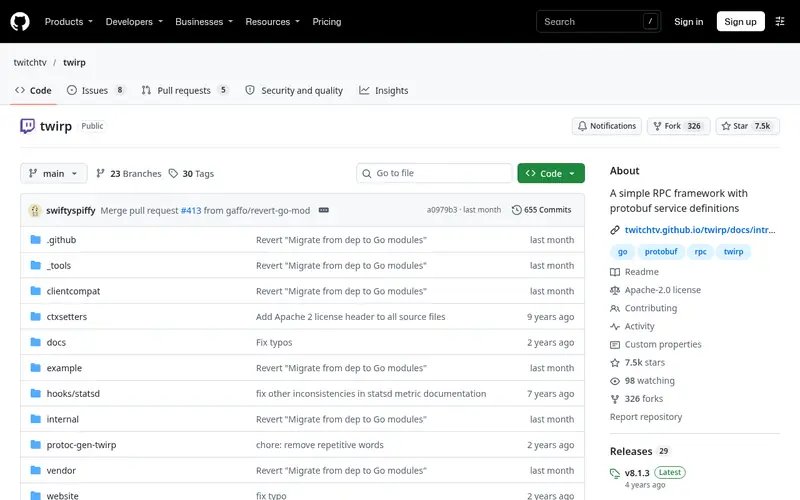
Twirp is an RPC framework from Twitch that defines services in .proto files and serves them over HTTP/1.1 or HTTP/2 using Protobuf or JSON payloads. It generates Go servers and clients, and clients exist for several other languages. The runtime is small and the routing model is easy to reason about, which helps when debugging with ordinary HTTP tools.
Twirp is released under the Apache 2.0 licence and is free. It does not support streaming RPC; every call is unary request and response. It also has a smaller community than gRPC, so fewer third-party integrations exist. It suits internal services where unary calls are enough and you want less machinery than a full gRPC stack. Teams that need bidirectional streaming should use grpc-go or Connect instead.
Standout: Small runtime with a simple HTTP model
Free (open source), as listed by the vendor (Twirp website). Confirm the current plan price before you buy.
Free plan. Plans change, so confirm on the vendor's pricing page before you buy.
Benefits
- Small runtime with a simple HTTP model
- Generated clients for Go and other languages
Drawbacks
- No streaming support
- Smaller community than gRPC
Skip it if this limit matters to you: no streaming support.
Verdict. A sensible pick for simple Protobuf RPC over HTTP with minimal tooling.
Alternatives in this guide: grpc-go, Connect RPC (connect-go), DRPC (storj)
DRPC (storj)
Best for lightweight Protobuf RPC without HTTP/2 dependency
What it is and where it fits
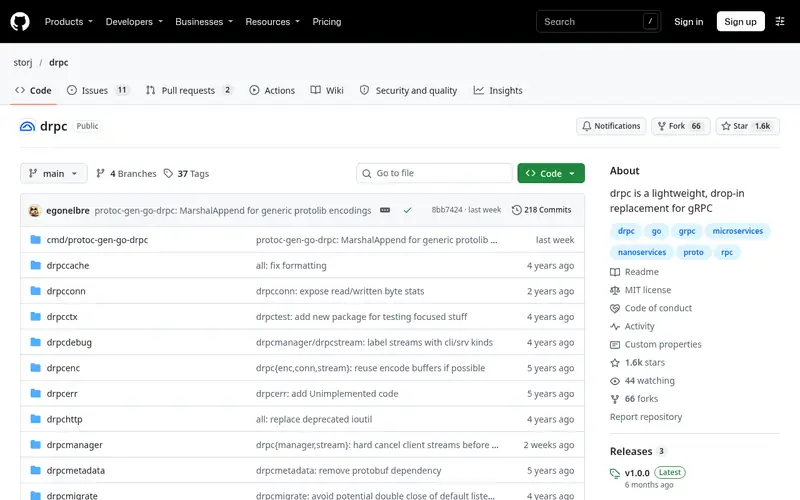
DRPC is an RPC framework from Storj that generates client and server stubs from .proto files. It does not depend on HTTP/2 or the gRPC runtime, so it can run over plain TCP connections or a transport you provide. The generated code is small and the wire format is Protobuf-based.
The project is maintained in the Storj GitHub organization under a permissive open-source licence and is free to use. Its adoption is concentrated in Storj's own distributed storage work, so public examples and third-party tooling are limited compared with gRPC. It supports streaming through its generated interfaces. It suits teams that want Protobuf RPC with a small dependency footprint and are comfortable with a narrower ecosystem. Most new projects with cross-language needs are better served by grpc-go or Connect.
Standout: Small codebase with generated stubs
Free (open source), as listed by the vendor (DRPC (storj) website). Confirm the current plan price before you buy.
Free plan. Plans change, so confirm on the vendor's pricing page before you buy.
Benefits
- Small codebase with generated stubs
- Works over plain TCP or custom transports
Drawbacks
- Niche adoption outside its origin project
- Fewer integrations and examples
Skip it if this limit matters to you: niche adoption outside its origin project.
Verdict. A sensible pick for lightweight Protobuf RPC without HTTP/2 dependency.
Alternatives in this guide: grpc-go, Connect RPC (connect-go), Twirp
net/rpc (Go standard library)
Best for legacy Go-to-Go RPC code already in use
What it is and where it fits
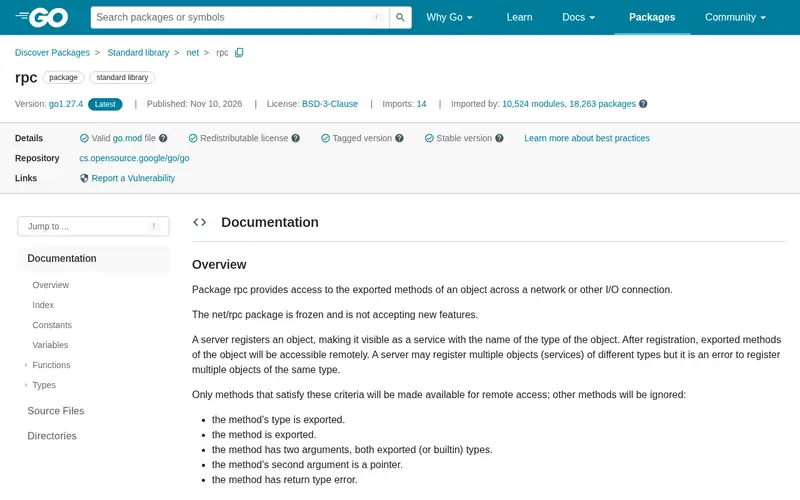
net/rpc is part of the Go standard library. It exposes methods on registered types over a connection, with a default gob codec and an optional JSON codec. Because it ships with Go, there is nothing to install and no code generation step.
The package is frozen: the Go team has said it will not add new features, and it is kept for compatibility. It is Go-only in practice because the default encoding is gob, and it has no streaming model or cross-language support. It is free as part of the Go distribution. New services should not start on net/rpc. Existing code that already uses it can keep running, but teams planning new RPC work should choose grpc-go, Connect or Twirp.
Standout: Ships with Go with no extra dependency
Free, as listed by the vendor (net/rpc (Go standard library) website). Confirm the current plan price before you buy.
Free plan. Plans change, so confirm on the vendor's pricing page before you buy.
Benefits
- Ships with Go with no extra dependency
- Simple API for Go-to-Go calls
Drawbacks
- Frozen and not accepting new features
- Gob encoding is Go-specific
Skip it if this limit matters to you: frozen and not accepting new features.
Verdict. A sensible pick for legacy Go-to-Go RPC code already in use.
Alternatives in this guide: grpc-go, Connect RPC (connect-go), Twirp
Kratos
Best for teams wanting a full Go microservice framework with RPC
What it is and where it fits
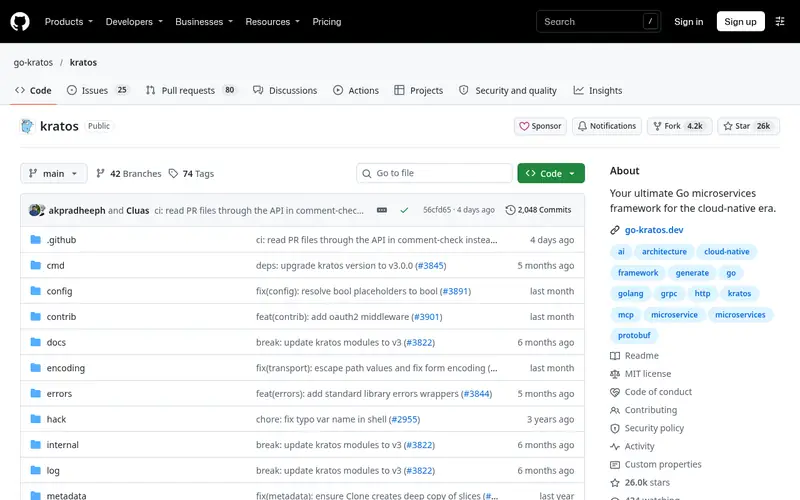
Kratos is a microservice framework from the go-kratos organization. It generates service code from .proto files and supports both gRPC and HTTP transports, with middleware for logging, tracing, recovery and similar concerns. It also provides configuration and registry integrations.
The project is released under the MIT licence and is free. It is a full framework, so it brings an opinionated layout and a larger surface to learn than a bare RPC library. It suits teams starting a new Go microservice estate that want transport, middleware and code generation decided up front. Teams with a small service or an existing stack should weigh whether the framework overhead is worth it against grpc-go alone.
Standout: Includes gRPC and HTTP transports plus code generation
Free (open source), as listed by the vendor (Kratos website). Confirm the current plan price before you buy.
Free plan. Plans change, so confirm on the vendor's pricing page before you buy.
Benefits
- Includes gRPC and HTTP transports plus code generation
- Built-in middleware for logging, tracing and recovery
Drawbacks
- Larger framework to learn
- Opinionated project layout
Skip it if this limit matters to you: larger framework to learn.
Verdict. A sensible pick for teams wanting a full Go microservice framework with RPC.
Alternatives in this guide: grpc-go, Connect RPC (connect-go), Twirp
Who should use what
Teams building cross-language services with streaming should start with grpc-go. Teams that need browser clients and plain HTTP alongside gRPC should look at Connect RPC. Teams with simple unary internal services should consider Twirp. Teams that want a full framework with code generation and middleware should evaluate Kratos. Anyone maintaining existing net/rpc code should plan a migration rather than start new work on it.
Questions to settle before you buy
What to check before you buy
- Confirm the project has recent commits and tagged releases.
- Check whether you need streaming, and whether the framework supports it.
- Verify the licence fits your organization's policy.
- Decide whether code generation from .proto files fits your build pipeline.
- Check client support for every language your services must talk to.
FAQ
Is grpc-go free to use?
Yes. grpc-go is open source under the Apache 2.0 licence and has no paid tier. You pay only in setup effort for the Protobuf toolchain and in the operational work of running gRPC services.
Can I use gRPC from a browser?
Not directly with grpc-go alone. Browsers need gRPC-Web and a proxy, or a framework like Connect RPC that serves gRPC-Web and HTTP/JSON from the same Go handlers.
Should I start a new project with net/rpc?
No. net/rpc is frozen and will not gain new features. It is Go-only in practice and has no streaming. New services should use grpc-go, Connect RPC or Twirp depending on their needs.
Does Twirp support streaming?
No. Twirp calls are unary request and response only. If you need client, server or bidirectional streaming, use grpc-go or Connect RPC.
Do these frameworks send my data to a third party?
No. They are libraries and servers that run in your own infrastructure. Nothing is sent to the project maintainers. Review your own logging and tracing setup, since middleware can record request data.
Sources we checked
Method: how we score · editorial policy.
Change log. First published 27 Nov 2026.