Stage 02 · Test · Researched comparison
Best Go HTTP Clients in 2026
Start with Go's standard net/http package. It is free, maintained by the Go team, and covers most client work without extra dependencies. Add github.com/go-resty/resty/v2 when you want a fluent API, automatic retries and built-in JSON handling with less boilerplate. Use github.com/hashicorp/go-retryablehttp when you need retry and backoff logic wrapped around the standard client without changing the rest of your code.

By Shihab Mia
Published 27 Nov 2026 · 5 tools compared
We run no ads and no affiliate links at launch. The order of a list follows our published method. See how we score.
Prices are the starting prices vendors list publicly. Plans change, so confirm the current price on the vendor page before you buy.
Key takeaways
- net/http is the default choice and needs no third-party dependency.
- Resty and retryablehttp are free, open-source wrappers that add retries and helpers.
- All five tools listed here are Go libraries, so no request data leaves your machine.
- Licence terms differ: most are MIT, but check each repository before shipping.
Who each pick is for
- Most projects that need a dependable HTTP clientnet/http (standard library)
- Teams that want a fluent client with retries and JSON helpersResty
- Adding retries and backoff to an existing net/http clientretryablehttp (HashiCorp)
- Clients that need retries, backoff and circuit breakingHeimdall
- Reusing correctly configured net/http transportsgo-cleanhttp
Comparison
| Tool | Best for | Standout feature | Listed starting price | Free plan or trial |
|---|---|---|---|---|
| 1net/http (standard library) | Most projects that need a dependable HTTP client | Ships with Go and needs no dependency | Free (open source) | Free plan |
| 2Resty | Teams that want a fluent client with retries and JSON helpers | Chainable request builder | Free (open source) | Free plan |
| 3retryablehttp (HashiCorp) | Adding retries and backoff to an existing net/http client | Drop-in wrapper around net/http | Free (open source) | Free plan |
| 4Heimdall | Clients that need retries, backoff and circuit breaking | HTTP client with retry, backoff and hystrix-style circuit breaker | Free (open source) | Free plan |
| 5go-cleanhttp | Reusing correctly configured net/http transports | Small helper for sane transport defaults | Free (open source) | Free plan |
How we picked
We picked libraries that are real, standalone Go packages and are currently maintained or part of the standard library. Criteria were fit for common client jobs (retries, middleware, transport reuse), platform coverage, licence terms, and whether request data stays local. All entries are libraries, so no request data is sent to a third party. Sources are vendor pages, project repositories and package documentation. Prices and licence terms can change, so confirm on the repository before you commit.
The tools, one by one
net/http (standard library)
Best for most projects that need a dependable HTTP client
What it is and where it fits
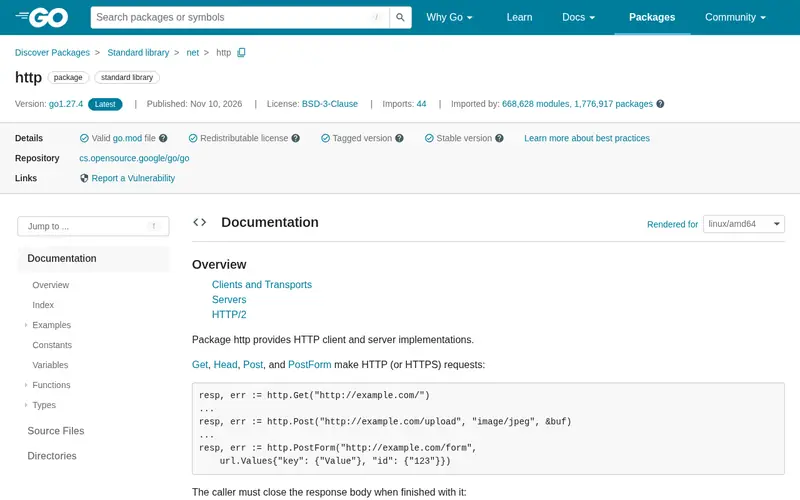
net/http is the client that ships with the Go toolchain. It runs on every platform Go supports, including Linux, macOS, Windows and the major BSDs. The Client type gives you connection pooling through Transport, per-request context cancellation, redirect policies and cookie handling. You set timeouts on the Client or the Transport, and you control TLS configuration directly.
Because it is part of the standard library, there is no version to pin and no supply-chain surface beyond Go itself. The trade-off is boilerplate: retries, exponential backoff, request logging and JSON decoding are left to you. For internal services and one-off calls that is usually fine. Skip it as your only client if you make many calls to flaky third-party APIs and want retry behavior out of the box.
Standout: Ships with Go and needs no dependency
Free (open source), as listed by the vendor (net/http (standard library) website). Confirm the current plan price before you buy.
Free plan. Plans change, so confirm on the vendor's pricing page before you buy.
Benefits
- Ships with Go and needs no dependency
- full control over transports, timeouts and TLS
Drawbacks
- Retries, backoff and JSON helpers require your own code
- verbose for simple calls
Skip it if this limit matters to you: retries, backoff and JSON helpers require your own code.
Verdict. A sensible pick for most projects that need a dependable HTTP client.
Alternatives in this guide: Resty, retryablehttp (HashiCorp), Heimdall
Resty
Best for teams that want a fluent client with retries and JSON helpers
What it is and where it fits
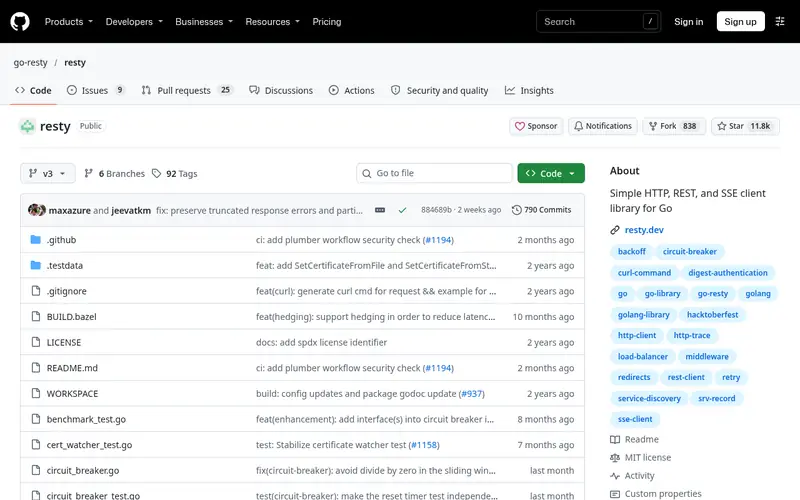
Resty is a widely used HTTP client library for Go. It wraps net/http with a fluent builder: SetHeader, SetBody, SetResult and similar methods chain into a single call. It includes configurable retry counts, wait times and retry conditions, plus automatic marshalling of request and response bodies for JSON and XML. It runs wherever Go runs.
The project is open source under the MIT licence. Resty is a good fit when your service talks to several external APIs and you want consistent retry and logging behavior without writing it each time. It is less suitable if you want zero dependencies or need fine control over the transport that the wrapper does not expose. Check the repository for the current major version before you import it.
Standout: Chainable request builder
Free (open source), as listed by the vendor (Resty website). Confirm the current plan price before you buy.
Free plan. Plans change, so confirm on the vendor's pricing page before you buy.
Benefits
- Chainable request builder
- built-in retry, backoff and JSON/XML marshalling
Drawbacks
- Adds a dependency
- its own API layer sits over net/http
Skip it if this limit matters to you: adds a dependency.
Verdict. A sensible pick for teams that want a fluent client with retries and JSON helpers.
Alternatives in this guide: net/http (standard library), retryablehttp (HashiCorp), Heimdall
retryablehttp (HashiCorp)
Best for adding retries and backoff to an existing net/http client
What it is and where it fits
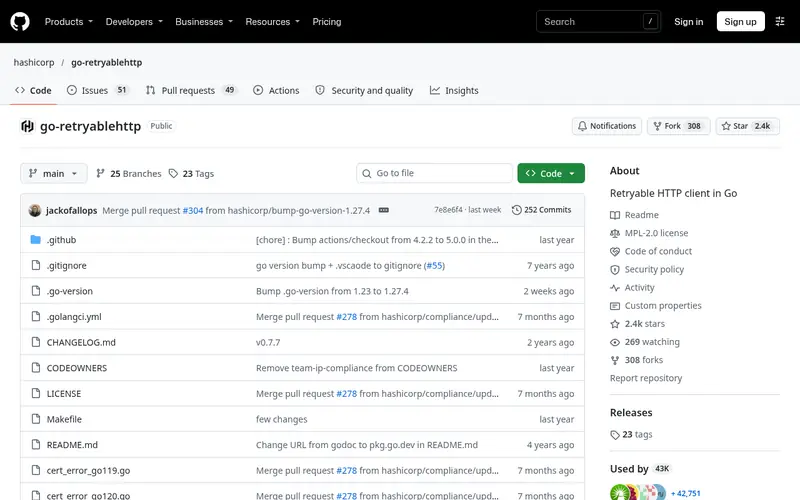
retryablehttp is a small library from HashiCorp that wraps the standard client with retry logic. You create a retryablehttp.Client, set RetryMax, RetryWaitMin and RetryWaitMax, and it retries on connection errors and on 500-level responses by default. A custom CheckRetry function lets you decide which responses are worth retrying. It is used inside several HashiCorp tools.
It runs on any platform Go supports and is open source under the Mozilla Public License 2.0. The scope is deliberately narrow: it does not give you a fluent API or body marshalling. That makes it easy to adopt in an existing codebase that already uses net/http. Skip it if you want an all-in-one client with JSON helpers; pair it with your own code or choose Resty instead.
Standout: Drop-in wrapper around net/http
Free (open source), as listed by the vendor (retryablehttp (HashiCorp) website). Confirm the current plan price before you buy.
Free plan. Plans change, so confirm on the vendor's pricing page before you buy.
Benefits
- Drop-in wrapper around net/http
- configurable retry policy and backoff
Drawbacks
- Focused on retries only
- no request builder or JSON helpers
Skip it if this limit matters to you: focused on retries only.
Verdict. A sensible pick for adding retries and backoff to an existing net/http client.
Alternatives in this guide: net/http (standard library), Resty, Heimdall
Heimdall
Best for clients that need retries, backoff and circuit breaking
What it is and where it fits
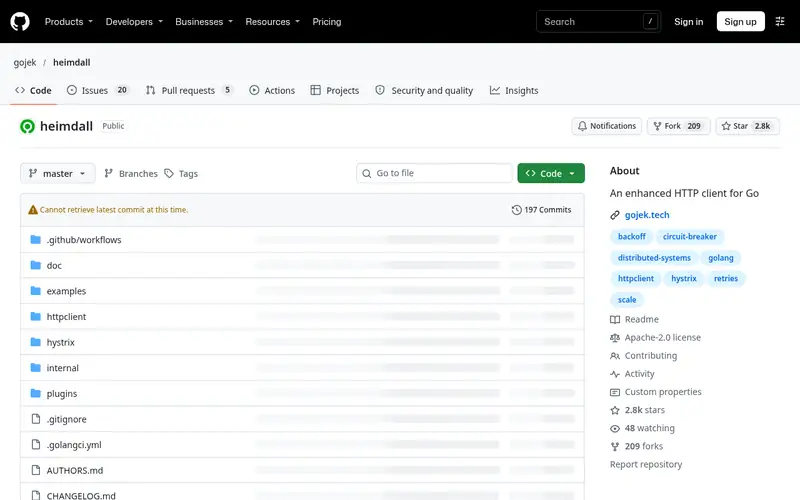
Heimdall is an HTTP client from Gojek that adds retry, backoff and circuit breaking on top of net/http. You pick a client type, such as a retry client or a hystrix client, and it handles the failure logic. That makes it useful when a downstream service is unreliable and you want to stop hammering it during an outage.
It is open source and runs on all Go platforms. Before adopting it, check the repository for recent commits and open issues, because maintenance activity has slowed compared with its peak. If you need active development and a large user base, Resty or retryablehttp are safer. Heimdall still fits teams that specifically want circuit breaking in the client layer and are comfortable with the project's pace.
Standout: HTTP client with retry, backoff and hystrix-style circuit breaker
Free (open source), as listed by the vendor (Heimdall website). Confirm the current plan price before you buy.
Free plan. Plans change, so confirm on the vendor's pricing page before you buy.
Benefits
- HTTP client with retry, backoff and hystrix-style circuit breaker
- simple API
Drawbacks
- Project activity is slower than in earlier years
- check maintenance status
Skip it if this limit matters to you: project activity is slower than in earlier years.
Verdict. A sensible pick for clients that need retries, backoff and circuit breaking.
Alternatives in this guide: net/http (standard library), Resty, retryablehttp (HashiCorp)
go-cleanhttp
Best for reusing correctly configured net/http transports
What it is and where it fits
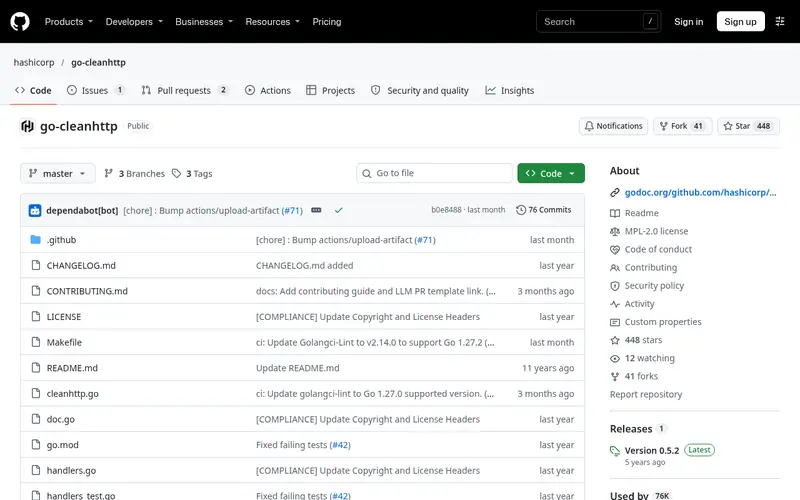
go-cleanhttp is a tiny HashiCorp library that returns a cloned, correctly configured http.Transport. The problem it solves is common: creating a new Transport for every request leaks connections and defeats pooling. cleanhttp gives you a shared transport with sensible defaults for timeouts and idle connections.
It is open source under the Mozilla Public License 2.0 and runs on every Go platform. It is not a full client, so it does not replace Resty or retryablehttp. Use it alongside net/http when you build clients in several places and want consistent transport settings. Skip it if you already manage a single shared Transport in your code; the benefit is small at that point.
Standout: Small helper for sane transport defaults
Free (open source), as listed by the vendor (go-cleanhttp website). Confirm the current plan price before you buy.
Free plan. Plans change, so confirm on the vendor's pricing page before you buy.
Benefits
- Small helper for sane transport defaults
- avoids per-request transport leaks
Drawbacks
- Not a full client
- does not add retries or helpers
Skip it if this limit matters to you: not a full client.
Verdict. A sensible pick for reusing correctly configured net/http transports.
Alternatives in this guide: net/http (standard library), Resty, retryablehttp (HashiCorp)
Who should use what
If you are writing a small service or a CLI and want no dependencies, use net/http. If your service calls several external APIs and you want retries, backoff and JSON helpers in one place, use Resty. If you already have a net/http codebase and only need retry logic, add retryablehttp. If you specifically need circuit breaking, evaluate Heimdall and check its maintenance status first. If you keep creating transports in several packages, go-cleanhttp fixes that with little code.
Questions to settle before you buy
What to check before you buy
- Confirm the module path and current major version in the repository before importing.
- Read the licence and check it matches your organization's policy.
- Set explicit timeouts on the client or transport; defaults can hang.
- Reuse one Transport per client instead of creating one per request.
- Check the repository's recent commit activity and open issues for maintenance signals.
FAQ
Do I need a third-party HTTP client in Go?
No. net/http covers most needs, including timeouts, TLS and connection pooling. Add a library when you want retries, backoff, a fluent builder or shared middleware without writing that code yourself. Start with the standard library and add a wrapper only when the boilerplate becomes a real cost.
Is Resty a replacement for net/http?
Resty wraps net/http rather than replacing it. You can still set a custom Transport and TLS config. It adds a fluent request builder, retry settings and body marshalling. If you need behavior Resty does not expose, you can drop down to the underlying client.
Are these libraries free?
Yes. All five entries are open source with no paid tier. Licences differ: net/http is part of Go, Resty is MIT, and retryablehttp and go-cleanhttp use the Mozilla Public License 2.0. Check each repository for the exact terms before shipping.
Do these clients send my request data anywhere?
No. They are Go libraries that run in your process. Requests go only to the hosts you call. That said, review any middleware or logging plugin you add, because it may write headers or bodies to logs.
Which client is best for retries?
retryablehttp is the narrowest fit: it wraps net/http with configurable retry counts and backoff. Resty includes retries plus a full request API. Heimdall adds circuit breaking. Pick based on whether you want retries alone or retries as part of a larger client.
Sources we checked
Method: how we score · editorial policy.
Change log. First published 27 Nov 2026.