Stage 02 · Test · Researched comparison
Best Go Email Libraries in 2026
go-mail (wneessen/go-mail) is the first pick for most teams sending mail from Go. It covers attachments, HTML and plain-text parts, SMTP auth and connection pooling in one maintained package. Choose emersion/go-message plus emersion/go-imap if your job is parsing messages or reading a mailbox rather than sending.

By Shihab Mia
Published 28 Nov 2026 · 5 tools compared
We run no ads and no affiliate links at launch. The order of a list follows our published method. See how we score.
Prices are the starting prices vendors list publicly. Plans change, so confirm the current price on the vendor page before you buy.
Key takeaways
- go-mail is actively maintained and handles sending, attachments, templates and connection reuse.
- The standard library net/smtp is frozen and low-level.
- emersion/go-message and emersion/go-imap cover parsing and IMAP reading, not sending.
- All listed libraries are free and open source, so cost is maintenance effort, not licence fees.
Who each pick is for
- General-purpose sending with attachments and templatesgo-mail
- Minimal dependencies and full control over the SMTP dialoguenet/smtp (standard library)
- Parsing and generating MIME messagesemersion/go-message
- Reading and managing mailboxes over IMAPemersion/go-imap
- Teams already sending through the SendGrid APIsendgrid-go
Comparison
| Tool | Best for | Standout feature | Listed starting price | Free plan or trial |
|---|---|---|---|---|
| 1go-mail | General-purpose sending with attachments and templates | Actively maintained | Free (open source) | Free plan |
| 2net/smtp (standard library) | Minimal dependencies and full control over the SMTP dialogue | Ships with Go, so no dependency to manage | Free | Free plan |
| 3emersion/go-message | Parsing and generating MIME messages | Handles MIME headers, multipart bodies and charset decoding | Free (open source) | Free plan |
| 4emersion/go-imap | Reading and managing mailboxes over IMAP | Full IMAP client with mailbox and message operations | Free (open source) | Free plan |
| 5sendgrid-go | Teams already sending through the SendGrid API | Official SDK for the SendGrid v3 API | See vendor pricing page | Free trial (See vendor terms) |
How we picked
We picked libraries that do the sending, parsing or mailbox job named for this guide and are currently maintained or part of the Go standard library. Criteria were fit for the task, platform support (all run wherever Go runs), licence and price, and the main limits such as missing features or provider lock-in. Sources are vendor pages, official documentation and project repositories. Prices and free-tier terms change, so confirm them on the vendor site before you commit.
The tools, one by one
go-mail
Best for general-purpose sending with attachments and templates
What it is and where it fits
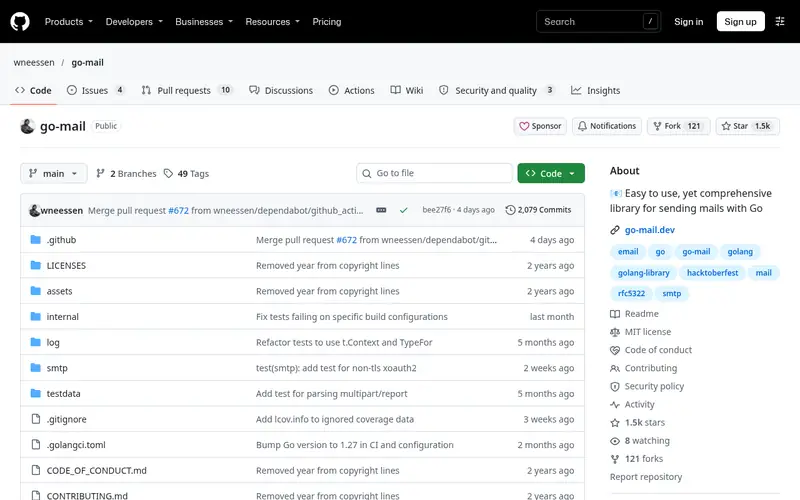
go-mail is a sending-focused package. You build a message with a fluent API, add To, Cc and Bcc recipients, attach files, set HTML and plain-text bodies, and hand it to a client that manages SMTP connections. It supports SMTP authentication mechanisms, TLS options and connection reuse, which matters when you send in bulk from a long-running service. It runs anywhere Go runs.
The licence is open source, so there is no fee. The main cost is learning the message and client types. It does not read mailboxes; for that you need an IMAP client. Teams that only need a one-line send may find it heavier than necessary, but services that send mixed content will use most of its features.
Standout: Actively maintained
Free (open source), as listed by the vendor (go-mail website). Confirm the current plan price before you buy.
Free plan. Plans change, so confirm on the vendor's pricing page before you buy.
Benefits
- Actively maintained
- rich message building with attachments and multiple body parts
Drawbacks
- Larger API surface to learn
- opinionated message model
Skip it if this limit matters to you: larger API surface to learn.
Verdict. A sensible pick for general-purpose sending with attachments and templates.
Alternatives in this guide: net/smtp (standard library), emersion/go-message, emersion/go-imap
net/smtp (standard library)
Best for minimal dependencies and full control over the SMTP dialogue
What it is and where it fits
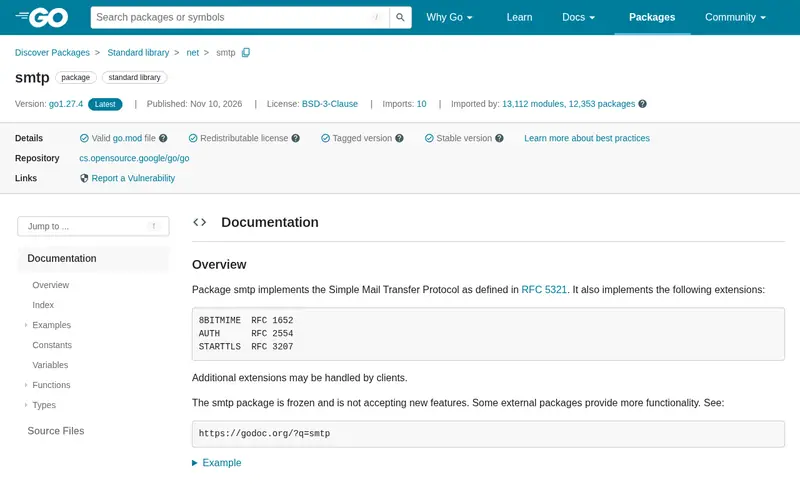
net/smtp is part of the Go standard library. It gives you a client for the SMTP protocol: connect, authenticate, set a sender and recipients, and write the message data. It does not build MIME messages, so HTML bodies, attachments and encoded headers are your responsibility, usually with mime/multipart from the standard library.
It costs nothing and adds no dependency. The trade-off is that the package is frozen: the Go team has said it will not gain new features, and it lacks conveniences such as connection pooling. It is a reasonable choice for a tiny internal sender where you control the message format, and a poor fit for anything that needs attachments or rich content without extra code.
Standout: Ships with Go, so no dependency to manage
Free, as listed by the vendor (net/smtp (standard library) website). Confirm the current plan price before you buy.
Free plan. Plans change, so confirm on the vendor's pricing page before you buy.
Benefits
- Ships with Go, so no dependency to manage
- direct access to SMTP commands
Drawbacks
- Frozen and in maintenance mode
- you build MIME messages yourself
Skip it if this limit matters to you: frozen and in maintenance mode.
Verdict. A sensible pick for minimal dependencies and full control over the SMTP dialogue.
Alternatives in this guide: go-mail, emersion/go-message, emersion/go-imap
emersion/go-message
Best for parsing and generating MIME messages
What it is and where it fits
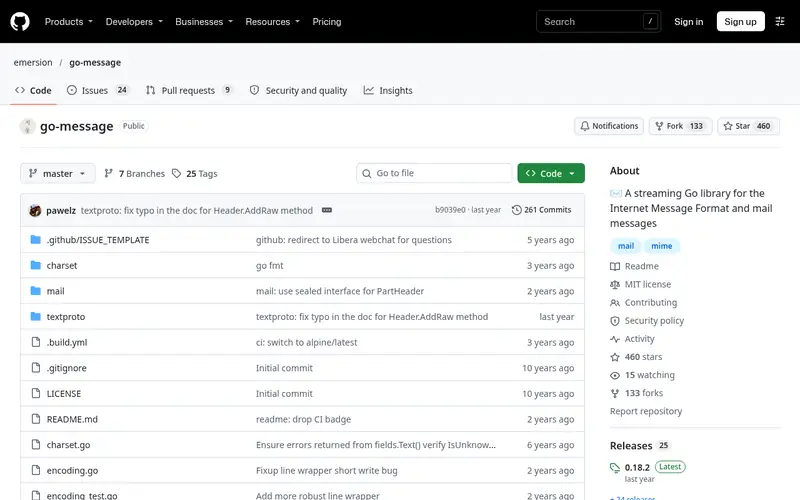
go-message is a MIME library. It reads and writes message headers and bodies, walks multipart structures, and decodes transfer encodings and charsets. If your job is to ingest mail, extract attachments or render HTML and plain-text parts, this is the piece that does the parsing work. It runs anywhere Go runs and has no runtime dependencies beyond the Go module graph.
It is open source with no paid tier. It is not a mail sender and does not talk to a server; you combine it with an SMTP client for sending or an IMAP client for reading. Teams building mail-processing pipelines, archiving tools or inbox features should start here rather than hand-rolling MIME parsing, which is easy to get wrong on edge cases.
Standout: Handles MIME headers, multipart bodies and charset decoding
Free (open source), as listed by the vendor (emersion/go-message website). Confirm the current plan price before you buy.
Free plan. Plans change, so confirm on the vendor's pricing page before you buy.
Benefits
- Handles MIME headers, multipart bodies and charset decoding
- pairs with go-imap
Drawbacks
- Parsing-focused, so it is not a sender on its own
Skip it if this limit matters to you: parsing-focused, so it is not a sender on its own.
Verdict. A sensible pick for parsing and generating MIME messages.
Alternatives in this guide: go-mail, net/smtp (standard library), emersion/go-imap
emersion/go-imap
Best for reading and managing mailboxes over IMAP
What it is and where it fits
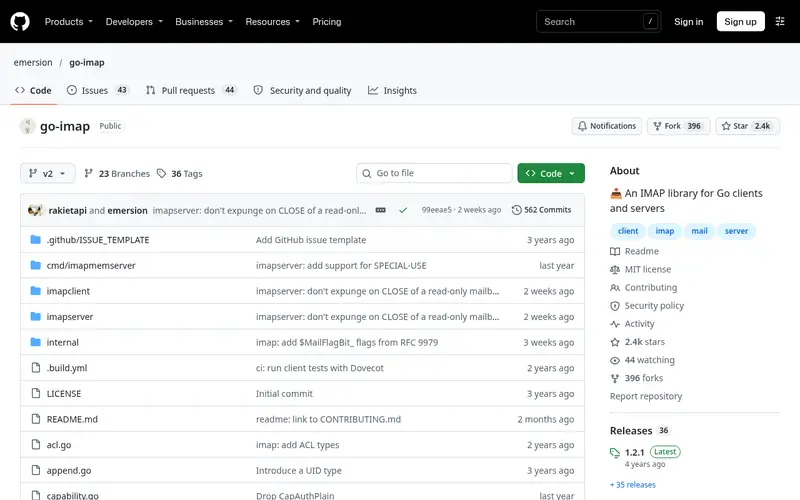
go-imap is an IMAP client library. You connect to a mail server, authenticate, list mailboxes, search, fetch messages and flags, and move or delete mail. Combined with go-message, it covers the read side of an email feature: pull a message, parse its MIME structure, and present the parts.
It is open source with no paid tier. It does not send mail, so a sending library is still required. IMAP servers differ in extensions and quirks, so test against the providers you actually use. It suits inbox-style features, mailbox sync tools and support-desk integrations. Skip it if you only need outbound notifications, where a sender alone is enough.
Standout: Full IMAP client with mailbox and message operations
Free (open source), as listed by the vendor (emersion/go-imap website). Confirm the current plan price before you buy.
Free plan. Plans change, so confirm on the vendor's pricing page before you buy.
Benefits
- Full IMAP client with mailbox and message operations
- works with go-message for parsing
Drawbacks
- IMAP only, so sending needs a separate SMTP library
- protocol details leak into your code
Skip it if this limit matters to you: IMAP only, so sending needs a separate SMTP library.
Verdict. A sensible pick for reading and managing mailboxes over IMAP.
Alternatives in this guide: go-mail, net/smtp (standard library), emersion/go-message
sendgrid-go
Best for teams already sending through the SendGrid API
What it is and where it fits
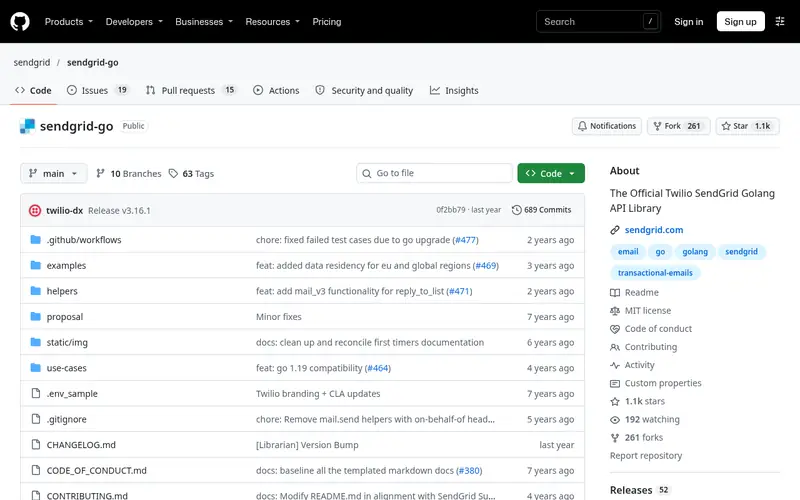
sendgrid-go is the official Go client for SendGrid's HTTP API. Instead of speaking SMTP, you build a mail object and post it to the API, which handles delivery, templates and provider-side tracking. It runs anywhere Go runs and is published as an open-source module, but actual sending needs a SendGrid account and API key.
Pricing is set by SendGrid and changes, so check the vendor pricing page for current plans and free-tier limits rather than relying on secondhand figures. The trade-off is lock-in: your send code depends on one provider's API shape. It suits teams that already use SendGrid for deliverability and analytics. If you want provider independence, keep a plain SMTP sender such as go-mail behind a small interface.
Standout: Official SDK for the SendGrid v3 API
See vendor pricing page, as listed by the vendor (sendgrid-go website). Confirm the current plan price before you buy.
Free trial (See vendor terms). Plans change, so confirm on the vendor's pricing page before you buy.
Benefits
- Official SDK for the SendGrid v3 API
- handles templates and delivery features
Drawbacks
- Ties your code to one provider
- sending requires a SendGrid account
Skip it if this limit matters to you: ties your code to one provider.
Verdict. A sensible pick for teams already sending through the SendGrid API.
Alternatives in this guide: go-mail, net/smtp (standard library), emersion/go-message
Who should use what
A backend service sending signup and receipt emails should start with go-mail for attachments, HTML bodies and connection reuse. A small script or internal tool that sends plain notifications can use net/smtp and skip the extra API. A team building inbox features, archiving or mail processing needs go-imap for reading and go-message for MIME parsing, with a sender added for replies. A company already on SendGrid for deliverability can use sendgrid-go and hide it behind an interface so the provider can change later.
Questions to settle before you buy
What to check before you buy
- Check the repository's last commit and open issues to confirm the library is maintained.
- Confirm the library covers your message shape: HTML, plain text, attachments, custom headers.
- Decide whether you need SMTP, a provider HTTP API, or both, and keep the choice behind an interface.
- Test against the real mail providers you use, including TLS and auth settings.
- Plan for timeouts, retries and rate limits so a slow mail server does not stall your service.
FAQ
Is net/smtp still usable in Go?
Yes. It ships with Go and works for basic sending. It is frozen, meaning it will not gain new features, and it does not build MIME messages. For attachments or HTML bodies you add mime/multipart yourself or use a higher-level library such as go-mail.
What is the difference between go-mail and net/smtp?
go-mail has a larger feature set: richer message building, attachments, multiple body parts and connection reuse. net/smtp is a low-level SMTP client that ships with Go and leaves MIME message construction to you. Both are free. Choose go-mail for production services with mixed content and net/smtp for minimal-dependency sends where you control the message format.
Do I need a separate library to read email?
Yes, if you want to read a mailbox. Sending libraries such as go-mail do not read mail. Use emersion/go-imap to talk to the server and emersion/go-message to parse the MIME content of fetched messages.
Can I avoid provider lock-in?
Keep your send code behind a small interface in your own package and implement it with a plain SMTP library such as go-mail. Provider SDKs like sendgrid-go can sit behind the same interface, so switching providers means writing one new implementation.
Are these libraries free?
The Go libraries listed here are free and open source, including go-mail, go-message and go-imap. sendgrid-go is an open-source client, but sending through SendGrid requires an account, and its pricing is set by the vendor.
Sources we checked
Method: how we score · editorial policy.
Change log. First published 28 Nov 2026.