Stage 02 · Test · Researched comparison
Best Flutter Testing Libraries in 2026
flutter_test is the first pick for most teams. It ships with the Flutter SDK, runs widget and unit tests, and needs no extra dependency. For full app flows on devices and emulators, add integration_test, also from the SDK. If you need mocks, mocktail is the common choice because it avoids generated code. Teams that test native permission dialogs and real device interactions should look at Patrol.

By Shihab Mia
Published 27 Nov 2026 · 6 tools compared
We run no ads and no affiliate links at launch. The order of a list follows our published method. See how we score.
Prices are the starting prices vendors list publicly. Plans change, so confirm the current price on the vendor page before you buy.
Key takeaways
- flutter_test and integration_test are free parts of the Flutter SDK, so start there before adding packages.
- mocktail is free and open source and skips code generation.
- Patrol is free and open source and adds native automation on top of integration tests.
- alchemist and bloc_test are free, open-source packages for golden tests and bloc state tests.
Who each pick is for
- Widget and unit tests that ship with the SDKflutter_test
- End-to-end app flows on devices and emulatorsintegration_test
- Dart mocks without generated codemocktail
- Integration tests that touch native UIPatrol
- Golden tests with configurable themes and platformsalchemist
- Testing bloc and cubit state transitionsbloc_test
Comparison
| Tool | Best for | Standout feature | Listed starting price | Free plan or trial |
|---|---|---|---|---|
| 1flutter_test | Widget and unit tests that ship with the SDK | No extra dependency | Free (open source) | Free plan |
| 2integration_test | End-to-end app flows on devices and emulators | Part of the SDK | Free (open source) | Free plan |
| 3mocktail | Dart mocks without generated code | No build_runner step | Free (open source) | Free plan |
| 4Patrol | Integration tests that touch native UI | Handles native dialogs and permission prompts | Free (open source) | Free plan |
| 5alchemist | Golden tests with configurable themes and platforms | Handles platform and theme variants in one test | Free (open source) | Free plan |
| 6bloc_test | Testing bloc and cubit state transitions | Purpose-built matchers for emitted states | Free (open source) | Free plan |
How we picked
We picked libraries that cover distinct layers of Flutter testing: SDK widget tests, SDK integration tests, mocking, native-aware integration tests, golden tests and bloc state tests. Criteria were fit for the job, supported platforms, licence and price, and the main limits each tool documents. Sources are official Flutter API docs, vendor pages and project repositories. Prices and package behavior change, so confirm details on the vendor or repository page before you commit.
The tools, one by one
flutter_test
Best for widget and unit tests that ship with the SDK
What it is and where it fits
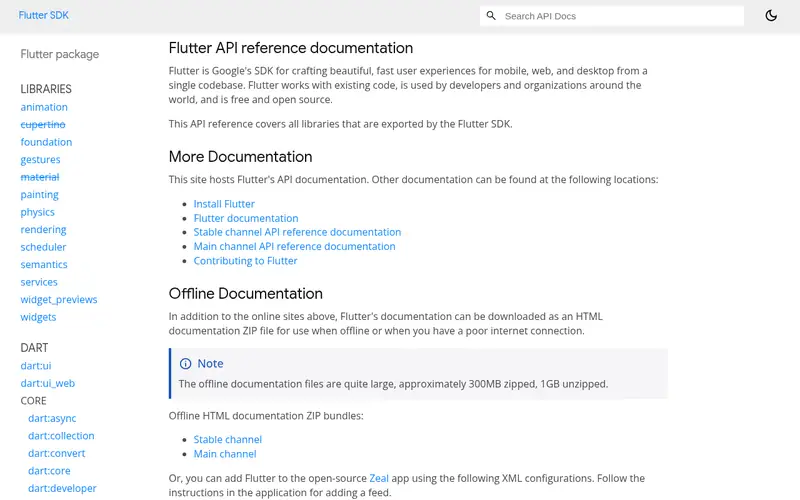
flutter_test is the testing library bundled with the Flutter SDK. It provides WidgetTester for pumping widgets, finders such as find.text and find.byType, and matchers like findsOneWidget. It also covers plain Dart unit tests through the test package that Flutter depends on.
It runs on any platform where you run flutter test, including CI machines with no device attached. Widget tests run in a simulated environment, so they are fast but do not exercise real platform channels or native UI. Golden file tests are possible here, but you manage the golden files and update commands yourself.
Use it as the base layer for unit and widget tests. Skip it only if you are testing something outside Flutter, such as a pure Dart backend package, where the test package alone is enough.
Standout: No extra dependency
Free (open source), as listed by the vendor (flutter_test website). Confirm the current plan price before you buy.
Free plan. Plans change, so confirm on the vendor's pricing page before you buy.
Benefits
- No extra dependency
- includes WidgetTester, finders and matchers
Drawbacks
- No native device automation
- golden tests need manual setup
Skip it if this limit matters to you: no native device automation.
Verdict. A sensible pick for widget and unit tests that ship with the SDK.
Alternatives in this guide: integration_test, mocktail, Patrol
integration_test
Best for end-to-end app flows on devices and emulators
What it is and where it fits
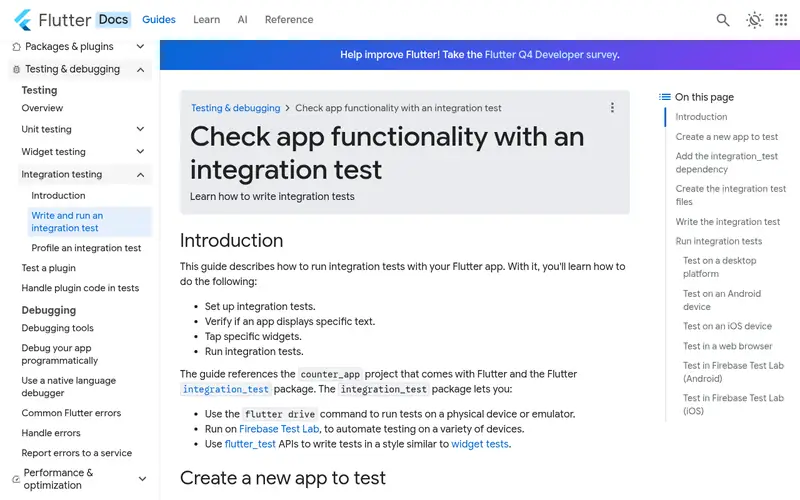
integration_test is the SDK package for driving a full app on a device, emulator or desktop target. You write tests with the same WidgetTester API as flutter_test, then run them with flutter test integration_test or through a device farm.
Because tests run against the real app, they catch wiring problems that widget tests miss: navigation, plugin calls, and startup behavior. The tradeoff is speed and setup. Each run needs a target device, and CI usually needs an emulator or a hosted device service.
It does not handle native dialogs, permission prompts or interactions outside the Flutter view. For those cases, pair it with Patrol or a native test tool. Teams with small apps and limited CI time often keep integration tests to a few critical paths.
Standout: Part of the SDK
Free (open source), as listed by the vendor (integration_test website). Confirm the current plan price before you buy.
Free plan. Plans change, so confirm on the vendor's pricing page before you buy.
Benefits
- Part of the SDK
- runs on real devices, emulators and desktop
Drawbacks
- Slower than widget tests
- some setup for driver and CI
Skip it if this limit matters to you: slower than widget tests.
Verdict. A sensible pick for end-to-end app flows on devices and emulators.
Alternatives in this guide: flutter_test, mocktail, Patrol
mocktail
Best for dart mocks without generated code
What it is and where it fits
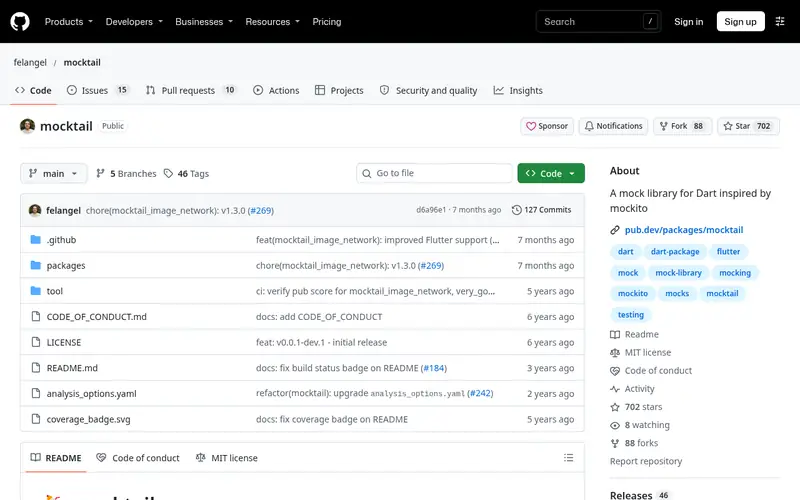
mocktail is a mock library for Dart and Flutter built by Felix Angelov. It lets you create mocks with Mock, stub calls with when, and verify with verify, all without running a code generator. That keeps test setup short and avoids stale generated files in the repository.
It works with null safety and supports registering fallback values for unstubbed calls, which matters when mocking classes that return non-nullable types. It runs anywhere Dart runs, so it fits unit tests and widget tests alike.
The main limit is that mocks are written by hand, so a renamed method shows up at runtime rather than at compile time. Teams that prefer generated mocks with stricter typing often pick a code-generation-based mock library instead. Both approaches are free, so the choice is mostly about workflow.
Standout: No build_runner step
Free (open source), as listed by the vendor (mocktail website). Confirm the current plan price before you buy.
Free plan. Plans change, so confirm on the vendor's pricing page before you buy.
Benefits
- No build_runner step
- clear API for stubs and verification
Drawbacks
- No code generation means less compile-time checking
- manual fallback values
Skip it if this limit matters to you: no code generation means less compile-time checking.
Verdict. A sensible pick for dart mocks without generated code.
Alternatives in this guide: flutter_test, integration_test, Patrol
Patrol
Best for integration tests that touch native UI
What it is and where it fits
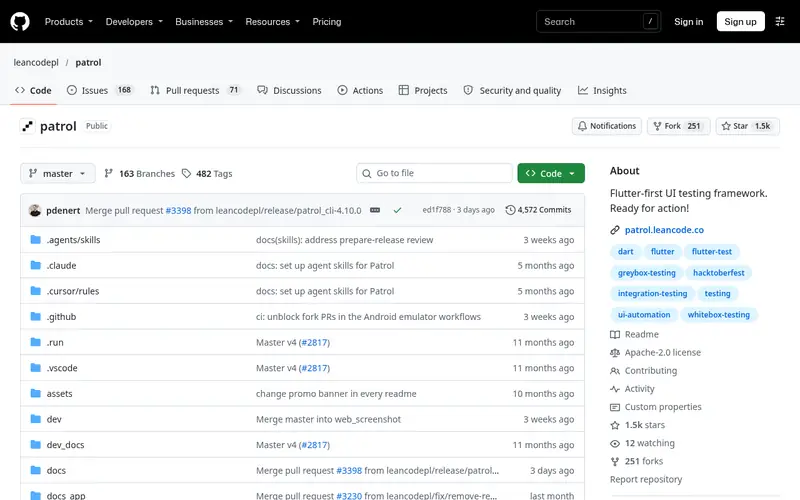
Patrol is an open-source testing framework from LeanCode. It extends Flutter integration tests so they can interact with native elements such as permission dialogs, system alerts and the notification shade. It also adds its own finders and a test runner that works with devices and emulators.
You add the patrol package and a small amount of platform configuration, then write tests that mix Flutter widget interactions with native taps. It runs on Android and iOS, and the project documents CI setup for common providers.
The tradeoff is setup effort per platform and a smaller ecosystem than the SDK packages. It is a good fit when your app depends on permissions, deep links or OS-level flows that integration_test cannot reach. Simple apps that never leave the Flutter view can stay with integration_test.
Standout: Handles native dialogs and permission prompts
Free (open source), as listed by the vendor (Patrol website). Confirm the current plan price before you buy.
Free plan. Plans change, so confirm on the vendor's pricing page before you buy.
Benefits
- Handles native dialogs and permission prompts
- custom finders for Flutter widgets
Drawbacks
- Extra setup for each platform
- smaller ecosystem than the SDK packages
Skip it if this limit matters to you: extra setup for each platform.
Verdict. A sensible pick for integration tests that touch native UI.
Alternatives in this guide: flutter_test, integration_test, mocktail
alchemist
Best for golden tests with configurable themes and platforms
What it is and where it fits
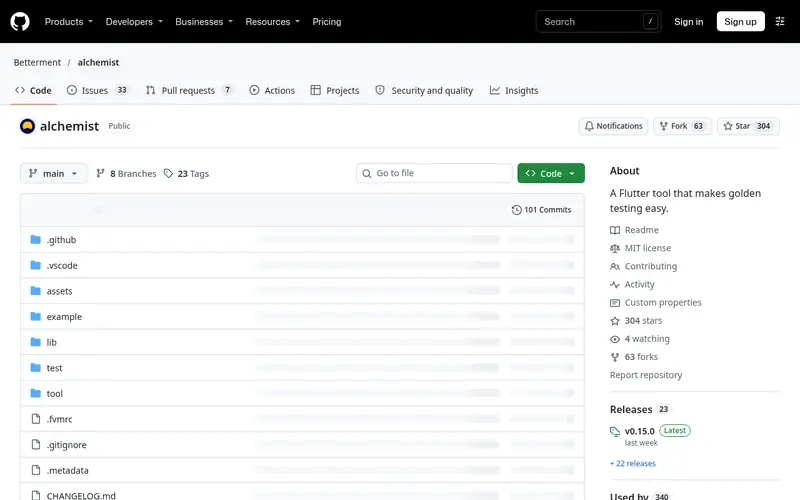
alchemist is a golden test library from Betterment. It wraps Flutter's golden file testing with helpers that render a widget across platforms, themes and text scales, so one test can cover several visual variants. It also provides utilities for running golden tests in CI and updating files.
Golden tests catch unintended visual changes, but they are sensitive to fonts, rendering backends and host platforms. alchemist reduces some of that friction, though you still need a consistent environment and a review process for updated images.
It is free and open source. Teams that want visual regression coverage on top of widget tests should consider it. Teams without a stable CI image or a plan for reviewing golden diffs may find the maintenance cost too high.
Standout: Handles platform and theme variants in one test
Free (open source), as listed by the vendor (alchemist website). Confirm the current plan price before you buy.
Free plan. Plans change, so confirm on the vendor's pricing page before you buy.
Benefits
- Handles platform and theme variants in one test
- helpers for CI golden runs
Drawbacks
- Golden files need review and updates
- rendering can differ across machines
Skip it if this limit matters to you: golden files need review and updates.
Verdict. A sensible pick for golden tests with configurable themes and platforms.
Alternatives in this guide: flutter_test, integration_test, mocktail
bloc_test
Best for testing bloc and cubit state transitions
What it is and where it fits
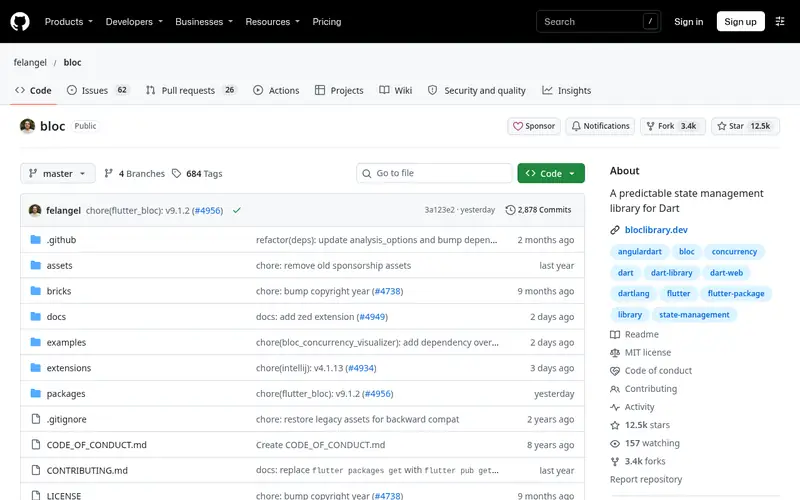
bloc_test is the testing package for the bloc state management library, also by Felix Angelov. It provides a blocTest helper that collects emitted states and compares them to an expected list, plus matchers such as emitsInOrder and emitsDone.
It is only relevant if your app uses bloc or cubit. For those codebases it removes a lot of boilerplate around subscriptions and stream assertions. It runs in plain Dart tests, so it is fast and works in any CI setup.
The package is free and open source and is versioned alongside bloc. Teams using other state management approaches, such as Riverpod or Provider, should skip it and test their notifiers or controllers directly with flutter_test.
Standout: Purpose-built matchers for emitted states
Free (open source), as listed by the vendor (bloc_test website). Confirm the current plan price before you buy.
Free plan. Plans change, so confirm on the vendor's pricing page before you buy.
Benefits
- Purpose-built matchers for emitted states
- works with the bloc package
Drawbacks
- Only useful if you use bloc or cubit
- adds another test dependency
Skip it if this limit matters to you: only useful if you use bloc or cubit.
Verdict. A sensible pick for testing bloc and cubit state transitions.
Alternatives in this guide: flutter_test, integration_test, mocktail
Who should use what
A team starting a new Flutter app should begin with flutter_test for widget and unit tests, then add integration_test for a few critical flows. A codebase with many interfaces to mock can use a code-generation-based mock library for generated, type-checked mocks, while a team that dislikes code generation should pick mocktail. Apps that depend on permission dialogs or OS-level flows should add Patrol. Teams using bloc should add bloc_test, and teams that want visual regression coverage should evaluate alchemist.
Questions to settle before you buy
What to check before you buy
- Confirm the package supports your current Flutter and Dart SDK versions.
- Check whether the library needs code generation and whether your CI already runs build_runner.
- Decide which tests run on devices and budget CI time for emulators or device farms.
- For golden tests, confirm you have a stable CI image and a review process for image diffs.
- Read the package license and confirm it is compatible with your project.
FAQ
Do I need extra packages to test a Flutter app?
No. flutter_test and integration_test ship with the SDK and cover unit, widget and end-to-end tests. Extra packages help with specific jobs: mocking, native UI automation, golden tests or bloc state assertions.
Is mocktail a good choice for mocking in Flutter?
Yes, for teams that want to avoid code generation. mocktail lets you create mocks, stub calls and verify interactions without build_runner, which keeps test setup short. The tradeoff is that mocks are written by hand, so interface changes surface at runtime rather than at compile time.
Can Flutter tests interact with native permission dialogs?
Not with integration_test alone. Patrol extends integration tests so they can tap native dialogs and system UI on Android and iOS. It needs extra platform setup per target.
Are golden tests reliable in CI?
They can be, if the rendering environment is consistent. Fonts, host platform and rendering backends affect output. Libraries like alchemist help manage variants, but you still need a stable CI image and a process for reviewing updated golden files.
Do any of these libraries cost money?
No. All six options listed here are free or open source. Costs come from CI infrastructure, device farms or hosted device services if you run integration tests at scale.
Sources we checked
Method: how we score · editorial policy.
Change log. First published 27 Nov 2026.