Stage 02 · Test · Researched comparison
Best Elixir Testing Tools in 2026
ExUnit is the first pick for most teams because it ships with Elixir and covers unit and integration tests with no extra dependency. Mox suits teams that need clean mocks for behaviour-based tests, and Wallaby fits projects that need real browser tests for Phoenix apps. All three are open source and free, so the choice comes down to the kind of test you need to write.

By Shihab Mia
Published 22 Nov 2026 · 7 tools compared
We run no ads and no affiliate links at launch. The order of a list follows our published method. See how we score.
Prices are the starting prices vendors list publicly. Plans change, so confirm the current price on the vendor page before you buy.
Key takeaways
- ExUnit is built into Elixir and is the default runner for unit and integration tests, so it costs nothing and needs no setup beyond the project.
- Mox is a free open-source library for defining mocks from behaviours and works well with async tests when you use it with Ecto sandbox.
- Wallaby drives real browsers for Phoenix feature tests and is free and open source, but it needs a browser driver installed.
- Most Elixir testing libraries are free and open source, so budget concerns are mostly about CI time and browser infrastructure, not licences.
Who each pick is for
- Default unit and integration testing for any Elixir projectExUnit
- Behaviour-based mocks in concurrent Elixir testsMox
- Browser-based feature tests for Phoenix applicationsWallaby
- Property-based testing and data generation in ElixirStreamData
- Coverage reports for Elixir projects and CI pipelinesExCoveralls
- Generating realistic test data in Elixir test suitesFaker
- Testing HTTP clients against a local stub serverBypass
Comparison
| Tool | Best for | Standout feature | Listed starting price | Free plan or trial |
|---|---|---|---|---|
| 1ExUnit | Default unit and integration testing for any Elixir project | Ships with Elixir so there is nothing to install | Free (open source) | Free plan |
| 2Mox | Behaviour-based mocks in concurrent Elixir tests | Mocks are defined from behaviours so contracts stay explicit | Free (open source) | Free plan |
| 3Wallaby | Browser-based feature tests for Phoenix applications | Drives real browsers through the WebDriver protocol | Free (open source) | Free plan |
| 4StreamData | Property-based testing and data generation in Elixir | Generates random inputs to find edge cases | Free (open source) | Free plan |
| 5ExCoveralls | Coverage reports for Elixir projects and CI pipelines | Produces coverage reports and can post them to Coveralls | Free (open source) | Free plan |
| 6Faker | Generating realistic test data in Elixir test suites | Provides many generators for names, addresses, dates and other fields | Free (open source) | Free plan |
| 7Bypass | Testing HTTP clients against a local stub server | Starts a real HTTP server in tests so clients are exercised end to end | Free (open source) | Free plan |
How we picked
We picked tools that are standalone projects and genuinely serve a testing job in Elixir: the built-in runner, mocking, property testing, browser automation, coverage, test data and HTTP stubbing. We checked fit for the job, supported platforms (anywhere Elixir runs, plus browser requirements for Wallaby), licence and price, and the main limits of each. Sources are vendor documentation, project repositories and public pricing pages. Prices and plan details can change, so confirm on the vendor site before you commit.
The tools, one by one
ExUnit
Best for default unit and integration testing for any Elixir project
What it is and where it fits
ExUnit is the test framework that comes with Elixir. It runs test modules, supports `async: True` so independent tests run in parallel, and provides setup callbacks, tags, assertions and doctests. Because it is part of the language distribution, every Elixir project already has it and there is no separate licence or account.
For this job it is the baseline. Most teams write unit and integration tests in ExUnit and add other libraries only for specific needs such as mocking or browser testing. It runs anywhere Elixir runs, including CI containers. The main limit is scope: it does not mock modules, drive a browser or collect coverage on its own. Teams that need those features add a library rather than replace ExUnit.
Standout: Ships with Elixir so there is nothing to install
Free (open source), as listed by the vendor (ExUnit website). Confirm the current plan price before you buy.
Free plan. Plans change, so confirm on the vendor's pricing page before you buy.
Benefits
- Ships with Elixir so there is nothing to install
- supports async tests, tags, setup callbacks and doctests
Drawbacks
- No built-in mocking or browser support
- reporting beyond the console needs extra tooling
Skip it if this limit matters to you: no built-in mocking or browser support.
Verdict. A sensible pick for default unit and integration testing for any Elixir project.
Alternatives in this guide: Mox, Wallaby, StreamData
Mox
Best for behaviour-based mocks in concurrent Elixir tests
What it is and where it fits
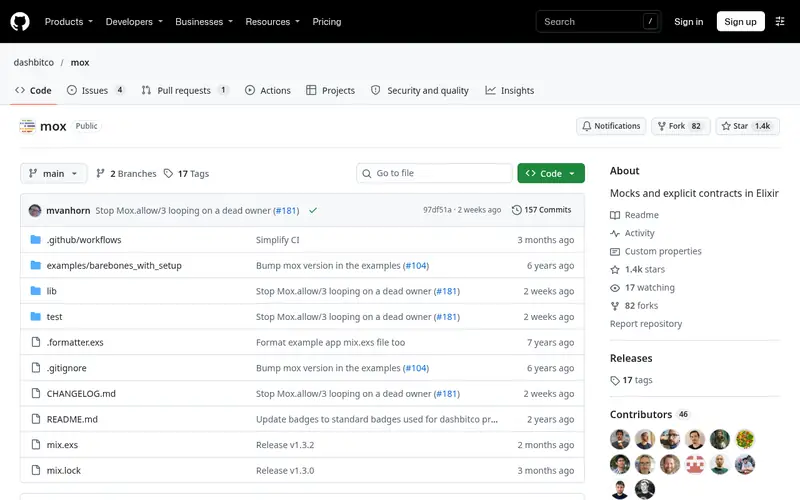
Mox is a library from Dashbit for defining mocks in Elixir. You declare a mock from an existing behaviour, set expectations in each test, and verify them when the test ends. It uses per-process ownership, so tests can run concurrently without mock state leaking between them.
It is a good fit for code that calls external services or modules you want to isolate. The trade-off is that Mox works best when your code depends on behaviours rather than concrete modules, which means some refactoring in older codebases. It does not replace ExUnit; it plugs into it. Teams that prefer stubs over strict expectation verification may find it heavier than they need.
Standout: Mocks are defined from behaviours so contracts stay explicit
Free (open source), as listed by the vendor (Mox website). Confirm the current plan price before you buy.
Free plan. Plans change, so confirm on the vendor's pricing page before you buy.
Benefits
- Mocks are defined from behaviours so contracts stay explicit
- supports async tests with per-process ownership
Drawbacks
- Requires defining behaviours for the modules you mock
- not a fit for tests that need real HTTP or database calls
Skip it if this limit matters to you: requires defining behaviours for the modules you mock.
Verdict. A sensible pick for behaviour-based mocks in concurrent Elixir tests.
Alternatives in this guide: ExUnit, Wallaby, StreamData
Wallaby
Best for browser-based feature tests for Phoenix applications
What it is and where it fits
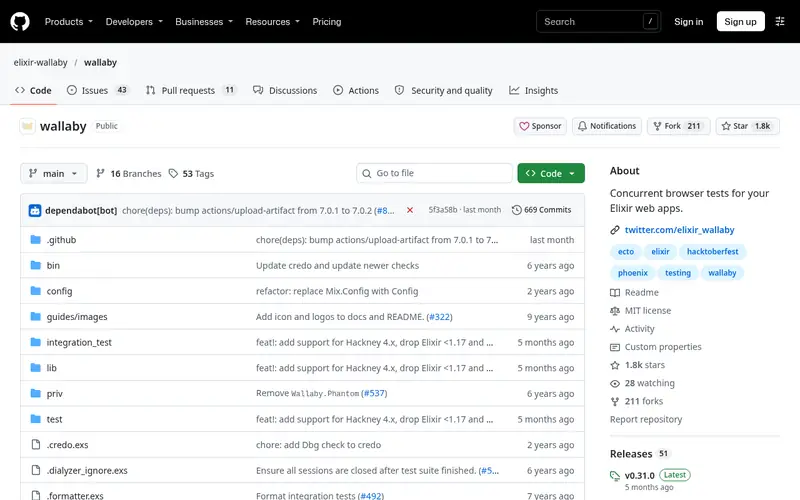
Wallaby is a browser testing library for Elixir. It talks to browsers through the WebDriver protocol and lets you write feature tests that click, fill forms and assert on rendered pages. It integrates with Phoenix and with the Ecto SQL sandbox so database state stays consistent during tests.
The cost is infrastructure. You need a browser and a driver such as ChromeDriver available wherever tests run, including CI. Browser tests are slower and more brittle than unit tests, so most teams keep them for critical user flows rather than full coverage. Teams without a Phoenix front end, or with mostly API code, will not get much from it.
Standout: Drives real browsers through the WebDriver protocol
Free (open source), as listed by the vendor (Wallaby website). Confirm the current plan price before you buy.
Free plan. Plans change, so confirm on the vendor's pricing page before you buy.
Benefits
- Drives real browsers through the WebDriver protocol
- integrates with Phoenix and Ecto sandbox for feature tests
Drawbacks
- Needs a browser and driver installed in local and CI environments
- browser tests are slower than unit tests
Skip it if this limit matters to you: needs a browser and driver installed in local and CI environments.
Verdict. A sensible pick for browser-based feature tests for Phoenix applications.
Alternatives in this guide: ExUnit, Mox, StreamData
StreamData
Best for property-based testing and data generation in Elixir
What it is and where it fits
StreamData is a property-based testing library for Elixir from Dashbit. Instead of listing example inputs, you describe properties that should always hold, and StreamData generates many inputs to try to break them. It integrates with ExUnit through a case template and shrinks failing inputs to smaller examples.
It suits code with clear invariants: parsers, encoders, state machines and data transformations. It is not a replacement for example-based tests, and teams new to property testing should start with a few properties rather than rewrite a suite. It is free and open source and runs anywhere ExUnit runs.
Standout: Generates random inputs to find edge cases
Free (open source), as listed by the vendor (StreamData website). Confirm the current plan price before you buy.
Free plan. Plans change, so confirm on the vendor's pricing page before you buy.
Benefits
- Generates random inputs to find edge cases
- integrates with ExUnit as a test case template
Drawbacks
- Property tests take practice to write well
- failures can be harder to reproduce without shrinking
Skip it if this limit matters to you: property tests take practice to write well.
Verdict. A sensible pick for property-based testing and data generation in Elixir.
ExCoveralls
Best for coverage reports for Elixir projects and CI pipelines
What it is and where it fits
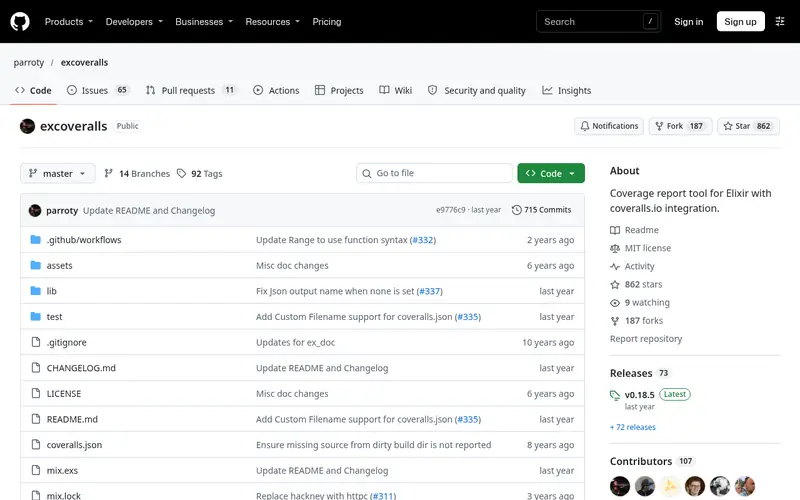
ExCoveralls collects test coverage for Elixir projects and formats the output. It can print a summary, generate HTML reports and upload results to Coveralls. It also supports minimum coverage thresholds so a CI build can fail when coverage drops.
It is useful for teams that want a visible coverage signal in pull requests. The caveat is that coverage measures lines executed, not whether assertions are meaningful, so a high number is not proof of good tests. It is free and open source and works with Mix projects. Teams that only need a local summary can use the built-in coverage tools instead.
Standout: Produces coverage reports and can post them to Coveralls
Free (open source), as listed by the vendor (ExCoveralls website). Confirm the current plan price before you buy.
Free plan. Plans change, so confirm on the vendor's pricing page before you buy.
Benefits
- Produces coverage reports and can post them to Coveralls
- supports minimum coverage thresholds in CI
Drawbacks
- Coverage numbers can mislead if tests are shallow
- setup and configuration add CI steps
Skip it if this limit matters to you: coverage numbers can mislead if tests are shallow.
Verdict. A sensible pick for coverage reports for Elixir projects and CI pipelines.
Faker
Best for generating realistic test data in Elixir test suites
What it is and where it fits
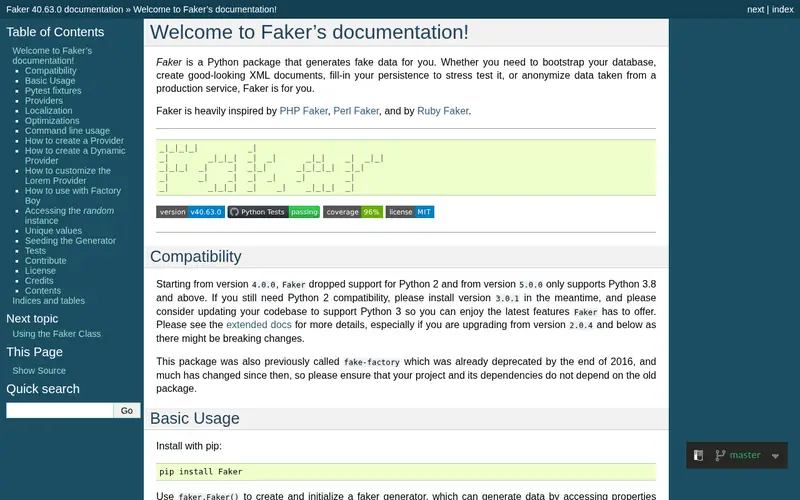
Faker is an Elixir library that generates fake data such as names, addresses, phone numbers and dates. It is commonly used in test setup and in seed scripts to avoid hard-coded sample values.
It helps make tests and development data more realistic without copying production data, which matters for privacy. The trade-off is randomness: unless you control the seed, a failing test may be harder to reproduce. Faker is free and open source. It is a helper, not a full factory library, so teams with complex relational fixtures often pair it with their own builders.
Standout: Provides many generators for names, addresses, dates and other fields
Free (open source), as listed by the vendor (Faker website). Confirm the current plan price before you buy.
Free plan. Plans change, so confirm on the vendor's pricing page before you buy.
Benefits
- Provides many generators for names, addresses, dates and other fields
- keeps test data readable
Drawbacks
- Random data can make failures harder to reproduce unless you seed it
- not a fixture or factory framework on its own
Skip it if this limit matters to you: random data can make failures harder to reproduce unless you seed it.
Verdict. A sensible pick for generating realistic test data in Elixir test suites.
Bypass
Best for testing HTTP clients against a local stub server
What it is and where it fits
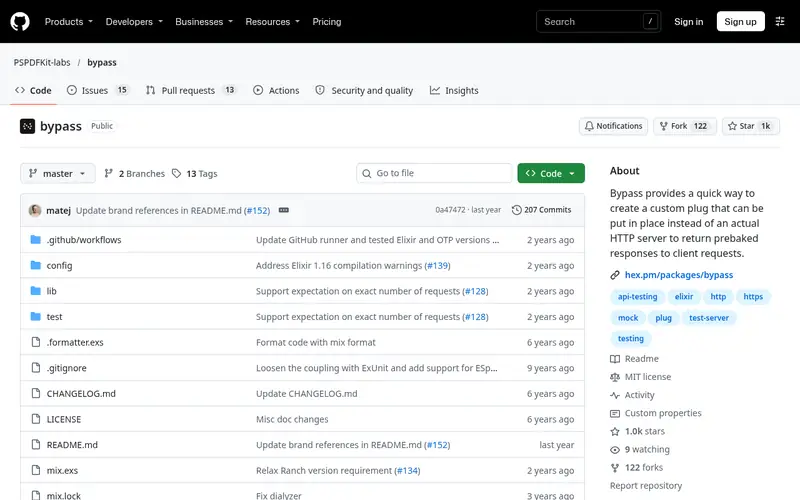
Bypass is an Elixir library that starts a real HTTP server inside your test suite. You configure it to return specific responses, point your HTTP client at it, and assert on the requests it received. This tests the client code against real network behavior rather than a mocked module.
It fits code that calls external HTTP APIs and where you want to verify request shape and response handling. It does not cover non-HTTP dependencies, and suites with many external calls can become verbose. It is free and open source and runs with ExUnit. Teams already using Mox for all dependencies may prefer to keep HTTP mocking in one style.
Standout: Starts a real HTTP server in tests so clients are exercised end to end
Free (open source), as listed by the vendor (Bypass website). Confirm the current plan price before you buy.
Free plan. Plans change, so confirm on the vendor's pricing page before you buy.
Benefits
- Starts a real HTTP server in tests so clients are exercised end to end
- lets you assert on requests received
Drawbacks
- Only covers HTTP interactions
- tests that need many stubs can get verbose
Skip it if this limit matters to you: only covers HTTP interactions.
Verdict. A sensible pick for testing HTTP clients against a local stub server.
Who should use what
If you are starting a new Elixir project, use ExUnit first and add libraries only when a need appears. If your code calls external services, add Mox for behaviour-based mocks and Bypass when you need to exercise a real HTTP client. If you maintain a Phoenix app with user-facing flows, add Wallaby for a small set of critical browser tests. If you work on parsers or data transformations, try StreamData for property tests alongside your example tests. Teams that need a coverage signal in CI can add ExCoveralls, and teams that need realistic sample data can use Faker.
Questions to settle before you buy
What to check before you buy
- Confirm the library is maintained and supports your Elixir and OTP versions.
- Check whether it runs in your CI environment, especially browser drivers for Wallaby.
- Decide whether you need mocks, real HTTP stubs or both, and keep the style consistent.
- Review how test data is generated so failures stay reproducible with a fixed seed.
- Confirm coverage thresholds and reporting fit your CI pipeline before enforcing them.
FAQ
Is ExUnit enough on its own?
For many projects, yes. ExUnit covers unit and integration tests and runs anywhere Elixir runs. Add Mox, Bypass, Wallaby or StreamData only when you need mocking, HTTP stubbing, browser tests or property tests. Keeping the suite small and fast is usually better than adding libraries for their own sake.
Do I need a paid tool for Elixir testing?
Most Elixir testing libraries are free and open source, including the ones in this guide. Costs usually come from CI minutes and browser infrastructure rather than licences. Check each project's repository for its licence and current maintenance status.
Can I run browser tests in CI?
Yes, with Wallaby, but you need a browser and driver installed in the CI image. Many teams run a headless browser in a container. Browser tests are slower, so keep them to critical flows and run them separately from fast unit tests where possible.
How do I keep test data private?
Do not copy production data into tests. Use generators such as Faker or your own builders to create sample data. If you test against real services, use stubs like Bypass or sandboxed environments, and never commit secrets or tokens to the repository.
What is property-based testing good for?
It is good for code with clear rules that should always hold, such as parsers, encoders and state machines. StreamData generates many inputs to try to break those rules. Start with a few properties and keep example-based tests for cases you want to document explicitly.
Sources we checked
Method: how we score · editorial policy.
Change log. First published 22 Nov 2026.