Stage 02 · Test · Researched comparison
Best Elixir HTTP Clients in 2026
Req is the first pick for most Elixir projects. It builds on Finch and Mint, ships with sensible defaults, and covers JSON, retries, redirects and testing without extra setup. Choose Finch when you need a supervised connection pool shared across many callers, such as inside a Phoenix app or a background job system. Choose Mint when you want to manage connections and requests at the socket level and build your own client behaviour.

By Shihab Mia
Published 27 Nov 2026 · 6 tools compared
We run no ads and no affiliate links at launch. The order of a list follows our published method. See how we score.
Prices are the starting prices vendors list publicly. Plans change, so confirm the current price on the vendor page before you buy.
Key takeaways
- Req, Finch, Mint, Tesla and HTTPoison are all free and open source, so cost is not the deciding factor.
- Req is the highest-level option and suits most application code; Finch and Mint sit lower in the stack.
- Tesla is the choice when you need swappable adapters or middleware, since it wraps other clients.
- HTTPoison depends on hackney, and Erlang :httpc ships with OTP but has a smaller feature set.
Who each pick is for
Comparison
| Tool | Best for | Standout feature | Listed starting price | Free plan or trial |
|---|---|---|---|---|
| 1Req | Most Elixir apps that want a high-level client | Built-in JSON, retries, redirects and compression | Free (open source) | Free plan |
| 2Finch | Shared connection pools in long-running apps | Supervised pool with configurable pool sizes | Free (open source) | Free plan |
| 3Mint | Low-level control over HTTP connections | Process-less design that fits any concurrency model | Free (open source) | Free plan |
| 4Tesla | Swappable adapters and middleware pipelines | Middleware system for logging, retries and headers | Free (open source) | Free plan |
| 5HTTPoison | Existing projects already built on hackney | Long-standing library with wide community usage | Free (open source) | Free plan |
| 6Erlang :httpc | Zero-dependency calls inside OTP | Ships with OTP, so no extra dependency | Free | Free plan |
How we picked
We compared libraries on fit for common Elixir HTTP work, the abstraction level they expose, how they handle connections and pooling, licence and cost, and the limits you hit in practice. Sources are the official project repositories, vendor documentation and the Erlang OTP documentation. All six options are free or open source, so price was not a differentiator. We did not run benchmarks. Library APIs and defaults change between releases, so confirm current behaviour on the project pages before you commit.
The tools, one by one
Req
Best for most Elixir apps that want a high-level client
What it is and where it fits
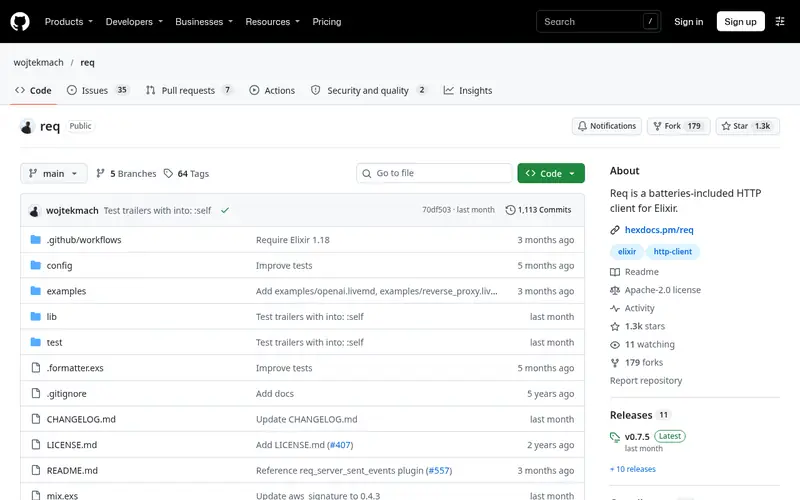
Req is a high-level HTTP client built on Finch and Mint. It returns a struct with the response body, headers and status, and it decodes JSON when the response content type calls for it. Common needs such as following redirects, retrying failed requests and decompressing responses work without extra configuration. You can attach steps to a request to change behaviour, which keeps custom logic explicit.
It runs wherever Elixir runs. The project is open source under the Apache 2.0 licence and is maintained in the wojtekmach/req repository. Because it depends on Finch, you get connection pooling underneath without wiring it up yourself. Req also includes helpers for testing, so you can stub responses in your test suite.
Skip Req if you need direct control over socket options or want to own the connection lifecycle. In those cases Finch or Mint fit better. For typical API calls, form posts and JSON services, Req is the shortest path.
Standout: Built-in JSON, retries, redirects and compression
Free (open source), as listed by the vendor (Req website). Confirm the current plan price before you buy.
Free plan. Plans change, so confirm on the vendor's pricing page before you buy.
Benefits
- Built-in JSON, retries, redirects and compression
- step-based request pipeline you can extend
Drawbacks
- Higher-level defaults can hide connection details
- newer than Finch and Mint
Skip it if this limit matters to you: higher-level defaults can hide connection details.
Verdict. A sensible pick for most Elixir apps that want a high-level client.
Finch
Best for shared connection pools in long-running apps
What it is and where it fits
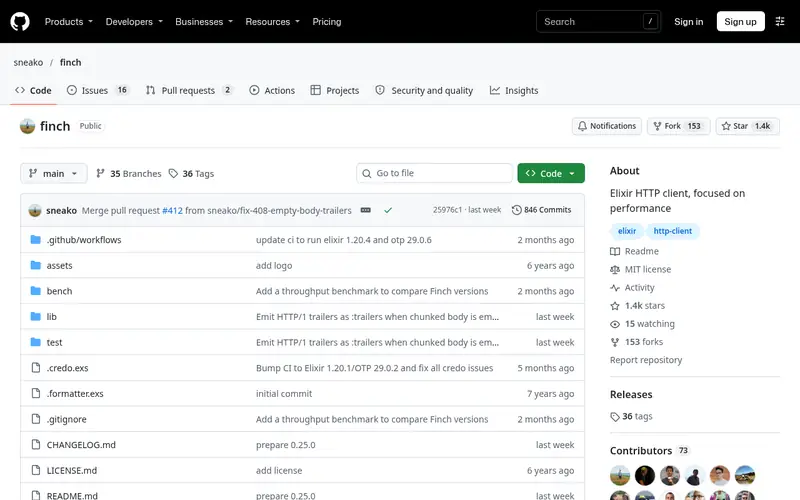
Finch is an HTTP client focused on connection pooling. You start it under your supervision tree, give each pool a name, and then make requests against that pool. This design suits Phoenix apps and background workers where many processes share connections to the same host. It uses Mint for the underlying protocol work and supports HTTP/1 and HTTP/2.
The library is open source and maintained in the sneako/finch repository. It does not decode JSON, follow redirects or retry for you. That is deliberate: Finch stays small and predictable, and you add the behaviour you need. Pool size and count are configuration values you set per pool.
Choose Finch when you want one supervised client for the whole application and are comfortable handling response parsing yourself. If you want those conveniences built in, use Req, which uses Finch underneath.
Standout: Supervised pool with configurable pool sizes
Free (open source), as listed by the vendor (Finch website). Confirm the current plan price before you buy.
Free plan. Plans change, so confirm on the vendor's pricing page before you buy.
Benefits
- Supervised pool with configurable pool sizes
- supports HTTP/1 and HTTP/2 through Mint
Drawbacks
- No JSON or retry helpers
- you handle request building yourself
Skip it if this limit matters to you: no JSON or retry helpers.
Verdict. A sensible pick for shared connection pools in long-running apps.
Mint
Best for low-level control over HTTP connections
What it is and where it fits
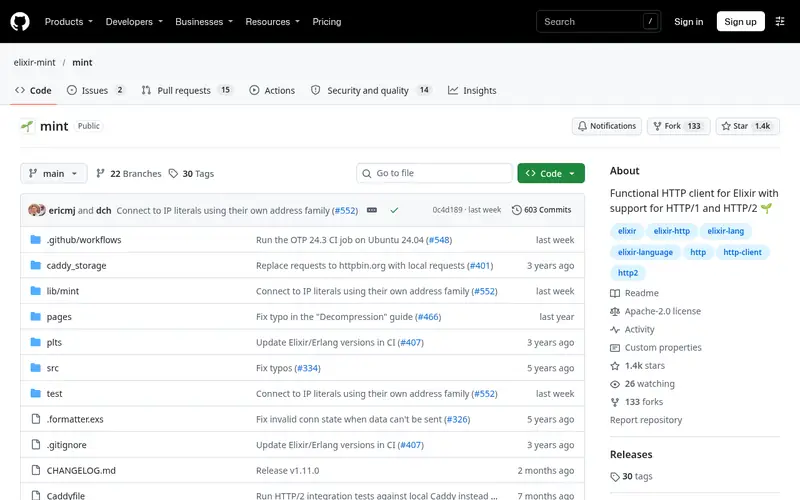
Mint is a low-level HTTP client. It does not own a process. Instead you open a connection, get a reference, and pass it between calls, which lets you fit it into whatever process structure you already have. It handles HTTP/1 and HTTP/2 and gives you direct access to the connection state.
The project is open source and maintained in the elixir-mint/mint repository. Because it is low level, it does not follow redirects, retry requests or parse response bodies for you. You write that logic. In return you get precise control over timeouts, connection reuse and protocol behaviour.
Mint is the right pick when you are building a client library, need custom connection handling, or want to avoid an extra process per connection. For ordinary application requests, Req or Finch will save you time.
Standout: Process-less design that fits any concurrency model
Free (open source), as listed by the vendor (Mint website). Confirm the current plan price before you buy.
Free plan. Plans change, so confirm on the vendor's pricing page before you buy.
Benefits
- Process-less design that fits any concurrency model
- explicit control of connection state
Drawbacks
- You manage connections, redirects and retries yourself
- more code for simple calls
Skip it if this limit matters to you: you manage connections, redirects and retries yourself.
Verdict. A sensible pick for low-level control over HTTP connections.
Tesla
Best for swappable adapters and middleware pipelines
What it is and where it fits
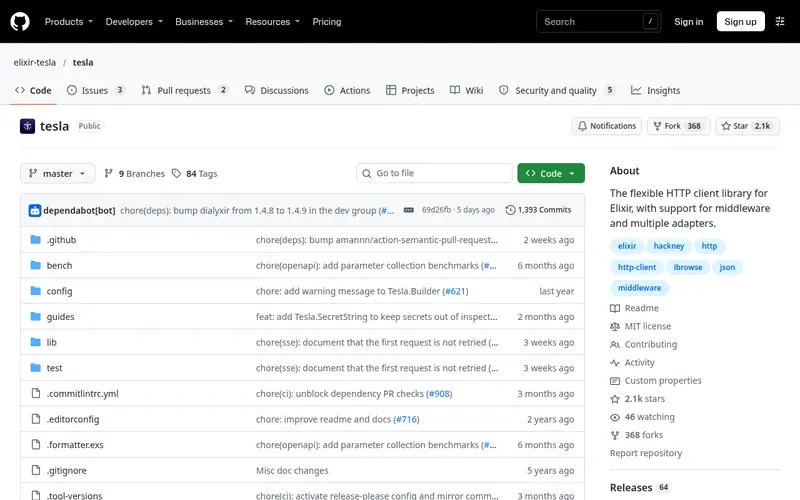
Tesla is an HTTP client with a middleware pipeline and a pluggable adapter. You define a client module, list middleware, and pick an adapter such as Mint, Finch or hackney. Because the adapter is configurable, you can change the underlying client without rewriting call sites. Middleware handles concerns like JSON encoding, logging and retries.
The library is open source and maintained in the elixir-tesla/tesla repository. It is a common choice in projects that already use a middleware pattern, and it works well when several services need consistent request behaviour. The tradeoff is indirection: when a request fails, you may need to check both the middleware stack and the adapter.
Skip Tesla if you want the fewest moving parts. Req covers similar ground with a step model and no adapter configuration.
Standout: Middleware system for logging, retries and headers
Free (open source), as listed by the vendor (Tesla website). Confirm the current plan price before you buy.
Free plan. Plans change, so confirm on the vendor's pricing page before you buy.
Benefits
- Middleware system for logging, retries and headers
- adapter can be swapped without changing call sites
Drawbacks
- Extra layer over another client
- middleware order can be confusing to debug
Skip it if this limit matters to you: extra layer over another client.
Verdict. A sensible pick for swappable adapters and middleware pipelines.
HTTPoison
Best for existing projects already built on hackney
What it is and where it fits
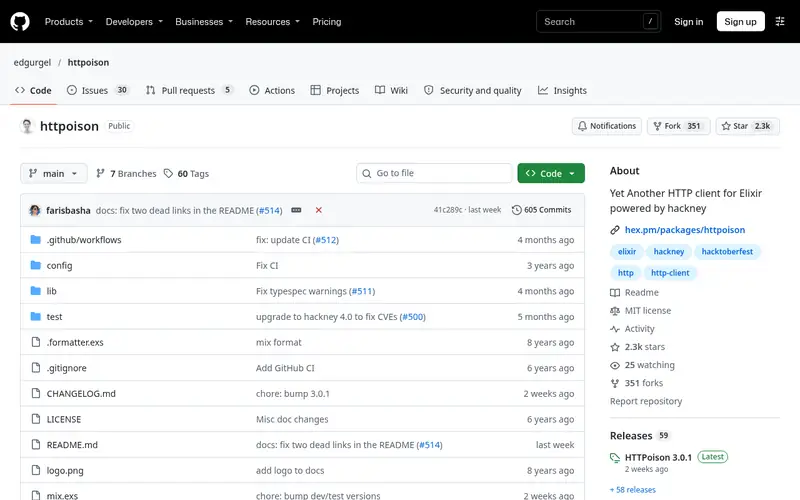
HTTPoison is an HTTP client that wraps the Erlang hackney library. It offers a straightforward API for GET, POST and other methods, and returns a response struct with status, headers and body. It has been used in Elixir projects for many years, so examples and answers are easy to find.
The project is open source and maintained in the edgurgel/httpoison repository. Because it wraps hackney, connection behaviour, TLS options and pooling come from that library, and you configure them through HTTPoison's options. It does not include JSON decoding or retry logic by default.
Choose HTTPoison if you maintain a codebase that already depends on it or on hackney directly. For new projects, Req and Finch offer more built-in behaviour with fewer dependencies.
Standout: Long-standing library with wide community usage
Free (open source), as listed by the vendor (HTTPoison website). Confirm the current plan price before you buy.
Free plan. Plans change, so confirm on the vendor's pricing page before you buy.
Benefits
- Long-standing library with wide community usage
- simple request and response API
Drawbacks
- Wraps hackney, so behaviour depends on it
- fewer built-in conveniences than Req
Skip it if this limit matters to you: wraps hackney, so behaviour depends on it.
Verdict. A sensible pick for existing projects already built on hackney.
Erlang :httpc
Best for zero-dependency calls inside OTP
What it is and where it fits
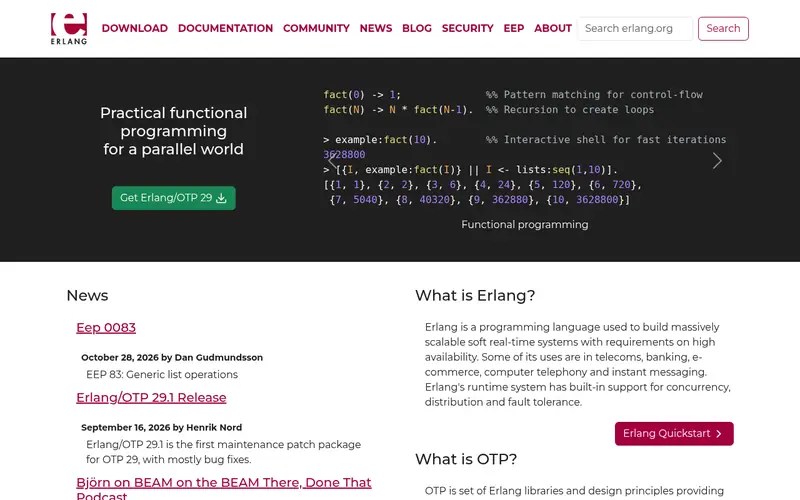
:httpc is the HTTP client that comes with Erlang's inets application, part of OTP. It is available in any Elixir project without adding a dependency. You call it with Erlang-style options and get back tuples, which means more boilerplate than the Elixir libraries above.
It is documented in the Erlang inets documentation. Because it ships with OTP, it is free and needs no licence review. It supports HTTP/1 and basic TLS configuration. It does not provide JSON handling, and its API is less ergonomic from Elixir than Req or Finch.
Use :httpc for small scripts, one-off calls, or environments where adding dependencies is restricted. For application code that makes many requests, a dedicated Elixir client will be easier to read and maintain.
Standout: Ships with OTP, so no extra dependency
Free, as listed by the vendor (Erlang :httpc website). Confirm the current plan price before you buy.
Free plan. Plans change, so confirm on the vendor's pricing page before you buy.
Benefits
- Ships with OTP, so no extra dependency
- usable from Elixir without a wrapper
Drawbacks
- Verbose options and tuple-based API
- fewer conveniences than Elixir libraries
Skip it if this limit matters to you: verbose options and tuple-based API.
Verdict. A sensible pick for zero-dependency calls inside OTP.
Who should use what
If you are writing a Phoenix app that calls a few JSON APIs, start with Req. If you run many background jobs against the same hosts and want one supervised pool, use Finch. If you are building a client library or need socket-level control, use Mint. If your team already standardizes on middleware and swappable adapters, Tesla fits. Keep HTTPoison if your codebase already depends on hackney, and reach for :httpc only when you cannot add a dependency.
Questions to settle before you buy
What to check before you buy
- Check which OTP and Elixir versions the library supports against your project.
- Confirm whether you need HTTP/2, and whether the client and its adapter support it.
- Decide who owns connection pooling: the library, your supervision tree, or your code.
- Review TLS and certificate options for any host you call over HTTPS.
- Check how the library handles timeouts, retries and redirects so failures are predictable.
FAQ
Is Req built on Finch and Mint?
Yes. Req uses Finch for connection pooling and Finch uses Mint for the underlying HTTP protocol work. That means Req inherits HTTP/1 and HTTP/2 support from those layers while adding JSON handling, retries, redirects and testing helpers on top.
Do I need a separate JSON library with Finch or Mint?
Yes. Finch and Mint handle HTTP transport but do not decode JSON. You parse response bodies yourself, typically with a JSON library such as Jason. Req decodes JSON for you when the response content type indicates JSON.
Is HTTPoison still a good choice?
It remains usable and is still maintained, but it wraps hackney, so its behaviour and options follow that library. New projects often get more built-in behaviour from Req or Finch. Keep HTTPoison if your codebase already depends on it or on hackney directly.
Can I use :httpc without adding a dependency?
Yes. :httpc comes with Erlang's inets application, which is part of OTP. It is available in any Elixir project. The tradeoff is a tuple-based Erlang API with more boilerplate and fewer conveniences than the Elixir client libraries.
Which client should I use for many requests to the same host?
Finch is designed for this. You start a named pool under supervision and share it across processes, which avoids opening new connections for every call. Req uses Finch underneath, so it also benefits from pooling while giving you a higher-level API.
Sources we checked
Method: how we score · editorial policy.
Change log. First published 27 Nov 2026.