Stage 02 · Test · Researched comparison
Best .NET JWT Libraries in 2026
Microsoft.IdentityModel.JsonWebTokens and System.IdentityModel.Tokens.Jwt from the Azure AD identity model extensions are the default choice for most .NET teams, since they are maintained by Microsoft and cover signing, validation and key handling. Microsoft.AspNetCore.Authentication.JwtBearer sits on top of them for ASP.NET Core bearer auth. For lighter token work, jose-jwt and JWT.Net are smaller alternatives, while Duende IdentityServer and OpenIddict are full token issuers rather than plain libraries.

By Shihab Mia
Published 27 Nov 2026 · 7 tools compared
We run no ads and no affiliate links at launch. The order of a list follows our published method. See how we score.
Prices are the starting prices vendors list publicly. Plans change, so confirm the current price on the vendor page before you buy.
Key takeaways
- Microsoft.IdentityModel and JwtBearer are open source and ship as NuGet packages, so there is no licence fee.
- jose-jwt and JWT.Net are small open-source libraries for encoding and decoding tokens, not full identity servers.
- Duende IdentityServer is commercial for most production use and requires a licence; OpenIddict is open source.
- These libraries run in your own process, so tokens and signing keys never leave your infrastructure.
Who each pick is for
- General JWT creation and validation on .NETMicrosoft.IdentityModel.JsonWebTokens
- Legacy code and JwtSecurityTokenHandler-based appsSystem.IdentityModel.Tokens.Jwt
- Bearer token auth in ASP.NET Core APIsMicrosoft.AspNetCore.Authentication.JwtBearer
- Lightweight JOSE and JWT encoding in .NETjose-jwt
- Simple JWT encode and decode tasksJWT.Net
- Teams that need a licensed OpenID Connect and OAuth serverDuende IdentityServer
- Open-source OpenID Connect server on ASP.NET CoreOpenIddict
Comparison
| Tool | Best for | Standout feature | Listed starting price | Free plan or trial |
|---|---|---|---|---|
| 1Microsoft.IdentityModel.JsonWebTokens | General JWT creation and validation on .NET | Maintained by Microsoft | Free (open source) | Free plan |
| 2System.IdentityModel.Tokens.Jwt | Legacy code and JwtSecurityTokenHandler-based apps | Familiar JwtSecurityTokenHandler API | Free (open source) | Free plan |
| 3Microsoft.AspNetCore.Authentication.JwtBearer | Bearer token auth in ASP.NET Core APIs | First-party ASP.NET Core integration | Free (open source) | Free plan |
| 4jose-jwt | Lightweight JOSE and JWT encoding in .NET | Small dependency | Free (open source) | Free plan |
| 5JWT.Net | Simple JWT encode and decode tasks | Straightforward API | Free (open source) | Free plan |
| 6Duende IdentityServer | Teams that need a licensed OpenID Connect and OAuth server | Full OIDC and OAuth 2.0 server | See vendor pricing page | Free trial (60 days) |
| 7OpenIddict | Open-source OpenID Connect server on ASP.NET Core | Open source under Apache 2.0 | Free (open source) | Free plan |
How we picked
We picked libraries that do the job named for .NET JWT work: creating, signing, validating or issuing tokens. Criteria were fit for the task, supported .NET platforms, licence and price, whether tokens stay in your own process, and known limits such as missing middleware or commercial terms. Sources are vendor pages, official documentation and project repositories. Prices and licence terms change, so confirm them on the vendor site before you commit.
The tools, one by one
Microsoft.IdentityModel.JsonWebTokens
Best for general JWT creation and validation on .NET
What it is and where it fits
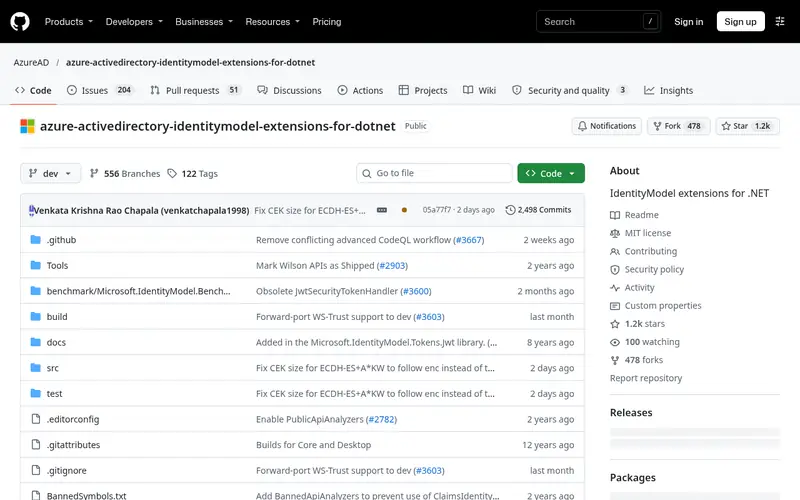
This is the current token library in the Azure AD identity model extensions for .NET. It creates, signs, encrypts, decrypts and validates JWTs and JWS/JWE tokens. It targets modern .NET versions and is the package Microsoft recommends for new code. Key resolution, token validation parameters and claim mapping are all handled here.
The API is broad, which helps with edge cases but adds a learning curve. Validation settings such as issuer, audience, lifetime and signing keys must be set explicitly; defaults are strict on purpose. The package is open source under the MIT licence and published on NuGet.
Skip it only if you need a very small dependency footprint or you are working on a legacy framework the current package no longer targets.
Standout: Maintained by Microsoft
Free (open source), as listed by the vendor (Microsoft.IdentityModel.JsonWebTokens website). Confirm the current plan price before you buy.
Free plan. Plans change, so confirm on the vendor's pricing page before you buy.
Benefits
- Maintained by Microsoft
- supports many signing and encryption algorithms
Drawbacks
- Configuration surface is large
- error messages can be hard to read
Skip it if this limit matters to you: configuration surface is large.
Verdict. A sensible pick for general JWT creation and validation on .NET.
Alternatives in this guide: System.IdentityModel.Tokens.Jwt, Microsoft.AspNetCore.Authentication.JwtBearer, jose-jwt
System.IdentityModel.Tokens.Jwt
Best for legacy code and JwtSecurityTokenHandler-based apps
What it is and where it fits
This package provides the JwtSecurityTokenHandler class that many existing .NET applications use. It reads and writes JWTs, validates signatures and maps claims. Microsoft's own guidance now recommends Microsoft.IdentityModel.JsonWebTokens for new development, but this package remains maintained for compatibility.
It is useful when you maintain older code or depend on libraries that expect JwtSecurityTokenHandler. It is open source under the MIT licence and distributed on NuGet. Both packages often appear together in the same solution during migration.
If you are starting a new project, prefer the JsonWebTokens package unless a dependency forces this one.
Standout: Familiar JwtSecurityTokenHandler API
Free (open source), as listed by the vendor (System.IdentityModel.Tokens.Jwt website). Confirm the current plan price before you buy.
Free plan. Plans change, so confirm on the vendor's pricing page before you buy.
Benefits
- Familiar JwtSecurityTokenHandler API
- wide ecosystem support
Drawbacks
- Microsoft now points new projects to JsonWebTokens
- older API design
Skip it if this limit matters to you: microsoft now points new projects to JsonWebTokens.
Verdict. A sensible pick for legacy code and JwtSecurityTokenHandler-based apps.
Alternatives in this guide: Microsoft.IdentityModel.JsonWebTokens, Microsoft.AspNetCore.Authentication.JwtBearer, jose-jwt
Microsoft.AspNetCore.Authentication.JwtBearer
Best for bearer token auth in ASP.NET Core APIs
What it is and where it fits
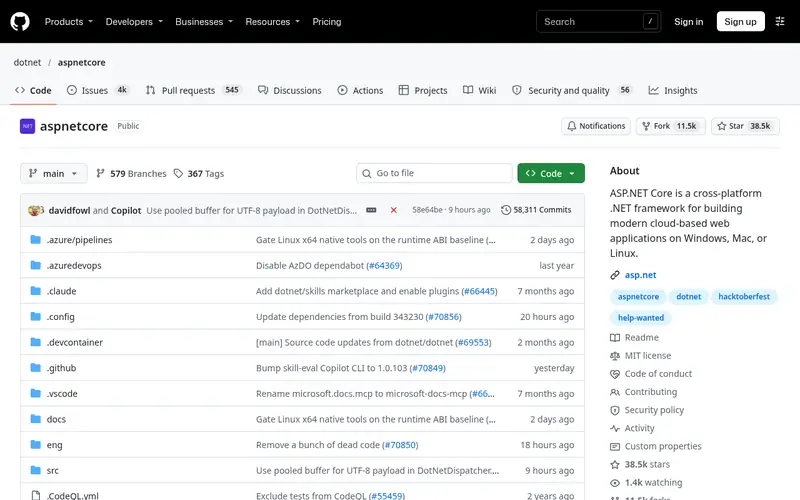
This package plugs JWT bearer authentication into ASP.NET Core. You configure authority, audience and token validation parameters, and the middleware validates incoming tokens and builds the user principal. It uses the Microsoft.IdentityModel libraries underneath, so validation behavior matches them.
It is the standard choice for protecting Web APIs and minimal APIs. It does not issue tokens; you still need an identity provider or a server such as Duende or OpenIddict. The package is open source, part of the dotnet/aspnetcore repository, and free to use.
Skip it if you are not on ASP.NET Core, or if you need custom token issuing inside the same library.
Standout: First-party ASP.NET Core integration
Free (open source), as listed by the vendor (Microsoft.AspNetCore.Authentication.JwtBearer website). Confirm the current plan price before you buy.
Free plan. Plans change, so confirm on the vendor's pricing page before you buy.
Benefits
- First-party ASP.NET Core integration
- works with the standard authentication pipeline
Drawbacks
- Only handles bearer validation, not token issuing
- tied to ASP.NET Core
Skip it if this limit matters to you: only handles bearer validation, not token issuing.
Verdict. A sensible pick for bearer token auth in ASP.NET Core APIs.
Alternatives in this guide: Microsoft.IdentityModel.JsonWebTokens, System.IdentityModel.Tokens.Jwt, jose-jwt
jose-jwt
Best for lightweight JOSE and JWT encoding in .NET
What it is and where it fits
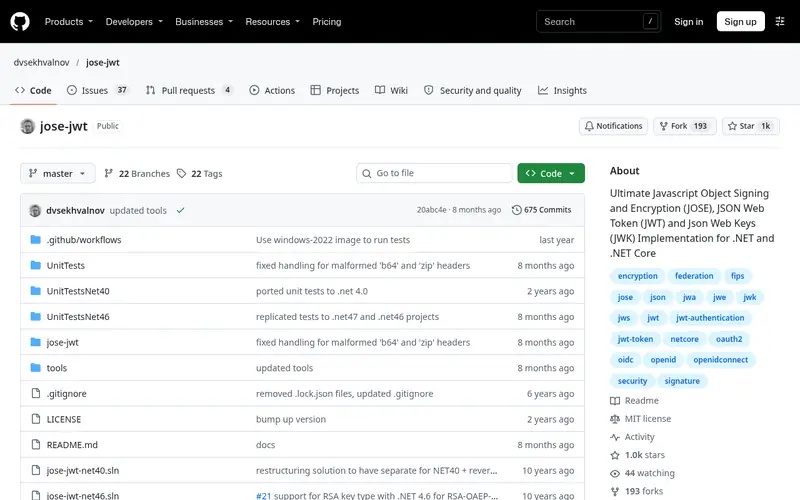
jose-jwt is a compact library for JSON Object Signing and Encryption. It handles JWS signing, JWE encryption, JWK keys and JWT payloads. The API is simple: encode and decode calls with a key and algorithm. It targets .NET Standard and modern .NET, so it works across many project types.
It suits teams that want direct control over JOSE operations without the larger Microsoft identity stack. It is open source under the MIT licence and available on NuGet. Documentation lives in the repository readme and examples.
The trade-off is a smaller community and fewer built-in integrations with ASP.NET Core authentication. If you need drop-in bearer middleware, use the Microsoft packages instead.
Standout: Small dependency
Free (open source), as listed by the vendor (jose-jwt website). Confirm the current plan price before you buy.
Free plan. Plans change, so confirm on the vendor's pricing page before you buy.
Benefits
- Small dependency
- covers JWS, JWE and JWK
Drawbacks
- Smaller community than Microsoft libraries
- fewer integrations
Skip it if this limit matters to you: smaller community than Microsoft libraries.
Verdict. A sensible pick for lightweight JOSE and JWT encoding in .NET.
Alternatives in this guide: Microsoft.IdentityModel.JsonWebTokens, System.IdentityModel.Tokens.Jwt, Microsoft.AspNetCore.Authentication.JwtBearer
JWT.Net
Best for simple JWT encode and decode tasks
What it is and where it fits
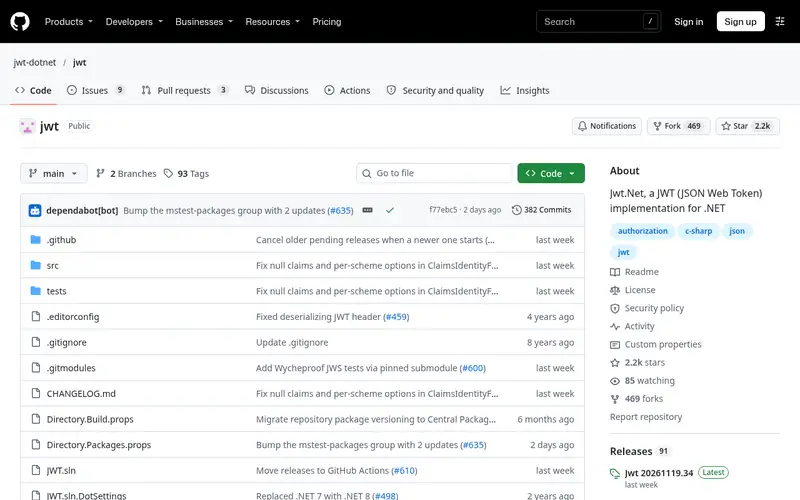
JWT.Net is a small library for creating and reading JWTs. It supports common signing algorithms through pluggable serializer and algorithm packages, and the basic encode/decode calls are short. It targets .NET Standard and modern .NET.
It fits scripts, internal tools and small services where you want minimal setup. It is open source under the MIT licence and published on NuGet. The repository lists supported algorithms and serializer options.
It is not a full identity server and does not provide ASP.NET Core middleware. For production APIs with strict validation requirements, the Microsoft libraries are the safer default.
Standout: Straightforward API
Free (open source), as listed by the vendor (JWT.Net website). Confirm the current plan price before you buy.
Free plan. Plans change, so confirm on the vendor's pricing page before you buy.
Benefits
- Straightforward API
- quick to add to small projects
Drawbacks
- Less feature depth than Microsoft libraries
- smaller maintainer base
Skip it if this limit matters to you: less feature depth than Microsoft libraries.
Verdict. A sensible pick for simple JWT encode and decode tasks.
Alternatives in this guide: Microsoft.IdentityModel.JsonWebTokens, System.IdentityModel.Tokens.Jwt, Microsoft.AspNetCore.Authentication.JwtBearer
Duende IdentityServer
Best for teams that need a licensed OpenID Connect and OAuth server

What it is and where it fits
Duende IdentityServer is an OpenID Connect and OAuth 2.0 framework for ASP.NET Core. It issues JWT access tokens and ID tokens, manages clients and scopes, and integrates with ASP.NET Core authentication. It is the successor to the earlier IdentityServer4 project.
It is a server, not a small helper library. You host it, configure clients and signing keys, and point your APIs at it. Licensing is commercial for most production scenarios; check the vendor page for current terms and the free trial. Development and testing use is covered under the vendor's terms.
Choose it when you need a standards-based token issuer with support. If you want an open-source issuer, look at OpenIddict.
Standout: Full OIDC and OAuth 2.0 server
See vendor pricing page, as listed by the vendor (Duende IdentityServer website). Confirm the current plan price before you buy.
Free trial (60 days). Plans change, so confirm on the vendor's pricing page before you buy.
Benefits
- Full OIDC and OAuth 2.0 server
- issues and validates JWTs
Drawbacks
- Commercial licence for most production use
- heavier to run than a library
Skip it if this limit matters to you: commercial licence for most production use.
Verdict. A sensible pick for teams that need a licensed OpenID Connect and OAuth server.
Alternatives in this guide: Microsoft.IdentityModel.JsonWebTokens, System.IdentityModel.Tokens.Jwt, Microsoft.AspNetCore.Authentication.JwtBearer
OpenIddict
Best for open-source OpenID Connect server on ASP.NET Core
What it is and where it fits
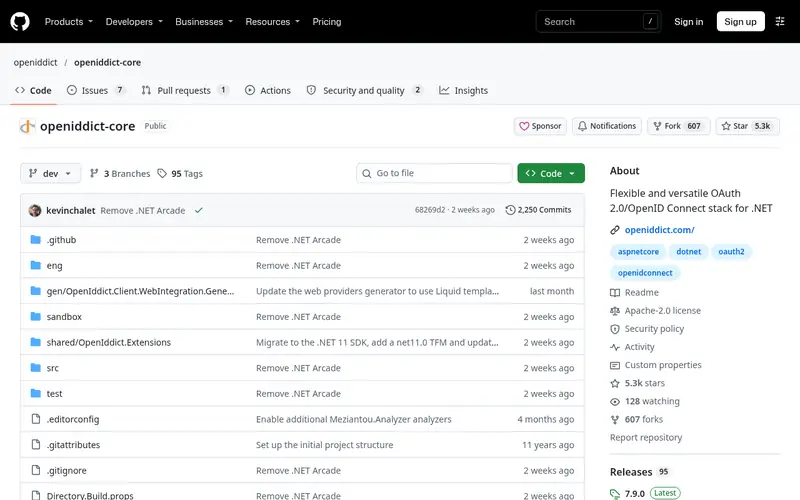
OpenIddict is an open-source OpenID Connect and OAuth 2.0 server stack for ASP.NET Core. It issues JWT tokens, handles clients and scopes, and integrates with ASP.NET Core Identity and EF Core. It is modular, so you add only the handlers you need.
It suits teams that want a self-hosted issuer without a commercial licence. The project is open source under the Apache 2.0 licence and maintained on GitHub. Setup involves registering the server, configuring the token endpoint and storing keys.
It is more work than adding a JWT encode/decode library. If you only need to validate tokens in an API, the Microsoft packages are simpler.
Standout: Open source under Apache 2.0
Free (open source), as listed by the vendor (OpenIddict website). Confirm the current plan price before you buy.
Free plan. Plans change, so confirm on the vendor's pricing page before you buy.
Benefits
- Open source under Apache 2.0
- works with ASP.NET Core and EF Core
Drawbacks
- More setup than a plain JWT library
- fewer paid support options
Skip it if this limit matters to you: more setup than a plain JWT library.
Verdict. A sensible pick for open-source OpenID Connect server on ASP.NET Core.
Alternatives in this guide: Microsoft.IdentityModel.JsonWebTokens, System.IdentityModel.Tokens.Jwt, Microsoft.AspNetCore.Authentication.JwtBearer
Who should use what
If you are building a new ASP.NET Core API that validates bearer tokens, use Microsoft.AspNetCore.Authentication.JwtBearer with the Microsoft.IdentityModel libraries. If you maintain older code that uses JwtSecurityTokenHandler, keep System.IdentityModel.Tokens.Jwt until you can migrate. If you need small, direct JOSE operations in a script or tool, jose-jwt or JWT.Net are lighter. If you need to run your own OpenID Connect server, choose Duende IdentityServer for commercial support or OpenIddict for an open-source stack.
Questions to settle before you buy
What to check before you buy
- Confirm the package targets your .NET version and is still receiving updates.
- Check the licence: MIT or Apache 2.0 for the libraries, commercial terms for Duende.
- Set issuer, audience, lifetime and signing key validation explicitly; do not rely on loose defaults.
- Keep signing keys in a secret store, not in source control or config files.
- Decide whether you need token validation only or a full issuer before adding a server.
FAQ
Which .NET JWT library should I use by default?
For most projects, Microsoft.IdentityModel.JsonWebTokens for token work and Microsoft.AspNetCore.Authentication.JwtBearer for ASP.NET Core bearer auth. Both are open source, maintained by Microsoft and cover signing and validation. Use System.IdentityModel.Tokens.Jwt only for older code that depends on JwtSecurityTokenHandler.
Are these JWT libraries free?
The Microsoft libraries, jose-jwt, JWT.Net and OpenIddict are open source and free to use. Duende IdentityServer is commercial for most production use and offers a free trial; check its pricing page for current terms.
What is the difference between a JWT library and an identity server?
A JWT library creates, signs and validates tokens inside your application. An identity server such as Duende IdentityServer or OpenIddict issues tokens to clients and manages users, clients and scopes. Many systems use both: the server issues tokens, and APIs validate them with a library.
Can I validate tokens without calling an external service?
Yes. The Microsoft libraries and jose-jwt validate signatures locally using public keys or shared secrets. You fetch signing keys from your issuer's metadata endpoint and cache them, so validation does not need a network call per request.
Do these libraries send my tokens anywhere?
No. They run in your process. Tokens and keys stay in your application and infrastructure. Be careful with any third-party web page that asks you to paste a token for decoding, since that sends the token to someone else's server.
Sources we checked
Method: how we score · editorial policy.
Change log. First published 27 Nov 2026.