Stage 02 · Test · Researched comparison
Best .NET HTTP Clients for API Calls in 2026
Start with HttpClient and IHttpClientFactory. They ship with .NET, handle connection pooling and DNS refresh, and cost nothing, which suits most teams. If you want typed interfaces instead of hand-written request code, Refit generates clients from interfaces. If you prefer a fluent, testable syntax with less ceremony, Flurl is a strong alternative. Add Microsoft.Extensions.Http.Resilience when you need retries and timeouts.

By Shihab Mia
Published 27 Nov 2026 · 6 tools compared
We run no ads and no affiliate links at launch. The order of a list follows our published method. See how we score.
Prices are the starting prices vendors list publicly. Plans change, so confirm the current price on the vendor page before you buy.
Key takeaways
- HttpClient with IHttpClientFactory is built into .NET and is free, so it is the default for most projects.
- Refit, RestSharp, Flurl and Kiota are open source and free to use.
- Microsoft.Extensions.Http.Resilience is free and open source and builds retry and timeout policies on top of Polly.
- All six options run on modern .NET; check each project's docs for supported target frameworks before you commit.
Who each pick is for
- Teams that want the built-in, dependency-free optionHttpClient with IHttpClientFactory
- Developers who want typed clients generated from interfacesRefit
- Teams that want an explicit request object APIRestSharp
- Developers who prefer fluent, chainable request codeFlurl
- Adding retries, timeouts and circuit breakers to HttpClientMicrosoft.Extensions.Http.Resilience
- Generating clients from OpenAPI descriptionsKiota
Comparison
| Tool | Best for | Standout feature | Listed starting price | Free plan or trial |
|---|---|---|---|---|
| 1HttpClient with IHttpClientFactory | Teams that want the built-in, dependency-free option | Ships with .NET and ASP.NET Core | Free | Free plan |
| 2Refit | Developers who want typed clients generated from interfaces | Declarative interfaces reduce request boilerplate | Free (open source) | Free plan |
| 3RestSharp | Teams that want an explicit request object API | Long-established library with a clear request and response model | Free (open source) | Free plan |
| 4Flurl | Developers who prefer fluent, chainable request code | Readable fluent syntax for URLs and requests | Free (open source) | Free plan |
| 5Microsoft.Extensions.Http.Resilience | Adding retries, timeouts and circuit breakers to HttpClient | Standard resilience handler with sensible defaults | Free (open source) | Free plan |
| 6Kiota | Generating clients from OpenAPI descriptions | Generates typed clients from OpenAPI specs | Free (open source) | Free plan |
How we picked
We picked libraries that are actively maintained and genuinely used for making HTTP calls in .NET. Criteria were fit for the job, supported platforms and target frameworks, licence and price, how well each option works with dependency injection and testing, and the main limits users hit. Sources are vendor documentation, project repositories and public pricing pages. Prices and licences change, so confirm details on the vendor site before you commit.
The tools, one by one
HttpClient with IHttpClientFactory
Best for teams that want the built-in, dependency-free option

What it is and where it fits
HttpClient is the base HTTP client in .NET. Used directly, a long-lived instance can hold stale DNS entries, and creating a new one per request can exhaust sockets. IHttpClientFactory solves both by pooling and rotating handlers on a schedule you configure.
It is part of Microsoft.Extensions.Http and works in ASP.NET Core, console apps and worker services. You register named or typed clients in dependency injection and inject them where needed. There is no licence cost and no separate package beyond the Microsoft.Extensions.Http package. The trade-off is boilerplate: you write request building, serialization and error handling yourself. Teams that want less code should look at Refit or Flurl.
Standout: Ships with .NET and ASP.NET Core
Free, as listed by the vendor (HttpClient with IHttpClientFactory website). Confirm the current plan price before you buy.
Free plan. Plans change, so confirm on the vendor's pricing page before you buy.
Benefits
- Ships with .NET and ASP.NET Core
- manages handler lifetime and connection pooling
Drawbacks
- Requires wiring and typed-client setup yourself
- no fluent request syntax
Skip it if this limit matters to you: requires wiring and typed-client setup yourself.
Verdict. A sensible pick for teams that want the built-in, dependency-free option.
Refit
Best for developers who want typed clients generated from interfaces
What it is and where it fits
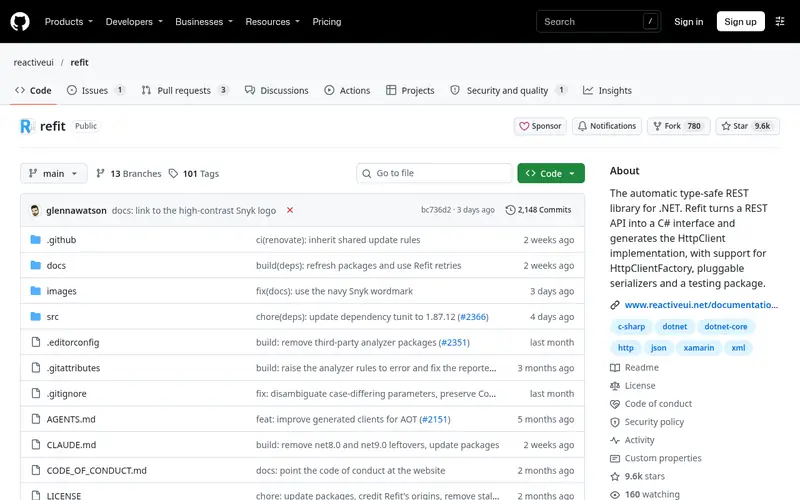
Refit turns a C# interface into a working HTTP client. You annotate methods with attributes for the route, verb and body, and Refit generates the implementation at runtime. Serialization uses System.Text.Json by default, with other options available.
It targets modern .NET and integrates with IHttpClientFactory through Refit.HttpClientFactory. That means you keep handler pooling and resilience policies while writing far less code. It is open source under a permissive licence. Skip it if you need fine-grained control over every request or you dislike attribute-driven APIs.
Standout: Declarative interfaces reduce request boilerplate
Free (open source), as listed by the vendor (Refit website). Confirm the current plan price before you buy.
Free plan. Plans change, so confirm on the vendor's pricing page before you buy.
Benefits
- Declarative interfaces reduce request boilerplate
- integrates with IHttpClientFactory and DI
Drawbacks
- Attribute-based API has a learning curve
- less control over low-level request details
Skip it if this limit matters to you: attribute-based API has a learning curve.
Verdict. A sensible pick for developers who want typed clients generated from interfaces.
Alternatives in this guide: HttpClient with IHttpClientFactory, RestSharp, Flurl
RestSharp
Best for teams that want an explicit request object API
What it is and where it fits
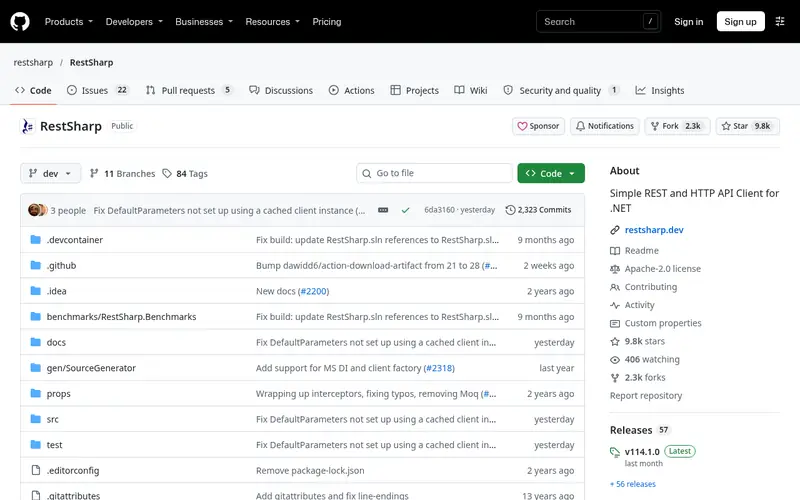
RestSharp is a standalone HTTP client library for .NET. You build a RestRequest, set the method, resource and parameters, then execute it with a RestClient. Responses expose status code, headers and deserialized bodies.
It is open source and has been used in .NET projects for many years. It supports multiple serializers and works in console apps, services and desktop apps. Because the API has changed between major versions, check the migration notes when upgrading. It suits teams that prefer explicit request objects over generated interfaces.
Standout: Long-established library with a clear request and response model
Free (open source), as listed by the vendor (RestSharp website). Confirm the current plan price before you buy.
Free plan. Plans change, so confirm on the vendor's pricing page before you buy.
Benefits
- Long-established library with a clear request and response model
- supports many serializers
Drawbacks
- More verbose than interface-based clients
- API changed across major versions
Skip it if this limit matters to you: more verbose than interface-based clients.
Verdict. A sensible pick for teams that want an explicit request object API.
Alternatives in this guide: HttpClient with IHttpClientFactory, Refit, Flurl
Flurl
Best for developers who prefer fluent, chainable request code
What it is and where it fits
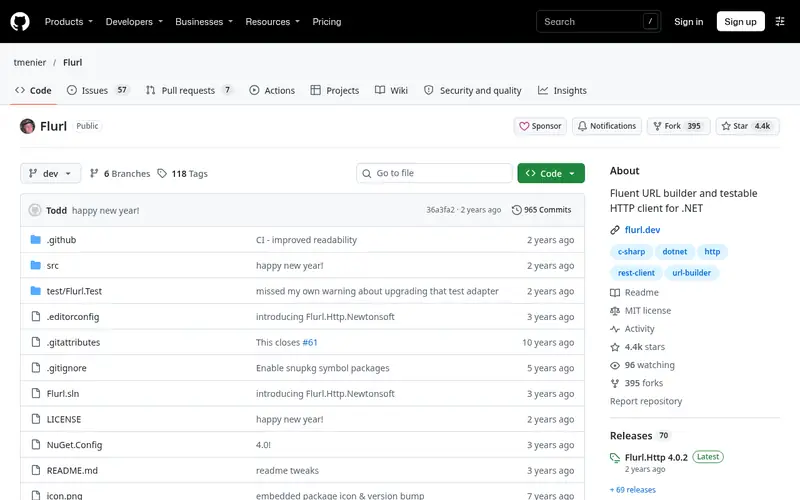
Flurl is a fluent URL builder and HTTP client for .NET. You chain calls like AppendPathSegment and SetQueryParam, then call GetJsonAsync or PostJsonAsync. It uses HttpClient underneath, so it benefits from the same handler behavior.
Flurl.Http includes Flurl.Http.Testing, which lets you fake HTTP calls in unit tests without a live server. The library is open source and free. It works in console apps, services and test projects. It suits developers who value short, readable request code, but teams that prefer explicit configuration may find the chaining less obvious to trace.
Standout: Readable fluent syntax for URLs and requests
Free (open source), as listed by the vendor (Flurl website). Confirm the current plan price before you buy.
Free plan. Plans change, so confirm on the vendor's pricing page before you buy.
Benefits
- Readable fluent syntax for URLs and requests
- testable with a built-in HTTP test library
Drawbacks
- Fluent chains can hide flow in long methods
- smaller ecosystem than HttpClient alone
Skip it if this limit matters to you: fluent chains can hide flow in long methods.
Verdict. A sensible pick for developers who prefer fluent, chainable request code.
Alternatives in this guide: HttpClient with IHttpClientFactory, Refit, RestSharp
Microsoft.Extensions.Http.Resilience
Best for adding retries, timeouts and circuit breakers to HttpClient
What it is and where it fits
Microsoft.Extensions.Http.Resilience is a library that adds resilience pipelines to HttpClient through IHttpClientFactory. It builds on Polly and provides an AddStandardResilienceHandler extension with defaults for retries, timeouts, rate limiting and circuit breaking.
It is not a replacement for HttpClient; it wraps the handlers you already use. That makes it a good fit alongside typed clients, Refit or Flurl. It is open source and free. The main risk is over-tuning: aggressive retries can amplify load on a failing service, so set limits based on the API you call. Teams with simple, reliable endpoints may not need it.
Standout: Standard resilience handler with sensible defaults
Free (open source), as listed by the vendor (Microsoft.Extensions.Http.Resilience website). Confirm the current plan price before you buy.
Free plan. Plans change, so confirm on the vendor's pricing page before you buy.
Benefits
- Standard resilience handler with sensible defaults
- integrates with IHttpClientFactory
Drawbacks
- Adds policy complexity that needs tuning
- not a client on its own
Skip it if this limit matters to you: adds policy complexity that needs tuning.
Verdict. A sensible pick for adding retries, timeouts and circuit breakers to HttpClient.
Alternatives in this guide: HttpClient with IHttpClientFactory, Refit, RestSharp
Kiota
Best for generating clients from OpenAPI descriptions
What it is and where it fits
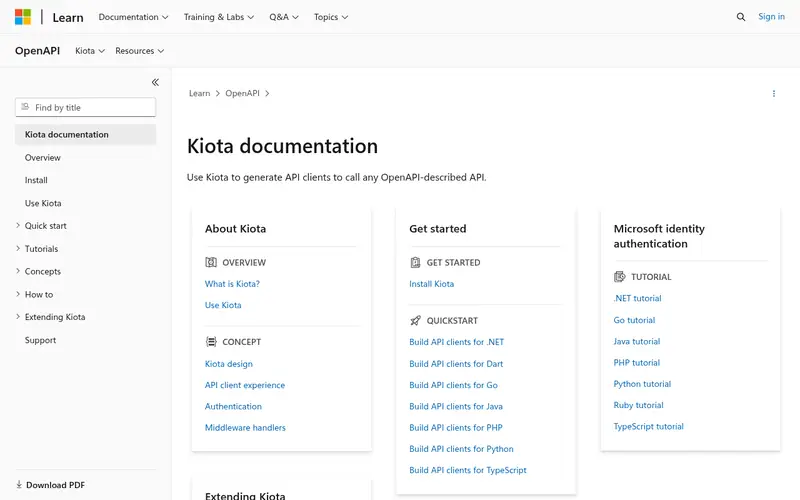
Kiota is a command-line tool and library from Microsoft that generates API clients from OpenAPI descriptions. For .NET, it produces C# client code you can call directly, with models and request builders derived from the spec.
It is open source and free. It suits teams integrating with large or frequently changing APIs, where hand-written clients would drift from the spec. The catch is spec quality: incomplete or inaccurate OpenAPI files produce awkward clients. It also generates a lot of code, so review what lands in your repository. For small APIs, a typed HttpClient or Refit is usually simpler.
Standout: Generates typed clients from OpenAPI specs
Free (open source), as listed by the vendor (Kiota website). Confirm the current plan price before you buy.
Free plan. Plans change, so confirm on the vendor's pricing page before you buy.
Benefits
- Generates typed clients from OpenAPI specs
- supports many languages including C#
Drawbacks
- Generated code can be large
- output quality depends on the spec
Skip it if this limit matters to you: generated code can be large.
Verdict. A sensible pick for generating clients from OpenAPI descriptions.
Alternatives in this guide: HttpClient with IHttpClientFactory, Refit, RestSharp
Who should use what
If you are starting a new ASP.NET Core service, use HttpClient with IHttpClientFactory and add Microsoft.Extensions.Http.Resilience for retries. If you call an API with many endpoints and want typed methods, Refit cuts boilerplate. If you prefer explicit request objects, RestSharp is a long-standing choice. If you want short, fluent code and easy HTTP fakes in tests, Flurl fits well. If you are integrating a large API with a solid OpenAPI spec, generate a client with Kiota.
Questions to settle before you buy
What to check before you buy
- Confirm the library supports your target frameworks and .NET version.
- Check how it integrates with IHttpClientFactory and dependency injection.
- Verify serialization options match your API, including System.Text.Json support.
- Review the licence and whether it fits your organization's policy.
- Check how you will fake HTTP calls in unit tests.
- Confirm the project is actively maintained with recent releases.
FAQ
Is HttpClient enough on its own?
Yes for many cases. Use IHttpClientFactory to manage handler lifetime and avoid socket exhaustion. Add resilience policies if the API can fail transiently. For large APIs, a typed client or generator saves code.
Do these libraries cost anything?
HttpClient, Refit, RestSharp, Flurl, Microsoft.Extensions.Http.Resilience and Kiota are free or open source. There is no paid tier for the libraries themselves. Support and hosting costs depend on your own infrastructure.
Which option works best with dependency injection?
HttpClient with IHttpClientFactory, Refit and Microsoft.Extensions.Http.Resilience are designed around DI. Flurl and RestSharp can be used with DI but need manual registration. Kiota generates plain client code you register yourself.
Can I combine these libraries?
Yes. A common setup is Refit or a typed HttpClient for requests, with Microsoft.Extensions.Http.Resilience added to the handler pipeline. Flurl also runs on HttpClient, so resilience handlers apply. Avoid stacking multiple retry layers.
How do I test code that makes HTTP calls?
Flurl.Http.Testing provides HTTP fakes. For HttpClient-based code, inject a custom HttpMessageHandler or use a test server. Refit clients can be tested by swapping the underlying handler. Keep tests offline so they do not depend on live APIs.
Sources we checked
Method: how we score · editorial policy.
Change log. First published 27 Nov 2026.