Stage 02 · Test · Researched comparison
Best C++ Networking Libraries in 2026
Boost.Asio is the first pick for most C++ teams that need portable asynchronous networking, because it covers TCP, UDP, timers and TLS through a single completion-based API and ships with Boost. Standalone Asio suits projects that want the same API without the full Boost dependency. libuv is a solid alternative when you need a small C event loop with a long track record, and Boost.Beast fits teams that need HTTP and WebSocket on top of Asio.

By Shihab Mia
Published 27 Nov 2026 · 7 tools compared
We run no ads and no affiliate links at launch. The order of a list follows our published method. See how we score.
Prices are the starting prices vendors list publicly. Plans change, so confirm the current price on the vendor page before you buy.
Key takeaways
- Boost.Asio and standalone Asio share one API; the difference is whether you pull in all of Boost or a header-only subset.
- libuv and libevent are C libraries with C++ bindings, so they fit mixed-language codebases and existing C services.
- Boost.Beast builds HTTP and WebSocket parsing on Asio, so it is an add-on rather than a replacement for an I/O layer.
- All seven options here are free and open source, so cost is not the deciding factor; licence terms and platform support are.
Who each pick is for
- Portable async I/O in Boost-based C++ projectsBoost.Asio
- Asio's API without the full Boost dependencyStandalone Asio
- Cross-platform event loops in C and C++ projectslibuv
- Full-stack C++ apps that need networking plus utilitiesPOCO C++ Libraries
- Event-driven servers and legacy C codebaseslibevent
- HTTP and WebSocket on top of Boost.AsioBoost.Beast
- Modern C++ wrappers around libuvuvw
Comparison
| Tool | Best for | Standout feature | Listed starting price | Free plan or trial |
|---|---|---|---|---|
| 1Boost.Asio | Portable async I/O in Boost-based C++ projects | Handles TCP, UDP, timers and TLS through one completion-based model | Free (open source) | Free plan |
| 2Standalone Asio | Asio's API without the full Boost dependency | Same API as Boost.Asio with a smaller footprint | Free (open source) | Free plan |
| 3libuv | Cross-platform event loops in C and C++ projects | Mature event loop with filesystem, DNS and process APIs | Free (open source) | Free plan |
| 4POCO C++ Libraries | Full-stack C++ apps that need networking plus utilities | Broad set of libraries including HTTP, sockets, TLS and threading | Free (open source) | Free plan |
| 5libevent | Event-driven servers and legacy C codebases | Simple event-loop model with buffered I/O and HTTP helpers | Free (open source) | Free plan |
| 6Boost.Beast | HTTP and WebSocket on top of Boost.Asio | HTTP/1 and WebSocket protocol support built on Asio | Free (open source) | Free plan |
| 7uvw | Modern C++ wrappers around libuv | Header-only C++17 wrappers over libuv handles and requests | Free (open source) | Free plan |
How we picked
We compared libraries on fit for common C++ networking jobs (async sockets, event loops, HTTP and WebSocket), platform support, licence terms, API style and language level, and the main limits each one imposes. Sources are vendor documentation pages, project repositories and public licence files. All entries are free and open source. Prices and licence terms can change, so confirm details on the official site before you commit.
The tools, one by one
Boost.Asio
Best for portable async I/O in Boost-based C++ projects

What it is and where it fits
Boost.Asio is the asynchronous I/O layer inside Boost. It provides sockets, resolvers, timers, signals and SSL through an executor and completion-handler model, and it runs on Windows, Linux, macOS and other POSIX systems. The proactor-style API lets you scale from a single thread to a thread pool without rewriting the socket code.
The main cost is conceptual: buffer lifetimes, handler invocation rules and strand-based synchronisation need study before the code is safe. If your project already uses Boost, adding Asio is cheap. If not, the dependency is heavy, and standalone Asio is often the better fit. Asio is also the base layer that Boost.Beast builds on, so choosing it keeps the HTTP and WebSocket option open.
Standout: Handles TCP, UDP, timers and TLS through one completion-based model
Free (open source), as listed by the vendor (Boost.Asio website). Confirm the current plan price before you buy.
Free plan. Plans change, so confirm on the vendor's pricing page before you buy.
Benefits
- Handles TCP, UDP, timers and TLS through one completion-based model
- widely used and well documented
Drawbacks
- Error handling and lifetime rules take time to learn
- full Boost is a large dependency
Skip it if this limit matters to you: error handling and lifetime rules take time to learn.
Verdict. A sensible pick for portable async I/O in Boost-based C++ projects.
Alternatives in this guide: Standalone Asio, libuv, POCO C++ Libraries
Standalone Asio
Best for asio's API without the full Boost dependency
What it is and where it fits
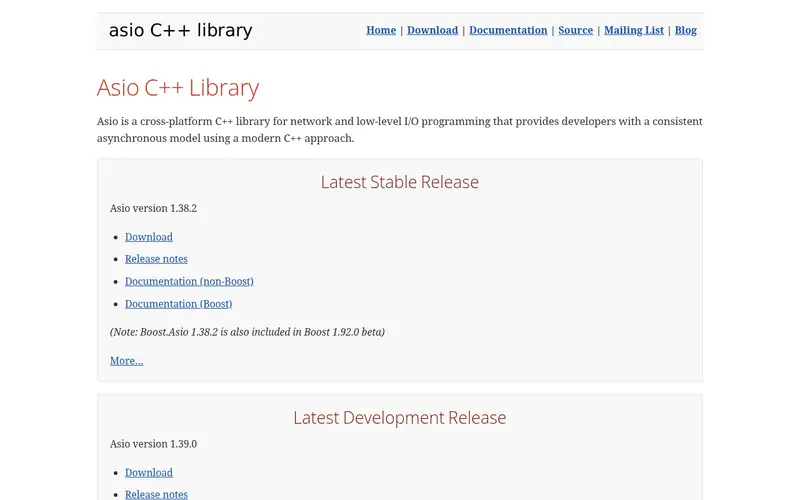
Standalone Asio is the same library as Boost.Asio, distributed outside Boost under the Boost Software License. It works header-only for many uses, which keeps build setup simple, and it supports the same sockets, timers and SSL facilities. It runs on Windows, Linux, macOS and other platforms with a C++11 or later compiler.
The catch is that a few parts still expect Boost headers, and examples and docs are spread across the Boost and think-async sites, so you sometimes cross-reference two sources. Teams that want Asio but refuse a full Boost install should start here. Teams already deep in Boost gain little by switching.
Standout: Same API as Boost.Asio with a smaller footprint
Free (open source), as listed by the vendor (Standalone Asio website). Confirm the current plan price before you buy.
Free plan. Plans change, so confirm on the vendor's pricing page before you buy.
Benefits
- Same API as Boost.Asio with a smaller footprint
- header-only use is possible
Drawbacks
- Some features need Boost headers
- documentation is split between two sites
Skip it if this limit matters to you: some features need Boost headers.
Verdict. A sensible pick for asio's API without the full Boost dependency.
Alternatives in this guide: Boost.Asio, libuv, POCO C++ Libraries
libuv
Best for cross-platform event loops in C and C++ projects
What it is and where it fits
libuv is a C library that provides an event loop, asynchronous TCP and UDP, DNS resolution, timers, filesystem operations and child processes. It runs on Windows, Linux, macOS and other Unix systems and powers Node.js, which gives it a large real-world footprint. C++ code can call it directly or through wrappers.
The API is plain C, so callbacks, handles and buffer lifetimes are your responsibility. That is fine for teams comfortable with C-style code and a plus for mixed C and C++ codebases. It is a poor fit if you want modern C++ types, RAII wrappers and compile-time checks out of the box; in that case look at uvw, which wraps libuv in C++.
Standout: Mature event loop with filesystem, DNS and process APIs
Free (open source), as listed by the vendor (libuv website). Confirm the current plan price before you buy.
Free plan. Plans change, so confirm on the vendor's pricing page before you buy.
Benefits
- Mature event loop with filesystem, DNS and process APIs
- used by Node.js, so it is heavily exercised
Drawbacks
- C API with manual memory management
- not a C++ abstraction
Skip it if this limit matters to you: C API with manual memory management.
Verdict. A sensible pick for cross-platform event loops in C and C++ projects.
Alternatives in this guide: Boost.Asio, Standalone Asio, POCO C++ Libraries
POCO C++ Libraries
Best for full-stack C++ apps that need networking plus utilities
What it is and where it fits
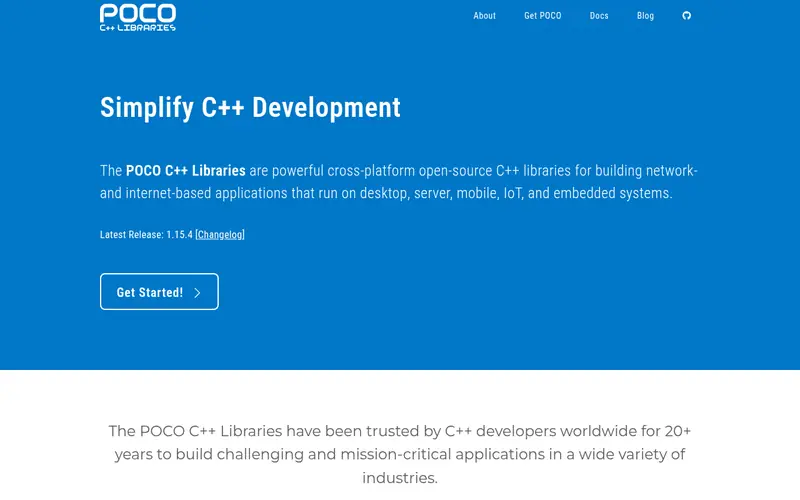
POCO is a collection of C++ class libraries covering networking, HTTP client and server, TLS, threads, filesystem, logging and more. Its Net and NetSSL modules give you sockets and secure sockets with a conventional class-based API rather than completion handlers. It runs on Windows, Linux, macOS and other platforms.
POCO suits teams that want one dependency for networking plus surrounding plumbing, such as an HTTP server with logging and configuration. The trade-off is size and a design that predates newer C++ async models. If you only need raw async sockets, Asio is leaner. If you want batteries included, POCO saves assembling several small libraries.
Standout: Broad set of libraries including HTTP, sockets, TLS and threading
Free (open source), as listed by the vendor (POCO C++ Libraries website). Confirm the current plan price before you buy.
Free plan. Plans change, so confirm on the vendor's pricing page before you buy.
Benefits
- Broad set of libraries including HTTP, sockets, TLS and threading
- consistent object-oriented API
Drawbacks
- Larger surface area than a pure I/O library
- some modules are heavier than focused alternatives
Skip it if this limit matters to you: larger surface area than a pure I/O library.
Verdict. A sensible pick for full-stack C++ apps that need networking plus utilities.
Alternatives in this guide: Boost.Asio, Standalone Asio, libuv
libevent
Best for event-driven servers and legacy C codebases
What it is and where it fits
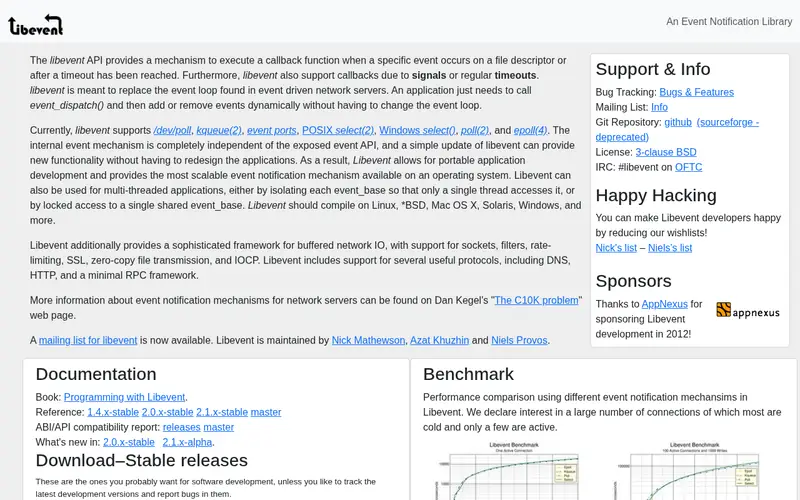
libevent is a C library for event-driven programming. It offers an event loop, buffered network I/O, timers, signals and a built-in HTTP server component, and it runs on Linux, macOS, Windows and other platforms. It has been used in many long-lived server projects, so its behaviour is well understood.
The API is C and reflects older design conventions, and development pace is slower than for Asio or libuv. That matters if you need modern TLS defaults or recent C++ integration. It remains a reasonable choice for maintaining existing event-driven services or for small C programs that need a loop and HTTP support without a large dependency.
Standout: Simple event-loop model with buffered I/O and HTTP helpers
Free (open source), as listed by the vendor (libevent website). Confirm the current plan price before you buy.
Free plan. Plans change, so confirm on the vendor's pricing page before you buy.
Benefits
- Simple event-loop model with buffered I/O and HTTP helpers
- portable across Unix and Windows
Drawbacks
- C API with older idioms
- less active development than some alternatives
Skip it if this limit matters to you: C API with older idioms.
Verdict. A sensible pick for event-driven servers and legacy C codebases.
Alternatives in this guide: Boost.Asio, Standalone Asio, libuv
Boost.Beast
Best for hTTP and WebSocket on top of Boost.Asio
What it is and where it fits
Boost.Beast adds HTTP/1 and WebSocket parsing and serialisation on top of Boost.Asio. It is header-only and ships with Boost, so it fits projects already using Asio. It runs wherever Asio runs: Windows, Linux, macOS and other platforms.
Beast is not a networking library by itself. You still need Asio for sockets, and you still manage the async control flow. That makes it a poor first choice for someone new to Asio, but a strong fit for teams that already have an Asio codebase and need to add an HTTP client, server or WebSocket endpoint without a second I/O stack. It does not cover HTTP/2.
Standout: HTTP/1 and WebSocket protocol support built on Asio
Free (open source), as listed by the vendor (Boost.Beast website). Confirm the current plan price before you buy.
Free plan. Plans change, so confirm on the vendor's pricing page before you buy.
Benefits
- HTTP/1 and WebSocket protocol support built on Asio
- header-only and part of Boost
Drawbacks
- Requires Asio knowledge first
- not a standalone I/O library
Skip it if this limit matters to you: requires Asio knowledge first.
Verdict. A sensible pick for HTTP and WebSocket on top of Boost.Asio.
Alternatives in this guide: Boost.Asio, Standalone Asio, libuv
uvw
Best for modern C++ wrappers around libuv
What it is and where it fits
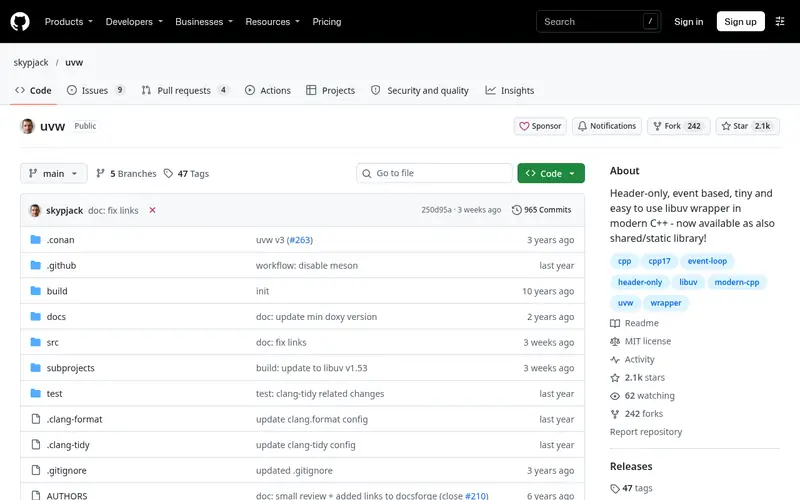
uvw is a header-only C++17 wrapper around libuv. It turns libuv handles, requests and the event loop into C++ classes with RAII, and it keeps the underlying libuv model rather than inventing a new one. It runs on the same platforms as libuv: Windows, Linux, macOS and other Unix systems.
Because it wraps libuv, every libuv constraint applies: the loop is not thread-safe, and blocking calls still block. The benefit is that you write C++ instead of C without leaving libuv's ecosystem, which helps when other parts of the system already use libuv. Teams without a libuv investment are usually better served by Asio.
Standout: Header-only C++17 wrappers over libuv handles and requests
Free (open source), as listed by the vendor (uvw website). Confirm the current plan price before you buy.
Free plan. Plans change, so confirm on the vendor's pricing page before you buy.
Benefits
- Header-only C++17 wrappers over libuv handles and requests
- keeps libuv's event loop model
Drawbacks
- Tracks libuv closely, so libuv limits carry over
- smaller community than Asio
Skip it if this limit matters to you: tracks libuv closely, so libuv limits carry over.
Verdict. A sensible pick for modern C++ wrappers around libuv.
Alternatives in this guide: Boost.Asio, Standalone Asio, libuv
Who should use what
New projects that want one async model across TCP, UDP and TLS should start with Boost.Asio, or standalone Asio if a full Boost install is unwanted. Teams that need HTTP or WebSocket endpoints on an existing Asio codebase should add Boost.Beast rather than a second stack. Mixed C and C++ services, or code that already follows Node.js patterns, fit libuv, with uvw as the C++ wrapper. Projects that want networking plus logging, configuration and an HTTP server in one dependency should look at POCO. Maintenance work on older event-driven C services often stays on libevent.
Questions to settle before you buy
What to check before you buy
- Confirm the library supports every platform you ship on, including Windows if you target it.
- Check the licence terms against your distribution model, especially for static linking.
- Decide whether you need raw sockets only or HTTP and WebSocket protocol handling too.
- Read the async model docs and confirm your team can follow the buffer and handler lifetime rules.
- Verify TLS support and which TLS backend the library uses on each platform.
FAQ
Is Boost.Asio the same as standalone Asio?
They are the same library. Boost.Asio ships inside Boost, while standalone Asio is distributed separately under the Boost Software License. The API is largely identical, but standalone use sometimes still needs Boost headers for a few features. Choose based on whether you already depend on Boost.
Do I need Boost.Beast if I use Boost.Asio?
No. Asio gives you sockets, not HTTP or WebSocket. Add Beast only if you need those protocols. If you only exchange raw TCP or UDP messages, Asio alone is enough and keeps the dependency smaller.
Can I use libuv from C++?
Yes. libuv has a C API that C++ can call directly. If you want RAII and C++ types, uvw wraps libuv handles and requests in header-only C++17 classes while keeping the same event loop model.
Which library should I pick for an HTTP server in C++?
Boost.Beast on top of Asio is a common choice for HTTP/1 servers. POCO also includes an HTTP server class. Neither covers HTTP/2, so check protocol requirements first. Both are free and open source.
Are these libraries free for commercial use?
All seven are open source. Boost.Asio, standalone Asio, Boost.Beast and uvw use the Boost Software License. libuv, libevent and POCO use permissive licences, but terms differ, so read the licence file in each repository before shipping.
Sources we checked
Method: how we score · editorial policy.
Change log. First published 27 Nov 2026.