Stage 02 · Test · Researched comparison
Best C/C++ Testing Frameworks in 2026
GoogleTest is the first pick for most teams writing C++ unit tests, because it is widely adopted, well documented and integrates with CMake and CI systems. Catch2 suits projects that want a single-header framework with readable assertions and BDD-style sections. doctest fits teams that need very fast compile times and minimal overhead. All three are free and open source.

By Shihab Mia
Published 22 Nov 2026 · 8 tools compared
We run no ads and no affiliate links at launch. The order of a list follows our published method. See how we score.
Prices are the starting prices vendors list publicly. Plans change, so confirm the current price on the vendor page before you buy.
Key takeaways
- GoogleTest, Catch2, doctest, Boost.Test and CppUTest are free and open source; CMocka and Unity are also free and open source.
- CTest ships with CMake and works as a test runner around other frameworks rather than a full assertion library.
- Header-only frameworks such as Catch2 and doctest reduce build setup but can increase compile time in large test suites.
- None of these frameworks send your code anywhere; they run locally, so test data stays on your machine.
Who each pick is for
- C++ teams that want a widely used framework with strong toolingGoogleTest
- C++ projects that want readable tests and simple setupCatch2
- C++ teams that prioritize fast compiles and low overheaddoctest
- CMake projects that need a test runner across frameworksCTest
- Embedded C projects that need a small test frameworkUnity
- C projects that need mocking and unit testing togetherCMocka
- C++ projects already using Boost that want an integrated test libraryBoost.Test
- C and C++ projects that want a lightweight xUnit-style frameworkCppUTest
Comparison
| Tool | Best for | Standout feature | Listed starting price | Free plan or trial |
|---|---|---|---|---|
| 1GoogleTest | C++ teams that want a widely used framework with strong tooling | Large assertion set and test fixtures | Free (open source) | Free plan |
| 2Catch2 | C++ projects that want readable tests and simple setup | Expressive assertion macros and BDD-style sections | Free (open source) | Free plan |
| 3doctest | C++ teams that prioritize fast compiles and low overhead | Very fast compile times compared with heavier frameworks | Free (open source) | Free plan |
| 4CTest | CMake projects that need a test runner across frameworks | Ships with CMake, so no extra dependency | Free (open source) | Free plan |
| 5Unity | Embedded C projects that need a small test framework | Small footprint and plain C | Free (open source) | Free plan |
| 6CMocka | C projects that need mocking and unit testing together | Built for C with mock objects and assertions | Free (open source) | Free plan |
| 7Boost.Test | C++ projects already using Boost that want an integrated test library | Full-featured with fixtures, datasets and multiple report formats | Free (open source) | Free plan |
| 8CppUTest | C and C++ projects that want a lightweight xUnit-style framework | Works for both C and C++ | Free (open source) | Free plan |
How we picked
We selected frameworks that are currently maintained, free and open source, and genuinely used for C or C++ unit testing. Criteria included fit for the job, supported platforms, licence terms, build integration, and main limits such as compile time, dependency size and language support. Sources are vendor pages, official documentation and project repositories. Prices and licences can change, so confirm details on the vendor or project site before you commit.
The tools, one by one
GoogleTest
Best for c++ teams that want a widely used framework with strong tooling
What it is and where it fits
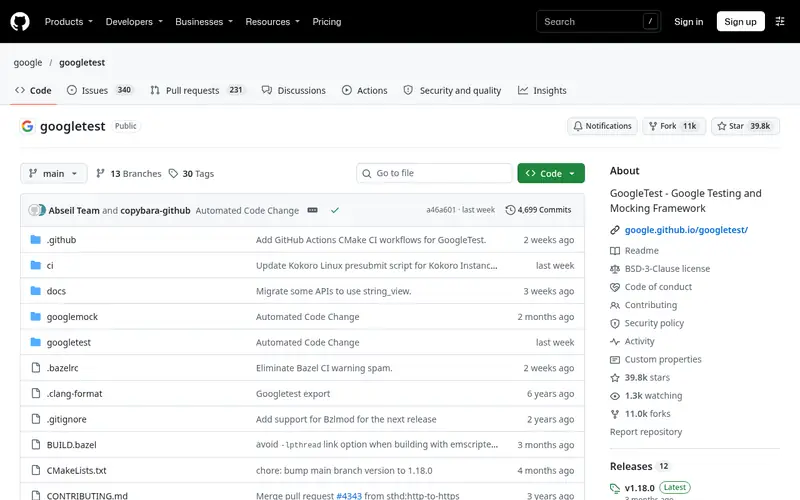
GoogleTest is a C++ testing framework from Google, maintained in the googletest repository. It provides assertions, test fixtures, parameterized tests, death tests and mock support through GoogleMock, which is bundled with it. It builds on Linux, macOS and Windows and is typically pulled in through CMake, a package manager or a vendored copy.
The framework uses test cases grouped into suites, with macros such as TEST and EXPECT_EQ. It produces XML output that CI systems can read. The main cost is build and setup overhead: it is not header-only in the simplest sense, and large suites take time to compile.
Choose GoogleTest when you want a mature framework with broad community documentation and mock support in one package. Skip it if you need C support or want the smallest possible dependency.
Standout: Large assertion set and test fixtures
Free (open source), as listed by the vendor (GoogleTest website). Confirm the current plan price before you buy.
Free plan. Plans change, so confirm on the vendor's pricing page before you buy.
Benefits
- Large assertion set and test fixtures
- works well with CMake and CI
Drawbacks
- Heavier setup than header-only options
- C++ only, no C support
Skip it if this limit matters to you: heavier setup than header-only options.
Verdict. A sensible pick for C++ teams that want a widely used framework with strong tooling.
Catch2
Best for c++ projects that want readable tests and simple setup
What it is and where it fits
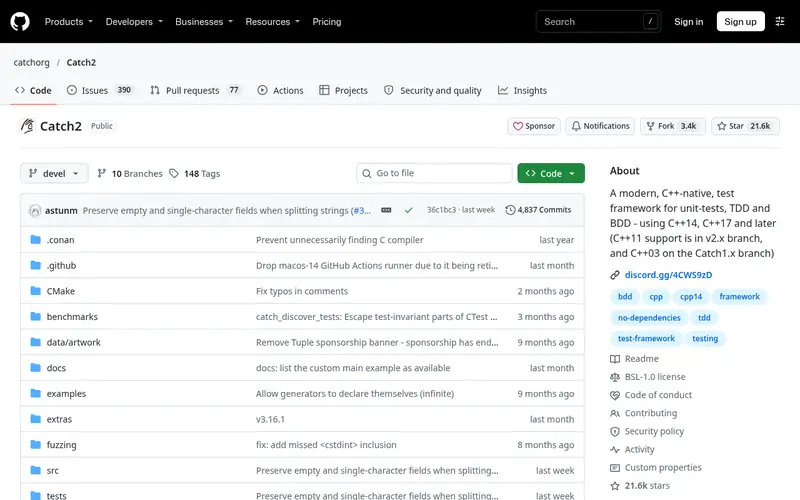
Catch2 is a C++ test framework known for natural assertion syntax and support for test sections that share setup code. Version 3 moved to a compiled library model, while earlier versions were header-only. It runs on Linux, macOS and Windows and works with CMake and other build systems.
Tests read close to plain code, and the framework reports failures with captured values. It also supports tags for selecting which tests run. The tradeoff is compile time: heavy use of templates and macros can slow large test builds.
Catch2 suits teams that value readable test code and want a framework they can drop into a repository with little configuration. Skip it if compile speed is the top priority or you are testing C code.
Standout: Expressive assertion macros and BDD-style sections
Free (open source), as listed by the vendor (Catch2 website). Confirm the current plan price before you buy.
Free plan. Plans change, so confirm on the vendor's pricing page before you buy.
Benefits
- Expressive assertion macros and BDD-style sections
- easy to vendor into a project
Drawbacks
- Compile times can grow in large suites
- C++ only
Skip it if this limit matters to you: compile times can grow in large suites.
Verdict. A sensible pick for C++ projects that want readable tests and simple setup.
Alternatives in this guide: GoogleTest, doctest, CTest
doctest
Best for c++ teams that prioritize fast compiles and low overhead
What it is and where it fits
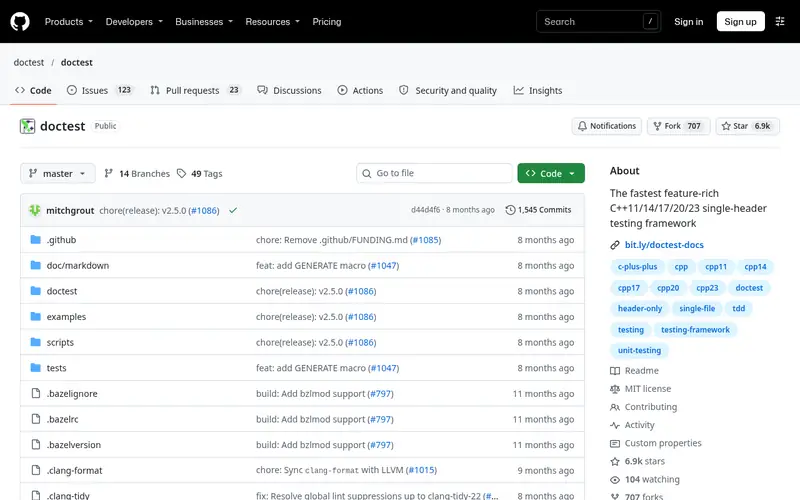
doctest is a single-header C++ testing framework designed for fast compilation and minimal runtime overhead. Its assertion syntax is similar to Catch2, so moving between the two is not difficult. It runs on Linux, macOS and Windows and needs only a C++ compiler.
Because it is a single header, integration is simple: copy the file into your project and start writing tests. The framework supports test cases, subcases, decorators and a command-line runner. The tradeoff is a smaller ecosystem and fewer third-party integrations than GoogleTest.
Pick doctest when build speed matters, such as large codebases or frequent CI runs. Skip it if you need built-in mocking or a very large body of tutorials and examples.
Standout: Very fast compile times compared with heavier frameworks
Free (open source), as listed by the vendor (doctest website). Confirm the current plan price before you buy.
Free plan. Plans change, so confirm on the vendor's pricing page before you buy.
Benefits
- Very fast compile times compared with heavier frameworks
- single header, easy to integrate
Drawbacks
- Smaller ecosystem than GoogleTest
- C++ only
Skip it if this limit matters to you: smaller ecosystem than GoogleTest.
Verdict. A sensible pick for C++ teams that prioritize fast compiles and low overhead.
Alternatives in this guide: GoogleTest, Catch2, CTest
CTest
Best for cMake projects that need a test runner across frameworks
What it is and where it fits
CTest is the test runner that comes with CMake. It discovers and runs tests defined in CMake files, reports pass and fail results, and supports parallel execution and timeouts. It is not an assertion framework; instead it runs test executables, which may be built with GoogleTest, Catch2, doctest or plain asserts.
CTest works wherever CMake works, including Linux, macOS and Windows. It is free and open source as part of CMake. Its limits are that assertions and fixtures come from the framework you pair it with, and teams not using CMake get little value from it.
Use CTest as the runner layer in a CMake project, especially when different parts of the codebase use different test frameworks. Skip it if your build system is not CMake or you want assertions built in.
Standout: Ships with CMake, so no extra dependency
Free (open source), as listed by the vendor (CTest website). Confirm the current plan price before you buy.
Free plan. Plans change, so confirm on the vendor's pricing page before you buy.
Benefits
- Ships with CMake, so no extra dependency
- can run tests from several frameworks
Drawbacks
- Not a full assertion library on its own
- tied to the CMake toolchain
Skip it if this limit matters to you: not a full assertion library on its own.
Verdict. A sensible pick for CMake projects that need a test runner across frameworks.
Alternatives in this guide: GoogleTest, Catch2, doctest
Unity
Best for embedded C projects that need a small test framework
What it is and where it fits
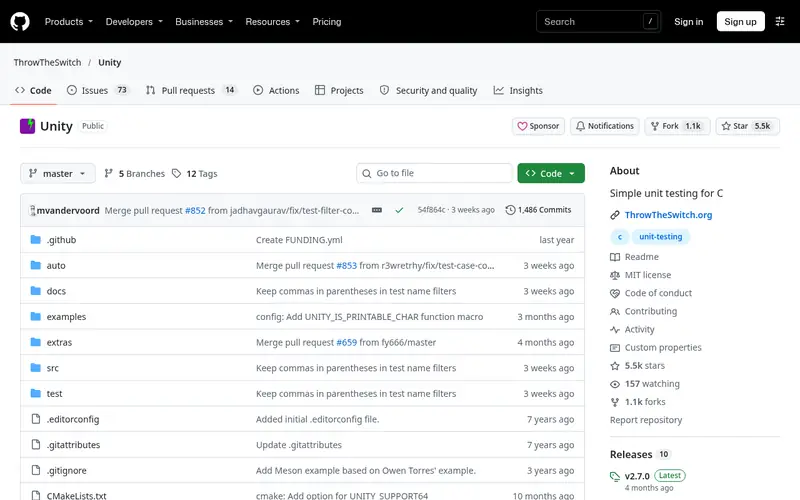
Unity is a unit test framework for C from ThrowTheSwitch.org. It is written in plain C, has a small footprint, and is designed to run both on host machines and on embedded targets. It provides assertion macros, test registration and a simple runner.
The framework is often paired with CMock for mocking and Ceedling as a build and test tool. It runs on Linux, macOS and Windows, and on microcontrollers where a full C++ framework would be too large. Its limits are fewer features and more manual setup than C++ frameworks.
Choose Unity for embedded C work where size and portability matter. Skip it for large C++ codebases that want fixtures, parameterized tests and rich reporting.
Standout: Small footprint and plain C
Free (open source), as listed by the vendor (Unity website). Confirm the current plan price before you buy.
Free plan. Plans change, so confirm on the vendor's pricing page before you buy.
Benefits
- Small footprint and plain C
- works on embedded targets and host machines
Drawbacks
- Minimal features compared with C++ frameworks
- manual test registration
Skip it if this limit matters to you: minimal features compared with C++ frameworks.
Verdict. A sensible pick for embedded C projects that need a small test framework.
Alternatives in this guide: GoogleTest, Catch2, doctest
CMocka
Best for c projects that need mocking and unit testing together
What it is and where it fits
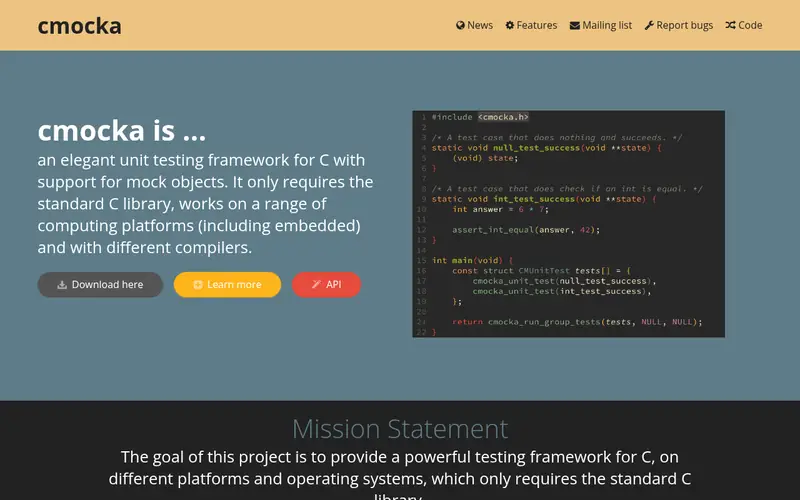
CMocka is a C unit testing framework with built-in support for mock objects. It provides assertion macros, test fixtures and a runner, and it works on Linux, macOS, Windows and embedded targets. It depends on a C compiler and, on some platforms, a few system libraries.
The framework is useful when you need to isolate C functions that call external code, since mocks are part of the design rather than an add-on. Its API is smaller than GoogleTest's, and documentation is more limited.
Pick CMocka for C projects that need mocking without pulling in a C++ toolchain. Skip it if you want extensive reporting, parameterized tests or a large ecosystem.
Standout: Built for C with mock objects and assertions
Free (open source), as listed by the vendor (CMocka website). Confirm the current plan price before you buy.
Free plan. Plans change, so confirm on the vendor's pricing page before you buy.
Benefits
- Built for C with mock objects and assertions
- supports embedded and desktop targets
Drawbacks
- Smaller community than C++ frameworks
- API is basic compared with GoogleTest
Skip it if this limit matters to you: smaller community than C++ frameworks.
Verdict. A sensible pick for C projects that need mocking and unit testing together.
Alternatives in this guide: GoogleTest, Catch2, doctest
Boost.Test
Best for c++ projects already using Boost that want an integrated test library
What it is and where it fits
Boost.Test is the testing library in the Boost C++ collection. It offers test cases, fixtures, data-driven tests, decorators and several output formats. It runs on Linux, macOS and Windows and is free under the Boost Software License.
The library can be used in header-only mode or as a compiled library. Its main drawback is weight: pulling in Boost for tests alone adds a large dependency and can slow builds. Documentation is thorough but assumes familiarity with Boost conventions.
Choose Boost.Test when Boost is already part of your stack and you want one consistent set of libraries. Skip it for small projects that would rather avoid the dependency.
Standout: Full-featured with fixtures, datasets and multiple report formats
Free (open source), as listed by the vendor (Boost.Test website). Confirm the current plan price before you buy.
Free plan. Plans change, so confirm on the vendor's pricing page before you buy.
Benefits
- Full-featured with fixtures, datasets and multiple report formats
- part of Boost
Drawbacks
- Heavy dependency if you do not already use Boost
- slower builds
Skip it if this limit matters to you: heavy dependency if you do not already use Boost.
Verdict. A sensible pick for C++ projects already using Boost that want an integrated test library.
Alternatives in this guide: GoogleTest, Catch2, doctest
CppUTest
Best for c and C++ projects that want a lightweight xUnit-style framework
What it is and where it fits
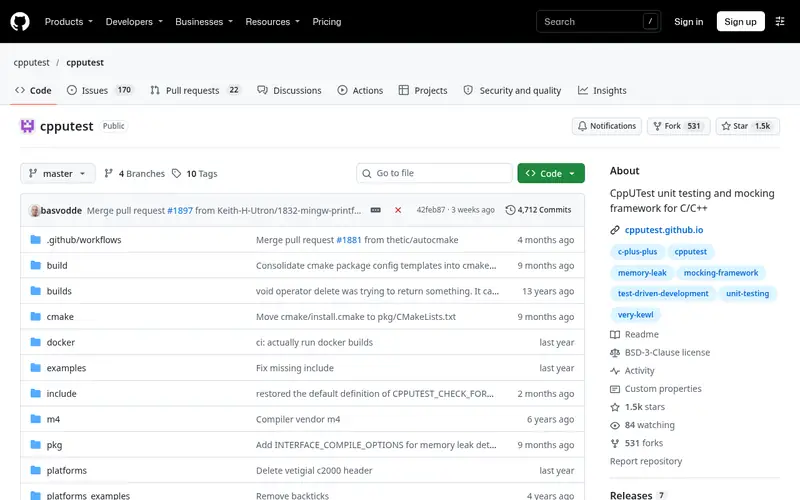
CppUTest is a unit testing framework for C and C++ with an xUnit style. It includes assertion macros, test fixtures, a mocking tool called CppUMock and built-in memory leak detection. It runs on Linux, macOS and Windows, and it is designed to work in embedded and cross-compiled environments.
The framework is a reasonable fit for mixed C and C++ codebases that want one tool. Its community and documentation are smaller than GoogleTest's, so fewer examples are available online.
Pick CppUTest when you test both C and C++ and want mocking and leak detection in one package. Skip it if you want the largest ecosystem or the most third-party integrations.
Standout: Works for both C and C++
Free (open source), as listed by the vendor (CppUTest website). Confirm the current plan price before you buy.
Free plan. Plans change, so confirm on the vendor's pricing page before you buy.
Benefits
- Works for both C and C++
- includes a mocking tool and memory leak detection
Drawbacks
- Smaller community than GoogleTest
- less documentation
Skip it if this limit matters to you: smaller community than GoogleTest.
Verdict. A sensible pick for C and C++ projects that want a lightweight xUnit-style framework.
Alternatives in this guide: GoogleTest, Catch2, doctest
Who should use what
Teams writing C++ unit tests with CMake and CI should start with GoogleTest, adding CTest as the runner. Projects that want readable tests and simple vendoring should look at Catch2 or doctest, with doctest favored when compile speed matters. Embedded C developers should consider Unity or CMocka, depending on whether mocking is needed. Mixed C and C++ codebases that want one lightweight framework with leak detection should evaluate CppUTest.
Questions to settle before you buy
What to check before you buy
- Confirm the framework supports your language mix, whether pure C, pure C++ or both.
- Check that it builds on every platform and compiler you target, including embedded toolchains.
- Verify integration with your build system and CI, including test discovery and report formats.
- Review licence terms, especially for vendored or statically linked copies.
- Test compile time and binary size on a representative suite before standardizing.
FAQ
Are these C/C++ testing frameworks free?
Yes. All eight options listed are free and open source. GoogleTest, Catch2, doctest, Unity, CMocka, Boost.Test and CppUTest are distributed under open-source licences, and CTest ships with CMake, which is also open source.
Which framework is best for testing C code rather than C++?
Unity and CMocka are written for C and work well on embedded targets. CppUTest also supports C. GoogleTest, Catch2, doctest and Boost.Test target C++ and are not a good fit for pure C projects.
Do I need a separate test runner?
Not always. GoogleTest, Catch2, doctest, Unity, CMocka, Boost.Test and CppUTest each include a runner. CTest is a runner only and is typically paired with one of the others in CMake projects.
Can these frameworks run on embedded targets?
Unity and CMocka are commonly used on microcontrollers. CppUTest is also designed for embedded and cross-compiled environments. The C++ frameworks are heavier and may not fit small targets.
Do these tools send my code or test data anywhere?
No. They are libraries and runners that execute locally on your machine or CI system. Your source code and test data stay in your environment.
Sources we checked
Method: how we score · editorial policy.
Change log. First published 22 Nov 2026.