Stage 01 · Write · Researched comparison
Best React Form Libraries in 2026
React Hook Form is the first pick for most teams. It keeps form state in uncontrolled inputs, so large forms re-render less, and it works with plain HTML inputs or any UI kit. Pick TanStack Form if you want a framework-agnostic, strongly typed form core. Pick Formik if you need a mature, widely documented API and do not mind controlled inputs. All three are open source and free to use.

By Shihab Mia
Published 27 Nov 2026 · 6 tools compared
We run no ads and no affiliate links at launch. The order of a list follows our published method. See how we score.
Prices are the starting prices vendors list publicly. Plans change, so confirm the current price on the vendor page before you buy.
Key takeaways
- React Hook Form, TanStack Form, Formik and React Final Form are free and open source under MIT-style licences.
- React Hook Form and TanStack Form support schema validation through resolvers or adapters, including Zod and Yup.
- Formik uses controlled inputs, so very large forms can re-render more often than React Hook Form.
- SurveyJS is a paid or hosted option; confirm current limits and prices on its vendor page.
Who each pick is for
- Most React apps with large or complex formsReact Hook Form
- Teams that want typed, framework-agnostic form stateTanStack Form
- Teams maintaining older React codebasesFormik
- Apps that need a subscription-based form state engineReact Final Form
- Forms generated from JSON Schema definitionsReact JSON Schema Form
- Teams that need a form builder and hosted form managementSurveyJS
Comparison
| Tool | Best for | Standout feature | Listed starting price | Free plan or trial |
|---|---|---|---|---|
| 1React Hook Form | Most React apps with large or complex forms | Small API surface with uncontrolled inputs | Free (open source) | Free plan |
| 2TanStack Form | Teams that want typed, framework-agnostic form state | Strong TypeScript inference | Free (open source) | Free plan |
| 3Formik | Teams maintaining older React codebases | Long track record and wide documentation | Free (open source) | Free plan |
| 4React Final Form | Apps that need a subscription-based form state engine | Fine-grained subscriptions limit re-renders | Free (open source) | Free plan |
| 5React JSON Schema Form | Forms generated from JSON Schema definitions | Generates forms from a schema | Free (open source) | Free plan |
| 6SurveyJS | Teams that need a form builder and hosted form management | Drag-and-drop form builder plus a runtime library | See vendor pricing page | Free trial (30 days) |
How we picked
We compared libraries on fit for React form work, supported platforms, licence and price, validation and schema support, and the main limits each one documents. We also noted whether a product is a code library or a hosted service, since that changes what you are committing to. Sources are vendor homepages, official documentation and project repositories. Prices and plan limits change, so confirm them on the vendor site before you commit.
The tools, one by one
React Hook Form
Best for most React apps with large or complex forms
What it is and where it fits
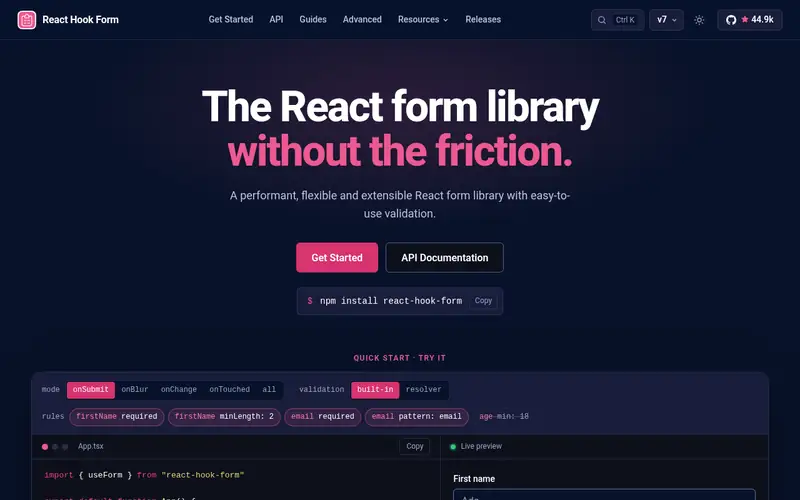
React Hook Form keeps field values in the DOM and subscribes only the components that need updates. That design keeps re-renders low on long forms. It ships hooks such as useForm, useFieldArray and useWatch, and it works with plain inputs or component libraries that forward refs. Validation can be inline or delegated to a schema library through the resolvers package, which supports Zod, Yup, Joi and others.
It runs anywhere React runs, including React Native, and it has no runtime dependencies beyond React. The project is open source and free. The main limit is the ref-based model: third-party inputs must forward refs, and some custom components need a Controller wrapper. Skip it if your team strongly prefers controlled inputs everywhere.
Standout: Small API surface with uncontrolled inputs
Free (open source), as listed by the vendor (React Hook Form website). Confirm the current plan price before you buy.
Free plan. Plans change, so confirm on the vendor's pricing page before you buy.
Benefits
- Small API surface with uncontrolled inputs
- schema validation through resolvers
Drawbacks
- Relies on refs, which can surprise developers used to controlled inputs
- advanced field arrays need care
Skip it if this limit matters to you: relies on refs, which can surprise developers used to controlled inputs.
Verdict. A sensible pick for most React apps with large or complex forms.
Alternatives in this guide: TanStack Form, Formik, React Final Form
TanStack Form
Best for teams that want typed, framework-agnostic form state
What it is and where it fits
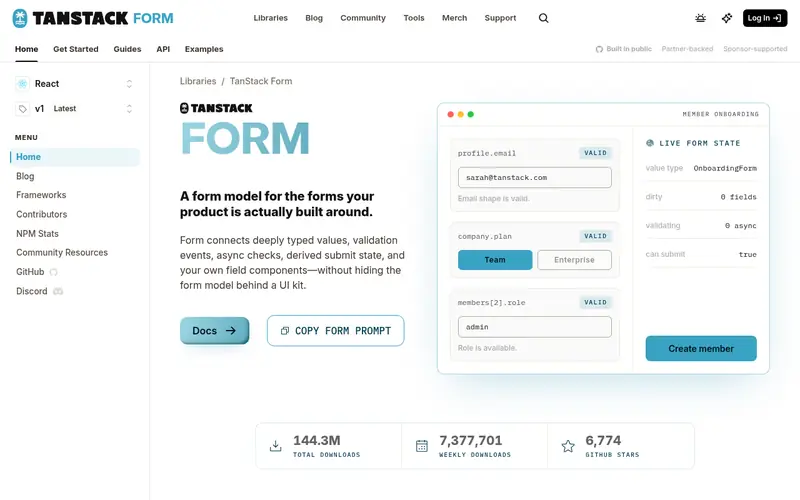
TanStack Form is part of the TanStack family and shares a core across several frameworks. The React adapter provides useForm and field-level APIs with aggressive TypeScript inference, so field names and values are checked at compile time. Validation can be synchronous or asynchronous and can be attached at form or field level, and standard schema support covers Zod and similar libraries.
It runs in any React app, including React Native, and is open source and free. Because the API is newer, you will find fewer tutorials and community answers than for React Hook Form or Formik. Choose it if type safety and a portable core matter more than a large body of existing examples.
Standout: Strong TypeScript inference
Free (open source), as listed by the vendor (TanStack Form website). Confirm the current plan price before you buy.
Free plan. Plans change, so confirm on the vendor's pricing page before you buy.
Benefits
- Strong TypeScript inference
- shared core across React, Vue, Angular and Solid
Drawbacks
- Younger ecosystem than React Hook Form
- fewer third-party examples
Skip it if this limit matters to you: younger ecosystem than React Hook Form.
Verdict. A sensible pick for teams that want typed, framework-agnostic form state.
Alternatives in this guide: React Hook Form, Formik, React Final Form
Formik
Best for teams maintaining older React codebases
What it is and where it fits
Formik is one of the oldest React form libraries. It stores values in component state, exposes handleChange and handleBlur helpers, and pairs with Yup for schema validation. The API is small and predictable, which makes it easy to read in existing codebases. It works with React DOM and React Native.
It is open source and free. The trade-off is performance: because inputs are controlled, every keystroke updates form state and can re-render subscribed components. On very large forms this shows up. The project is still maintained but receives fewer changes than in its earlier years. It is a reasonable choice for small forms and legacy apps, less so for new large-scale builds.
Standout: Long track record and wide documentation
Free (open source), as listed by the vendor (Formik website). Confirm the current plan price before you buy.
Free plan. Plans change, so confirm on the vendor's pricing page before you buy.
Benefits
- Long track record and wide documentation
- simple controlled-input model
Drawbacks
- Controlled inputs re-render more on large forms
- development has slowed
Skip it if this limit matters to you: controlled inputs re-render more on large forms.
Verdict. A sensible pick for teams maintaining older React codebases.
Alternatives in this guide: React Hook Form, TanStack Form, React Final Form
React Final Form
Best for apps that need a subscription-based form state engine
What it is and where it fits
React Final Form is the React binding for Final Form, a framework-agnostic form state engine. It uses a subscription model, so components re-render only when the state they watch changes. Validation can be synchronous or asynchronous, and it integrates with the same schema libraries as other options.
It runs in React DOM and React Native and is open source and free. The documentation is solid but the community is smaller than React Hook Form's, so answers to edge cases are harder to find. The project is maintained but moves slowly. Pick it if the subscription model fits your architecture and you want a core you can reuse outside React.
Standout: Fine-grained subscriptions limit re-renders
Free (open source), as listed by the vendor (React Final Form website). Confirm the current plan price before you buy.
Free plan. Plans change, so confirm on the vendor's pricing page before you buy.
Benefits
- Fine-grained subscriptions limit re-renders
- framework-agnostic Final Form core
Drawbacks
- Smaller community than React Hook Form
- fewer recent updates
Skip it if this limit matters to you: smaller community than React Hook Form.
Verdict. A sensible pick for apps that need a subscription-based form state engine.
Alternatives in this guide: React Hook Form, TanStack Form, Formik
React JSON Schema Form
Best for forms generated from JSON Schema definitions
What it is and where it fits
React JSON Schema Form builds a form from a JSON Schema document plus an optional UI schema that controls layout and widgets. It is useful when forms are data-driven, such as admin panels or configuration editors, and when the schema already exists for validation elsewhere. It ships themes for common UI kits and lets you register custom widgets and fields.
It runs in React DOM and is open source and free. The main limit is flexibility: complex layouts and cross-field behavior often need custom widgets, and the schema becomes a second source of truth to maintain. Skip it if you want full control over markup or your forms change shape often.
Standout: Generates forms from a schema
Free (open source), as listed by the vendor (React JSON Schema Form website). Confirm the current plan price before you buy.
Free plan. Plans change, so confirm on the vendor's pricing page before you buy.
Benefits
- Generates forms from a schema
- supports custom widgets and UI themes
Drawbacks
- Less control over layout than hand-written forms
- schema design becomes the main work
Skip it if this limit matters to you: less control over layout than hand-written forms.
Verdict. A sensible pick for forms generated from JSON Schema definitions.
Alternatives in this guide: React Hook Form, TanStack Form, Formik
SurveyJS
Best for teams that need a form builder and hosted form management
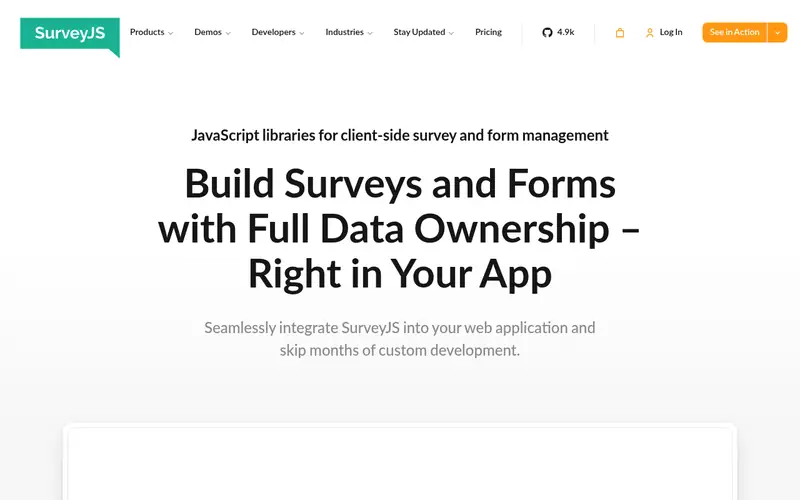
What it is and where it fits
SurveyJS provides a form builder, a runtime form library for React and other frameworks, and optional backend services for storing submissions. Forms are defined as JSON, which makes them portable and easy to version. The React integration renders surveys and forms and exposes events for custom logic.
The core libraries are open source, but the builder and backend products are commercial, with a free trial and paid tiers. Check the vendor pricing page for current limits, because seat counts and feature gates change. It suits teams that want non-developers to edit forms. Skip it if you only need form state in code.
Standout: Drag-and-drop form builder plus a runtime library
See vendor pricing page, as listed by the vendor (SurveyJS website). Confirm the current plan price before you buy.
Free trial (30 days). Plans change, so confirm on the vendor's pricing page before you buy.
Benefits
- Drag-and-drop form builder plus a runtime library
- JSON-based form definitions
Drawbacks
- Advanced features and self-hosted backends are paid
- heavier than a code-only library
Skip it if this limit matters to you: advanced features and self-hosted backends are paid.
Verdict. A sensible pick for teams that need a form builder and hosted form management.
Alternatives in this guide: React Hook Form, TanStack Form, Formik
Who should use what
If you are building a new React app with long forms and want low re-render cost, start with React Hook Form. If your team leans on TypeScript and wants a form core you can reuse across frameworks, look at TanStack Form. If you maintain an older codebase already using Formik, staying on it is usually cheaper than a rewrite. If forms are defined by JSON Schema, React JSON Schema Form saves layout work. SurveyJS fits teams that want a visual builder.
Questions to settle before you buy
What to check before you buy
- Confirm the library supports your React version and any React Native target.
- Check that your UI components forward refs if you plan to use React Hook Form.
- Verify schema validation support for the library you already use, such as Zod or Yup.
- Review the licence and, for hosted products, the current free-tier submission limits.
- Test a large form with field arrays before adopting, since re-render behavior differs.
FAQ
Which React form library is best for large forms?
React Hook Form and React Final Form both limit re-renders by subscribing only the components that need updates. React Hook Form does this with uncontrolled inputs and refs; React Final Form uses explicit subscriptions. Formik's controlled-input model re-renders more on large forms, so test with your real field counts before choosing.
Are these React form libraries free?
React Hook Form, TanStack Form, Formik, React Final Form and React JSON Schema Form are open source and free. SurveyJS has open-source runtime libraries but paid builder and backend products. Check vendor pages for current limits.
Can I use Zod or Yup with these libraries?
Yes. React Hook Form supports both through its resolvers package, and TanStack Form supports standard schema validation including Zod. Formik is commonly paired with Yup. React Final Form and React JSON Schema Form also accept schema-based validation, though the setup differs per library.
Do I need a backend to use these libraries?
No. The code libraries handle client-side state and validation only, so you still send data to your own API. If you do not want to run a server for simple forms, a hosted product such as SurveyJS offers optional backend services for storing submissions. Decide where submission data lives before you pick.
Is it safe to paste form data into online tools?
Do not paste secrets, tokens or production data into third-party web pages. For validation or formatting checks, prefer tools that run locally in the browser or offline. The libraries in this guide run in your own app, so form data stays in your environment unless you send it to a backend you control.
Sources we checked
Method: how we score · editorial policy.
Change log. First published 27 Nov 2026.